
On this page
Start here
Quick answer
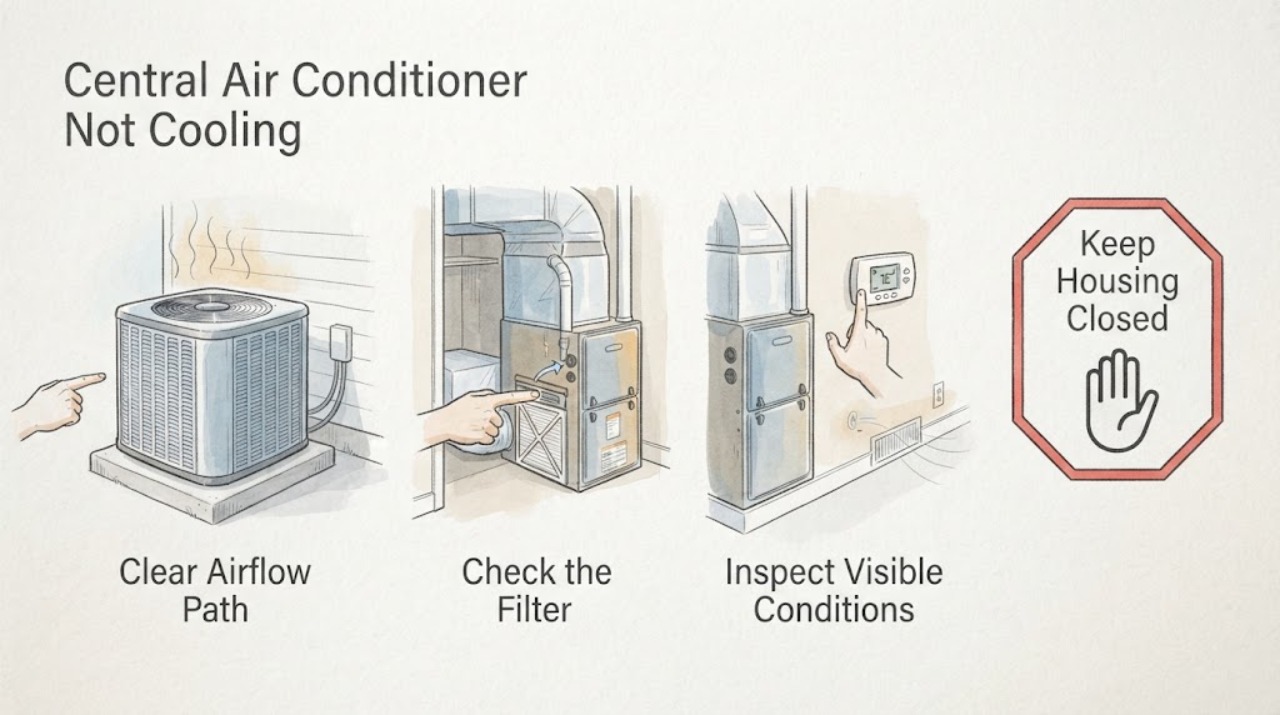
When a Lennox central air conditioner is not cooling, first determine whether the indoor air handler runs, whether the outdoor condenser runs, and whether the thermostat is still calling for cooling. Check the thermostat mode and setpoint, the filter and supply airflow, the indoor and outdoor units from a safe exterior position, and any visible ice, condensate overflow, or alert code. Lennox notes that the outdoor condenser must operate with the indoor unit to produce cooling; a dirty filter can contribute to a frozen indoor coil, while a tripped breaker, capacitor, fan, float switch, refrigerant, or compressor problem needs professional diagnosis. Do not open an electrical panel, handle refrigerant, remove service covers, or keep resetting a breaker. Turn the system off and arrange licensed HVAC service for ice that does not clear, warm air with the outdoor unit silent, repeated electrical trips, a refrigerant or compressor concern, water damage, a service-urgent alert, or any burning smell.
Work through in order
Diagnostic checks
Use only checks that match the exact appliance or system and its official guide.
-
Check 1
Set the thermostat to cooling according to its normal controls, confirm the setpoint is below the room temperature, and check one or two supply registers for airflow. Note whether the indoor blower starts, the air is cool or warm, and whether the thermostat displays an alert or low-power condition.
Expected result: The thermostat is not calling for cooling, the indoor blower is silent, airflow is weak, airflow is strong but warm, the thermostat shows a service alert, or the indoor unit runs normally.
Next step: Record the exact alert and continue only with safe filter and outdoor observations. If a Lennox service-urgent alert is present, the indoor unit fails to run, or the room remains warm despite a valid call, arrange HVAC service rather than changing wiring.
Stop if: Do not remove the thermostat from its base, bridge terminals, open the air-handler cabinet, or continue after a burning odor, smoke, or water near electrical equipment.
Why this matters
Why: No cooling demand or a thermostat power issue can prevent a start. Weak or absent airflow keeps a filter, blower, duct, or condensate safety issue possible. Strong warm airflow shifts attention to the outdoor condenser, frozen coil, refrigerant circuit, or compressor.
-
Check 2
Turn the system off at the thermostat before inspecting accessible return grilles, supply registers, and the air filter. Look for a heavily loaded filter, closed registers, blocked returns, or furniture and coverings restricting airflow; replace the filter only with the model-specified type and orientation.
Expected result: The filter is visibly dirty or collapsed, returns or registers are blocked, airflow improves after an approved filter change, or airflow remains weak with a clean filter and open grilles.
Next step: Run cooling only after the filter is correctly installed and the airflow path is open. If airflow remains weak, the coil is iced, or the blower does not run, keep cooling off and arrange HVAC service.
Stop if: Do not wash a disposable filter, operate without the filter, insert tools into the blower, remove an access panel, or continue running the system when ice is forming.
Why this matters
Why: Restricted airflow can reduce cooling and contribute to an indoor coil freezing. Improvement after the filter and grille check supports an airflow restriction, but persistent weakness leaves blower, coil, duct, or condensate safety problems possible.
-
Check 3
With a valid cooling call and from a safe distance, observe the outdoor condenser without removing its cover. Note whether the fan spins, the cabinet makes a normal operating sound, warm air leaves the top or side as designed, and the nearby disconnect or electrical panel shows an obvious tripped position.
Expected result: The outdoor unit is silent, the fan is not spinning, the fan spins but the air indoors remains warm, an unusual hum or noise is present, a breaker has tripped, or the unit runs normally.
Next step: If safe and dry, check the thermostat and the electrical panel without opening equipment; a breaker that trips again requires service. For a silent unit, abnormal noise, or a running unit that does not cool, turn cooling off as appropriate and arrange licensed HVAC diagnosis.
Stop if: Do not open the disconnect or condenser panel, touch the fan or capacitor, reset a breaker repeatedly, pour water on the unit, or reach through the grille.
Why this matters
Why: A silent condenser can result from power, thermostat, contactor, capacitor, fan, or control problems. A running fan with warm indoor air keeps a blocked or frozen indoor coil, refrigerant, compressor, or airflow problem possible. A repeated trip is an electrical stop, not a reset challenge.
-
Check 4
Inspect the accessible indoor coil cabinet exterior, larger refrigerant line near the indoor unit, and condensate pan or drain area for visible ice, water, overflow, or a float-switch indication without opening the cabinet. If ice is visible, switch cooling off and allow a complete thaw before any further cooling test.
Expected result: Ice is visible on the coil or line, the drain pan contains water, a float switch has stopped the system, the condensate drain backs up, or no ice and water problem is visible.
Next step: Keep cooling off while the system thaws. Replace a dirty filter if applicable and check only an obvious exterior drain issue described by the manual; if ice returns, the pan remains full, or the float switch recurs, call an HVAC technician.
Stop if: Do not chip ice, use a heat source, pour chemicals into an unknown drain, handle refrigerant, bypass a float switch, or restart cooling while ice remains.
Why this matters
Why: Ice can follow restricted airflow or a refrigerant issue and can damage the system if cooling continues. Water in the pan or a tripped float switch can shut the system down to limit overflow; a clear exterior does not rule out an internal coil or drain fault.
-
Check 5
From outside the condenser cabinet, look for leaves, grass, or other debris blocking the surrounding airflow and for visible damage, corrosion, or a bent grille. Remove only loose debris that is safely reachable without touching the fan or coil; keep the clearance and cleaning method specified by the owner's manual.
Expected result: Loose debris is restricting the exterior airflow, the coil or grille is damaged or heavily impacted, the unit is surrounded by normal open airflow, or the condenser has an unusual odor or sound.
Next step: Remove only loose, dry debris from a powered-off unit if it can be done without contact, then make one normal cooling observation. Arrange professional coil, fan, electrical, or compressor service for damage, persistent warm air, odor, or abnormal sound.
Stop if: Do not spray into the electrical compartment, straighten fins with a tool, remove the grille, use a pressure washer, or operate a damaged condenser.
Why this matters
Why: Exterior obstruction can reduce heat rejection and cooling performance. Bent fins, heavy contamination, unusual noise, or odor can involve the fan, coil, electrical components, or compressor and cannot be confirmed by exterior cleaning.
-
Check 6
Record the Lennox model and serial information, thermostat setting and alert text, indoor airflow, filter condition, outdoor-unit operation, ice or condensate findings, breaker behavior, unusual sounds or odors, and the time the cooling stopped before requesting service.
Expected result: Cooling remains absent after the thermostat, filter, exterior airflow, and thaw checks; an alert returns; the condenser is silent; ice reappears; water accumulates; or an electrical, refrigerant, or compressor problem is suspected.
Next step: Keep cooling off for ice, leakage, repeated breaker trips, burning odor, or unsafe equipment and arrange licensed HVAC service. Give the technician the exact model, alert, observations, and any photos taken from a dry safe position.
Stop if: Do not order refrigerant, capacitor, compressor, or control parts from the symptom alone, open service panels, test live circuits, or continue operation after a safety alert or water damage.
Why this matters
Why: The remaining causes require measurements and access to electrical, airflow, refrigerant, condensate, or compressor components. The observed pattern helps a technician distinguish an airflow restriction from an outdoor-unit, control, or refrigeration fault.
Use your observations
Decision map
Find the observation that best matches what you see, then follow the next safe action.
-
PATH 01Next step
What you see
The thermostat is not calling for cooling, the indoor blower is silent, airflow is weak, or a service alert prevents normal operation.
Do this next
Record the alert and check only the accessible filter, returns, and thermostat settings. Arrange HVAC service for absent airflow, a recurring alert, or any cabinet, wiring, blower, or float-switch work.
Why this path and its safety boundary
Why it matters: A thermostat, indoor power, filter, blower, duct, condensate safety, or control problem is more likely than a refrigerant-only fault.
-
PATH 02Next step
What you see
The indoor blower provides strong warm airflow during a cooling call, but the outdoor condenser is silent or its fan does not run.
Do this next
Check the thermostat and electrical panel only from a safe position; do not open the disconnect or condenser. Stop repeated reset attempts and arrange licensed HVAC service if the outdoor unit does not start or a breaker trips.
Why this path and its safety boundary
Why it matters: Power, thermostat communication, a tripped breaker, capacitor, contactor, fan motor, or outdoor control problem is more likely than a supply-register issue.
-
PATH 03Next step
What you see
The indoor blower and outdoor condenser run, but supply air stays warm or cooling is weak with no obvious filter or register obstruction.
Do this next
Look for visible ice and turn cooling off if ice appears. Arrange HVAC diagnosis for refrigerant, compressor, coil, or concealed airflow work; do not add refrigerant or continue a weak-cooling test indefinitely.
Why this path and its safety boundary
Why it matters: A frozen or blocked indoor coil, refrigerant leak or low charge, compressor issue, airflow fault, or temperature-control problem remains possible.
-
PATH 04Next step
What you see
Ice is visible on the indoor coil or refrigerant line, the drain pan contains water, or a float switch has stopped cooling.
Do this next
Turn cooling off and let the system thaw. Check the filter and accessible drain area only as the manual permits; call a technician if ice returns, water remains, or the safety switch recurs.
Why this path and its safety boundary
Why it matters: Restricted airflow, refrigerant conditions, a blocked condensate path, or a safety control is more likely than a simple thermostat setting.
-
PATH 05Next step
What you see
A breaker trips again, burning odor or smoke appears, refrigerant leakage is suspected, a compressor or capacitor is suspected, the outdoor unit is damaged, or a Lennox service-urgent alert persists.
Do this next
Turn the system off from a safe location, leave damaged equipment alone, and arrange licensed HVAC service. Follow local emergency guidance for smoke, fire, or a carbon-monoxide alarm.
Why this path and its safety boundary
Why it matters: This is an electrical, refrigerant, mechanical, or safety fault outside ordinary user checks. Continuing operation or opening panels can cause shock, fire, equipment damage, or refrigerant exposure.
Helpful context
Understand the symptom
Start by separating an airflow problem from an outdoor-unit problem
A central air conditioner needs both the indoor air handler and outdoor condenser. Strong airflow that is warm points toward the outdoor unit, refrigerant circuit, or a frozen indoor coil. Weak or absent airflow points first toward the filter, blower, indoor power, duct or condensate safety control. A silent outdoor unit with a cooling call is a different branch from an outdoor fan that runs while the air remains warm.
Ice is a stop signal, not a reason to add refrigerant
Visible ice on the indoor coil or refrigerant line can follow restricted airflow or a refrigerant problem. Turn cooling off and let the system thaw rather than scraping ice or continuing to run the compressor. Replace a visibly dirty filter with the size and type specified for the system; if ice returns or airflow remains abnormal, a technician must check the coil, blower, condensate path, and refrigerant circuit.
Electrical and refrigerant work stays with the technician
A breaker, disconnect, capacitor, contactor, fan motor, compressor, refrigerant charge, and low-pressure protection can all affect cooling. These components can retain electrical energy or require regulated handling. Use only exterior observations and a thermostat check; do not remove panels, test live voltage, touch a capacitor, or connect refrigerant equipment.
Safety boundary
Stop conditions
- Stop for a burning odor, smoke, a repeated breaker trip, visible refrigerant or water damage, a carbon-monoxide alarm, an obstructed or damaged vent or electrical enclosure, a service-urgent alert, ice that returns or will not thaw, or an outdoor unit that remains abnormal after basic checks. Do not open electrical panels, touch capacitors or fans, test live circuits, bypass float switches, handle refrigerant, chip ice, or continue operating a damaged system.
Only after diagnosis
Potential parts
- air filter
Consider this only when the installed filter is visibly loaded, damaged, or the exact system documentation identifies a scheduled replacement, and use it as an airflow-maintenance item rather than proof of a failed cooling component.
Filter size, depth, media, airflow rating, and orientation are system-specific; confirm the exact Lennox model and filter markings before selecting one. - condensate float switch or drain component
Consider this only after a technician confirms that a failed float switch, pump, or drain component—not a blockage or pan installation issue—is causing the cooling safety shutdown.
Switch type, drain configuration, wiring, and installation requirements vary by system; confirm the model and have a qualified technician perform the replacement. - condenser fan motor or capacitor
Consider this only when licensed HVAC testing confirms a failed outdoor fan motor or capacitor after checking power, controls, airflow, and the compressor circuit.
Electrical ratings, mounting, rotation, and system compatibility are model-specific; capacitors can retain energy and are not user-service parts. - evaporator coil or refrigerant-system component
Consider this only after a qualified technician confirms a leaking or damaged coil or another refrigerant-circuit fault; warm air or ice alone does not identify the failed component.
Coil, refrigerant, metering, and pressure specifications must match the exact Lennox system and applicable regulations; do not select or install from a symptom alone.
When checks do not resolve it
Need a professional?
Call a licensed HVAC contractor when the indoor or outdoor unit does not run, cooling remains absent after thermostat, filter, register, and exterior checks, ice returns, condensate backs up, a breaker trips, an alert returns, airflow is weak, or refrigerant, compressor, capacitor, fan, coil, wiring, or control work may be needed. Use urgent service for smoke, burning odor, fire, flooding near electrics, or a service-urgent safety condition.
Have this ready
- Provide the Lennox model and serial information, thermostat call and alert text, indoor airflow and temperature impression, filter condition, outdoor fan and sound observations, ice or condensate findings, breaker behavior, unusual odors or noises, recent maintenance, and photos taken only from a dry safe position.
Common questions
FAQ
Why is my Lennox central air conditioner running but not cooling?
If the indoor blower runs but the air remains warm, check whether the outdoor condenser runs and look for visible ice or a dirty filter. A frozen coil, airflow restriction, refrigerant problem, compressor issue, or outdoor-unit fault can produce warm air. Turn cooling off for ice and arrange HVAC service for refrigerant or compressor diagnosis.
What should I check first when a Lennox AC is not cooling?
Confirm the thermostat is calling for cooling, check indoor airflow and the filter, observe whether the outdoor condenser starts, and look for visible ice, condensate overflow, or a Lennox alert. These observations separate thermostat, airflow, outdoor-unit, frozen-coil, and service branches without opening the equipment.
Why is the outdoor unit not turning on when the Lennox thermostat calls for cooling?
Possible causes include a thermostat or communication issue, a tripped breaker, a capacitor or contactor fault, a fan motor problem, a safety switch, or another electrical or control fault. Check the thermostat and electrical panel only from a safe position; do not open the condenser or repeatedly reset a breaker.
What should I do if ice is on my Lennox AC coil or line?
Turn cooling off and let the system thaw completely. Check for a visibly dirty filter and restricted registers or returns, but do not chip the ice or add refrigerant. If ice returns, airflow remains weak, or the drain pan contains water, call a licensed HVAC technician.
Can I reset the breaker to fix a Lennox air conditioner that is not cooling?
A single safe visual check of a tripped breaker may be reasonable, but a breaker that trips again indicates an electrical problem. Do not keep resetting it, remove electrical covers, or touch capacitors. Turn the system off and arrange professional service for repeated trips.
Can I add refrigerant to my Lennox AC myself?
No. Warm air or ice does not prove that the charge is low, and refrigerant work requires the appropriate equipment, diagnosis, and qualified handling. A technician should locate any leak, check airflow and coil condition, and verify the system before charging or repairing it.
What does a Lennox service-urgent no-cool alert mean?
Lennox describes a service-urgent alert as a no-heat, no-cool, or no-ventilation status and directs the homeowner to licensed HVAC service. Record the alert or warning code and provide it with the model and the cooling observations; do not clear the alert by changing hidden settings.
Read the exact guide
Official sources
- How can I troubleshoot or diagnose what is wrong with my system?Lennox Support Center · Official Lennox support directing users to check active alerts or warnings, record the alert or warning code, and contact a dealer or Lennox when the issue needs resolution.
- What does this alert or notification mean?Lennox Support Center · Official Lennox support distinguishing service-urgent no-cool status from maintenance notifications and stating that service-urgent alerts require a licensed HVAC contractor.
- Outside AC Unit Not Working?Lennox · Official Lennox homeowner guidance explaining that the indoor and outdoor units must work together for cooling and covering thermostat, breaker, capacitor, fan, filter, frozen-coil, float-switch, refrigerant, debris, and professional-service checks.
Community feedback
Share a repair observation
Share a plain-text repair observation. Accepted observations are published automatically; this page may take a moment to update.