
On this page
Start here
Quick answer
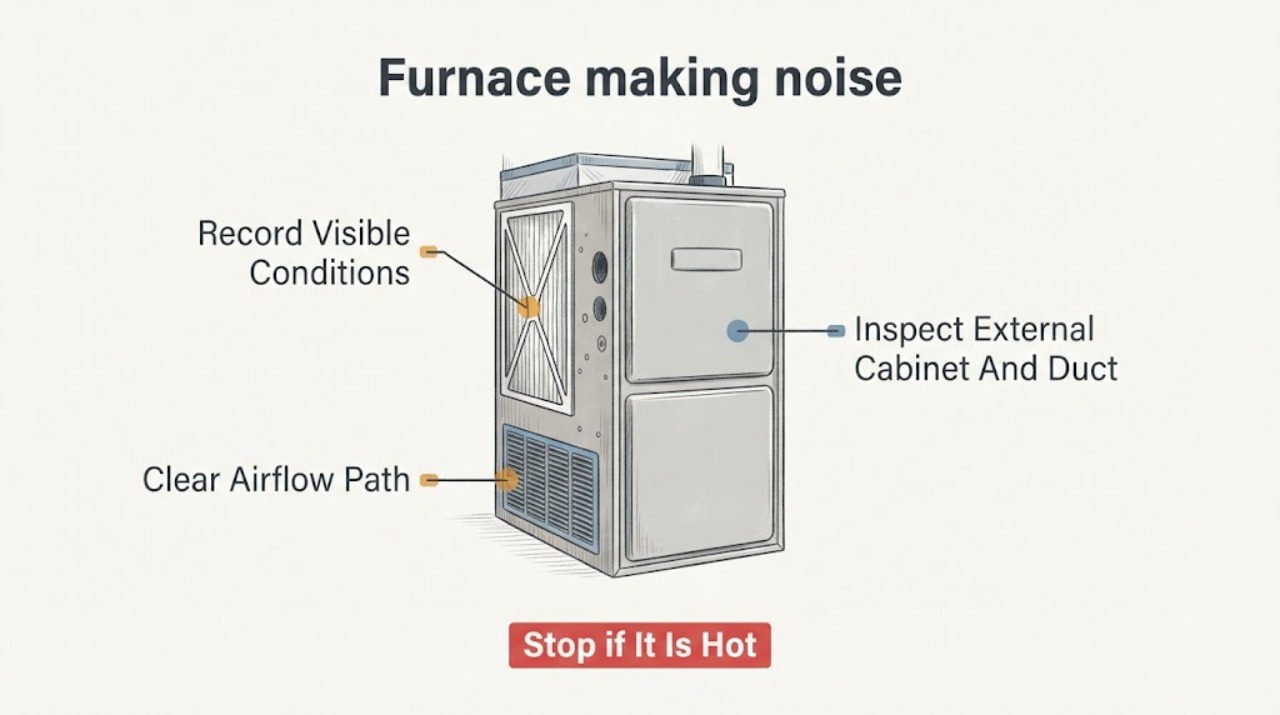
First identify when the Lennox furnace makes the noise: a brief click or soft hum can occur during a normal call for heat, while a loud buzz, rattle, screech, bang, grinding sound, or noise that continues when the furnace is idle needs attention. Turn the system off if the sound is sudden, worsening, or accompanied by a burning smell, flickering lights, a repeated breaker trip, smoke, a gas odor, or weak airflow. With power off and the cabinet cool, replace a visibly dirty filter with the exact size and airflow direction, make sure return and supply grilles are open, and check only for an externally loose access panel or object touching the cabinet. Do not open the blower or burner compartments, adjust gas pressure, touch wiring, or run the furnace with an unsecured blower door. A noise that remains after the filter and external checks, or that comes from the blower, motor, transformer, ignition, burner, vent, or gas path, requires a qualified Lennox HVAC technician.
Before you begin
Safety first
- This article supports stopping a heat call, isolating power when safe, replacing a user-accessible filter with the exact approved type, clearing external grilles or objects, and observing sound timing from outside the cabinet. A licensed technician must handle blower and burner access, wiring, controls, gas, ignition, combustion, venting, pressure, and final safety testing.
Work through in order
Diagnostic checks
Use only checks that match the exact appliance or system and its official guide.
-
Check 1
If the furnace is running, set the thermostat to stop the heat call and stand clear of the cabinet. Do not remove a panel or place a hand near the blower. Record the sound only from a safe position and note whether it happens at startup, ignition, steady blower operation, shutdown, or while the furnace is idle.
Expected result: Classify the sound as a soft hum, brief click, whoosh, buzz, rattle, scraping, grinding, squeal, bang, vibration, or repeated electrical-like chatter; note duration, location, and whether airflow or heat changed.
Next step: Keep the furnace off and arrange service for a persistent, sharp, grinding, banging, electrical, or combustion-related sound. If the sound is brief and normal but airflow is weak, continue with the external filter and grille checks.
Stop if: Stop immediately for smoke, burning or metallic odor, gas odor, a sudden bang, visible flame outside the burner area, repeated breaker trips, or a cabinet that becomes unusually hot.
Why this matters
Why: A brief hum, click, or whoosh can be normal operation, but a loud or worsening sound, a sound while idle, or a sound paired with weak airflow suggests a blower, electrical, panel, duct, or control issue. A bang at ignition points toward a combustion or ignition path that needs service.
-
Check 2
With the furnace off and cool, inspect the user-accessible return filter and confirm that supply and return grilles are open and not blocked by furniture or coverings. Replace a visibly dirty standard filter only with the size, type, and airflow direction specified for the Lennox system; do not remove a furnace access panel just to reach an internal filter unless the exact manual permits it.
Expected result: Record a clean filter, a gray or packed filter, a filter installed backward, a collapsed filter, blocked grilles, weak airflow, or a filter that is difficult to remove because the compartment is unsafe or inaccessible.
Next step: Correct a simple filter or grille issue as the manual permits, then observe the next normal heat call only if there is no danger signal. If noise or weak airflow remains, leave the system off and arrange HVAC service for the blower, motor, duct, or control path.
Stop if: Do not run without a required filter, force a filter into the rack, use an unapproved high-resistance filter, or reach into an internal filter or blower compartment with power connected.
Why this matters
Why: A dirty or backward filter and blocked airflow can make the blower work harder and can add hum or vibration. They do not explain a bang at ignition, a gas odor, a persistent idle buzz, or a grinding sound from the blower compartment.
-
Check 3
From outside the furnace, inspect the visible cabinet panels, return plenum, supply transition, nearby duct, flue or intake exterior, and objects resting against the unit. Check that access panels appear fully seated and that ductwork, a condensate line, or a nearby appliance is not vibrating against the cabinet; do not open the burner or blower compartments.
Expected result: Look for a loose or bowed panel, a missing fastener, an object touching the cabinet, a duct or pipe vibrating against metal, an unsecured vent connection, or no visible external source.
Next step: Remove only a loose object from outside the cabinet and close a panel that is already designed to latch without tools. If a panel will not seat, the cabinet vibrates internally, or the vent or intake looks damaged or detached, keep the furnace off and request service.
Stop if: Do not wedge, tape, drill, or screw a panel into place, move a flue, alter intake piping, or operate with a missing or loose blower door.
Why this matters
Why: A loose cover or external contact can amplify a harmless motor or airflow vibration. A disconnected, damaged, or questionable vent or intake changes the combustion-safety boundary and is not a panel-tightening task.
-
Check 4
Without opening the cabinet, compare the noise timing with the thermostat call, the indoor blower starting or stopping, and the sound continuing when no heat or fan call is active. Check the room for a tripped breaker or visible light flicker, but do not reset a breaker repeatedly to reproduce the sound.
Expected result: Record reduced airflow with a buzz or squeal, a rattle or bang that follows blower start, a buzz while idle, repeated breaker trips, flickering lights, or no change in airflow or electrical behavior.
Next step: Keep power off and arrange qualified HVAC diagnosis for blower, motor, transformer, capacitor, wiring, or control symptoms. Provide the timing and airflow observations rather than trying to test voltage or lubricate the motor.
Stop if: Do not remove electrical covers, touch terminals, reset a repeatedly tripping breaker, add lubricant, change motor settings, or bypass a safety control.
Why this matters
Why: Lennox associates reduced airflow and unusual screeching, squealing, rattling, or banging with a struggling or damaged blower motor. A buzz while idle, flicker, or breaker trip makes a transformer, wiring, capacitor, or other electrical fault more concerning than a filter alone.
-
Check 5
From the room entrance and without using a flame or opening the furnace, note whether the noise occurs exactly at burner ignition or is accompanied by gas, burning plastic, metallic, or exhaust-like odor. If gas is suspected, leave immediately and contact the gas utility or emergency service from outside; do not operate electrical switches or the furnace controls.
Expected result: Record a normal brief ignition click, a delayed or loud ignition bang, rotten-egg or sulfur-like gas odor, burning or metallic odor, visible smoke, a carbon-monoxide alarm, or no odor and no combustion symptom.
Next step: For any gas odor, alarm, smoke, exhaust concern, or loud ignition, evacuate or ventilate only as emergency guidance allows and obtain professional or utility help before re-entry or operation. For a quiet ignition with no hazard signs, continue only with the service decision from the earlier checks.
Stop if: Never relight a burner, adjust a gas valve, measure gas pressure, bleed a line, inspect flame with a tool, or restart after a gas or combustion alarm without qualified clearance.
Why this matters
Why: A loud ignition event can involve combustion air, ignition, gas, or venting and requires licensed service. Lennox warns that gas leaks, electrical overheating, blocked or faulty venting, and combustion problems can create fire, explosion, or carbon-monoxide risk; lack of odor does not rule out carbon monoxide.
-
Check 6
Record the Lennox model and serial information if it is safely visible, the exact sound description and timing, filter condition, airflow change, panel or duct observations, and any odor or safety event. Keep the furnace off until a qualified technician has cleared a noise that persists after simple external checks.
Expected result: Provide whether the system is gas or another fuel type, whether the sound is from the cabinet, registers, or vent area, whether it occurs while idle, and whether the noise began after a filter change, service, installation change, or power event.
Next step: Arrange a qualified Lennox HVAC inspection for persistent or unexplained noise, reduced airflow, repeated cycling, abnormal ignition, electrical symptoms, or any hazard signal. Ask the technician to verify blower operation, panels, filter fit, duct and vent condition, ignition, combustion safety, and controls together.
Stop if: Do not keep cycling the furnace for a recording, remove panels for a closer listen, run it with a safety door open, or order a motor, transformer, blower, or gas component before diagnosis.
Why this matters
Why: These details distinguish a filter or air-distribution issue from blower, electrical, ignition, combustion-air, vent, or control service. A noise that persists with a clean, correctly installed filter and no external contact is not a safe part-identification exercise.
Use your observations
Decision map
Find the observation that best matches what you see, then follow the next safe action.
-
PATH 01Safety boundary
What you see
The sound is a soft hum, short click, or brief airflow whoosh that occurs only at a normal start, ignition, blower transition, or shutdown, with normal heat and airflow and no odor or electrical warning.
Do this next
Confirm the filter is correctly installed and grilles are open, then monitor only during ordinary operation. Arrange service if the sound becomes persistent, sharp, or associated with reduced heat or airflow.
Why this path and its safety boundary
Why it matters: Normal operating sound is more likely than a failed component, but a new sound that grows louder or changes character should not be dismissed.
Safety stop: Stop for a bang, grinding, sustained buzz, smoke, gas odor, burning smell, breaker trip, or carbon-monoxide alarm.
-
PATH 02Safety boundary
What you see
The noise follows blower operation, airflow is weak, the filter is dirty or backward, grilles are blocked, or a loose external panel, duct, or object vibrates against the cabinet.
Do this next
Replace the filter with the exact approved size and airflow direction, open grilles, and remove only an external loose object. If the sound or weak airflow remains, keep the furnace off and arrange HVAC service.
Why this path and its safety boundary
Why it matters: Restricted airflow or external vibration is more likely than an ignition fault, although a persistent noise after the simple correction still needs blower and motor inspection.
Safety stop: Do not run without a filter, use a forced panel fix, open the blower compartment, or treat repeated vibration as harmless when the motor sounds strained.
-
PATH 03Safety boundary
What you see
A squeal, screech, rattle, or bang tracks blower start or steady operation, airflow is reduced, the noise continues after a filter check, or a buzz occurs while idle with flicker or breaker symptoms.
Do this next
Leave the furnace off and have a qualified technician diagnose the blower and electrical path. Report whether the sound is present with no heat call and whether a breaker or light changed.
Why this path and its safety boundary
Why it matters: A worn or stressed blower motor, bearing, blower wheel, transformer, capacitor, wiring, or control is more likely than a filter or cabinet vibration.
Safety stop: Do not touch wiring, reset a recurring breaker trip, lubricate internal parts, change force or speed settings, or operate with the blower door removed.
-
PATH 04Safety boundary
What you see
The noise is a delayed or loud bang at ignition, a rumble after the burners light, or is paired with gas odor, exhaust-like odor, smoke, a carbon-monoxide alarm, or a questionable intake or vent.
Do this next
Turn the furnace off if it can be done without exposure, leave the area for a gas odor or alarm, and contact the gas utility or a licensed HVAC professional from a safe location. Do not restart until cleared.
Why this path and its safety boundary
Why it matters: Ignition, combustion air, gas supply, burner, heat exchanger, or venting is more likely than an air filter issue. This pattern carries fire, explosion, or combustion-gas risk.
Safety stop: Do not adjust gas pressure, relight burners, bleed gas lines, inspect flames with tools, repair venting, or use electrical switches in a suspected gas leak.
-
PATH 05Safety boundary
What you see
The filter and external checks are normal but the furnace still makes a persistent buzz, grind, scrape, rattle, vibration, or other unusual noise, or the sound is present while the system is idle.
Do this next
Keep the furnace off and arrange a qualified Lennox HVAC inspection. Give the technician the model, sound recording if safely obtained without repeated cycling, timing, airflow result, and any recent service or filter change.
Why this path and its safety boundary
Why it matters: An internal motor, blower wheel, bearing, transformer, control, duct connection, or another model-specific fault remains possible. The absence of a visible cause is not evidence that continued operation is safe.
Safety stop: Do not open the cabinet, run repeated cycles, hold a safety switch, bypass controls, or choose a replacement component from the sound alone.
Helpful context
Understand the symptom
The timing and character of the sound matter
A furnace can make a brief click as ignition starts, a soft hum as a blower begins, or a short whoosh as air moves through ducts. A new metallic rattle, grinding sound, persistent buzz, screech, bang, or noise that continues while the furnace is idle is a different pattern. Note whether it begins at the thermostat call, during blower operation, at burner ignition, during shutdown, or with no heat call; that timing separates air movement, blower, electrical, and combustion paths without opening the unit.
A filter check is useful but does not prove the cause
Lennox explains that a clogged filter restricts airflow and makes the blower work harder. A dirty filter can therefore accompany a hum or vibration, but changing it will not correct a failing motor, loose electrical component, damaged blower wheel, or ignition fault. Use the filter size and airflow arrow specified for the installed system; advanced filtration or an internal filter compartment may require the exact owner manual or a technician.
Gas and combustion sounds have a firm boundary
A loud noise at ignition, a gas odor, a burning or metallic odor, or a venting concern is not a user adjustment opportunity. Lennox service literature warns that improper installation or adjustment can create fire, explosion, combustion-gas, or carbon-monoxide hazards. Leave gas controls, burners, pressure checks, wiring, blower compartments, and vent repairs to licensed service; leave the home and contact the gas utility from outside if gas is suspected.
Safety boundary
Stop conditions
- Turn the furnace off and seek urgent professional or utility help for gas odor, a carbon-monoxide alarm, smoke, a loud ignition bang, visible flame outside the burner area, or exhaust or venting concern.
- Keep the furnace off for burning or metallic odor, flickering lights, repeated breaker trips, a hot cabinet, exposed wiring, or a noise that is sudden, worsening, grinding, or persistent while idle.
- Do not open blower or burner compartments, touch wiring, adjust gas pressure or valves, relight burners, alter venting, bypass safety switches, or run the unit with an unsecured access door.
- Do not keep cycling a noisy furnace to reproduce the sound; a clean filter or quiet moment does not clear an unresolved motor, electrical, ignition, combustion, or vent fault.
Only after diagnosis
Potential parts
- Lennox-compatible air filter
Consider a filter only when the installed filter is visibly dirty, collapsed, damaged, or the wrong size or direction and the exact furnace or filter-system instructions identify its replacement.
Confirm the exact Lennox model, filter dimensions, approved filtration type, airflow arrow, and any cabinet or media-filter requirements; do not infer fit from the noise. - furnace blower motor or blower wheel
Consider this category only after service testing confirms reduced airflow, bearing noise, wheel damage, motor strain, or another blower fault that matches the noise timing.
Confirm the exact model, motor type and controls, wheel dimensions and rotation, mounting, voltage, and airflow requirements through the service manual or technician. - furnace transformer, capacitor, or control component
Consider this category only when a qualified electrical diagnosis identifies a buzzing transformer, failed capacitor, wiring fault, or control component as the source.
Verify electrical ratings, control compatibility, wiring configuration, and exact Lennox model before selection; do not substitute a part based on sound alone. - ignition, burner, combustion-air, or vent component
Consider this category only after licensed service confirms an ignition, burner, combustion-air, gas, or venting fault associated with a loud ignition or combustion noise.
Gas and combustion components require exact model documentation, approved ratings, installation procedures, leak checks, and professional commissioning; never order from a symptom alone.
When checks do not resolve it
Need a professional?
Arrange qualified Lennox HVAC service for noise that persists after a correct filter and external-contact check, any reduced airflow, blower or motor squeal/rattle/grind, an idle buzz, loose internal-sounding vibration, repeated electrical symptom, or abnormal ignition. Treat gas odor, carbon-monoxide alarm, smoke, loud ignition, burning or metallic odor, or a questionable vent as an urgent safety boundary and contact the gas utility or emergency service from a safe location.
Safety scope: This article supports stopping a heat call, isolating power when safe, replacing a user-accessible filter with the exact approved type, clearing external grilles or objects, and observing sound timing from outside the cabinet. A licensed technician must handle blower and burner access, wiring, controls, gas, ignition, combustion, venting, pressure, and final safety testing.
Common questions
FAQ
What does a normal Lennox furnace sound like?
A soft hum as the blower starts, a brief ignition click, or a short whoosh from air movement can be normal. A loud or persistent buzz, rattle, grind, screech, bang, or sound while the furnace is idle is not something to ignore, especially with weak airflow, odor, or electrical symptoms.
Can a dirty filter make a Lennox furnace noisy?
Yes. A clogged filter restricts airflow and makes the blower work harder, which can add hum or vibration. Replace a visibly dirty filter only with the exact approved size and airflow direction. If the noise remains, the filter was not the complete cause and the blower or another component needs service.
Why does my furnace make a bang when it starts?
A loud or delayed bang at ignition can involve combustion air, ignition, gas, burner, or venting rather than a loose filter or panel. Turn the furnace off and arrange licensed HVAC service. Do not adjust gas pressure, relight burners, or repeat starts to reproduce the bang.
What should I do if the furnace buzzes when it is not running?
A buzz while idle can point toward a transformer, wiring, capacitor, or another electrical control rather than the blower alone. Turn the furnace off, do not reset a recurring breaker trip, and request qualified service. Burning odor, flickering lights, smoke, or heat makes this an urgent shutdown condition.
Is it safe to remove a Lennox furnace panel to locate the noise?
Not for this symptom. The blower and burner compartments contain electrical, rotating, gas, and combustion hazards, and the blower door must be secured during operation. Limit checks to the filter, grilles, external contact, and sound timing; have a qualified technician open the unit and test internal parts.
Read the exact guide
Official sources
- Does Your Heater Smell Like It’s Burning?Lennox · Official Lennox consumer safety guidance; emergency actions should also follow local utility and emergency instructions.
- Instructions for Troubleshooting Ignition or Noise Issues for Ultra Low NOx 80% Efficiency R454B Equipped -01 ModelsLennox · Official Lennox technical guide for the named model family; it is not a homeowner adjustment procedure and does not identify every Lennox furnace design.
- Safety InstructionsLennox · Official Lennox furnace safety instructions; the PDF applies to the specified product family and safety principles must be reconciled with the installed model manual.
- Lennox Air Filters | Air Filter ReplacementLennox · Official Lennox filter guidance; filter location and access vary by system and installation.
- What is an HVAC Blower MotorLennox · Official Lennox educational guidance; exact blower design and access vary by furnace model.
- Why Is My Furnace Making a Buzzing Noise?Lennox · Official Lennox consumer guidance; sound causes and service procedures vary by installed model.
Community feedback
Share a repair observation
Share a plain-text repair observation. Accepted observations are published automatically; this page may take a moment to update.