
On this page
Start here
Quick answer
If a mini split has frost or ice on the indoor coil or refrigerant tubing, turn off cooling and let the ice melt without chipping it or continuing to run the system in cooling. Once it is fully thawed and there is no water or electrical hazard, check the accessible filter, visible airflow obstructions, and operating mode according to the unit manual. A dirty filter, blocked airflow, low refrigerant, or another system fault can contribute to freezing; if icing returns, airflow stays weak, water leaks, the fan behaves abnormally, or refrigerant or electrical work would be needed, stop and arrange qualified HVAC service.
Before you begin
Safety first
- This article supports only ordinary-access observation and manufacturer-approved filter or visible-obstruction care. Do not open sealed refrigerant or electrical sections, test live circuits, chip ice, or add refrigerant.
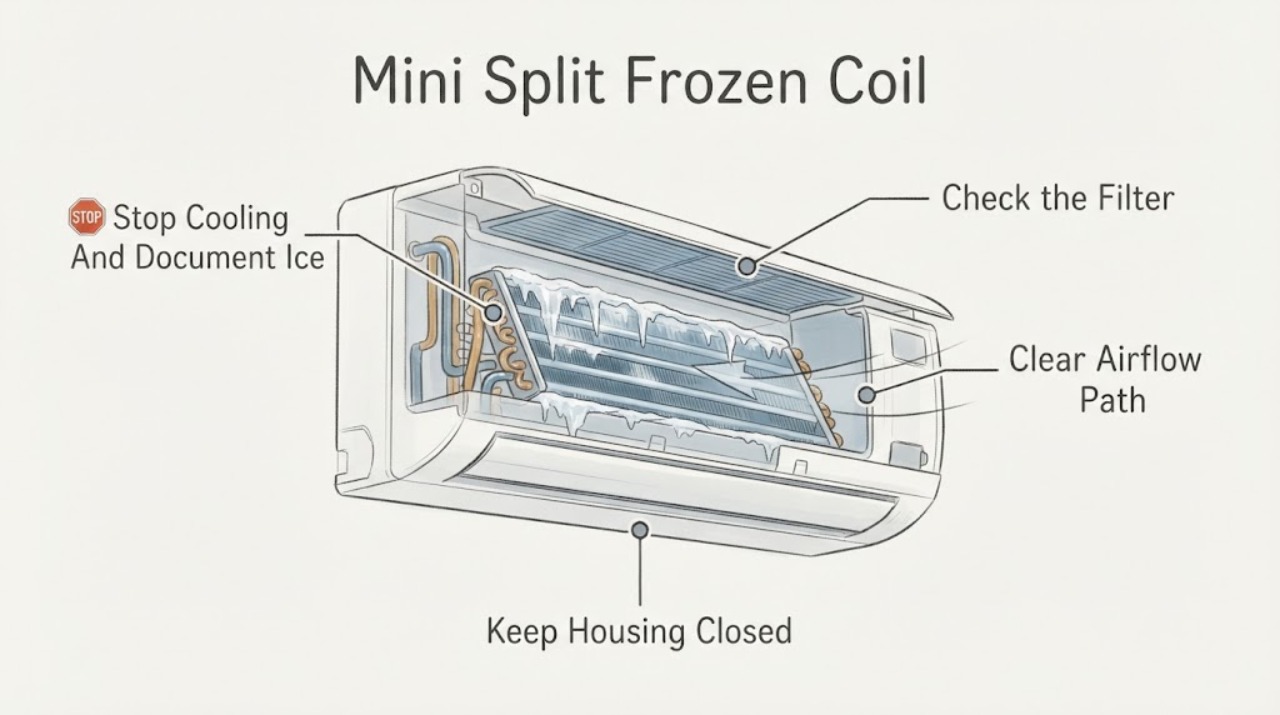
Work through in order
Diagnostic checks
Use only checks that match the exact appliance or system and its official guide.
-
Check 1
Turn off the mini split's cooling command and note where frost or ice is visible: the indoor coil area, the exposed refrigerant tubing, the outdoor unit, or more than one location. Put a towel or pan below the indoor unit if meltwater could reach a wall, floor, or furniture.
Expected result: Record whether ice is present, whether water is already dripping or overflowing, whether the indoor fan is moving air, and whether any burning smell, sparking, or other immediate electrical hazard is present.
Next step: Leave cooling off and allow safe thawing according to the unit manual. Arrange service immediately for electrical danger, uncontrolled water, or ice that reaches wiring or controls; otherwise continue only with the accessible checks after the ice is gone.
Stop if: Do not chip, scrape, pull, or pry ice from fins or tubing, and do not open panels or touch wet electrical parts.
Why this matters
Why: Ice or frost confirms a stop-and-thaw condition, not a reason to continue cooling. Water damage or an electrical hazard raises the urgency; the location and recurrence pattern help the technician distinguish airflow, drain, outdoor-unit, and refrigerant possibilities.
-
Check 2
After the coil is thawed, turn the system off and inspect the indoor filter from the ordinary access described in the manufacturer's instructions. Clean or replace it only by that procedure, then reseat it correctly.
Expected result: Classify the filter as visibly clogged or dusty, damp or moldy, damaged, correctly seated and clean, or inaccessible without force or panel disassembly.
Next step: Use the specified filter-care method and monitor the system only after it is fully thawed. If the filter is clean but icing returns or airflow remains weak, stop cooling and request HVAC diagnosis.
Stop if: Stop if the filter cannot be reached safely, water is near controls, the cabinet is damaged, or cleaning would require opening sealed sections or handling wiring.
Why this matters
Why: A clogged filter can restrict indoor airflow and contribute to coil freezing; a clean, correctly seated filter makes the filter a less likely explanation. A wet, moldy, damaged, or inaccessible filter requires more care than a routine cleaning check.
-
Check 3
With cooling off and the ice gone, inspect only visible indoor airflow openings and the area immediately around the wall unit for blocked intake or discharge paths, heavy dust, curtains, furniture, or other obstructions. Do not dismantle the indoor unit or scrub the evaporator coil.
Expected result: Note whether airflow is normal, weak, absent, uneven, or noisy, and whether a visible obstruction can be removed without touching fins, fan blades, wiring, or internal drain parts.
Next step: Remove only an obvious loose obstruction with the system off. If airflow is still weak or the coil freezes again, stop operating in cooling and arrange qualified service.
Stop if: Do not insert tools, hands, sprays, or a vacuum nozzle into the fan, fins, drain pan, or electrical area; stop for unusual noise or a damaged component.
Why this matters
Why: Weak or absent airflow keeps restricted airflow in the fault path even if the filter looks clean. Normal visible airflow with recurring ice points toward a deeper coil, refrigerant, fan, sensor, or control problem that cannot be confirmed by visual inspection.
-
Check 4
Read the remote or controller and confirm the intended operating mode and fan setting, then observe the indoor fan only from outside the cabinet after the coil has thawed. Do not remove the cover or bypass a control.
Expected result: Record whether the unit is in cooling, fan-only, dry, or heat mode; whether the fan starts and moves air; and whether the controller shows a fault indication or an unusual stop-start pattern.
Next step: Correct only an obvious mode or fan-setting error using the manual. If the fan remains abnormal, a code returns, or ice reappears, leave cooling off and give the technician the observed mode and indication.
Stop if: Do not reset repeatedly, open electrical covers, perform energized electrical testing, bypass controls, or attempt motor, capacitor, sensor, or refrigerant work.
Why this matters
Why: An incorrect mode or a fan that does not move air can explain poor cooling or contribute to icing, but a controller setting cannot prove a motor, sensor, board, or refrigerant fault. A fault indication or abnormal fan behavior makes repeated operation unhelpful.
-
Check 5
With the system off, inspect the outdoor unit from a safe distance for leaves, snow, shrubs, or other visible obstructions around the cabinet and coil. Remove only loose debris that the manufacturer's instructions allow you to remove; do not straighten fins or open the unit.
Expected result: Record whether the outdoor airflow path is clear, blocked, heavily dirty, unusually noisy, or covered in thick ice, and whether the indoor coil freezes again after the visible obstruction is addressed.
Next step: Keep the outdoor airflow path clear and observe only after the indoor coil is thawed. If thick ice, abnormal fan behavior, or recurrent indoor icing remains, stop cooling and call a qualified HVAC technician.
Stop if: Do not chip outdoor ice, spray a running unit, remove guards, touch moving parts, or work near exposed electrical components.
Why this matters
Why: Restricted outdoor airflow can reduce heat-transfer performance and is a useful visible lead, but outdoor ice, a non-running fan, refrigerant loss, and coil contamination require professional diagnosis. A clear outdoor unit does not rule out an indoor airflow or refrigerant issue.
-
Check 6
Once the coil is fully thawed, inspect the visible area below the indoor unit for excessive condensate, overflow, or a blocked-looking drain outlet, then monitor whether normal operation produces another frost or ice pattern. Do not open the drain pan or flush concealed tubing.
Expected result: Classify the result as no leak and no recurrence, meltwater that drains normally, persistent dripping or overflow, or ice that returns after the filter and visible airflow checks.
Next step: Stop cooling and arrange qualified HVAC service for persistent water, any recurring ice, weak airflow, abnormal sounds, or a suspected refrigerant issue. Give the technician photos and the before-and-after observations.
Stop if: Do not open sealed refrigerant or electrical compartments, add refrigerant, pierce tubing, force a drain blockage, or continue cooling through repeated freeze-ups.
Why this matters
Why: Normal drainage and no recurrence support a resolved airflow or maintenance issue, but persistent water can indicate a drain or coil problem. Recurring ice after accessible checks keeps low refrigerant, hidden airflow restriction, fan, sensor, or control faults in the diagnostic path.
Use your observations
Decision map
Find the observation that best matches what you see, then follow the next safe action.
-
PATH 01Safety boundary
What you see
Ice is accompanied by uncontrolled water, water near controls, burning odor, sparking, or another electrical hazard.
Do this next
Leave cooling off, keep people away from wet or damaged components, and arrange qualified HVAC or electrical service as appropriate.
Why this path and its safety boundary
Why it matters: The immediate risk is water or electrical damage, not a routine filter check.
Safety stop: Do not touch wet controls, open covers, or restore power to a visibly damaged or wet unit.
-
PATH 02Safety boundary
What you see
After thawing, the filter is clogged or a visible airflow obstruction is found, and there is no water or electrical hazard.
Do this next
Clean or replace the accessible filter and clear only permitted loose obstructions using the manufacturer's instructions; monitor for recurrence without forcing operation.
Why this path and its safety boundary
Why it matters: Restricted airflow is a plausible contributor to the freeze, but it is not proof that the system is otherwise healthy.
Safety stop: Stop and arrange service if airflow remains weak, the coil freezes again, or the filter/cabinet is damaged or inaccessible.
-
PATH 03Safety boundary
What you see
The filter and visible airflow path are clear, but the indoor coil or connected tubing freezes again.
Do this next
Keep cooling off and schedule qualified HVAC diagnosis. Provide the unit identity, photos, mode, airflow, water, and recurrence observations.
Why this path and its safety boundary
Why it matters: A concealed airflow, coil, fan, sensor, control, or refrigerant problem remains possible; the cause cannot be selected from the ice alone.
Safety stop: Do not measure or add refrigerant, open sealed panels, or repeatedly run the mini split through another freeze-up.
-
PATH 04Safety boundary
What you see
After thawing, the indoor fan has weak, absent, noisy, or erratic airflow.
Do this next
Leave cooling off and arrange qualified HVAC inspection rather than opening the fan compartment or testing components.
Why this path and its safety boundary
Why it matters: The airflow fault may be contributing to the freezing and may involve the fan or a control that needs service.
Safety stop: Stop immediately for a burning smell, sparking, exposed wiring, or water near electrical parts.
-
PATH 05Safety boundary
What you see
The ice has cleared and does not return, but cooling remains weak or the unit runs unusually long.
Do this next
Recheck only the manual's mode, accessible filter, and visible airflow path. If performance remains abnormal, request HVAC diagnosis.
Why this path and its safety boundary
Why it matters: The original freeze may have exposed a continuing airflow, outdoor-unit, thermostat, or refrigerant-related problem; absence of ice does not confirm a repair.
Safety stop: Do not open the refrigerant circuit or electrical panels, and do not keep running a unit that begins icing again.
Helpful context
Understand the symptom
What a frozen mini split coil usually tells you
Ice on the indoor coil or the connected copper tubing is not normal cooling performance. Restricted airflow from a dirty filter or obstruction can lower heat transfer, while low refrigerant or a fan or control fault can also leave a coil icing. The visible ice identifies a symptom, not a part that a homeowner can safely replace or recharge. Thawing and the observations below help separate a simple accessible airflow issue from a service diagnosis.
Let the ice thaw without turning the symptom into damage
Turn cooling off and protect the area below the indoor unit from meltwater. Do not chip, scrape, bend, or pull ice from the fins or refrigerant tubing, and do not keep running cooling to see whether the ice clears. If the manual provides a fan-only or defrost setting, use it only as the manual directs; otherwise leave cooling off until the coil is thawed. Continuing to operate with a frozen evaporator coil can damage the coil.
Use the thawed condition to choose the next step
After thawing, clean or replace only an accessible filter using the installed manufacturer's instructions, and remove leaves or other visible debris around the outdoor unit with power off. Do not open sealed panels, measure refrigerant, alter wiring, or attempt an electrical diagnosis. If the filter and visible airflow path are clear but the coil freezes again, the system needs qualified HVAC diagnosis rather than repeated resets or cleaning.
Safety boundary
Stop conditions
- Turn cooling off for a frozen coil; do not continue operating through repeated freeze-ups.
- Never chip, scrape, pull, or pry ice from the coil, fins, tubing, or outdoor unit.
- Do not open sealed panels, touch wet electrical parts, perform energized electrical testing, bypass controls, or alter wiring.
- Do not measure, add, recover, or otherwise handle refrigerant; refrigerant diagnosis belongs to a qualified HVAC technician.
- Stop for uncontrolled water, burning odor, sparking, exposed wiring, abnormal fan behavior, or recurring ice and arrange professional service.
When checks do not resolve it
Need a professional?
Arrange qualified HVAC service when icing returns after the accessible filter and airflow checks, airflow is weak or absent, the outdoor unit is heavily iced or its fan is abnormal, water leaks or overflows, a fault indication returns, cooling remains poor, or refrigerant or electrical diagnosis would be required. Keep the system off in cooling until it is assessed.
Safety scope: This article supports only ordinary-access observation and manufacturer-approved filter or visible-obstruction care. Do not open sealed refrigerant or electrical sections, test live circuits, chip ice, or add refrigerant.
Common questions
FAQ
Why does a mini split coil freeze?
Common possibilities include restricted indoor airflow from a dirty filter or obstruction, a dirty coil, low refrigerant, fan or control problems, or another system fault. Ice is a symptom, so use only the accessible checks in the article and have a qualified HVAC technician diagnose recurring freezing.
Can I chip the ice off a mini split coil?
No. Turn cooling off and let the ice thaw according to the unit manual; do not chip, scrape, pull, or pry it from the coil, fins, or tubing. Mechanical damage can turn a service issue into a larger repair.
Should I keep running a mini split while the coil is frozen?
No. Stop cooling while it thaws. Afterward, inspect only the accessible filter and visible airflow path. If the coil freezes again, airflow is weak, water leaks, or refrigerant or electrical work is suspected, arrange qualified HVAC service.
Does a clean filter prove the mini split is fixed?
No. A clean filter removes one possible airflow restriction, but recurring ice can still involve hidden airflow, coil, fan, control, drain, or refrigerant problems. Recurrence is a service boundary, not a reason to keep resetting the system.
Read the exact guide
Official sources
- Heat Pump Troubleshooting Guide | Common Heat Pump Problems & FixesCarrier · Carrier heat-pump troubleshooting guidance; only visible, manual-approved checks should be adapted to a particular mini split.
- Ductless Mini Split Maintenance | Ductless Mini Split CleaningCarrier · Carrier's ductless mini split maintenance guidance; the installed unit's manual controls the exact access and cleaning procedure.
- Troubleshoot an Air Conditioner | AC Troubleshooting | CarrierCarrier · Carrier air-conditioning troubleshooting guidance for evaporator-coil freezing; a mini split's model manual and a qualified technician govern unit-specific diagnosis.
Community feedback
Share a repair observation
Share a plain-text repair observation. Accepted observations are published automatically; this page may take a moment to update.