
On this page
Start here
Quick answer
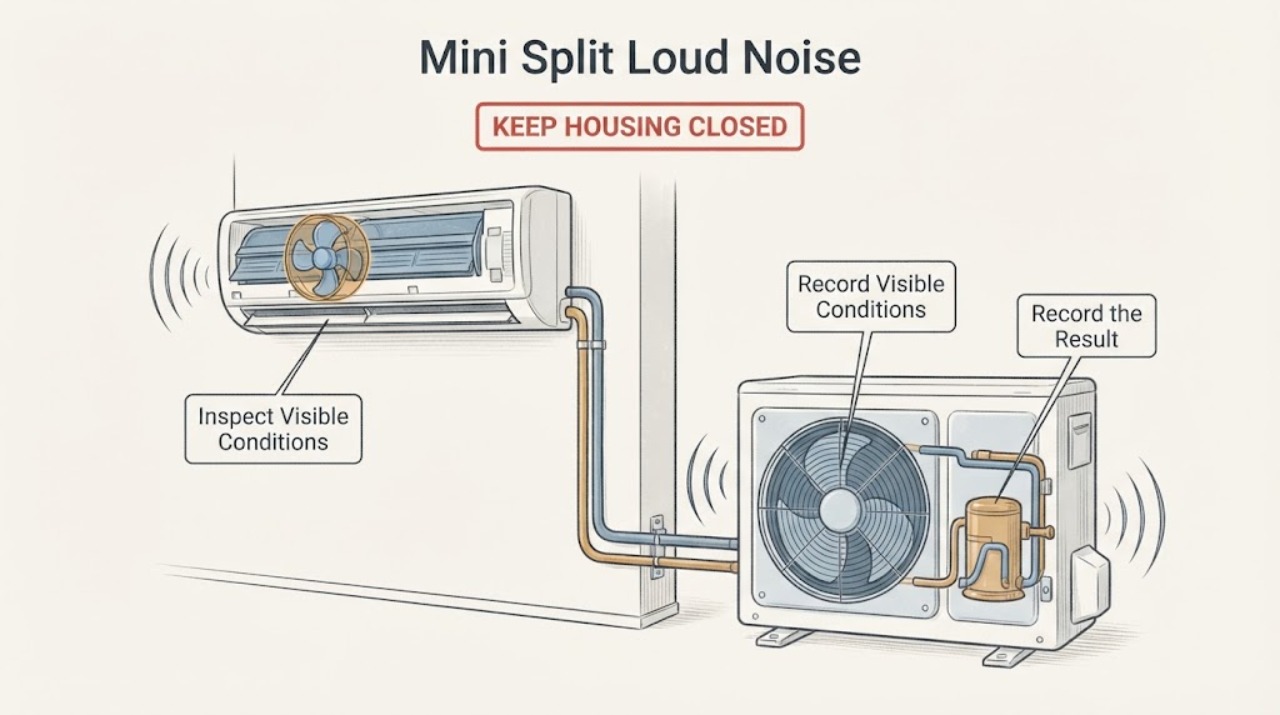
A mini split can make brief water-flow, louver, airflow or defrost sounds that are normal for its design, but a new or unusually loud banging, grinding, rattling, screeching, prolonged buzzing or hissing sound needs attention. First record whether the sound comes from the indoor head or outdoor unit and whether it occurs at startup, shutdown, defrost or continuous operation. From outside the equipment, check the user-accessible filter, air inlets and outlets, visible debris and obvious panel or mounting movement. A hissing sound with ice or poor heating or cooling can indicate a refrigerant problem, and a sudden mechanical or electrical noise should be stopped and professionally inspected. Do not open the cabinet, reach near a fan, handle refrigerant, tighten internal electrical parts or keep running the mini split after a burning smell, smoke, water leak, sparking or severe vibration.
Before you begin
Safety first
- The reader should not open indoor or outdoor cabinets, reach near moving fans, handle refrigerant, connect gauges, tighten line-set fittings, rewire controls, bypass safety devices, scrape ice or keep running the system after smoke, burning smell, sparking or water near electrical equipment.
Work through in order
Diagnostic checks
Use only checks that match the exact appliance or system and its official guide.
-
Check 1
Record the sound in a short video from a safe distance and note its location, character, duration and timing: indoor or outdoor, startup or shutdown, steady operation, mode change or defrost.
Expected result: The sound is a brief water-flow, louver or defrost sound, or it is a new loud bang, grind, rattle, screech, prolonged buzz or hiss.
Next step: If it matches a documented normal sound and comfort is normal, compare with the model manual and monitor. If it is new, loud, prolonged or paired with reduced heating or cooling, stop the unit if safe and continue only with the external checks below.
Stop if: Stop immediately for a burning smell, smoke, sparking, severe vibration, water near electrical equipment, a fan striking something, or a sound that rapidly worsens.
Why this matters
Why: Fujitsu and Daikin describe some water-flow, louver and defrost noises as normal operating behavior. Trane says a normally quiet unit that suddenly becomes loud, or a prolonged unusual sound, should be repaired rather than dismissed.
-
Check 2
Inspect and clean the indoor filter only as the model manual permits, then look for objects blocking the indoor or outdoor air inlet and outlet. Remove only loose debris that is safely reachable without touching a fan or coil.
Expected result: The filter is dusty, an airflow path is blocked, or the outdoor unit is surrounded by debris; alternatively, the airflow path is clear.
Next step: Restore the filter and airflow path, then make one supervised test in the same mode. If the noise remains, stop trying to correct it with additional cleaning and arrange HVAC service.
Stop if: Do not remove the blower, coil, fan guard or cabinet, insert tools through a grille, wash energized equipment, or scrape ice from a coil.
Why this matters
Why: Daikin and Trane identify dirty filters and blocked airflow as causes of reduced performance, and LG's official noise guidance notes that dust or obstacles can make wind noise louder. A clean, clear path does not rule out a mechanical or sealed-system fault.
-
Check 3
From outside the unit, look for an obviously loose front cover, displaced louver, unstable outdoor cabinet, contact with a wall or stand, or debris that could visibly vibrate. Do not remove fasteners or reach into either unit.
Expected result: The noise coincides with visible panel movement or vibration, or no external movement is visible while the sound persists.
Next step: If a panel, louver or mounting condition is visibly displaced, turn the system off and contact the installer or HVAC technician. If nothing is visible, use the recorded sound and timing to request a whole-system inspection.
Stop if: Do not tighten internal hardware, rebalance a fan, move the outdoor unit, remove covers or continue operation when the cabinet shakes severely.
Why this matters
Why: Rattling or vibration can come from a fan, blower, compressor, loose hardware or an unlevel mounting condition, according to Trane. A visual clue helps the technician but cannot establish which internal part is loose or failing.
-
Check 4
Check whether the sound occurs with ice on the indoor or outdoor coil, weak heating or cooling, a hissing or bubbling sound near refrigerant lines, or a sudden increase in energy use. Make this a visual and listening check only.
Expected result: Ice, hissing, poor capacity or a new sound from the refrigerant-line or compressor area is present, or the system has normal capacity and no sealed-system clues.
Next step: If any refrigerant or icing clue is present, turn the affected unit off and arrange qualified mini-split service. If none is present, continue only with the model manual and the service branch if the sound persists.
Stop if: Do not add refrigerant, connect gauges, cut or tighten line-set fittings, chip ice, or restart a system that is leaking, frozen or making a loud compressor sound.
Why this matters
Why: Trane identifies hissing near a mini-split heat pump, frozen coils and reduced capacity as possible refrigerant symptoms, while noting that filters can create similar performance complaints. These symptoms cannot confirm a leak without professional testing.
-
Check 5
After the filter and external-obstruction check, decide whether the mini split can complete a normal call without the abnormal sound returning. Keep the model manual and the sound recording available for the service visit.
Expected result: The sound disappears and the system operates normally, or it returns, becomes louder, or appears with another performance or safety symptom.
Next step: If it returns or remains abnormal, stop the system if safe and contact a qualified HVAC technician or the installer, providing the sound, location, timing, mode and recent maintenance history.
Stop if: Do not keep running the unit unattended to reproduce the sound, open either cabinet, perform live electrical tests or bypass a thermal or pressure safety.
Why this matters
Why: A temporary reduction after cleaning may indicate airflow noise, but a returning or worsening sound points toward a fan, blower, compressor, mounting, refrigerant or electrical diagnosis. An absence of visible clues does not make a loud new sound safe to ignore.
Use your observations
Decision map
Find the observation that best matches what you see, then follow the next safe action.
-
PATH 01Next step
What you see
The sound occurs only during startup, louver movement, refrigerant flow or an automatic defrost event and the system otherwise performs normally.
Do this next
Compare it with the exact model manual and monitor. If it becomes prolonged, louder or occurs outside that operating event, arrange service.
-
PATH 02Next step
What you see
The filter is dusty or an inlet, outlet or surrounding path is visibly obstructed.
Do this next
Clean or replace the user-accessible filter as specified and clear loose obstructions. A recurring noise after this check needs service.
-
PATH 03Next step
What you see
The sound is a new rattle, bang, grind or vibration, or the housing visibly moves.
Do this next
Stop the unit if safe and arrange HVAC inspection for fan, blower, compressor, mounting or loose-component diagnosis; do not remove covers.
-
PATH 04Next step
What you see
Hissing or bubbling occurs near refrigerant lines, ice is present, or heating or cooling capacity drops with the noise.
Do this next
Turn the affected unit off and arrange qualified mini-split service; do not handle refrigerant or continue operation.
-
PATH 05Next step
What you see
There is burning odor, smoke, sparking, repeated breaker operation, water near electrical equipment or severe vibration.
Do this next
Stop operation, disconnect power only if safe, leave panels closed and seek qualified HVAC or electrical help as appropriate.
Helpful context
Understand the symptom
Sound type and timing matter
A short water-flow sound after a mode change, a small louver movement noise or a sizzling sound during automatic defrost can be normal on some split systems. A new sound that is loud, prolonged, grinding, rattling, banging or accompanied by a performance change should be treated as abnormal until the manufacturer manual says otherwise.
Start with the parts a homeowner can see
Dust on a filter, an obstructed airflow path or debris around the outdoor unit can make airflow louder and reduce performance. Cleaning a user-accessible filter and removing loose debris from around the unit can narrow the cause, but it does not justify opening the indoor head or outdoor cabinet.
Do not diagnose sealed or electrical components by sound alone
A hissing or bubbling sound near refrigerant lines, ice on a coil, electrical buzzing, severe vibration or a burning smell can involve refrigerant, compressor, fan, motor, controls or wiring. These require qualified HVAC diagnosis; do not attach gauges, remove panels, touch wiring or bypass a safety control.
Only after diagnosis
Potential parts
- mini-split air filter
Consider this category only when the user-accessible filter is damaged or cannot be cleaned and the model manual specifies replacement; a loud sound alone does not identify the filter as the cause.
Confirm the exact indoor-unit model and manufacturer fit information before ordering; do not install a more restrictive filter as a noise experiment. - indoor blower, louver or outdoor fan component
Consider this category only after a qualified inspection finds contact, imbalance, bearing, motor or louver damage associated with the recorded noise; the sound pattern is not enough to identify a component.
Internal fan and louver work should be confirmed and installed by qualified service using the exact unit model. - compressor, refrigerant or mounting component
This is a professional-diagnosis category for persistent rattling, compressor noise, hissing, icing or vibration after user-accessible checks; no part should be selected from the sound alone.
Do not handle refrigerant, open the sealed system or move the outdoor unit; qualified service must confirm the fault and system fit.
When checks do not resolve it
Need a professional?
Call a qualified HVAC technician when the mini split makes a new, loud or prolonged noise, rattles or vibrates, loses heating or cooling capacity, hisses near refrigerant lines, develops ice, or remains noisy after the user-accessible filter and obstruction checks. Stop immediately for burning smell, smoke, sparking, severe vibration, water near electrical equipment or repeated breaker trips; disconnect power only if safe and do not open the cabinets or handle refrigerant.
Safety scope: The reader should not open indoor or outdoor cabinets, reach near moving fans, handle refrigerant, connect gauges, tighten line-set fittings, rewire controls, bypass safety devices, scrape ice or keep running the system after smoke, burning smell, sparking or water near electrical equipment.
Common questions
FAQ
Are all mini split noises a sign of failure?
No. Daikin and Fujitsu describe some water-flow, louver and defrost sounds as normal. A new, unusually loud, prolonged, grinding, banging, rattling or hissing sound is different and should be checked or serviced.
Can a dirty filter make a mini split louder?
Yes, restricted airflow can increase wind noise and reduce performance. Clean or replace only the user-accessible filter as the model manual allows; if the noise continues, arrange HVAC service.
What does hissing from a mini split mean?
A hissing or bubbling sound near refrigerant lines, especially with ice or poor heating or cooling, can indicate a refrigerant problem, but sound alone cannot confirm a leak. Turn the affected unit off and have a qualified technician diagnose it.
Should I keep using a mini split that suddenly becomes very loud?
No. A sudden loud sound can involve the fan, blower, compressor, mounting or electrical system. Turn it off if safe and arrange HVAC service, especially if there is vibration, burning smell, smoke, water or a performance change.
Read the exact guide
Official sources
- Is This Normal? HVAC Smells and Sounds, ExplainedTrane · Manufacturer guidance distinguishing normal and abnormal HVAC sounds, including defrost, rattling, humming, high-pitched, clicking and hissing sounds.
- How to Identify and Fix Mini-Split Refrigerant IssuesTrane · Manufacturer guidance on hissing, ice, reduced capacity, filter checks and the professional boundary for refrigerant leak diagnosis and recharge.
- TroubleshootingDaikin · Official split-system troubleshooting for normal and abnormal sounds, filters, airflow obstructions, water leaks and power-related stop conditions.
- AIRSTAGE MINI-SPLITS TroubleshootingFujitsu General · Official mini-split FAQ describing delayed restart protection and normal water-flow, casing-expansion and automatic-defrost sounds.
- LG Air Conditioner - Troubleshooting Loud Noises During OperationLG Electronics · Official guidance linking louder wind noise to airflow obstacles and dusty filters.
- Heat Pump Troubleshooting: Diagnosing Common IssuesTrane · Manufacturer heat-pump guidance on unusual noise, ice, thermostat or power symptoms and professional service.
Community feedback
Share a repair observation
Share a plain-text repair observation. Accepted observations are published automatically; this page may take a moment to update.