
On this page
Start here
Quick answer
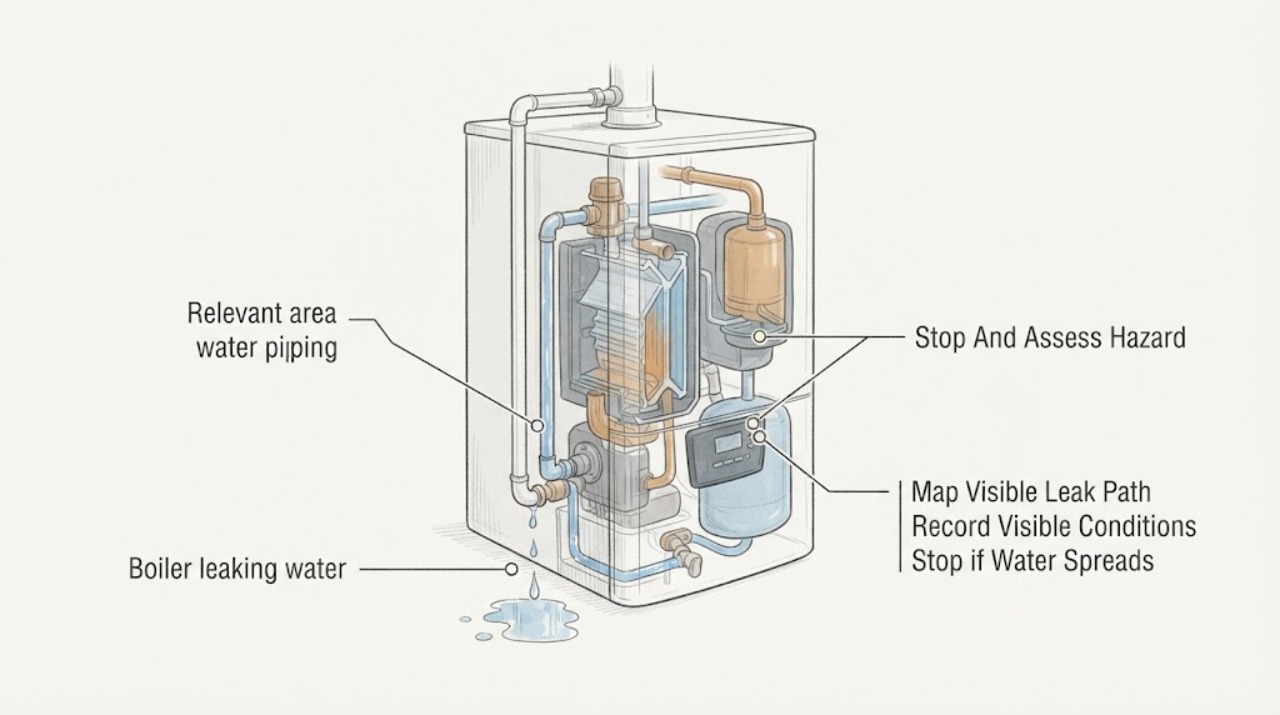
Treat water under or around a Navien boiler as a leak until the source is identified. From a dry, safe position, note whether water is actively flowing, where the first wet point appears, whether it is hot, and whether the leak changes when the boiler heats. Check the display and pressure indication without opening the cabinet, and look only at visible piping, the condensate route, and the relief-valve discharge path. A leak from a connection, relief path, condensate drain, heat exchanger, expansion system, or nearby pipe can have different causes; a rising pressure, repeated makeup water, or persistent leak needs qualified boiler service. Navien says homeowner troubleshooting is limited because the appliance involves water, electricity, and gas, and its guidance reserves internal components, draining, relief-valve work, and leak correction for qualified contractors. Do not remove the front cover, touch hot discharge, open a gas or water connection, or keep operating a boiler that is leaking, smoking, or producing a gas odor.
Work through in order
Diagnostic checks
Use only checks that match the exact appliance or system and its official guide.
-
Check 1
From a safe, dry position, determine whether the leak is a drip, stream, spray, steam, or hot discharge and whether there is a gas odor, smoke, scorching, or water near electrical equipment.
Expected result: Record a contained cool drip, fast flow, hot water or steam, gas odor, smoke or scorching, or water reaching electrical equipment.
Next step: For any urgent warning, leave the boiler area and use emergency, gas, electrical, or plumbing help as appropriate. Otherwise keep the boiler under observation only long enough to locate the external wet area.
Stop if: Do not touch hot water, steam, relief discharge, wiring, or a wet electrical enclosure, and do not operate the boiler to reproduce a dangerous leak.
Why this matters
Why: Fast flow, hot discharge, combustion warning, or electrical exposure is an immediate safety boundary; a slow contained drip can be documented while service is arranged.
-
Check 2
Without removing the front cover or insulation, look for the first wet point at visible water piping, valves, fittings, the condensate outlet, relief-valve discharge path, and nearby system connections.
Expected result: Record a wet connection, water at the condensate route, discharge from the relief path, water below the cabinet with no visible source, or a nearby pipe rather than the boiler.
Next step: Photograph or mark the first wet point and leave the boiler off if the leak is active or recurring. Arrange a qualified boiler or plumbing technician for any source that is not a simple external pipe issue.
Stop if: Do not tighten fittings, remove panels, peel insulation, disconnect hoses, or reach behind the boiler.
Why this matters
Why: A visible connection or pipe can be a plumbing repair path; condensate and relief discharge have distinct operating causes; water with no external source keeps an internal leak possible.
-
Check 3
Read the front display and visible pressure indication without opening the cabinet; record any warning, pressure trend while heating, and whether the leak begins during a heating or hot-water call.
Expected result: Record normal-looking display with a stable indication, a pressure rise during heating, repeated low indication or makeup behavior, an error message, or no display.
Next step: Provide the display and timing to a qualified Navien technician. Do not refill, bleed, reset repeatedly, or adjust system pressure unless the model manual and a qualified professional direct it.
Stop if: Do not open the cabinet, operate a relief lever, change a fill valve, or continue operation when pressure behavior is abnormal or water is escaping.
Why this matters
Why: A rising pressure with discharge can make expansion or relief behavior relevant; repeated low indication can accompany a system leak. An error or blank display needs the exact model manual and service diagnosis, not a guessed reset.
-
Check 4
From outside the cabinet, observe whether water appears at the external condensate route or relief-valve discharge arrangement and whether the discharge is cool, hot, continuous, or associated with boiler heating.
Expected result: Record a dry route, intermittent condensate during operation, continuous discharge, hot discharge, a blocked-looking or disconnected pipe, or no safe view of the route.
Next step: Leave the boiler off and arrange qualified service for any continuous, hot, blocked-looking, or disconnected discharge. Do not touch the line or try to clear an internal trap.
Stop if: Do not lift the relief lever, catch hot discharge by hand, insert tools, pour chemicals, or remove a condensate trap.
Why this matters
Why: Condensate and relief discharge have different causes. Continuous or hot relief discharge can indicate pressure or valve problems and is not a safe homeowner adjustment; a disconnected condensate route can cause water damage.
-
Check 5
Inspect only accessible nearby heating and domestic-water piping for a wet joint, corrosion, dripping valve, or water trail, keeping clear of gas piping, hot surfaces, and electrical parts.
Expected result: Record dry nearby pipes, a wet system connection, a wet domestic-water connection, corrosion or mineral tracks, or water that appears to originate inside the cabinet or wall.
Next step: Stop using the boiler if the leak is active or hot and request boiler or plumbing service. Provide the pipe location and whether it changes with heating or hot-water use.
Stop if: Do not touch gas piping, hot tubing, electrical connections, valves that require force, or concealed piping.
Why this matters
Why: A nearby pipe can be the true source of the puddle, while corrosion, an internal source, or a concealed leak needs professional diagnosis. Visual moisture cannot confirm pressure or gas safety.
-
Check 6
Record the Navien model and serial number if safely visible, leak rate and first wet point, display or pressure behavior, operating mode, condensate or relief observations, nearby pipe condition, and any gas or electrical warning.
Expected result: Confirm that the record contains external observations only and that no cover, relief valve, water connection, gas connection, control, or condensate component was disturbed.
Next step: Contact the original installer, qualified boiler contractor, or Navien service specialist and provide the model, serial number, photos, display, pressure trend, and timing.
Stop if: Stop all homeowner troubleshooting when diagnosis requires draining, pressure adjustment, front-cover removal, gas work, electrical measurement, relief-valve work, or internal access.
Why this matters
Why: This handoff lets a qualified contractor distinguish piping, relief, expansion, condensate, heat-exchanger, control, and combustion-related paths without unsafe owner testing.
Use your observations
Decision map
Find the observation that best matches what you see, then follow the next safe action.
-
PATH 01Safety boundary
What you see
The leak is fast or hot, there is steam, gas odor, smoke, scorching, water near electrical equipment, or a relief path is discharging forcefully.
Do this next
Leave the area or keep clear, do not operate the boiler, and use appropriate emergency, gas, electrical, or plumbing help from a safe location.
Why this path and its safety boundary
Why it matters: The immediate risk is scalding, gas, fire, electrical, or pressure injury rather than identifying a replacement part.
Safety stop: Do not touch discharge, close unknown valves, open the cabinet, or restore operation to test the leak.
-
PATH 02Next step
What you see
A visible water connection or nearby system pipe is the first wet point, with no hot discharge or gas or electrical warning.
Do this next
Leave the boiler off if the leak continues, photograph the connection, and arrange qualified boiler or plumbing service. Do not tighten it by force.
Why this path and its safety boundary
Why it matters: A plumbing connection or system-piping leak is more likely than a hidden boiler control fault, but pressure and temperature still require professional handling.
-
PATH 03Next step
What you see
Water appears at the relief discharge and the visible pressure rises during heating, or the relief route leaks continuously.
Do this next
Turn the boiler off and request qualified service. Keep clear of hot discharge and do not lift the relief lever or refill the system.
Why this path and its safety boundary
Why it matters: Expansion, over-pressure, circulation, or relief-valve behavior is possible; a relief valve must not be treated as a faucet to adjust.
-
PATH 04Next step
What you see
Water appears at an external condensate route during boiler operation, or the route is disconnected, overflowing, or visibly blocked.
Do this next
Leave the boiler off if water is escaping or backing up and arrange qualified Navien service. Do not remove the trap or pour cleaner into the route.
Why this path and its safety boundary
Why it matters: Condensate drainage or trap performance becomes more likely, but the component may be inside the appliance or connected to a larger drain path.
-
PATH 05Next step
What you see
Water appears below or inside the cabinet with no visible external source, or the leak returns while all visible piping remains dry.
Do this next
Keep the boiler off and request a qualified Navien boiler contractor. Do not remove the front cover, drain the unit, or attempt internal repair.
Why this path and its safety boundary
Why it matters: An internal heat-exchanger, valve, gasket, sensor, or concealed-pipe issue remains possible and cannot be safely diagnosed from outside.
Helpful context
Understand the symptom
Make the boiler safe before tracing the drip
Water from a boiler can be hot, and the appliance combines water, electricity, combustion, and pressure. Keep clear of a spray, steam, hot discharge, or water near electrical equipment. If there is a gas odor, smoke, scorching, a fast leak, or a relief line discharging, leave the area and use the appropriate emergency or gas response. For a slow, contained leak with no warning, record the source from a distance and arrange qualified service rather than opening the cabinet.
Separate a visible connection from an internal leak
Use a dry cloth or paper towel only on accessible exterior surfaces and watch for the first wet point. Water can run along piping or the cabinet base, so the lowest puddle is not necessarily the source. A connection or nearby system pipe may leak continuously; a relief or condensate path may appear only during operation; an internal heat-exchanger or valve leak requires a technician. Do not tighten a fitting or remove insulation to chase the water.
Use pressure and timing as evidence, not a DIY diagnosis
Record the pressure display or gauge while the system is cool and while it heats, without removing a cover or adjusting a fill valve. A pressure that rises unusually as the boiler heats, drops repeatedly, or triggers a warning can make the expansion system, relief path, circulation, or a system leak relevant. Navien's manual notes that excessive pressure rise can indicate an expansion-tank sizing or performance problem, but pressure readings alone do not identify the failed component.
Condensate is not permission to open the boiler
Condensing boilers can produce water through a condensate route. Look from a safe position for a disconnected, overflowing, or visibly wet external condensate pipe or trap, but do not remove the trap, pour chemicals into it, or open the cabinet. Navien documentation directs service personnel to inspect and clean condensate components and to correct water leaks; an owner should provide the visible timing and location to the technician.
Safety boundary
Stop conditions
- Stop immediately for gas odor, smoke, fire, scorching, steam, hot or fast water discharge, water near electrical equipment, a repeated fault, or an uncontrollable leak.
- Leave the boiler off for a persistent leak, abnormal pressure trend, relief discharge, condensate overflow, water below the cabinet, or a leak that returns after operation.
- Never remove the front cover, drain or refill the boiler, operate a relief lever, adjust pressure, touch gas or electrical connections, clear an internal condensate trap, or repair sealed components as a homeowner.
Only after diagnosis
Potential parts
- pressure-relief valve or discharge component
A relief valve is only a candidate after a qualified technician confirms the valve itself is leaking and rules out over-pressure, expansion, or installation causes; hot discharge is a safety boundary.
Confirm the exact Navien model, pressure and temperature rating, discharge arrangement, local requirements, and manufacturer-approved fit with a qualified contractor. - condensate trap, gasket, valve, or heat-exchanger component
Internal or condensate parts require model-specific diagnosis because water can originate in piping, relief, expansion, or sealed combustion components.
Have a qualified Navien contractor identify the failed part and verify the exact model, service procedure, sealing requirements, and approved replacement.
When checks do not resolve it
Need a professional?
Call the original installer, a qualified boiler contractor, or a Navien service specialist for any active or recurring water leak, pressure change, relief discharge, condensate overflow, internal or concealed source, or leak that cannot be isolated safely. Use emergency, gas, electrical, or plumbing help for gas odor, smoke, fire, hot or fast discharge, water near electrical equipment, or flooding.
Have this ready
- Provide the model and serial number if safely visible, first wet point, leak rate and temperature impression, display and pressure behavior, operating mode, condensate and relief observations, nearby pipe condition, photos, and any gas or electrical warning.
Common questions
FAQ
Can I keep running a Navien boiler that is leaking water?
Do not keep operating a boiler with an active or recurring leak, abnormal pressure, relief discharge, condensate overflow, hot water, gas odor, smoke, or water near electrical equipment. Leave it off and contact a qualified Navien boiler contractor; do not open the cabinet.
Where does water around a Navien boiler usually come from?
The visible source may be a water connection, system pipe, pressure-relief route, condensate path, expansion-related discharge, or an internal component. Dry the exterior, identify the first wet point and timing, and let a qualified technician determine the failed part.
Should I lift the Navien boiler relief-valve lever to test it?
No. Navien warns that relief-valve discharge can be hot and requires a safe discharge arrangement; inspection and replacement belong with a licensed or qualified contractor. Keep clear of any discharge and arrange service.
Can a homeowner repair a Navien boiler water leak?
Only basic external observation is appropriate without model-specific professional guidance. Navien limits homeowner troubleshooting because the boiler involves water, electricity, and gas, and internal components, draining, pressure work, and leak correction should be handled by a qualified contractor.
Read the exact guide
Official sources
- NFC-H User's Information ManualNavien · Opened Navien official user information manual used for general condensing-boiler leak and safety boundaries; exact installed model manual controls all procedures.
- FAQs | Residential BoilersNavien · Navien official residential boiler FAQ used for the safe owner boundary and service handoff; exact model documentation governs operation and maintenance.
- NCB Brochures, Manuals & DocumentsNavien · Navien official downloads index used to direct model-specific documentation selection without inventing a model or procedure.
Community feedback
Share a repair observation
Share a plain-text repair observation. Accepted observations are published automatically; this page may take a moment to update.