
On this page
Start here
Quick answer
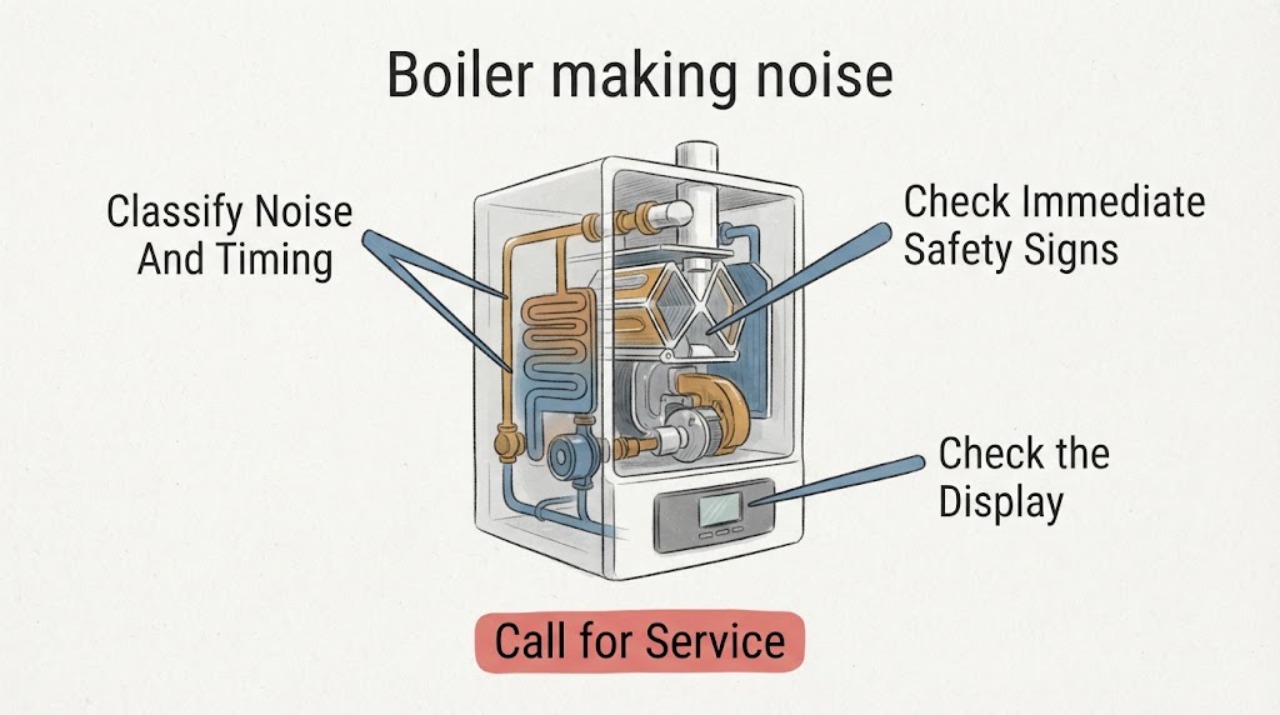
A noisy Navien boiler should be narrowed by sound, timing, and the part of the system where it is heard—not by opening the cabinet or changing gas, water, or safety settings. From a safe position, note whether the sound is gurgling, bubbling, rushing, humming, vibrating, clicking, banging, or whistling; whether it occurs at ignition, during circulation, at shutdown, or continuously; and whether the display shows a warning, pressure changes, a leak, or a vent or condensate issue. Navien explains that air in the system can interfere with circulation or contribute to overheating, and its service guidance calls for checking system pressure, piping, expansion equipment, air vents, filters, condensate, venting, and leaks. Homeowner checks are limited because the appliance combines water, electricity, and gas. If you smell gas, a carbon-monoxide alarm sounds, smoke or flame looks abnormal, hot water or steam escapes, water reaches wiring, a safety relief device discharges, or the noise is accompanied by a lockout or active leak, leave the area as appropriate and call emergency or qualified service. Do not restart the boiler repeatedly or treat a noise as proof of a failed part.
Before you begin
Safety first
- Owner checks are limited to safe listening, reading a visible display or label, viewing accessible vent, intake, piping, condensate, and pressure or temperature indications without touching, and documenting the pattern. A qualified Navien professional must handle cabinet access, gas and combustion work, electrical tests, venting repairs, relief and hydronic pressure work, draining or filling, internal cleaning, and part selection.
Work through in order
Diagnostic checks
Use only checks that match the exact appliance or system and its official guide.
-
Check 1
From a dry, stable position, listen without touching the boiler and record the sound description, where it is loudest, and when it occurs: ignition, burner operation, pump or circulation, domestic hot-water demand, shutdown, or standby. Note whether the sound is continuous, intermittent, or getting louder; do not create extra heat calls just to reproduce it.
Expected result: Record gurgling or bubbling, humming or vibration, rushing or whistling, clicking or banging, a fan-like sound, or a noise from nearby piping rather than the cabinet; also record its timing relative to a heat call.
Next step: Continue only with safe external observations when there is no gas odor, smoke, abnormal flame, hot discharge, leak, or alarm. If the noise is new, severe, or accompanied by a warning, leave the unit off and arrange qualified service.
Stop if: Stop for gas odor, a carbon-monoxide alarm, smoke, flame abnormality, steam, scalding water, active leaking, electrical arcing, or a noise that coincides with a safety lockout.
Why this matters
Why: Gurgling keeps air or flow issues in consideration; vibration can involve circulation equipment or mounting; rushing or whistling can involve water or vent airflow; clicking or banging can involve expansion, scale, combustion, or a component. Timing and location narrow the path but do not identify a failed part.
-
Check 2
Before going closer, check the mechanical-room entrance for gas odor, a carbon-monoxide alarm, smoke, an unusual flame visible only through the designed observation area, hot water or steam, water near wiring or controls, and a puddle or relief discharge. Do not use a flame, operate switches in a suspected gas leak, or touch wet equipment.
Expected result: Record no immediate hazard, gas odor, a carbon-monoxide alarm, smoke or abnormal flame, steam or hot discharge, water at electrical equipment, or an active leak or relief discharge.
Next step: For gas odor or a carbon-monoxide alarm, leave as appropriate and contact the gas utility or emergency services from a safe location. For smoke, fire, steam, hot water, electrical contact, active flooding, or relief discharge, keep clear and request urgent qualified service; do not restart the boiler.
Stop if: Stop immediately for gas odor, a carbon-monoxide alarm, fire, smoke, abnormal flame, exposed wiring, water near electrical parts, steam, scalding discharge, or rapidly spreading water.
Why this matters
Why: Gas odor or a carbon-monoxide alarm is an emergency, not a noise branch. Smoke, abnormal flame, hot discharge, water near electricity, or relief discharge creates fire, shock, burn, or pressure risk. A quiet noise with no hazard can still need service, but it does not make cabinet access safe.
-
Check 3
Without opening the cabinet or changing settings, read the front-panel status, operating icons, and any displayed error or service message. Note whether the noise occurs during space heating, domestic hot-water operation, an auto-air-purge indication, standby, or a lockout; photograph the display if safe.
Expected result: Record a normal display, an error code, a service reminder, an air-purge or combustion indication, a lockout, or a blank or damaged display.
Next step: Write down the exact code and model before contacting service. Do not repeatedly reset, clear, or override a warning to see whether the noise returns; follow the exact manual or technician direction for any permitted reset.
Stop if: Stop for a repeated lockout, an error tied to flame, venting, overheat, low water, or condensate, a damaged display, or any instruction that requires cover removal or internal testing.
Why this matters
Why: A code or operating state can connect the noise with flow, ignition, heat-exchanger temperature, venting, condensate, or another monitored condition, but a code alone does not prove which component failed. Navien's manuals are model-specific and direct unresolved problems to authorized or licensed service.
-
Check 4
From outside the boiler, visually inspect the accessible vent termination and combustion-air intake for blockage, separation, corrosion, melting, or objects close to the openings. Look only; do not climb, insert an object, seal a joint, alter vent length, or remove a cover.
Expected result: Record clear and intact openings, debris or blockage, a separated or damaged joint, corrosion or melting, ice or snow, or no safe view of the termination.
Next step: Turn off and discontinue use if vent or intake parts are damaged, separated, corroded, or melted, and arrange qualified service. Remove only loose exterior debris when it can be done from the ground without touching the appliance or vent; otherwise leave it for service.
Stop if: Stop for gas odor, exhaust entering the building, melted or separated venting, ice that cannot be safely removed, or any need to access the roof, wall penetration, or cabinet.
Why this matters
Why: A vent or intake restriction or damaged connection can create abnormal airflow, combustion, noise, and carbon-monoxide risk. A clear termination does not rule out a concealed vent, fan, gas, or combustion issue.
-
Check 5
With the unit off or not firing and surfaces cool, look from outside the cabinet at the condensate outlet, visible drain tubing, heating supply and return piping, air separator or vent area, and nearby floor. Check for moisture, corrosion, drips, a loose-looking tube, or vibration transmitted to the wall; do not open the cabinet or manipulate a valve.
Expected result: Record a dry system, condensate at the outlet, a cool drip at a visible heating connection, corrosion, a loose or kinked-looking drain, unusual pipe vibration, or water emerging from inside the cabinet.
Next step: Keep the boiler off and arrange qualified service for any active drip, cabinet water, corrosion, abnormal vibration, or condensate overflow. Do not tighten a pressurized connection, remove the condensate trap, or pour chemicals into a drain.
Stop if: Stop for hot surfaces, steam, pressurized spray, unknown liquid, water near controls, a cracked pipe, or any need to remove the front cover or condensate assembly.
Why this matters
Why: Condensate moisture, heating-loop leakage, air-vent leakage, and internal cabinet water are different service paths. Air in the system can interfere with circulation, while a leak or vibration can worsen equipment damage; visual moisture does not identify the failed seal, pump, vent, or heat exchanger.
-
Check 6
Read the installed system pressure or temperature gauge only if it is clearly visible without touching hot piping. Note whether the reading changes sharply when the boiler heats, whether the noise follows a pump or zone call, and whether radiators or heating zones are uneven or fail to warm; do not bleed radiators, add water, open a drain, or adjust the expansion tank.
Expected result: Record a stable reading within the exact manual's documented range, an unexplained pressure rise, a low or fluctuating reading, noise that follows circulation, uneven zones, or no gauge or safe access.
Next step: Photograph the gauge and provide the pattern to a qualified boiler technician. Leave the system settings and valves unchanged unless the exact manual or technician gives a safe, model-specific instruction.
Stop if: Stop for a pressure or temperature alarm, a rapidly changing reading, hot or leaking piping, a relief discharge, or any step requiring bleeding, filling, draining, or opening a valve.
Why this matters
Why: Navien directs technicians to check system pressure, piping, expansion equipment, air vents, and circulation filters. A pressure rise, circulation-linked noise, or uneven zone pattern makes air, flow, expansion, pump, or system design issues more likely, but readings cannot be judged generically across models.
-
Check 7
Prepare a service record with the Navien model and serial number, sound description and location, timing, display code or operating icon, vent and intake condition, visible moisture or corrosion, pressure or temperature trend, affected heating zones, recent installation or maintenance, and a short recording made from a safe position. Do not remove covers to collect more details.
Expected result: Confirm that the record contains direct observations and model identity, not an assumed failed pump, fan, heat exchanger, valve, vent, or expansion tank.
Next step: Arrange qualified Navien boiler service when the noise persists, is new or worsening, affects heating, follows a code or lockout, or requires internal inspection, cleaning, draining, gas work, electrical testing, or pressure diagnosis.
Stop if: Stop owner troubleshooting when the next step requires cabinet access, gas or combustion adjustment, electrical testing, relief-valve operation, hydronic draining or filling, or contact with hot, pressurized, or contaminated fluid.
Why this matters
Why: The combined pattern helps a technician distinguish air or flow, pump or mounting vibration, vent or combustion, scale or heat-exchanger, condensate, expansion, or external piping issues. Navien recommends authorized or licensed service when basic checks do not resolve a problem.
Use your observations
Decision map
Find the observation that best matches what you see, then follow the next safe action.
-
PATH 01Next step
What you see
Noise is accompanied by gas odor, a carbon-monoxide alarm, smoke, abnormal flame, exhaust entering the building, water near wiring, steam, scalding discharge, or rapid water loss.
Do this next
Leave the area as appropriate and contact emergency services, the gas utility, or urgent qualified service from a safe location. Do not operate switches in a suspected gas leak, touch wet electrical parts, or restart the boiler.
-
PATH 02Next step
What you see
Gurgling or rushing follows a heating or pump call, zones are uneven, the gauge changes, and there is no gas, vent, leak, or electrical warning.
Do this next
Have a qualified technician assess system pressure, air vents or separators, expansion equipment, circulation filters, pump operation, and piping. Do not bleed, refill, drain, or adjust the expansion tank as a generic owner fix.
-
PATH 03Next step
What you see
Whistling, roaring, or fan-like noise occurs at ignition or firing and the vent or intake is blocked, separated, corroded, melted, iced, or otherwise questionable, or a vent-related code appears.
Do this next
Turn off and discontinue use, keep clear of the termination, and arrange qualified service to inspect venting, combustion air, fan, gas, and controls. Do not insert objects or alter vent connections.
-
PATH 04Next step
What you see
Noise is paired with water at the condensate outlet, a visible heating connection, relief discharge, cabinet seam, or floor, or with corrosion or a loose-looking drain path.
Do this next
Keep the boiler off and arrange qualified service to trace the liquid and inspect condensate, relief, piping, pump, seals, and heat exchanger as applicable. Do not touch unknown or hot liquid, open the cabinet, or tighten a pressurized fitting.
-
PATH 05Next step
What you see
Clicking, banging, humming, or vibration is new or persistent, follows firing or circulation, and no external vent, leak, pressure, display, or gas warning explains it.
Do this next
Schedule qualified boiler service for pump or fan bearings, mounting, heat-exchanger or scale, flow, and control diagnosis. A noise alone does not justify ordering a pump, fan, or heat exchanger.
-
PATH 06Next step
What you see
The sound cannot be localized, the model or manual is unknown, the display is blank or inconsistent, or safe observations do not separate the possible paths.
Do this next
Leave the unit in the safest state available and provide the model, recording, timing, display, gauge, and visible-condition notes to an authorized or licensed boiler professional. Do not copy another model's settings or disassembly procedure.
Helpful context
Understand the symptom
The sound pattern is a clue, not a diagnosis
Gurgling or bubbling can make trapped air or flow a consideration; humming or vibration may be associated with a pump, mounting, or nearby piping; whistling or rushing can involve airflow or water flow; and clicking, banging, or popping can be a combustion, expansion, scale, or component clue. Those are starting hypotheses, not owner-level diagnoses. Record when the sound starts and where it is loudest, then compare that pattern with display messages, heat demand, leaks, and circulation. A noise that is new, worsening, or paired with a safety symptom should be escalated rather than repeatedly tested.
Navien models and installation layouts differ
Navien sells several boiler and combi-boiler families, with different controls, pumps, filters, vent arrangements, condensate paths, and hydronic piping. A pressure or temperature reading has meaning only against the exact model and system design. Use the model-specific User's Information and Installation & Operation manuals for any permitted owner check; do not copy a setting, reset sequence, filter location, or part from another Navien model.
Keep gas, venting, electricity, and hot water outside the DIY boundary
Navien's manual says not to use the appliance when vent or intake parts are damaged, separated, corroded, or melted and directs qualified service for inspection and maintenance. It also warns that gas odor requires avoiding switches and ignition attempts. Do not remove the front cover, adjust gas or combustion settings, open the relief valve, drain the boiler, or work on wiring to chase a noise. The safe owner contribution is observation, a visible display or label, and a clear service handoff.
Safety boundary
Stop conditions
- Do not open the Navien cabinet, adjust gas or combustion settings, test wiring or live voltage, alter venting, or remove a fan, pump, heat exchanger, or control as an owner noise test.
- Do not bleed, fill, drain, or repressurize the hydronic system; do not operate a relief valve or cap its discharge; and do not touch hot, pressurized, unknown, or contaminated fluid.
- Turn off and discontinue use if vent or intake parts are damaged, separated, corroded, melted, or blocked, or if the boiler shows a related safety or combustion warning.
- For gas odor, a carbon-monoxide alarm, smoke, fire, abnormal flame, steam, scalding water, water near electrical equipment, active flooding, or rapid pressure or temperature change, keep clear and request emergency or qualified service from a safe location.
Only after diagnosis
Potential parts
- circulator pump or pump isolation component
Consider this only when qualified diagnosis links a circulation-related hum, vibration, or flow symptom to the pump or its isolation or mounting components after air, pressure, and piping causes are assessed.
Confirm the exact Navien model, pump type, electrical and flow ratings, control compatibility, system design, and approved installation instructions before replacement; do not run a dry or unapproved pump. - fan or vent-air component
Consider this only when service confirms a fan, vent-air, or combustion component issue after external intake and vent observations and displayed codes are reviewed.
Verify the exact Navien model, gas type, vent arrangement, electrical ratings, and qualified combustion-testing requirements; do not substitute a visually similar fan or alter venting. - air vent, separator, or hydronic filter service
Consider this category only when qualified diagnosis finds air, restricted circulation, a leaking vent, or a blocked heating-side filter that matches the noise and zone or pressure pattern.
Confirm the exact model, piping layout, fluid, connection, pressure and temperature ratings, and service procedure; opening the hydronic loop or filter requires appropriate isolation and skills. - heat exchanger or scale-related service
Consider this only after qualified service confirms scale, flow restriction, overheating, corrosion, or a heat-exchanger defect as the cause of the noise.
Verify the exact Navien model, heat-exchanger design, approved cleaning or replacement path, water quality, pressure, and combustion checks; do not chemically flush or open the boiler as an owner test.
When checks do not resolve it
Need a professional?
Call a qualified Navien boiler technician when the noise is new, persistent, worsening, affects heating or hot water, follows an error or lockout, occurs with pressure or circulation changes, or cannot be localized with safe observations. Arrange urgent service for vent or intake damage, water near electrical equipment, active leaks, relief discharge, steam, hot water, or abnormal flame. For gas odor, a carbon-monoxide alarm, smoke, fire, or exhaust entering the building, leave as appropriate and contact emergency services or the gas utility from a safe location.
Safety scope: Owner checks are limited to safe listening, reading a visible display or label, viewing accessible vent, intake, piping, condensate, and pressure or temperature indications without touching, and documenting the pattern. A qualified Navien professional must handle cabinet access, gas and combustion work, electrical tests, venting repairs, relief and hydronic pressure work, draining or filling, internal cleaning, and part selection.
Have this ready
- Provide the Navien model and serial number, exact sound description and location, timing, display code or operating icon, safe recording, vent and intake condition, visible moisture or corrosion, gauge trend, affected zones, recent service or installation, and any emergency or stop condition observed.
Common questions
FAQ
Why is my Navien boiler making noise?
The sound may involve air or circulation, a pump or fan, vent or combustion airflow, scale or heat-exchanger flow, expansion, condensate, or nearby piping. Classify the sound and timing first; a noise alone does not identify a failed part.
What does gurgling in a Navien boiler mean?
Gurgling can make air or flow issues more likely. Navien explains that air can interfere with pump circulation or contribute to overheating. Do not bleed or refill the system as a generic fix; have a qualified technician assess pressure, air elimination, expansion, and flow.
Is a humming or vibrating boiler pump normal?
Some operating sound can occur, but a new, loud, worsening, or circulation-linked hum or vibration needs diagnosis. It may involve mounting, air, flow, pump, or piping; do not touch a hot pump or order a replacement without model-specific diagnosis.
Why does the boiler whistle when it fires?
Whistling or roaring during ignition or firing can involve vent or combustion-air flow, fan operation, water flow, or another component. Inspect only accessible vent and intake openings from a safe position; stop using the boiler if they are damaged or blocked and call a professional.
Can scale make a Navien boiler bang or click?
Scale, flow restriction, expansion, or component operation can be possible clues, but the sound does not prove scale. A qualified technician should evaluate water quality, flow, heat-exchanger condition, pressure, and the exact model before any cleaning or replacement.
Should I bleed my Navien boiler to stop the noise?
Do not bleed or drain the boiler or heating loop as a generic homeowner test. Navien notes that air matters to circulation, but removing air and restoring system pressure requires the correct piping, valves, equipment, and model-specific procedure.
Can I reset a noisy Navien boiler?
Do not repeatedly reset it to reproduce a noise or clear a warning. Record the exact display code and operating state, then follow the exact user manual or contact an authorized or licensed technician. A reset does not repair a pressure, vent, leak, gas, or mechanical problem.
What if the boiler noise comes with water or condensate?
Keep the boiler off and arrange qualified service. Moisture at a condensate outlet, heating connection, relief discharge, cabinet, or floor can indicate different causes, and hot or unknown liquid should not be touched or chemically cleaned.
When is a Navien boiler noise an emergency?
Treat gas odor, a carbon-monoxide alarm, smoke, fire, abnormal flame, exhaust entering the building, steam, scalding water, water near electrical equipment, active flooding, relief discharge, or a safety lockout as urgent. Leave as appropriate and call emergency or qualified service from a safe location.
What information should I give the Navien technician?
Give the model and serial number, sound description and location, timing, display code or icon, a safe recording, vent and intake condition, visible moisture or corrosion, gauge trend, affected zones, and recent installation or maintenance.
Read the exact guide
Official sources
- NFC Warranty InformationNavien · Navien NFC warranty language used only to avoid treating noise as proof of a defective part; warranty terms vary by product and do not replace diagnosis.
- FAQs | Residential BoilersNavien · Navien residential boiler FAQ used for general system mechanics and safety boundaries; exact model manuals govern.
- Boiler Brochures, Manuals & DocumentsNavien · Navien document index used to establish that model-specific manuals are required; no generic setting or part fit is inferred.
- NFC-H User's Information ManualNavien · NFC-H manual used for model-specific examples of Navien condensing boiler safety and service boundaries; other Navien models may differ.
- Navien Product & Technical SupportNavien · Navien support page used for qualified service handoff; it is not a DIY repair procedure.
Community feedback
Share a repair observation
Share a plain-text repair observation. Accepted observations are published automatically; this page may take a moment to update.