
On this page
Start here
Quick answer
Read the Navien system pressure from a safe, dry position and record whether the reading is low when the system is cool, changes sharply as it heats, or is accompanied by a low-pressure message or no heat. Do not use a generic fill target: Navien models and hydronic systems differ, and the exact manual and installer design control the permitted cold-fill range. Look for visible water at boiler piping, relief discharge, automatic air vents, radiators, manifolds, and floors, but do not open the cabinet, lift a relief-valve lever, drain, bleed, or add water as a guess. A pressure that falls again, a visible leak, no heat, a relief discharge, a rapidly changing gauge, or a low reading that cannot be explained needs qualified Navien or licensed HVAC service. Gas odor, exhaust concern, smoke, or a carbon-monoxide alarm is an emergency boundary.
Before you begin
Safety first
- This article supports passive gauge and display observation, checking a thermostat demand, visually checking accessible areas for leaks, and recording the model and symptom history. A qualified technician should verify pressure, leak sources, expansion, relief protection, air management, pumps, valves, filters, sensors, gas, combustion, and controls, and perform any refill, drain, purge, or repair.
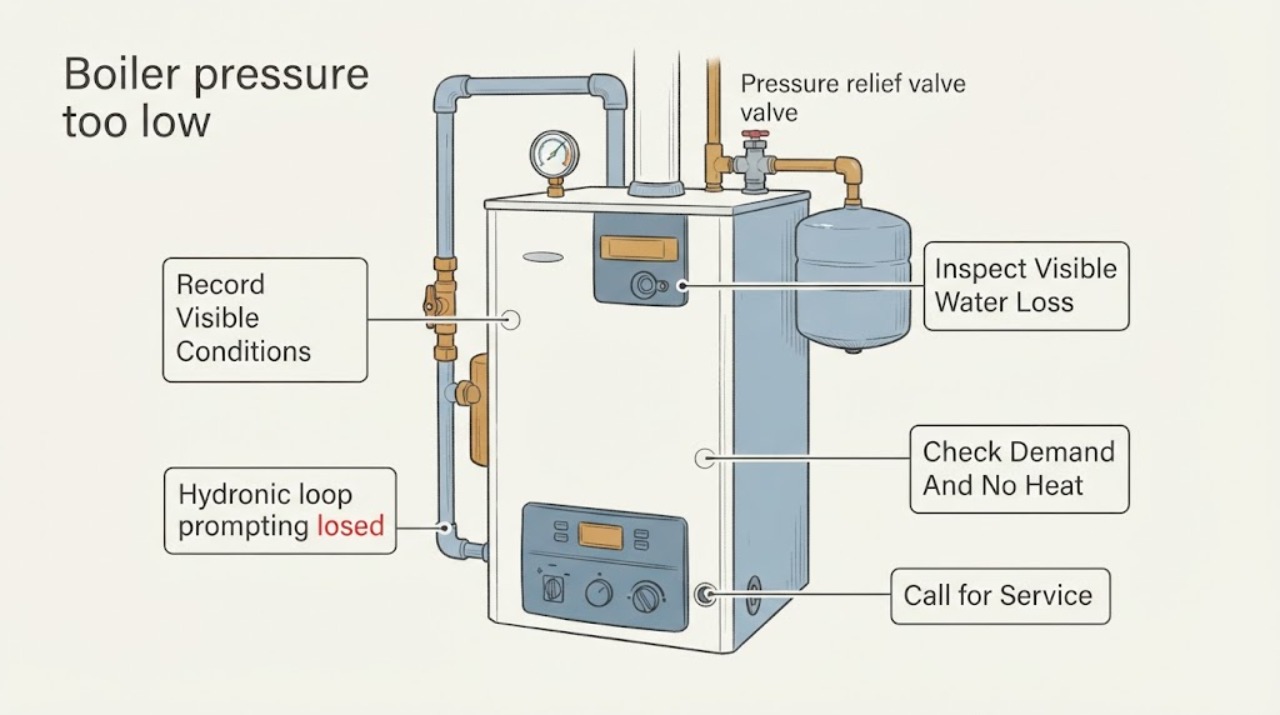
Work through in order
Diagnostic checks
Use only checks that match the exact appliance or system and its official guide.
-
Check 1
From a dry, safe position, read the Navien pressure or pressure-temperature gauge and record whether the boiler and heating loop are cool, actively heating, or recently off; do not touch hot piping or adjust any valve.
Expected result: The gauge may read low only when cool, remain low while heating, fall over time, rise sharply as the system heats, fluctuate, or disagree with a display message.
Next step: Photograph the gauge and display, compare only with the exact model manual, and keep the boiler unused or at its safe state if no heat or an error accompanies the reading.
Stop if: Stop for a rapidly changing reading, water discharge, scalding surface, leak, unusual noise, pressure-relief event, gas odor, exhaust concern, smoke, or carbon-monoxide alarm.
Why this matters
Why: A single reading cannot identify the fault. A persistent low reading suggests insufficient system water or a leak, while a large heat-related change makes expansion, air, circulation, or control conditions more likely. An inconsistent gauge or message needs verification rather than a guessed fill.
-
Check 2
Without opening the cabinet or moving insulation, visually inspect accessible boiler and heating-system piping, valves, circulators, automatic air vents, relief discharge area, manifolds, radiators, baseboards, and nearby flooring for fresh moisture or staining.
Expected result: There may be no visible water, a drip or wet fitting, a relief discharge, a damp floor or emitter, corrosion or staining, or water inside an inaccessible enclosure.
Next step: Keep the boiler in a safe off or standby state as appropriate, protect the area from slips, and arrange qualified service to find and correct the loss before any refill decision.
Stop if: Do not touch hot water, lift a relief-valve lever, tighten pressurized fittings, remove covers, or continue near flooding, electrical equipment, or a structural water-damage area.
Why this matters
Why: Visible or recurring water supports a leak or relief event as the reason for pressure loss. No visible water does not rule out a concealed leak, air vent issue, gauge problem, or a system-side loss. A relief discharge can involve hot water and overpressure history, not merely low fill.
-
Check 3
Check the thermostat or heating control for a valid heat call and note whether the Navien boiler fires, whether domestic hot water works, and whether one or all radiators, baseboards, or radiant zones are cold; do not change wiring or force a call.
Expected result: The thermostat may not call, the boiler may be in standby or lockout, domestic hot water may work while space heat does not, or the boiler may run while only one or all zones remain cold.
Next step: Record the exact pattern and leave the heating system closed to service if pressure is low or heat is absent; do not bleed, drain, refill, or bypass a low-pressure or safety control as a generic fix.
Stop if: Stop for a leak, pressure-relief discharge, hot-water release, gas or exhaust odor, abnormal combustion noise, smoke, or a carbon-monoxide alarm.
Why this matters
Why: A low-pressure display plus no heat can reflect a protected lockout or insufficient circulation, but a missing demand or a single cold zone may be a control or distribution issue. Hot water operation does not prove the space-heating loop is healthy.
-
Check 4
Read and photograph the front display, pressure warning, operating state, and any error message before attempting a reset; use only the exact model manual's permitted front-panel remedy and only once when no unsafe symptom is present.
Expected result: The display may show low pressure, normal standby, a heating cycle, a flow or sensor warning, a recurring lockout, or no display despite an accessible power source.
Next step: Follow the exact manual only for a basic user reset if allowed; if pressure remains low, the code returns, or heat does not recover, leave the boiler in the safe state and arrange Navien or licensed HVAC service.
Stop if: Do not repeatedly reset, alter installer parameters, bypass a low-water cutoff or sensor, remove the cover, or open the combustion area.
Why this matters
Why: A documented message can direct the technician to pressure, flow, temperature, ignition, or sensor checks, but it does not identify a homeowner-replaceable part. A recurring error or no display with confirmed power needs professional diagnosis.
-
Check 5
Record the Navien model and serial information, boiler or combi-boiler type, gauge reading and temperature state, display message, last service or refill, visible water, relief discharge, zone symptoms, and any gas or vent concern; do not order a pressure part from the reading alone.
Expected result: The history may show pressure loss after service, a recurring drop, pressure rise during heating, a single-zone circulation issue, a display lockout, or no obvious external loss.
Next step: Contact the original installer, a licensed hydronic HVAC professional, or a Navien Service Specialist and provide the records; ask for leak, pressure, expansion, circulation, and safety inspection before any refill or part replacement.
Stop if: Do not drain or refill the system, remove the relief valve, open a filter, alter gas or safety controls, or substitute a component by appearance.
Why this matters
Why: Possible causes include a system leak, relief or air-vent problem, expansion issue, fill-control problem, gauge fault, air or filter restriction, or a boiler or zone-control fault. The exact model and system layout determine which components and procedures apply.
Use your observations
Decision map
Find the observation that best matches what you see, then follow the next safe action.
-
PATH 01Safety boundary
What you see
The gauge is low and fresh water, staining, a leaking vent, a wet fitting, or relief discharge is visible in the boiler or heating loop.
Do this next
Keep the system in a safe state and arrange qualified service to locate and repair the leak or relief condition before deciding how to restore pressure.
Why this path and its safety boundary
Why it matters: A water loss or relief event is more likely than a simple gauge or setting issue, and refilling without correcting it can produce repeated loss or damage.
Safety stop: Do not tighten hot or pressurized fittings, operate the relief lever, drain the boiler, or keep adding water.
-
PATH 02Safety boundary
What you see
The gauge reads low but no external leak is visible and the boiler area appears dry.
Do this next
Record the reading and temperature state, keep the system unused if heat is absent, and arrange model-specific pressure and leak diagnosis rather than using a universal refill target.
Why this path and its safety boundary
Why it matters: A concealed system leak, automatic air vent, gauge error, recent service condition, or fill-control issue remains possible; a dry cabinet does not prove the loop is sound.
Safety stop: Do not remove covers, open vents, drain or refill, or assume that no puddle means no water loss.
-
PATH 03Safety boundary
What you see
The pressure returns only temporarily after an authorized or prior refill, then falls again or the low-pressure message returns.
Do this next
Stop repeating refills and arrange qualified service with the timing, readings, and visible leak observations recorded.
Why this path and its safety boundary
Why it matters: An unresolved leak, relief discharge, air-management issue, expansion problem, or fill-control fault is more likely than a one-time low reading.
Safety stop: Do not keep operating with repeated low pressure, bypass a low-water cutoff, or treat makeup water as the repair.
-
PATH 04Safety boundary
What you see
The gauge is low when cool but rises sharply while the boiler heats, or the relief discharge area becomes wet.
Do this next
Stop normal use if the pressure or discharge is abnormal and arrange qualified hydronic service to inspect expansion, relief, gauge, and system conditions.
Why this path and its safety boundary
Why it matters: Expansion-tank performance, air management, overfill, or a gauge or control issue is more likely than simple loss of fill. A relief event can be hot and hazardous.
Safety stop: Do not operate the relief lever, add more water, drain pressure, or touch hot discharge piping.
-
PATH 05Safety boundary
What you see
A low-pressure message appears with no heat, a lockout, cold emitters, or a boiler that does not respond to a valid thermostat demand.
Do this next
Photograph the message, leave the cabinet closed, and arrange Navien or licensed HVAC service; do not reset repeatedly or change pressure without the exact manual and diagnosis.
Why this path and its safety boundary
Why it matters: The unit may be protecting itself from inadequate water or flow, but thermostat, power, zone, circulator, filter, sensor, or another fault can produce a similar no-heat pattern.
Safety stop: Stop for leaks, hot-water discharge, gas or exhaust odor, smoke, unusual combustion noise, or a carbon-monoxide alarm.
-
PATH 06Safety boundary
What you see
Gas odor, a gas-leak sound, exhaust concern, soot, smoke, abnormal combustion, or a carbon-monoxide alarm occurs with the low-pressure complaint.
Do this next
Leave immediately for suspected gas leakage or a carbon-monoxide alarm, avoid operating electronics inside, and contact emergency or gas authorities from outside; have the boiler inspected before use.
Why this path and its safety boundary
Why it matters: This is a fuel or combustion safety event, not a pressure-adjustment task. Continued operation can expose occupants to fire or combustion products.
Safety stop: Do not reset, relight, adjust gas valves, inspect the vent, or re-enter until the relevant authority or qualified professional says it is safe.
Helpful context
Understand the symptom
A low gauge is a symptom, not a fill instruction
Navien systems may be heating-only boilers or combi-boilers with different piping and controls. A low reading can accompany a leak, air, an incorrect or drifting gauge, recent service, or an expansion or fill-control issue. Compare the reading with the exact model manual and installation record; do not apply a universal pressure number to every Navien installation.
Trace water before adding water
Look for fresh water around accessible boiler and heating pipes, valves, circulators, air vents, relief discharge piping, manifolds, radiators, baseboards, and floors. A hidden leak can lose pressure without leaving a large puddle. Repeatedly adding makeup water can conceal the cause and introduce minerals or air, so the source should be corrected by a professional.
Watch how pressure changes with temperature
Record the gauge when the system is cool and again only as a passive observation while the system operates normally; do not create a heating cycle just to test it. A low reading that falls further, a sharp rise as the boiler heats, or relief discharge points to different system conditions that need diagnosis rather than the same refill response.
No heat may be a circulation or control problem too
If the thermostat calls but the boiler remains idle, or the boiler fires while emitters stay cold, pressure is only one possible cause. Navien troubleshooting also distinguishes power, standby, heating demand, heating-side flow, and system filters. Do not bleed radiators, drain piping, open a filter, or adjust gas or safety controls without model-specific professional direction.
Safety boundary
Stop conditions
- Stop and obtain emergency or gas-authority help from outside for gas odor, a gas-leak sound, carbon-monoxide alarm, smoke, fire, soot, or a serious exhaust concern; do not operate electronics inside during a suspected gas leak.
- Do not use a universal pressure target, repeatedly add makeup water, drain, bleed, purge, or refill a Navien system as a generic response; the exact model manual and system design control any permitted refill procedure.
- Do not lift a pressure-relief valve lever, touch hot discharge, remove a relief valve, open a service port, or work inside the boiler cabinet; relief and pressure work belongs to qualified service.
- Do not bypass a low-water cutoff, sensor, lockout, or other safety control, and do not repeatedly reset a low-pressure or error condition after it returns.
- Arrange qualified Navien or licensed hydronic HVAC service for a persistent low reading, recurring pressure loss, visible leak, relief discharge, sharp pressure rise, no heat, cold zones, or an unexplained gauge or display message.
Only after diagnosis
Potential parts
- pressure gauge or pressure sensor
Consider this only when service verifies that the gauge or sensor is inaccurate or failed rather than reporting a real low-pressure condition.
Match the exact Navien model, sensor type, connection, control interface, and system configuration; a new gauge does not repair a leak or low fill. - expansion tank or relief valve assembly
Consider this only when diagnosis links pressure loss, discharge, or heat-related pressure rise to expansion or relief protection.
The assembly, discharge routing, pressure setting, and installation require qualified service; never choose or operate a relief part from appearance alone. - automatic air vent or heating-side filter
Consider this only when service confirms a leaking vent or restricted heating-side component is affecting pressure or circulation.
Match the exact model and installed piping, and follow safe isolation, temperature, pressure, refill, and purge procedures performed by qualified service. - fill-control valve or hydronic piping repair
Consider this only after diagnosis identifies a failed fill-control component or leak in the connected heating loop.
The repair depends on the system design, backflow protection, pressure controls, pipe materials, and local requirements; do not add water repeatedly while waiting.
When checks do not resolve it
Need a professional?
Arrange qualified Navien or licensed hydronic HVAC service when the pressure remains low, falls again, rises sharply when heating, triggers a warning, accompanies no heat or cold zones, follows a refill or service, or has any visible leak, wet relief discharge, or uncertain gauge reading. Do not use a generic fill value or repeatedly add water. For gas odor, a gas-leak sound, carbon-monoxide alarm, smoke, or fire, leave and contact emergency or gas authorities from outside before any boiler troubleshooting.
Safety scope: This article supports passive gauge and display observation, checking a thermostat demand, visually checking accessible areas for leaks, and recording the model and symptom history. A qualified technician should verify pressure, leak sources, expansion, relief protection, air management, pumps, valves, filters, sensors, gas, combustion, and controls, and perform any refill, drain, purge, or repair.
Common questions
FAQ
Can I just add water when my Navien boiler pressure is low?
Do not use a generic refill target or repeat refills without finding the cause. Record the gauge and check for visible leaks from a safe position; use only a refill procedure expressly permitted by the exact model manual and installation, or have a qualified technician perform it.
Why does boiler pressure drop again after it is restored?
A recurring drop can indicate a leak, relief discharge, air vent issue, expansion or fill-control problem, or an inaccurate gauge. Keep a record of the cool and heated readings and arrange hydronic service instead of continuing to add water.
Is low Navien boiler pressure the reason my radiators are cold?
It may be involved, but cold emitters can also result from a missing heat call, zone control, circulator, heating-side filter, air, sensor, or another system condition. Check the thermostat and display without opening the boiler, then arrange service for persistent low pressure or no heat.
Read the exact guide
Official sources
- FAQs | Residential Boilers | ResidentialNavien · Navien residential boiler FAQ used for general system mechanics and the homeowner service boundary; the exact model and piping system determine pressure settings and repairs.
- NHB-55H Ultra-High Efficiency Heating BoilerNavien · Navien product information for one heating-boiler family used to illustrate that pumps and zone controls are part of the heating system; it does not identify the user's model or a failed component.
- CPSC Issues Winter Weather Safety Tips to Prevent Fires and Carbon Monoxide PoisoningU.S. Consumer Product Safety Commission · CPSC household safety guidance used for the gas and combustion emergency boundary; it does not diagnose a Navien boiler or prescribe pressure work.
- NFC-H User's Information ManualNavien · Opened Navien NFC-H user and maintenance manual used for model-documented pressure and space-heating examples; the user's exact Navien model manual and installed hydronic design control settings and permitted actions.
Community feedback
Share a repair observation
Share a plain-text repair observation. Accepted observations are published automatically; this page may take a moment to update.