
On this page
Start here
Quick answer
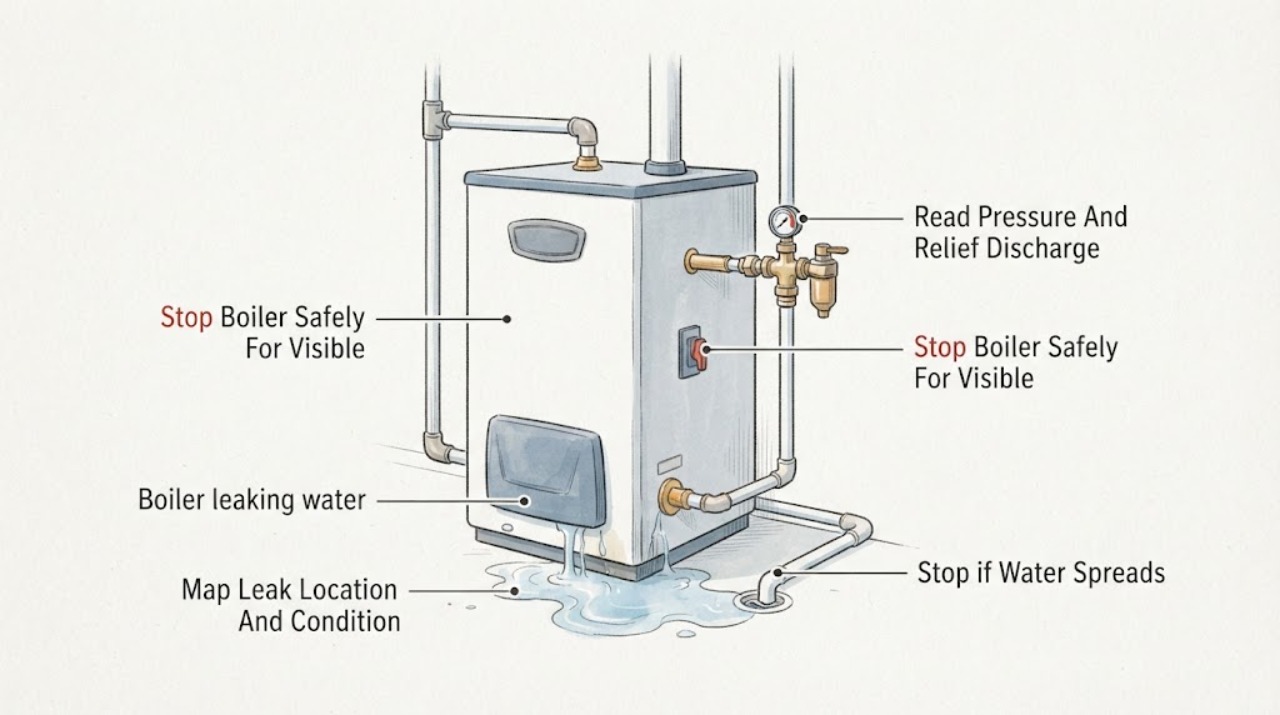
A leaking Peerless boiler may be losing water from a fitting, valve, pump, relief discharge, expansion or pressure problem, condensate drain, or the boiler vessel itself. From a safe position, note exactly where water starts, whether it is cool or near a hot surface, whether the pressure gauge is outside its normal marked range, and whether the leak appears only while the boiler fires or heats. Turn the thermostat off and use the accessible service switch to stop the boiler only when there is no gas, smoke, electrical, steam, or scalding hazard; do not open the cabinet, lift the relief-valve lever, add water, or adjust gas or pressure controls as a guess. Leave the system off and arrange qualified heating service for an active leak, rising or abnormal pressure, relief-valve discharge, water near electrical parts, a leak from the boiler body, or any gas odor or carbon-monoxide alarm.
Before you begin
Safety first
- This article supports safe visual tracing, reading an accessible gauge without touching controls, turning off a thermostat call or accessible service switch when no hazard prevents it, and documenting model and leak behavior. It does not authorize cabinet or burner access, gas or water-valve adjustment, pressure testing, relief-valve operation, refilling, condensate or vent disconnection, electrical testing, or boiler repair.
Work through in order
Diagnostic checks
Use only checks that match the exact appliance or system and its official guide.
-
Check 1
From a dry, stable position, use a flashlight to identify the first visible point of water around the Peerless boiler and accessible system piping. Do not remove panels or touch the boiler. Note whether the water comes from a threaded fitting, valve, pump area, relief discharge pipe, condensate tube, radiator or baseboard connection, the boiler jacket or floor beneath it, and whether the boiler is hot or running.
Expected result: Record a slow drip, a steady stream, water spraying, a puddle that is growing, staining or corrosion, water only during firing or heating, or water that continues while the boiler is off. Note whether water is near electrical wiring, the burner, or a flue connection.
Next step: Use the location and hazard branch below. If the flow is active, hot, near electrical parts, or the source cannot be traced safely, keep clear and arrange urgent qualified heating service.
Stop if: Do not touch hot water or steam, wipe around live electrical parts, remove the jacket, or keep the boiler firing while water is reaching the burner or controls.
Why this matters
Why: A fitting, valve, pump, radiator, or condensate connection is more likely when the first wet point is outside the boiler body. A leak that continues while off may be on the water side or a pressure-related discharge. Water from the jacket, heat-exchanger area, or a hidden location can indicate a boiler-vessel or internal fault and is not a homeowner repair.
-
Check 2
If there is no gas odor, smoke, flame abnormality, carbon-monoxide alarm, or immediate electrical or scalding hazard, turn the thermostat call off and use the accessible boiler service switch according to the owner's instructions. If the leak is active or hazardous, do not reach through water or around hot equipment; leave the area or call for emergency help as appropriate. Do not close or adjust gas, water, fill, or relief controls as a guess.
Expected result: Note whether the leak slows after the boiler stops, continues at the same rate, or becomes worse. Record any burner, pump, or control that remains on, and whether the boiler has an alert or lockout.
Next step: Keep the boiler off until a qualified professional evaluates the leak, especially when water is pooling, the pressure changes, or the source is internal. Do not restart it to see whether the leak returns.
Stop if: If gas is smelled, do not operate electrical switches or use a phone in the building; follow the gas supplier or emergency instructions from a safe location. Do not operate a boiler that has been under water.
Why this matters
Why: A leak that changes with firing or circulation may involve heated piping, a pump or valve seal, expansion, condensate, or a relief event. A leak that continues while cold and off may indicate stored system pressure, a supply-side leak, or a vessel or piping failure. Stopping the call does not make a pressure or hot-water leak safe.
-
Check 3
Without touching the relief-valve lever or removing any cap, read the boiler's accessible pressure gauge and visually inspect the end of the relief discharge pipe for fresh water. Compare the gauge only with the normal range or marked information for the exact Peerless model and installation; do not add water or adjust the fill valve to chase a number.
Expected result: Record pressure within the model's normal marked range, pressure above or below that range, a gauge that rises sharply as the boiler heats, water from the relief discharge, or no pressure reading. Note whether the discharge is hot and whether the relief pipe is blocked or improperly terminated.
Next step: Photograph or record the gauge and discharge location from a safe position, leave the boiler off if pressure is abnormal or water is discharging, and arrange qualified boiler service. Never cap, plug, isolate, or repeatedly test the relief valve.
Stop if: Do not lift the relief-valve lever, loosen fittings, open the fill valve, bleed radiators, or alter expansion or pressure controls while a leak is unresolved.
Why this matters
Why: Relief discharge or pressure that rises beyond the system's normal range can indicate expansion, fill, control, or relief-valve problems and requires professional diagnosis. Low or absent pressure can accompany water loss or a gauge fault. A dry relief pipe does not rule out a separate piping or vessel leak.
-
Check 4
For accessible external piping only, inspect joints, valves, pumps, radiators or baseboards, and condensate tubing for wetness, corrosion, a loose or disconnected section, or an obvious blockage. A high-efficiency condensing boiler may produce normal condensate, but recurring leakage, a damaged tube, or water at an unexpected joint needs service. Do not disconnect tubing, loosen unions, or remove insulation.
Expected result: Classify the first wet point as a system-piping joint, valve or pump seal, radiator or baseboard connection, condensate tube or trap, vent or air-intake area, or the boiler body. Note whether nearby floors, walls, electrical equipment, or combustible materials are wet.
Next step: Keep the system off when the leak is active or near electrical or combustion components and arrange qualified heating service. If the leak is a minor cool drip at an accessible connection, do not tighten it while pressurized or hot; document it for the technician.
Stop if: Do not open the burner cabinet, disconnect condensate components, clear a vent, tighten hot or pressurized fittings, or apply sealant as a temporary repair.
Why this matters
Why: An external connection or condensate path may be serviceable, but the source can be hidden behind insulation or inside the boiler. Water at a vent, combustion-air path, jacket, or electrical area raises safety and equipment concerns. A leak from a radiator or baseboard may be on the same closed heating circuit and can reduce boiler pressure.
-
Check 5
Arrange qualified heating or boiler service for any ongoing Peerless boiler leak, abnormal pressure, relief discharge, water from the boiler body, repeated low-water condition, or leak that returns after the system cools. Provide the model and serial information from a safe location, the first wet point, pressure-gauge behavior, whether the leak changes with firing, and any safety alert.
Expected result: The remaining possibilities include a fitting or valve seal, pump, relief valve, expansion or fill problem, condensate drain, heat exchanger or vessel, frozen or damaged piping, control issue, or venting or combustion-related condensate.
Next step: Have the professional isolate and repair the source, verify pressure and relief protection, inspect combustion and condensate paths when applicable, and confirm leak-free operation before returning the boiler to service.
Stop if: Do not refill repeatedly, bypass low-water or relief protection, alter gas controls, remove the boiler jacket, or restart it after a leak from an internal or electrical area.
Why this matters
Why: A Peerless boiler's visible water does not identify a safe replacement part. Pressure, heat, combustion, and closed-loop water conditions can make an apparently small leak a safety or property-damage issue.
Use your observations
Decision map
Find the observation that best matches what you see, then follow the next safe action.
-
PATH 01Safety boundary
What you see
Water is hot, flowing steadily, pooling near the burner or electrical controls, spraying, or coming from the boiler jacket, heat-exchanger area, or an inaccessible location.
Do this next
Keep people clear, stop operation only from a safe accessible control if no gas or electrical hazard prevents it, and arrange urgent qualified boiler service. Protect property only from a dry safe location; do not handle the leak.
Why this path and its safety boundary
Why it matters: Scalding, electrical, combustion, vessel, or major piping risk is more likely than a simple cool fitting drip. The boiler should not be operated to gather more information.
Safety stop: Do not touch hot water or steam, reach through pooled water, open panels, or restart the boiler.
-
PATH 02Safety boundary
What you see
Fresh water appears at the pressure-relief discharge, the pressure gauge rises sharply or exceeds the exact model's normal range, or pressure repeatedly falls after the system is refilled by a professional.
Do this next
Leave the boiler off, do not touch the relief lever or fill controls, and arrange qualified heating service to test pressure, expansion, relief protection, and the water circuit.
Why this path and its safety boundary
Why it matters: Expansion, fill, control, relief-valve, or system-leak problems are more likely. The relief device is a safety component and the discharge must not be blocked or treated as a routine drain.
Safety stop: Do not cap or isolate the relief pipe, open the fill valve, repeatedly reset the boiler, or operate it while pressure is abnormal.
-
PATH 03Safety boundary
What you see
The first wet point is a cool accessible fitting, valve, pump, radiator or baseboard connection, or condensate tube, with no gas, smoke, carbon-monoxide, electrical, or overflow hazard.
Do this next
Turn the heat call off if safe, do not tighten or disconnect the part while hot or pressurized, and arrange qualified service. Monitor the area from a safe distance and keep electrical equipment dry.
Why this path and its safety boundary
Why it matters: An external seal, connection, pump or valve, or condensate path is more likely than an internal boiler-vessel leak, but the water can still reduce system pressure and damage nearby materials.
Safety stop: Do not apply tape or sealant as a pressure repair, remove insulation, disconnect condensate tubing, or keep running the boiler while the drip grows.
-
PATH 04Safety boundary
What you see
There is gas odor, a carbon-monoxide alarm, smoke, flame abnormality, an exposed or blocked vent, or water has reached the burner or combustion controls.
Do this next
Do not light appliances or operate electrical switches in the odor area. Leave if needed, contact the gas supplier or emergency services from a safe location, and do not return the boiler to service until qualified personnel inspect it.
Why this path and its safety boundary
Why it matters: This is a fuel-burning appliance emergency or serious combustion/electrical hazard, not a routine leak-location check.
Safety stop: Do not attempt ignition, adjust gas controls, clear the vent, reset safety devices, or use the boiler after it has been under water.
Helpful context
Understand the symptom
Find the leak without opening the boiler
Water on the floor does not identify the failed part. It may travel from a threaded fitting, valve, pump, relief discharge, condensate tube, radiator or baseboard connection, or the boiler vessel before reaching the floor. First use a flashlight and a dry floor marker or towel from a safe distance to trace where water begins. Do not touch hot metal, steam, electrical parts, or the burner cabinet.
Pressure and relief discharge need professional judgment
A pressure relief valve can discharge when system pressure is too high, but it must not be capped, blocked, or repeatedly operated as a homeowner test. Pressure readings and normal ranges vary by Peerless model and system design. Record the gauge position and any water from the relief discharge without changing the fill valve, expansion tank, or relief setting.
A gas-fired boiler has a strict stop boundary
Peerless instructions reserve installation and service for qualified personnel and warn against unauthorized gas-control work. Gas odor, a carbon-monoxide alarm, smoke, flame abnormality, or water reaching electrical equipment requires immediate safety action and professional help. A boiler that has been under water should not be restarted until inspected.
Safety boundary
Stop conditions
- Leave the area and follow gas-supplier or emergency guidance for gas odor, smoke, a carbon-monoxide alarm, flame abnormality, or suspected combustion problem; do not operate electrical switches in the odor area.
- Keep the Peerless boiler off and arrange urgent qualified service for hot or active water flow, water near electrical or burner controls, a leak from the boiler body, a rapidly rising or abnormal pressure gauge, or relief-valve discharge.
- Do not open the boiler jacket or burner cabinet, adjust gas controls, bypass low-water or relief protection, lift the relief lever, open the fill valve, or repeatedly refill or reset the system.
- Do not tighten hot or pressurized fittings, disconnect condensate or vent components, apply sealant as a pressure repair, or operate a boiler that has been under water.
- Arrange qualified heating service for any recurring leak, water loss, low-water condition, abnormal pressure, corrosion, condensate problem, or leak that cannot be traced from a safe dry position.
Only after diagnosis
Potential parts
- boiler safety relief valve
Consider this category only when qualified testing confirms the relief valve leaks or is not functioning correctly after pressure and expansion causes are evaluated.
Match the exact Peerless boiler model, system design, valve rating, discharge requirements, and approved installation; never cap or substitute a relief valve by appearance. - boiler expansion or fill-control component
Consider this category only when a qualified professional confirms abnormal pressure or water loss is caused by an expansion, fill, or related control component.
Verify the Peerless model, hydronic system design, pressure settings, and manufacturer-approved component before replacement; do not adjust pressure as a guess. - boiler fitting, valve, pump seal, or gasket
Consider this category only when the first wet point and a qualified inspection identify a specific external connection, valve, pump seal, gasket, or approved service part as the leak source.
Match the exact model, connection size, temperature and pressure requirements, material, and service instructions; do not use sealant or a generic part as a pressure repair. - condensate trap or drain component
Consider this category only for a condensing Peerless model when a qualified inspection confirms a cracked, blocked, disconnected, or failed condensate component.
Confirm the exact model, condensate routing, materials, termination, and approved service method before replacement; do not disconnect or modify the drain as a homeowner test.
When checks do not resolve it
Need a professional?
Arrange qualified heating or boiler service for any recurring or active Peerless boiler leak, water from the boiler body, a relief-valve discharge, abnormal or rapidly rising pressure, water near electrical or combustion components, a condensate or venting leak, or a leak that causes low-water shutdown. Treat gas odor, smoke, a carbon-monoxide alarm, flame abnormality, scalding flow, flooding, or a boiler that has been under water as urgent safety conditions.
Safety scope: This article supports safe visual tracing, reading an accessible gauge without touching controls, turning off a thermostat call or accessible service switch when no hazard prevents it, and documenting model and leak behavior. It does not authorize cabinet or burner access, gas or water-valve adjustment, pressure testing, relief-valve operation, refilling, condensate or vent disconnection, electrical testing, or boiler repair.
Common questions
FAQ
Where can a leaking Peerless boiler lose water?
Water may begin at an external fitting, valve, pump, radiator or baseboard connection, relief discharge, condensate tube, or the boiler vessel itself. Trace the first wet point from a safe dry position without opening the cabinet or touching hot surfaces. A leak from the jacket, heat-exchanger area, or an inaccessible location needs qualified service.
Should I turn off a Peerless boiler that is leaking?
If there is no gas, smoke, electrical, scalding, or other immediate hazard, turn off the heat call and use the accessible service switch according to the owner's instructions. Do not reach through water or around hot equipment. For gas odor, a carbon-monoxide alarm, active hot flow, water near controls, or flooding, follow emergency guidance and arrange urgent qualified service.
What if water is coming from the boiler pressure relief pipe?
Do not cap the pipe, lift the relief lever, or open the fill valve. Record the accessible pressure gauge and whether the discharge is hot, leave the boiler off if pressure is abnormal or water continues, and arrange qualified service to evaluate expansion, fill, pressure, and relief protection. The correct pressure range depends on the exact model and system.
Can a Peerless condensing boiler normally make water?
A high-efficiency condensing boiler can produce condensate, but recurring leakage, a damaged or disconnected condensate tube, water at an unexpected joint, or a blocked drainage path needs professional evaluation. Do not disconnect or modify the condensate system as a test, and keep water away from electrical and combustion components.
Should I keep refilling a leaking Peerless boiler?
No. Repeated refilling can conceal ongoing water loss and change system pressure while the cause remains unresolved. Record the leak and gauge behavior, leave the boiler off when pressure is abnormal or water is active, and arrange qualified heating service. Do not adjust gas, fill, expansion, or safety controls as a guess.
Read the exact guide
Official sources
- Peerless Combi 160 Boiler Installation, Operation & Maintenance ManualPeerless Boilers / PB Heat, LLC · Official Combi 160 manual used for model-specific examples and safety boundaries; other Peerless models can differ.
- DE Boilers Series Gas Installation, Operation & Maintenance ManualPeerless Boilers / PB Heat, LLC · Official Peerless DE series manual; pressure ranges, components, and procedures vary by model and installation.
- Boiler FAQs & Common QuestionsWeil-McLain · Weil-McLain manufacturer FAQ used for a general service boundary; Peerless model-specific procedures remain controlling.
- Boiler Winter Maintenance ChecklistWeil-McLain · Weil-McLain general boiler maintenance guidance used for cross-manufacturer diagnostic categories; Peerless model instructions control for Peerless-specific work.
Community feedback
Share a repair observation
Share a plain-text repair observation. Accepted observations are published automatically; this page may take a moment to update.