
On this page
Start here
Quick answer
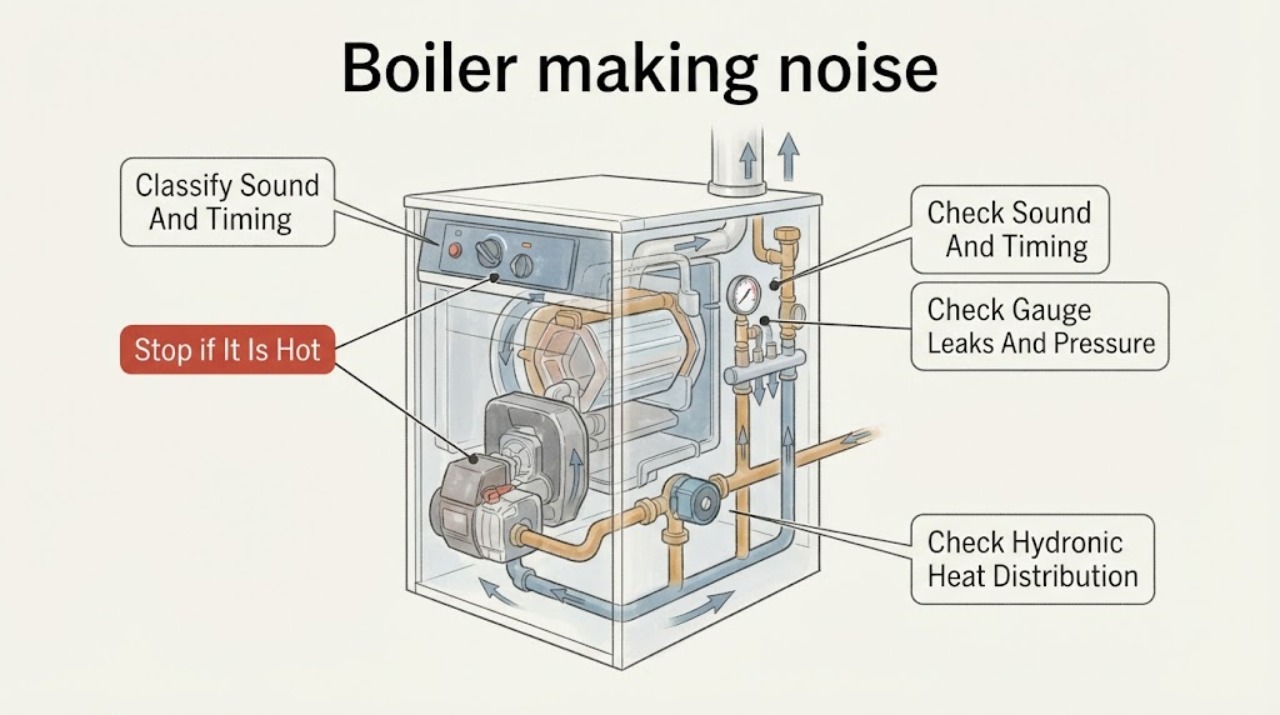
A noisy Peerless boiler can be producing water-flow noise from air or excessive velocity, a circulator or other moving-part sound, expansion or pressure-related banging, or a combustion, venting, ignition, or control fault. First identify whether the sound is a bang, gurgle, hiss, hum, vibration, roar, delayed ignition, or relief-valve discharge and whether it comes from the boiler, pump, pipes, radiators, or vent. From a safe position, record the pressure/temperature gauge, visible leaks, heat distribution, display alerts, and accessible vent or condensate condition; do not open the boiler or adjust gas, controls, relief devices, or internal water components. Turn the boiler off and obtain qualified heating service for gas or flue odor, smoke, rollout, repeated lockout, water near electrical parts, rapidly changing pressure, relief discharge, or a new hard bang or ignition noise.
Work through in order
Diagnostic checks
Use only checks that match the exact appliance or system and its official guide.
-
Check 1
From a safe position, listen during a normal call for heat and note whether the Peerless boiler noise occurs at ignition, while the burner runs, when the circulator starts, as radiators heat, when the burner stops, or after the call ends. Identify whether it is a bang, pop, roar, gurgle, hiss, hum, rattle, or vibration.
Expected result: Record a bang or pop at ignition, a gurgle in pipes or radiators, a steady pump hum, a rattle at the cabinet or piping, a hiss, a relief-valve discharge, or a sound with flame rollout, smoke, gas odor, or flue odor.
Next step: Record the timing and turn the boiler off for a hard bang, abnormal ignition, odor, smoke, rollout, or worsening vibration. Continue only with visual checks when the sound is mild and no warning sign is present.
Stop if: Stop immediately for gas or flue odor, smoke, flame outside the burner area, a carbon-monoxide alarm, water near electrical equipment, a strong hiss, relief discharge, or an abrupt worsening sound.
Why this matters
Why: Ignition-linked noise makes combustion, draft, gas, or burner timing more relevant. Gurgling and pipe noise make air or flow more likely. A pump-linked hum or vibration makes the circulator or mounting relevant. A hiss, discharge, odor, smoke, or rollout is a safety boundary rather than a home diagnosis.
-
Check 2
From a safe position and without touching hot piping, read the Peerless pressure/temperature gauge if fitted and look around accessible boiler piping, valves, pumps, radiators, and baseboards for water, staining, corrosion, or relief-valve discharge. Compare the reading with the model manual rather than using a generic target.
Expected result: Record a stable reading in the model's normal range, a reading that rises or falls noticeably during a cycle, a low or high reading, recurring water, a wet relief outlet, or no gauge that can be read safely.
Next step: Leave the boiler off and request qualified service for an abnormal trend, recurring leak, relief discharge, or any pressure reading outside the model guidance. Do not add water, bleed the system, adjust the relief valve, or alter fill controls as a noise remedy.
Stop if: Do not touch hot water, relief-valve hardware, valves, electrical parts, or leaking connections; stop if water approaches electrical equipment or steam is present.
Why this matters
Why: Pressure movement with banging, relief discharge, or leaks makes expansion, fill, air, circulation, or piping trouble more likely. A stable gauge does not rule out air, flow, circulator, burner, venting, or control noise. A wet or corroded area needs service even if the noise is intermittent.
-
Check 3
After the system has operated only if no safety warning is present, walk through the heated zones and note whether radiators, baseboards, or radiant zones warm evenly. Listen from a safe distance for gurgling or rushing in particular pipes and note any zone that stays cold while others heat.
Expected result: Record even heat with no water-side sound, one zone with gurgling and poor heat, several zones with air-like noise, a circulator hum with no heat movement, or visible leakage near an emitter.
Next step: Record the affected zone and turn the boiler off for persistent noise, no circulation, leaks, or hot-water concerns. Do not purge loops, open manual vents, adjust balancing valves, or remove a circulator cover unless a qualified technician directs the work.
Stop if: Do not touch hot radiators, piping, vents, pumps, or valves, and do not open a drain or vent where hot water or steam could escape.
Why this matters
Why: Gurgling plus a cold zone makes trapped air or circulation trouble more likely than a burner sound. A pump hum with no heat response makes circulator, valve, flow, or control trouble relevant. Uneven heat with leaks needs system service, not repeated thermostat changes.
-
Check 4
From outside the boiler enclosure, inspect only accessible vent and combustion-air piping, exterior terminations, and condensate tubing when the Peerless model uses them. Look for an obvious blockage, separation, corrosion, water, or damage; check the display for an alert without opening the cabinet.
Expected result: Record clear intact piping, a blocked or damaged termination, a loose joint, condensate leakage or blockage, an alert or lockout, or a sound that starts with the vent fan or burner.
Next step: Turn the boiler off and request qualified heating service for a blockage, separation, damage, leak, alert, lockout, or burner-linked noise. Do not clear internal passages, disconnect tubing, reset a lockout repeatedly, or adjust draft or gas settings.
Stop if: Do not enter the combustion chamber, remove a jacket or vent, handle a pressure switch, alter gas piping, or operate with a blocked, damaged, or disconnected vent.
Why this matters
Why: A vent, combustion-air, condensate, or alert issue can cause abnormal burner or fan sounds and unsafe operation. A clear exterior does not prove the vent, pressure switch, draft, burner, or heat exchanger is healthy.
-
Check 5
Prepare a service record with the Peerless model if visible from ordinary access, fuel type if known, sound description and location, ignition or pump timing, gauge trend, leaks, zone heat response, vent or condensate observations, display alerts, and recent work or water refill.
Expected result: Confirm that the record contains external observations only and that no boiler panel, burner, gas valve, relief device, pump, vent, wiring, or control was disturbed.
Next step: Arrange qualified Peerless boiler service for a new, persistent, or unexplained noise. Keep the boiler off when any stop condition is present and provide the record to the technician.
Stop if: Do not continue operating a boiler with gas or flue odor, smoke, rollout, repeated lockout, relief discharge, rapidly changing pressure, or water near electrical components.
Why this matters
Why: The combined timeline helps a technician separate air and flow noise from circulator, pressure, ignition, venting, combustion, or control faults without asking the owner to make a hazardous internal diagnosis.
Use your observations
Decision map
Find the observation that best matches what you see, then follow the next safe action.
-
PATH 01Next step
What you see
The sound is gurgling, rushing, or knocking in radiators or pipes; one or more zones heat unevenly; and the gauge or accessible piping shows no immediate leak or dangerous pressure event.
Do this next
Arrange qualified heating service to evaluate air removal, vents, pump location, flow, and balance. Do not purge hot water or adjust valves as a trial.
Why this path and its safety boundary
Why it matters: Air in the hydronic circuit, excessive water velocity, system balance, or circulation trouble is more likely than a burner fault. Peerless identifies air bubbles and excessive velocity as flow-noise causes.
-
PATH 02Next step
What you see
A hum, rattle, or vibration starts when the circulator operates, heat movement is weak or absent, or the sound follows a pump or pipe connection rather than burner ignition.
Do this next
Turn the boiler off if heat is not circulating, the sound is worsening, or water is present, and request qualified diagnosis of the pump and hydronic circuit.
Why this path and its safety boundary
Why it matters: A circulator, valve, mounting, bearing, air pocket, low-flow, or piping issue becomes more likely. A stable thermostat call does not establish that the pump is moving water correctly.
-
PATH 03Next step
What you see
Banging or hissing occurs with a pressure trend, relief-valve discharge, recurring water, corrosion, or a cold or overfilled-looking system area.
Do this next
Leave the boiler off and arrange qualified service. Do not add water, drain, reset the relief valve, or alter expansion-tank or fill settings.
Why this path and its safety boundary
Why it matters: Expansion, fill, air-removal, relief, or piping trouble is more likely and can damage the boiler or release hot water. The gauge must be interpreted against the exact Peerless model guidance.
-
PATH 04Next step
What you see
The noise is a bang, pop, roar, or delayed ignition sound at burner start, or it occurs with a vent alert, blocked termination, gas or flue odor, smoke, rollout, or repeated lockout.
Do this next
Turn off the boiler and obtain qualified heating service. Leave the area and follow local emergency guidance for a strong gas odor, smoke, or a carbon-monoxide alarm.
Why this path and its safety boundary
Why it matters: Ignition, gas, draft, combustion-air, pressure-switch, venting, or safety-control trouble is more likely than water-side air. Peerless troubleshooting places these checks inside professional boiler diagnostics.
-
PATH 05Next step
What you see
The boiler remains warm and operates without a visible leak or alert, but a new noise persists after the location, timing, gauge, zone, and exterior vent observations are recorded.
Do this next
Stop repeated restarts and request qualified Peerless boiler inspection, giving the sound recording or written timing and all observed system changes.
Why this path and its safety boundary
Why it matters: A concealed burner, heat-exchanger, pump, control, piping, or mounting problem remains possible. A lack of a visible warning does not make continued trial operation a repair.
Helpful context
Understand the symptom
The sound location separates water-side and combustion clues
A gurgle or rushing sound in radiators and pipes is more consistent with air or flow. A pump hum or vibration points toward a circulator or mounting issue. A bang at burner start, a roar, or a flue-related sound needs combustion and venting attention. A hiss near a relief valve, pipe joint, or vent has a different risk from a quiet expansion ping. Record the location and timing without putting hands near hot surfaces, burners, fans, pumps, or vent parts.
Air and flow problems can make a hydronic system noisy
Peerless describes water-system flow noise as air bubbles carried in the water or excessive velocity through pipes and valves. Its guidance points to air removal, purging, venting, and system balance as technical remedies. Those operations can release hot water or alter pressure, so the homeowner should record the symptom and visible gauge or leak condition rather than purge the boiler or adjust valves without qualified instruction.
Peerless manuals set a professional service boundary
Peerless states on its residential boiler product pages that its installation manuals and technical literature are intended for professional installers and that installation or maintenance techniques should not be attempted by homeowners. The safe home contribution is a visual and auditory record: model, sound, pressure trend, leaks, heat response, alerts, and any gas or flue warning. A qualified technician can then inspect combustion, venting, water flow, controls, and safety devices.
Only after diagnosis
Potential parts
- air-removal or hydronic vent component
Consider only after qualified diagnosis confirms trapped air or a failed air-removal component is causing the water-side noise.
Match the exact Peerless boiler, system pressure, temperature, piping arrangement, and local code requirements; do not select a vent by thread size alone. - circulator pump
Consider only after testing confirms a circulator or pump-related fault rather than air, valve, control, or piping restriction.
Confirm required flow, head, voltage, control method, flange or connection dimensions, and system configuration with a qualified technician. - expansion tank
Consider only when qualified evaluation links pressure rise, relief discharge, or expansion symptoms to a failed or incorrectly sized tank.
Confirm system volume, heating medium, cold-fill pressure, tank connection, and model requirements before selection or installation.
When checks do not resolve it
Need a professional?
Arrange qualified Peerless boiler service for any new or persistent bang, gurgle, hum, hiss, vibration, or burner-linked noise, especially with uneven heat, leaks, pressure movement, alerts, or lockout. Turn the boiler off for gas or flue odor, smoke, rollout, carbon-monoxide alarm, relief discharge, rapidly changing pressure, water near electrical parts, or a worsening ignition sound. Do not open the boiler, adjust gas or draft, purge hot water, change safety controls, or reset a lockout repeatedly.
Have this ready
- Give the technician the Peerless model if visible, fuel type if known, sound type and location, ignition or pump timing, gauge trend, leaks or relief discharge, zone heat response, vent and condensate observations, display alerts, recent refill or service, and any gas or flue warning.
Common questions
FAQ
Why is my Peerless boiler gurgling or making water-flow noise?
Air bubbles in the hydronic circuit or excessive water velocity through pipes and valves can make gurgling or rushing sounds. Uneven heat or a cold zone supports that direction, but purging and balancing can release hot water and should be handled by qualified service.
What does a bang or pop when the Peerless boiler starts mean?
An ignition-linked bang or pop can involve burner timing, gas, draft, combustion air, venting, or a safety control. Turn the boiler off for repeated or hard ignition noise, odor, smoke, or rollout and obtain qualified heating service.
Should I add water or bleed the radiators to stop boiler noise?
Do not add water, drain the system, or open a vent as a first response. Record the gauge, leaks, and affected zones. Pressure and hot-water work can create scalding or equipment risks, and the correct remedy depends on the Peerless system design.
When is a noisy boiler an emergency?
Stop the boiler and leave the area as appropriate for a strong gas or flue odor, smoke, flame outside the burner area, carbon-monoxide alarm, relief discharge, water near electrical parts, or a severe worsening ignition sound. Follow local emergency guidance and arrange qualified service.
Read the exact guide
Official sources
- Installation Survey – WaterPeerless Boilers / PB Heat · Peerless water-system survey used for general hydronic symptom interpretation; its installation and adjustment procedures are not homeowner repair instructions.
- Series WBV®Peerless Boilers / PB Heat · Peerless product page used as a second model-family confirmation that homeowner maintenance techniques are outside the published boundary.
- TroubleshootingPeerless Boilers / PB Heat · Peerless boiler manual used for symptom categories and professional boundaries; the exact procedure depends on the boiler model.
- Water Piping & ControlsPeerless Boilers / PB Heat · Peerless PBC model-family guidance used for general water-side reasoning only; pressure and flow values are not generalized to other models.
- Series 63™ BoilerPeerless Boilers / PB Heat · Peerless product page used to establish the professional service boundary; it is not a diagnosis for every Peerless boiler model.
Community feedback
Share a repair observation
Share a plain-text repair observation. Accepted observations are published automatically; this page may take a moment to update.