
On this page
Start here
Quick answer
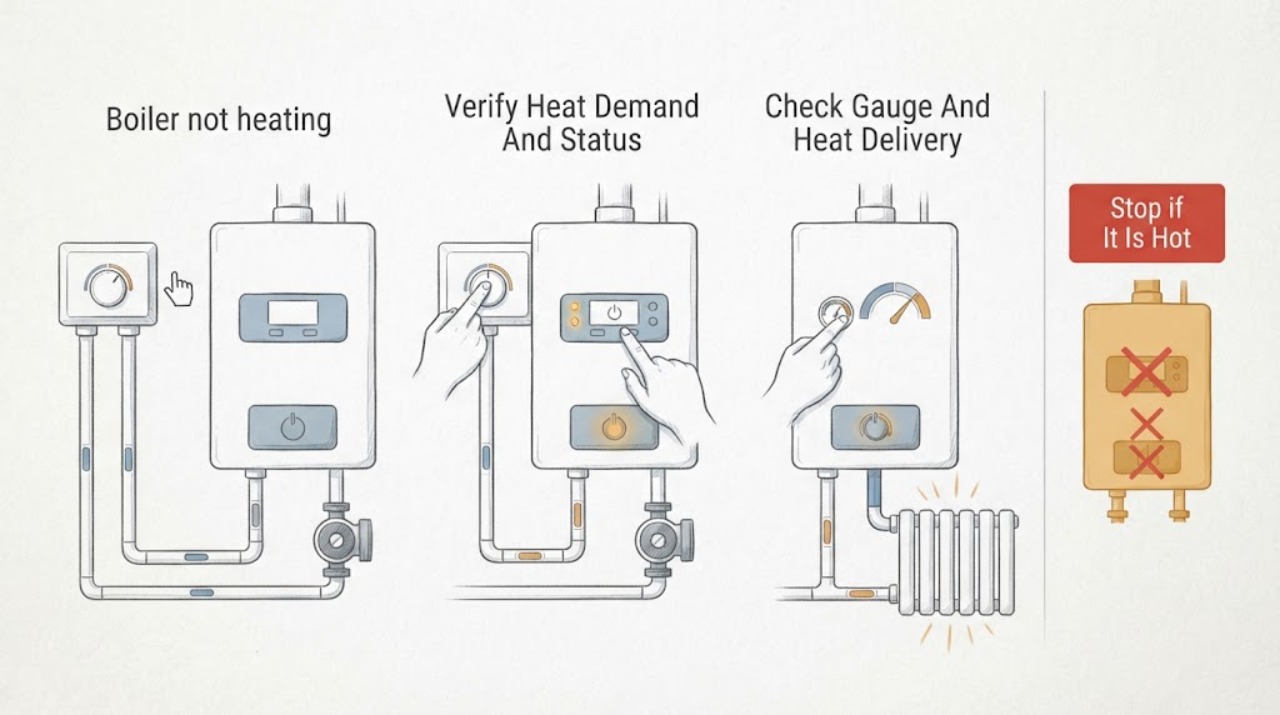
When a Peerless boiler is not heating, first determine whether the thermostat is calling, whether the boiler has power and an alert, whether the burner starts, and whether hot water reaches the heating zones. A no-heat condition can come from a thermostat or control demand problem, loss of power or fuel, a limit or low-water safety response, air or a circulation blockage, circulator failure, ignition or venting trouble, or a clogged system. From safe external access, record the thermostat call, boiler display, gauge trend, burner response, radiator or baseboard heat, visible leaks, and accessible vent or condensate condition. Do not open the boiler, adjust gas or combustion settings, purge hot water, reset a safety repeatedly, or bypass a control. Turn the boiler off and obtain qualified heating service for gas or flue odor, smoke, rollout, carbon-monoxide alarm, water near electrical parts, repeated lockout, abnormal pressure, or a burner that lights and shuts down.
Work through in order
Diagnostic checks
Use only checks that match the exact appliance or system and its official guide.
-
Check 1
Set the thermostat to the normal heating mode and a modestly higher target only if it is safe to do so, then read the thermostat and Peerless display from the outside. Record whether there is a heat call, whether the boiler shows demand or standby, and whether any alert or lockout is visible.
Expected result: Record no heat call, a heat call with standby, a heat call with a burner or pump state, an alert or lockout, a blank display, or a thermostat that is unresponsive or repeatedly resetting.
Next step: Correct only an obvious thermostat mode or schedule error. If the call is present but no heat is produced, keep the record and continue with external checks; do not remove the control cover or reset a lockout repeatedly.
Stop if: Stop for smoke, gas or flue odor, a carbon-monoxide alarm, exposed or hot wiring, water near electrical parts, flame outside the burner area, or repeated lockout.
Why this matters
Why: No demand makes the thermostat, schedule, zone control, or call wiring more likely. A demand with standby can mean the boiler temperature is already above its operating band or a limit is active. A demand with an alert, lockout, blank display, or repeated reset points toward a power, control, ignition, or safety issue.
-
Check 2
From a dry position, check whether the boiler's normal power switch and display appear on, and note whether a known heating circuit breaker or service switch is off or has tripped. If the fuel supply has an external user-accessible shutoff and its state is clearly marked, record its position without manipulating gas controls.
Expected result: Record a normal display and switch, a dark display, a tripped breaker or off service switch, a fuel shutoff that appears closed, or a repeated trip, odor, scorch mark, or unusual warmth.
Next step: Restore only an obvious switched-off service switch if it was accidentally turned off and no warning exists; do not repeatedly reset a breaker or change a fuel-valve position. Arrange qualified service when power or fuel status is uncertain or the fault returns.
Stop if: Do not open an electrical panel, touch exposed conductors, reset a breaker after a repeat trip, operate a gas control, or continue near a gas odor, smoke, heat, or damaged enclosure.
Why this matters
Why: A dark display or off supply can explain no heat, but a breaker trip, scorch mark, warmth, or odor can indicate an unresolved electrical fault. A closed fuel valve can prevent firing, while any gas odor or uncertain fuel condition requires immediate professional or utility guidance.
-
Check 3
Without touching hot piping, read the pressure and temperature gauge if fitted and walk through accessible radiators, baseboards, or radiant zones. Note whether the boiler becomes warm, whether one zone or all zones remain cold, and whether the gauge changes noticeably during a heat call.
Expected result: Record a boiler that stays cold, a hot boiler with cold emitters, one cold zone, all zones cold, a stable gauge, rapidly changing pressure, or a visible leak or relief discharge.
Next step: Keep the boiler off and request qualified diagnosis for abnormal pressure, leaks, relief discharge, or persistent no-heat. Do not add water, drain, bleed, adjust the relief valve, or interpret a generic pressure number outside the model manual.
Stop if: Do not touch hot water, relief hardware, vents, pumps, valves, or leaking connections; stop if water or steam approaches electrical equipment.
Why this matters
Why: A cold boiler with a heat call makes demand, power, fuel, limit, ignition, or control trouble more likely. A warm boiler with cold zones makes a circulator, air, valve, flow, priority, or blocked-circuit issue more likely. Pressure movement, leakage, or relief discharge adds an expansion or water-side safety concern.
-
Check 4
From safe access, compare the zone response and listen for gurgling, rushing, or a circulator hum during a heat call. Look for accessible manual or automatic air-vent leakage without opening or adjusting a vent, and note whether the boiler runs while no hot water reaches a zone.
Expected result: Record gurgling with a cold zone, a steady circulator hum with no heat movement, no pump sound, several zones cold, air-vent leakage, or normal circulation with no room heat.
Next step: Request qualified hydronic service for air, pump, valve, or flow symptoms. Do not purge loops, open vents, remove pump covers, or change balancing or zone-valve settings while the system is hot or pressurized.
Stop if: Stop for hot-water leakage, steam, a seized or vibrating pump, a loose electrical cover, or any condition that requires reaching inside the boiler or piping enclosure.
Why this matters
Why: Gurgling and a cold zone make trapped air or flow trouble more likely. A pump sound without heat movement can still involve a failed pump, valve, air pocket, or blocked circuit. Normal circulation with a cold room makes emitter, balance, insulation, control, or capacity problems more relevant than a simple thermostat error.
-
Check 5
Inspect only accessible vent, combustion-air, and condensate piping from outside the boiler cabinet. Look for an obvious blockage, disconnection, corrosion, leakage, or condensate issue, and record any alert, lockout, burner start-and-stop, or unusual flame or fan sound without opening the cabinet.
Expected result: Record clear intact piping, a blocked or disconnected termination, water or condensate leakage, an alert or lockout, burner ignition followed by shutdown, or gas or flue odor.
Next step: Turn the boiler off and obtain qualified heating service for any blockage, disconnection, leak, alert, lockout, or abnormal burner sequence. For a carbon-monoxide alarm, smoke, or strong gas odor, leave the area and follow local emergency guidance.
Stop if: Do not clear internal vent passages, adjust gas or draft, remove a jacket, open a burner compartment, bypass a limit or pressure switch, or reset a safety repeatedly.
Why this matters
Why: A vent, combustion-air, condensate, ignition, pressure-switch, or limit issue can keep the boiler from heating even when the thermostat calls. Gas or flue odor, flame rollout, or repeated ignition shutdown is a safety condition, not a homeowner adjustment.
Use your observations
Decision map
Find the observation that best matches what you see, then follow the next safe action.
-
PATH 01Next step
What you see
The thermostat does not show a heat call, or it shows a call while the Peerless control remains in standby with no alert and the boiler temperature appears above its operating band.
Do this next
Correct only an obvious thermostat setting and allow one normal response. If the call remains ignored or the boiler does not heat, request qualified control and boiler diagnosis.
Why this path and its safety boundary
Why it matters: A thermostat schedule, zone demand, control input, or normal temperature differential is more likely than a failed burner. A call with standby can also involve limit or control state.
-
PATH 02Next step
What you see
The thermostat calls, the display is dark or shows a lockout, a breaker or service switch is off, or the burner does not start; especially if the condition follows a trip or outage.
Do this next
Do not keep resetting protection or opening the boiler. Leave it off when the fault returns and arrange qualified heating service; provide the display, switch, and trip timeline.
Why this path and its safety boundary
Why it matters: Power, low-voltage control, fuel, ignition, limit, or other safety interruption is more likely. The owner cannot confirm line voltage, gas pressure, or safety-switch operation from the display.
-
PATH 03Next step
What you see
The boiler fires or becomes hot, but one or more radiators, baseboards, or heating zones remain cold; gurgling, a pump sound, a closed-looking valve, or a pressure change may also be present.
Do this next
Request qualified hydronic service to test flow, air removal, pump, valves, and controls. Do not bleed, purge, drain, or adjust hot or pressurized components.
Why this path and its safety boundary
Why it matters: Air, circulator, zone valve, control priority, low flow, or a clogged hydronic circuit is more likely than a thermostat setting. A pump sound alone does not prove circulation.
-
PATH 04Next step
What you see
The burner tries to start and stops, ignition is delayed, a vent or combustion-air path looks blocked or disconnected, an alert or lockout repeats, or gas or flue odor is present.
Do this next
Turn the boiler off and obtain qualified heating service. Leave the area for smoke, strong gas odor, or a carbon-monoxide alarm and follow local emergency guidance.
Why this path and its safety boundary
Why it matters: Ignition, gas, draft, combustion-air, pressure-switch, venting, or safety-control trouble is more likely than a simple no-demand problem.
-
PATH 05Next step
What you see
The gauge changes abnormally, water appears at the boiler, piping, pump, radiator, or relief outlet, the boiler has been wet, or pressure symptoms accompany no heat.
Do this next
Keep the boiler off and arrange qualified service. Do not add water, drain, open relief hardware, or use a boiler or control that has been under water.
Why this path and its safety boundary
Why it matters: A leak, expansion, fill, air-removal, relief, or water-side failure may be preventing safe operation and can damage controls or property.
Helpful context
Understand the symptom
Start with the heat demand, not the burner cabinet
A thermostat can show a call for heat while the boiler remains in standby, or the boiler can run while a circulator or zone valve fails to move heat. The first useful split is whether there is a demand, whether the control acknowledges it, whether the burner fires, and whether the emitters warm. Peerless control guidance uses demand, burner state, pump state, power, and limit status to separate these paths; those readings are observations for service, not permission to open the control.
A hot boiler with cold rooms can still have a water-side fault
If the boiler fires but radiators, baseboards, or zones stay cold, air, a failed circulator, a closed or failed zone valve, a clogged circuit, or control priority can interrupt heat delivery. If the boiler never fires, the call, power, fuel, limit, ignition, or venting path becomes more relevant. Do not assume the thermostat is the cause just because the room is cold.
Peerless service literature is not a homeowner repair procedure
Peerless product documentation states that installation and maintenance techniques in its manuals are intended for professional installers and should not be attempted by homeowners. A homeowner can safely supply the model, fuel type, display state, gauge trend, zone response, visible leak or vent observations, and the timeline of the no-heat event. A qualified technician must test the burner, gas, electrical, venting, water, and safety circuits.
Only after diagnosis
Potential parts
- circulator pump
Consider only after qualified testing confirms that the pump is not moving heat or has an electrical or mechanical fault rather than an air, valve, control, or flow restriction.
Confirm required flow, head, voltage, control method, connection dimensions, and system configuration with a qualified technician. - air-removal component
Consider only when qualified diagnosis links gurgling, cold zones, or repeated air accumulation to a failed or missing air-removal component.
Match the Peerless model, system pressure and temperature, piping arrangement, and local code requirements; do not select a vent by thread size alone. - boiler control or ignition component
Consider only after qualified testing identifies a failed control, ignition module, sensor, or related part as the reason a valid heat call does not produce heat.
Use the exact Peerless model documentation and technician-confirmed electrical and fuel-system requirements; do not substitute a control from appearance alone.
When checks do not resolve it
Need a professional?
Arrange qualified Peerless boiler service when a valid heat call produces no burner response, the boiler fires but zones stay cold, air or circulation symptoms persist, a display alert or lockout returns, or pressure or leak symptoms appear. Turn the boiler off for gas or flue odor, smoke, rollout, carbon-monoxide alarm, water near electrical parts, abnormal pressure, or repeated ignition shutdown. Do not open the boiler, adjust gas or draft, purge hot water, bypass safeties, or reset a lockout repeatedly.
Have this ready
- Give the technician the Peerless model if visible, fuel type, thermostat call and setting, display or lockout state, burner and pump response, gauge trend, zone heat pattern, vent and condensate observations, leaks, recent power or water events, and any gas or flue warning.
Common questions
FAQ
Why is my Peerless boiler not heating even though the thermostat calls for heat?
The boiler may not detect the demand, may lack power or fuel, may be in a limit or safety state, or may have ignition, venting, circulator, air, or water-flow trouble. Record the call, display, burner response, pump response, and zone heat before arranging qualified diagnosis.
What if the Peerless boiler is hot but the radiators are cold?
That pattern points toward a circulator, air pocket, zone valve, flow restriction, control priority, or blocked hydronic circuit rather than the thermostat alone. Do not bleed or purge hot water as a first step; request qualified hydronic service.
Should I reset the Peerless boiler when it will not heat?
Do not reset a lockout repeatedly. Record the alert and what happened before it appeared. A single reset may be allowed by the exact user manual, but a returning lockout, abnormal ignition, gas odor, smoke, or no heat needs qualified service.
Can low water or air cause a Peerless boiler to stop heating?
Air, low flow, circulation trouble, or a water-side condition can prevent heat from reaching the zones or activate a safety response. Read the gauge and look for leaks from a safe position, but do not add water, drain, purge, or adjust safety components without qualified instruction.
When is a Peerless boiler no-heat problem an emergency?
Turn the boiler off and leave the area as appropriate for a strong gas or flue odor, smoke, flame outside the burner area, carbon-monoxide alarm, water near electrical parts, or repeated ignition shutdown. Follow local emergency guidance and obtain qualified heating service.
Read the exact guide
Official sources
- PB Heat: Contact us for your boiler needsPB Heat · PB Heat support page used only to reinforce that homeowner system questions should be handled by the installer or qualified heating professional.
- Residential Boilers - Gas Boilers Series MI-e® BoilerPeerless Boilers / PB Heat · Peerless product page used to establish the professional boundary; it is not a diagnosis for every Peerless boiler model.
- TroubleshootingPeerless Boilers / PB Heat · Peerless PFC control manual used for general status-reading branches; display labels and features vary by model.
- TroubleshootingPeerless Boilers / PB Heat · Peerless boiler manual used for symptom categories and safety boundaries; exact procedures depend on the boiler model.
- User’s Information ManualPeerless Boilers / PB Heat · Peerless 211A user manual used for general user safety and observable heating symptoms; it is not a universal model procedure.
- Water Piping & ControlsPeerless Boilers / PB Heat · Peerless PBC model-family guidance used only for water-side reasoning; pressure and flow values are not generalized to other models.
Community feedback
Share a repair observation
Share a plain-text repair observation. Accepted observations are published automatically; this page may take a moment to update.