
On this page
Start here
Quick answer
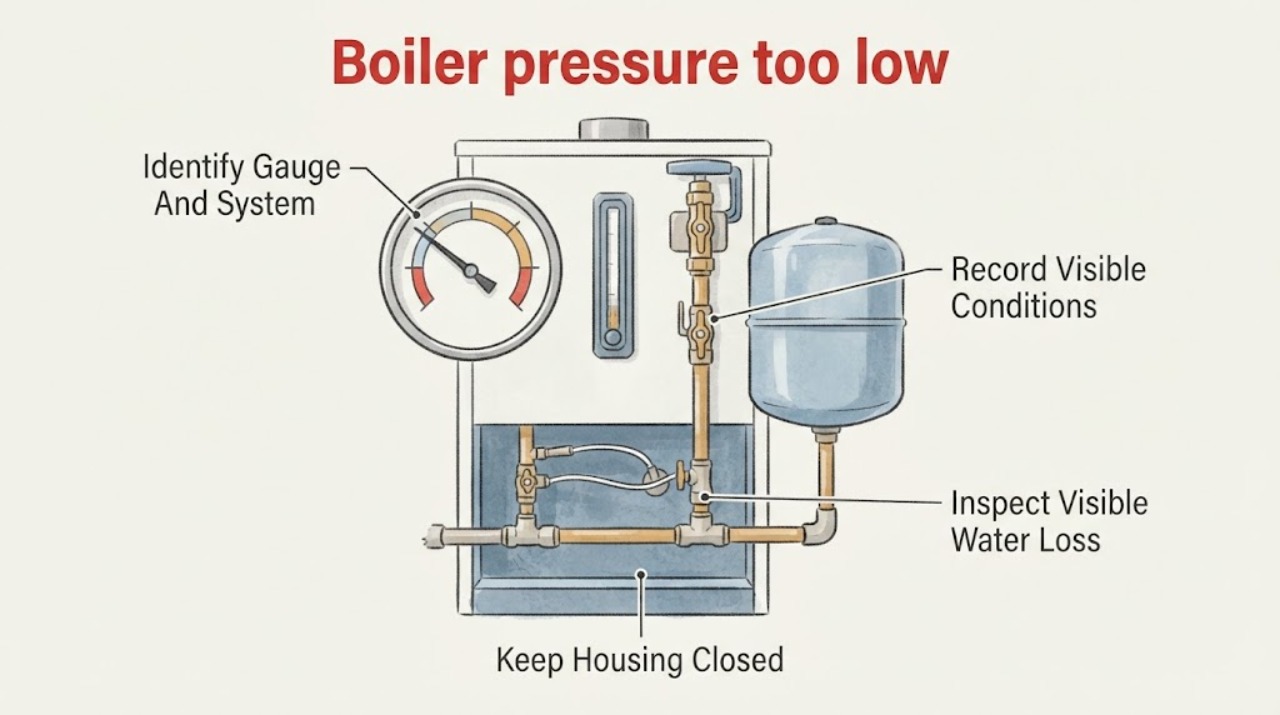
A Peerless boiler pressure reading that looks too low is not enough to justify opening a fill valve: Peerless makes both steam and hot-water boilers, and their gauges and normal operating behavior differ by model. First identify whether the appliance has a steam gauge and gauge glass or a hot-water pressure/temperature gauge, then record the reading with the system cool and again after a heat call without touching hot pipes or controls. Look for visible water loss at boiler fittings, radiators or baseboards, the relief-valve discharge, and the fill or expansion-tank area. A falling reading, low-water cutoff, no heat, repeated need for make-up water, leaking relief valve, or gauge that remains at zero needs a qualified boiler professional. Do not remove fittings, bleed radiators, open the relief valve, adjust gas or burner controls, or add water unless the exact Peerless manual and a qualified technician expressly authorize that procedure for the model.
Before you begin
Safety first
- This article supports identifying the Peerless model and gauge type, reading visible indicators, recording pressure trends from a safe position, and looking for accessible signs of water loss. Do not open valves, bleed or drain the system, touch hot or pressurized components, adjust gas or burner controls, bypass safety devices, or remove panels.
Work through in order
Diagnostic checks
Use only checks that match the exact appliance or system and its official guide.
-
Check 1
From a safe position, photograph the Peerless rating plate and gauge face, and note whether the boiler has a steam gauge with a water gauge glass or a hot-water pressure/temperature gauge; do not remove a jacket or cover to find the information.
Expected result: Record the model, fuel type if shown, gauge labels, presence of a gauge glass or low-water cutoff, whether the boiler is calling for heat, and whether the displayed value is steady or moving.
Next step: Use the exact Peerless manual to identify the gauge and normal observation points; if the model or gauge type is unclear, stop at this identification check and arrange professional service.
Stop if: Do not remove covers, touch hot surfaces, disconnect a gauge, or substitute a pressure target from another Peerless model.
Why this matters
Why: Steam and hot-water boilers use different indicators, and Peerless model families have different controls and installation requirements. A pressure reading cannot be interpreted safely until the system type and model are known.
-
Check 2
With the boiler not firing and the system cool enough to observe without touching piping, record the gauge or water-level indication; if the owner manual permits observation during a normal heat call, record whether the indication changes as the system heats.
Expected result: Note whether the reading is low only when cool, remains unchanged at all times, falls during operation, rises and then drops, or coincides with a low-water cutoff or loss of heat.
Next step: Keep the boiler off if the reading is at zero, the low-water protection has acted, or heat is lost; provide the trend and model information to a qualified technician rather than opening a valve to chase a number.
Stop if: Do not touch hot pipes, bleed radiators, remove the gauge, reset a safety control repeatedly, or fire the boiler with suspected low water.
Why this matters
Why: A changing reading can reflect normal system response or a leak/expansion issue depending on boiler type. A reading that never changes suggests a gauge or connection problem, while a falling reading with lost heat or a low-water control indicates a potentially empty or leaking system.
-
Check 3
When all surfaces can be viewed safely, inspect accessible boiler piping, circulator or zone connections, radiators or baseboards, drain points, the fill assembly, and the relief-valve discharge for fresh water, staining, corrosion, or a damp floor; use sight only and do not wipe hot or pressurized parts.
Expected result: Record a definite drip, a dried mineral or rust trail, moisture at the relief outlet, water near a concealed wall or ceiling, or no visible leak anywhere in the accessible system.
Next step: Turn the boiler off if water is escaping or the floor is wet, protect the area without touching hot water, and arrange qualified boiler service; do not tighten fittings or open the relief valve.
Stop if: Do not touch discharge water, cap a relief outlet, loosen boiler fittings, remove insulation, or continue heating with an active leak.
Why this matters
Why: A visible loss can explain a falling pressure and needs repair at its source. Moisture at a relief discharge can indicate overpressure, a fill or expansion problem, or a relief valve that is not seating. No visible leak does not rule out concealed piping or an inaccurate gauge.
-
Check 4
Look without operating controls for recent work, a visibly closed or disturbed make-up-water arrangement, a service tag, repeated boiler refills, relief discharge, or an expansion-tank area that is wet or corroded; keep hands away from valves and hot components.
Expected result: Record whether the low reading appeared after draining, maintenance, a power outage, a freeze, a relief discharge, or no known event, and whether the system has required water more than once.
Next step: Give the history and photographs to the installer or boiler technician; do not open a fill valve, drain the boiler, or change an expansion-tank charge as a homeowner test.
Stop if: Do not manipulate fill, drain, isolation, relief, or gas controls, and do not add treatment chemicals or antifreeze without model-specific professional direction.
Why this matters
Why: A recent drain or service event may explain a one-time reading, while repeated refilling, a wet relief outlet, or unexplained pressure loss makes a fill valve, expansion tank, relief valve, leak, or air-removal problem more likely. A closed valve cannot be safely corrected from a generic instruction because Peerless systems vary.
-
Check 5
Observe the home's heating response and the boiler display or status lights without resetting safety controls: note whether zones heat, the circulator runs, the burner starts, the low-water cutoff or lockout is active, and whether unusual sounds or air noise occur.
Expected result: Record no heat in one zone versus all zones, repeated lockout, short cycling, gurgling, water hammer or bubbling, and any error or service indicator shown by the model.
Next step: Leave the boiler in its safe stopped state and arrange HVAC/boiler service when heat is lost, a safety control has acted, or abnormal sounds accompany the low reading.
Stop if: Do not bypass a low-water cutoff, repeatedly reset a lockout, run the burner with suspected inadequate water, or remove the burner or control panel.
Why this matters
Why: A low reading plus no heat or low-water protection points to a system condition that can damage the boiler if it fires. One cold zone may reflect flow or air trouble rather than boiler pressure alone; repeated lockout or unusual noise requires service diagnosis.
-
Check 6
Prepare the model and serial information, gauge or gauge-glass photos, cold and heating observations, visible leak locations, recent service or refill history, heating symptoms, and any active safety indication for a qualified boiler professional.
Expected result: Confirm whether the likely path is a steam water-level issue, a hydronic pressure loss, a gauge indication problem, an expansion or relief issue, a fill-system issue, or an unknown condition.
Next step: Keep the boiler off when pressure is falling, water is escaping, heat is lost, or a low-water control has acted, and provide the complete record for diagnosis and safe refill or repair.
Stop if: Do not continue operating an unverified low-water boiler, open the pressure-relief valve, disconnect piping, or attempt internal service.
Why this matters
Why: A clear trend and system type allow the technician to choose the correct checks. A low reading without a confirmed cause should not be treated as proof that a gauge, fill valve, expansion tank, or relief valve is defective.
Use your observations
Decision map
Find the observation that best matches what you see, then follow the next safe action.
-
PATH 01Safety boundary
What you see
The Peerless boiler is a steam model with a gauge glass, the water level is at the model's normal mark, heat is operating, and the pressure indication is low but stable.
Do this next
Have a boiler professional compare the gauge, gauge glass, pressure control, and model manual if the reading is new, the heating performance changed, or the gauge is stuck.
Why this path and its safety boundary
Why it matters: The low pressure-gauge reading may reflect normal steam operation or a gauge indication issue rather than a low-water condition; it is not enough to justify adding water.
Safety stop: Do not fill a steam boiler based only on a low gauge, alter the pressure control, or bypass the low-water cutoff.
-
PATH 02Safety boundary
What you see
The Peerless boiler is a hot-water system and the pressure falls between observations, especially with lost heat, a low-water indication, or repeated need for make-up water.
Do this next
Keep the boiler off if heat is lost or low-water protection acts and arrange qualified hydronic service to locate the cause before refilling or firing again.
Why this path and its safety boundary
Why it matters: Water loss, air removal, a fill-system fault, relief discharge, expansion-tank problem, concealed piping leak, or gauge issue is more likely than a harmless fixed reading.
Safety stop: Do not repeatedly open the fill valve, drain the system, bleed radiators, or run the boiler with inadequate water.
-
PATH 03Safety boundary
What you see
Water, corrosion trails, or relief-valve discharge is visible around boiler piping, a relief outlet, a fill assembly, radiators, baseboards, or the floor.
Do this next
Stop heating if safe, keep clear of hot discharge, protect the floor, and arrange prompt boiler service to repair the source and verify the safety valve and system pressure.
Why this path and its safety boundary
Why it matters: An active or previous water loss can explain low pressure; relief discharge can also indicate an overpressure, fill, expansion, or relief-valve problem that should not be hidden.
Safety stop: Do not cap, plug, tighten, or obstruct a relief discharge, and do not touch hot water or loosen a wet fitting.
-
PATH 04Safety boundary
What you see
The gauge stays at zero or an implausibly low reading while the boiler appears to heat, there is no visible water loss, and no low-water or heat-loss symptom is present.
Do this next
Do not replace or remove the gauge yourself; have a technician verify the gauge against the correct Peerless system instrumentation and inspect the connection.
Why this path and its safety boundary
Why it matters: A stuck gauge, blocked gauge connection, wrong gauge interpretation, or a hidden system problem remains possible; normal-looking heat does not prove the indication is accurate.
Safety stop: Do not tap the gauge, remove its fitting, add water to make the needle move, or rely on it for safe operation until verified.
-
PATH 05Safety boundary
What you see
The low reading accompanies a low-water cutoff, boiler lockout, no heat, unusual boiling or gurgling, or a burner that will not operate.
Do this next
Leave the boiler in its safe stopped state and request qualified service for the water level, pressure, flow, controls, and heat exchanger condition before resetting or refilling.
Why this path and its safety boundary
Why it matters: The boiler may be protecting itself from inadequate water, poor flow, air, or another unsafe operating condition; a low reading is part of a broader service fault.
Safety stop: Do not bypass the low-water cutoff, reset repeatedly, fire the burner dry, or open the boiler or burner controls.
Helpful context
Understand the symptom
Identify the kind of Peerless boiler first
Peerless sells steam and hot-water boilers, and a low reading means different things in those systems. A steam system commonly has a water gauge glass and a steam pressure gauge; a hydronic hot-water system commonly uses a pressure/temperature gauge. The model and its manual control the correct interpretation, not a generic number found online. Record the gauge face, any water-level glass, the model on the rating plate, and whether the home is still heating.
A low reading can be a loss of water or a bad indication
If pressure falls over time, the system may be losing water through a fitting, radiator or baseboard circuit, drain, relief-valve discharge, automatic fill assembly, or concealed piping. If the reading never changes while the boiler operates, the gauge or its connection may be inaccurate. A steam boiler's gauge can also remain near its low operating range while the gauge glass shows the relevant water level. Do not select a replacement gauge or add water until the technician confirms which condition is present.
Use external observations only
With the boiler off and safe to approach, look for fresh moisture, corrosion trails, staining, or discharge near accessible piping and the relief-valve outlet. Do not touch hot water, open the relief valve, loosen a fitting, or remove a boiler cover. A low-water cutoff or a lockout is a protective response, not an invitation to bypass a control.
Why repeated topping-up is a warning
A system that needs frequent make-up water has an unresolved leak, relief-valve issue, expansion-tank problem, fill-valve problem, or another hydronic fault. Peerless documentation warns that excessive make-up water can damage boiler and system components through corrosion or deposits. Repeatedly opening a fill valve can also overfill the system or hide the leak, so the pattern should be reported to a qualified boiler technician.
Safety boundary
Stop conditions
- Stop and arrange prompt boiler service for falling pressure, a low-water cutoff, no heat, visible water loss, relief-valve discharge, or a boiler that will not safely operate.
- Do not open a fill, drain, isolation, or pressure-relief valve, bleed radiators, disconnect piping, or add chemicals or antifreeze as a generic low-pressure fix.
- Do not bypass or repeatedly reset a low-water cutoff, burner lockout, vent safety, or other protective control.
- Do not touch hot water, steam, venting, relief discharge, or energized controls, and do not remove the boiler jacket or burner panel.
- Do not apply a pressure target from another Peerless model: confirm the steam or hot-water system, gauge type, and exact model manual with a qualified professional.
Only after diagnosis
Potential parts
- Peerless boiler pressure or pressure-temperature gauge
Consider this class only when a technician verifies that the gauge or its connection is inaccurate or damaged after comparing the indication with the correct steam or hot-water system behavior.
Match the exact Peerless model, steam or hydronic service, scale, connection, temperature rating, and installation requirements; do not replace a gauge to conceal water loss. - boiler pressure-reducing fill valve
Consider this class only when a qualified diagnosis confirms that the make-up-water or pressure-reducing valve is not supplying or regulating the system correctly after leaks and gauge accuracy are checked.
Match the exact Peerless system, piping arrangement, inlet connection, pressure range, backflow protection, and local requirements; filling and valve replacement are professional work. - boiler expansion tank
Consider this class only when a technician confirms an expansion-tank charge, diaphragm, bladder, or tank-size fault associated with pressure loss or relief discharge.
Match the exact system volume, boiler type, tank orientation, connection, and manufacturer's requirements; do not adjust or replace a pressurized tank based on one low reading. - boiler pressure-relief valve
Consider this class only when the relief valve is confirmed to leak, discharge improperly, or fail inspection after the underlying fill and expansion causes are evaluated.
Match the exact boiler model, system type, rated setting, capacity, discharge arrangement, and applicable code; never cap or obstruct a relief valve.
When checks do not resolve it
Need a professional?
Arrange qualified Peerless boiler service when the pressure reading falls, remains at zero, conflicts with the water gauge glass, or returns low after any prior refill. Call promptly for visible leakage, relief-valve discharge, a low-water cutoff, no heat, repeated lockout, unusual boiling or gurgling, or a gauge that may be stuck. Do not open a fill valve or attempt pressure, expansion-tank, relief-valve, gas, burner, or internal piping work from a generic instruction; Peerless documentation reserves installation and maintenance procedures for qualified professionals.
Safety scope: This article supports identifying the Peerless model and gauge type, reading visible indicators, recording pressure trends from a safe position, and looking for accessible signs of water loss. Do not open valves, bleed or drain the system, touch hot or pressurized components, adjust gas or burner controls, bypass safety devices, or remove panels.
Common questions
FAQ
What pressure should my Peerless boiler show?
There is no single safe number for every Peerless boiler. Peerless makes steam and hot-water models with different gauges and controls. Identify the exact model and whether it is steam or hydronic, then use that model's manual or a qualified boiler technician to interpret the reading.
Can I open the fill valve when my Peerless boiler pressure is low?
Do not open it as a generic test. A low reading may be a normal steam indication, a gauge fault, a leak, an expansion or relief problem, or an inadequate-water condition. Opening the wrong valve can overfill the system or hide a leak; have the exact model and cause verified first.
Why does my Peerless boiler pressure keep dropping?
Repeatedly falling pressure can come from water escaping at piping, radiators or baseboards, a relief-valve discharge, fill-system trouble, an expansion-tank issue, concealed piping, air or flow problems, or an inaccurate gauge. Look for visible moisture without touching hot or pressurized parts and arrange qualified service.
Is low boiler pressure an emergency?
Treat a low reading as urgent when it accompanies a low-water cutoff, no heat, an active leak, relief discharge, unusual boiling or gurgling, repeated lockout, or a gauge that falls toward zero. Keep the boiler in its safe stopped state and arrange qualified boiler service rather than repeatedly resetting or refilling it.
Read the exact guide
Official sources
- PFC-2000-4000 Boiler I,O&M ManualPB Heat / Peerless Boilers · Peerless PFC commercial condensing hot-water boiler manual; its model-specific values and procedures must not be generalized to another Peerless boiler.
- Series MI-x™PB Heat / Peerless Boilers · Peerless Series MI-x product page; other Peerless models vary and their exact manuals control pressure and service procedures.
- Contractor FAQPB Heat / Peerless Boilers · Peerless contractor FAQ; it is not a homeowner pressure-adjustment procedure.
- CC Installation ManualPB Heat / Peerless Boilers · Peerless CC gas/oil boiler installation manual; it establishes system distinctions and safety boundaries, not a universal pressure setting.
- Series 63-x™PB Heat / Peerless Boilers · Peerless Series 63-x product page; not a universal pressure guide for every Peerless boiler.
- Series 64™PB Heat / Peerless Boilers · Peerless Series 64 product page; commercial model information used only to establish system-type differences, not to set a homeowner pressure target.
Community feedback
Share a repair observation
Share a plain-text repair observation. Accepted observations are published automatically; this page may take a moment to update.