
On this page
Start here
Quick answer
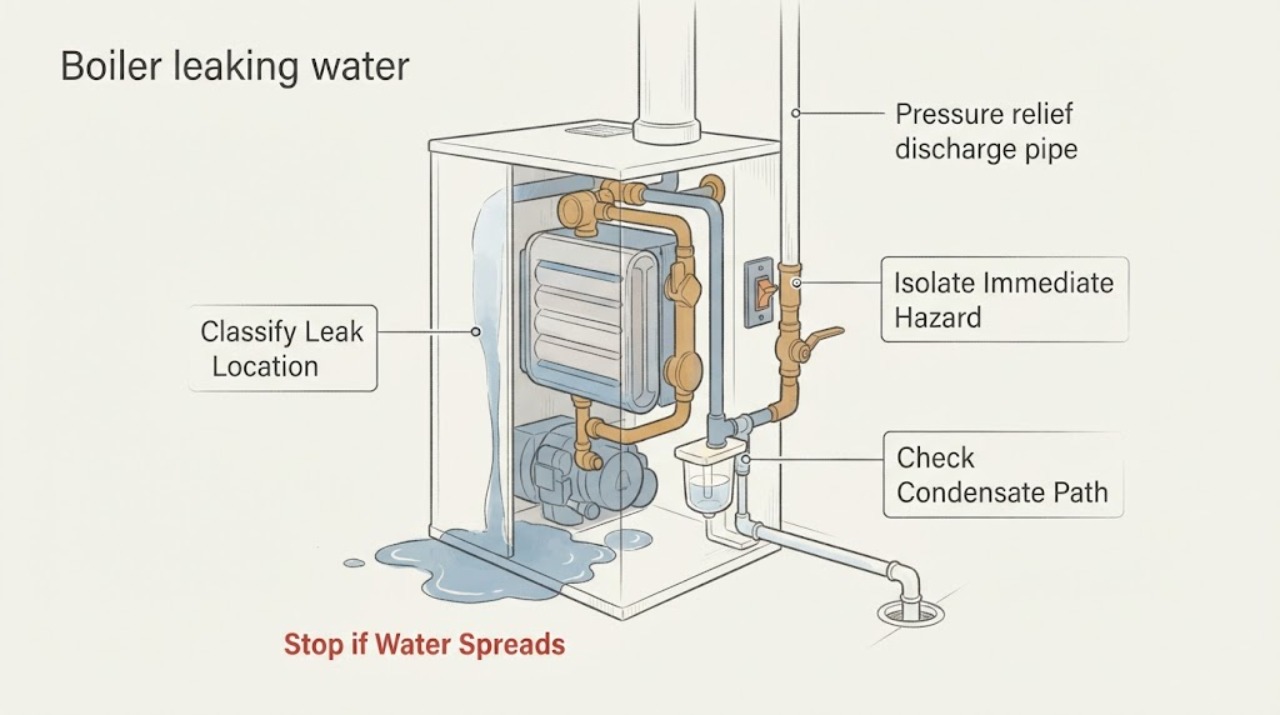
Treat water around a Rheem boiler as a source-identification and safety issue, not as a loose-fitting repair by default. From a dry, safe position, look for the first wet point: a heating-water joint or valve, the pressure-relief discharge, the condensate trap or outlet, or water emerging from the cabinet or heat-exchanger area. Rheem's boiler guidance tells homeowners to visually inspect for leaks or corrosion and examine the relief valve, discharge piping, condensate trap, and outlet; Rheem also identifies a leaking joint or seal and a cracked or corroded heat exchanger as different possibilities. Do not touch hot discharge, cap a relief pipe, open the cabinet, drain or refill the hydronic loop, adjust gas pressure, or alter a safety control. If there is gas odor, a carbon-monoxide alarm, steam or hot spray, active flooding, electrical contact, a cabinet or heat-exchanger leak, or an uncontrolled pressure event, leave the area as appropriate, call emergency or qualified service, and do not restart the boiler to reproduce the leak.
Before you begin
Safety first
- Owner checks are limited to safe external observation, reading a visible label or display, documenting moisture, and protecting people and flooring without touching hot or pressurized parts. A qualified boiler professional must handle gas and electrical isolation decisions, relief-valve diagnosis, cabinet access, hydronic draining or refilling, condensate-trap service, leak repair, pressure testing, combustion checks, and replacement decisions.
Work through in order
Diagnostic checks
Use only checks that match the exact appliance or system and its official guide.
-
Check 1
From a dry, stable position with the boiler not being touched, look for the highest or first wet point. Check only visible areas around the supply and return connections, valves, relief discharge pipe, condensate trap and outlet, cabinet seams, and nearby pipes. Note whether the liquid is cool, warm, or producing steam without placing a hand on it.
Expected result: Record a dry cabinet with a wet nearby joint, moisture at the condensate path, moisture or discharge at the relief pipe, water from inside the cabinet, or an unidentified puddle.
Next step: Take a safe photo and continue only with external observations if there is no heat, steam, gas odor, electrical contact, or active flooding. Keep the boiler off and arrange qualified service when the first wet point is inside the cabinet or uncertain.
Stop if: Stop for steam, hot spray, gas odor, an active high-volume leak, water near electrical components, a cracked cabinet, or a floor or ceiling that is becoming unsafe.
Why this matters
Why: A visible joint or valve keeps an external connection in consideration. Condensate-path moisture may be a drainage issue. Relief-pipe moisture is a safety-valve branch. Water emerging from the cabinet or heat-exchanger area is more serious and cannot be diagnosed by tightening an external fitting.
-
Check 2
Before any closer look, check from the entrance to the mechanical area for a gas odor, carbon-monoxide alarm, smoke, unusual combustion noise, visible flame abnormality, steam, scalding water, or water reaching electrical equipment. Do not operate electrical switches or use a flame or spark to locate a leak.
Expected result: Record no immediate hazard, a gas odor, a carbon-monoxide alarm, smoke or abnormal flame, steam or hot discharge, or water near wiring, controls, or an electrical outlet.
Next step: For gas odor or a carbon-monoxide alarm, leave as appropriate and contact emergency services or the gas utility from a safe location. For steam, hot discharge, smoke, or electrical contact, keep clear and request urgent qualified service. Do not restart the boiler to test it.
Stop if: Stop immediately for gas odor, carbon-monoxide alarm, smoke, fire, exposed or energized electrical equipment, steam, scalding water, or rapidly spreading water.
Why this matters
Why: Gas odor or a carbon-monoxide alarm is an emergency rather than a boiler-repair clue. Steam, hot discharge, or water contacting electricity adds burn or shock risk. A quiet cool drip with no hazard still requires source identification, but it does not make opening the boiler safe.
-
Check 3
If the unit is a condensing Rheem boiler and the area is cool and dry enough to inspect, look at the outside of the condensate trap, outlet tubing, and any neutralizer or drain connection. Check for a disconnected tube, a puddle directly below the outlet, a blocked-looking or kinked route, or moisture that appears only while the boiler operates; do not remove the trap or pour anything into it.
Expected result: Record a dry and connected path, a loose or split tube, water at the outlet, a backed-up or kinked-looking path, or a model without an identifiable condensate assembly.
Next step: Keep the boiler off if condensate is pooling, the path is disconnected, or liquid is reaching the cabinet; have a qualified technician inspect and service the condensate system under the exact model instructions. Do not disassemble or chemically clean it as an owner test.
Stop if: Stop for acidic or unknown liquid on skin, a split or pressurized tube, water near electronics, a concealed leak, or any step requiring trap removal or cabinet access.
Why this matters
Why: Moisture at the condensate path keeps condensate drainage or an improperly connected outlet in consideration. A blocked-looking path can cause overflow or equipment damage. The visible symptom does not prove that the trap, neutralizer, or internal drain is the failed component.
-
Check 4
From a safe distance, inspect the visible end and route of the pressure-relief discharge pipe for drops, a wet floor, corrosion, a missing or obstructed outlet, or signs of a recent hot discharge. Do not touch the pipe, turn the relief valve, cap the outlet, or place a container where it could block the discharge.
Expected result: Record a dry discharge, intermittent cool moisture, a hot or forceful discharge, corrosion or an obstructed outlet, or no safe view of the relief assembly.
Next step: Leave the boiler off and request qualified boiler service for any discharge, corrosion, obstruction, or uncertainty. The technician must determine why the relief device opened and verify the safety arrangement; do not replace or cap it as a leak fix.
Stop if: Stop for hot water, steam, forceful discharge, a blocked or capped pipe, or any attempt that would require touching or removing the relief valve.
Why this matters
Why: Moisture at this pipe can indicate that the relief device has opened because of a pressure or temperature condition or that the valve is not sealing. An obstructed or altered discharge arrangement is unsafe. A dry pipe does not rule out another leak source.
-
Check 5
With the boiler off and surfaces cool, inspect from outside the cabinet for droplets, rust, scale, wet insulation, or a trail from visible supply and return joints, isolation valves, air separators, expansion-tank connections, or nearby piping. Do not tighten fittings or remove insulation, covers, or panels.
Expected result: Record a dry connection, a single cool drip at a visible joint, corrosion or a widening wet area, a leak that appears only while heating, or moisture that starts inside the cabinet.
Next step: Photograph the location and keep the boiler off if the drip continues, grows, or comes from the cabinet. Arrange qualified service to inspect the joint, piping, expansion and relief components, and heat exchanger as applicable.
Stop if: Stop for hot surfaces, pressurized spray, a split pipe, water near electrical controls, cabinet removal, or any fitting that appears seized or damaged.
Why this matters
Why: A single external joint or seal can be a serviceable connection issue, while corrosion, a widening wet area, or a cabinet-origin leak raises concern for component or heat-exchanger damage. A leak that changes with heating or pressure needs a technician to assess the system, not an improvised tightening.
-
Check 6
Without opening the cabinet or changing settings, note the Rheem model and serial label if safely visible, any display message or lockout, the system pressure or temperature shown by the control if the unit normally displays it, and whether the leak appears during a heat call, after shutdown, or continuously. Do not top up, reset, or alter a safety control to make the leak recur.
Expected result: Record a diagnostic message, pressure or temperature outside the model's normal documented range, a leak only during operation, a continuous leak, or no readable display or label.
Next step: Photograph the display and label from a safe position and provide them to a qualified boiler technician. Leave settings and safety controls unchanged unless the model manual or technician directs a safe shutdown.
Stop if: Stop for an alarm, repeated lockout, abnormal heat, gas odor, water entering controls, or any instruction that requires opening the cabinet or manipulating gas, relief, or electrical components.
Why this matters
Why: A display or operating pattern can help a technician distinguish a pressure, flow, temperature, condensate, or component issue, but a generic pressure or temperature value cannot be judged without the exact Rheem model and system design. A continuous or worsening leak is an escalation signal.
-
Check 7
Prepare a service handoff with the Rheem model and serial number, leak location and first wet point, liquid temperature if observed without touching, photos, timing relative to heating, display messages, pressure or temperature shown by the control, recent installation or service, and whether water reached flooring or electrical equipment.
Expected result: Confirm that the record contains direct observations and safe photos, not an assumed failed relief valve, heat exchanger, pump, seal, or condensate trap.
Next step: Keep the boiler isolated as directed by the technician or exact manual and arrange qualified Rheem boiler service. Protect the floor from a cool drip without touching hot or contaminated liquid or obstructing any relief discharge.
Stop if: Stop owner troubleshooting when the next step requires cabinet access, draining or refilling the hydronic loop, opening a relief valve, changing gas or electrical settings, handling hot or pressurized water, or lifting the unit.
Why this matters
Why: The pattern helps a qualified technician separate an external joint or drain issue from relief discharge, condensate overflow, pressure-control trouble, corrosion, or a cabinet or heat-exchanger leak. Model identity is essential because Rheem boiler families and controls differ.
Use your observations
Decision map
Find the observation that best matches what you see, then follow the next safe action.
-
PATH 01Next step
What you see
There is gas odor, a carbon-monoxide alarm, smoke, abnormal flame, steam or scalding discharge, water near electrical controls, or rapidly spreading water.
Do this next
Leave the area as appropriate and contact emergency services, the gas utility, or urgent qualified service from a safe location. Do not operate switches in a suspected gas leak, touch wet electrical equipment, or restart the boiler.
-
PATH 02Next step
What you see
Moisture comes from the pressure-relief discharge, the pipe is hot or has discharged forcefully, the outlet is obstructed, or the display shows a pressure or temperature concern.
Do this next
Keep clear and arrange qualified boiler service to determine why the relief device opened and verify the discharge arrangement. Never cap, plug, hold closed, or replace the relief device as a DIY leak repair.
-
PATH 03Next step
What you see
A condensing model has moisture at the condensate trap, outlet, neutralizer, or tubing, while the relief pipe and heating-water joints remain dry and there is no immediate hazard.
Do this next
Turn the boiler off if safe and have a qualified technician inspect the condensate path, connections, and internal drain. Do not remove the trap, pour chemicals into it, or assume the liquid is safe to handle.
-
PATH 04Next step
What you see
A cool, low-volume drip begins at one visible supply or return connection, valve, or joint, with no cabinet-origin leak, relief discharge, combustion warning, or widening puddle.
Do this next
Keep the boiler off or follow the technician's shutdown direction, photograph the joint, and schedule qualified service. Do not tighten a pressurized or hot connection or remove insulation to expose it.
-
PATH 05Next step
What you see
Water appears inside the cabinet or from the heat-exchanger area, corrosion is widespread, the leak grows during firing, or water continues after external joints and condensate observations are dry.
Do this next
Keep the boiler off and arrange prompt qualified Rheem boiler service. Rheem notes that a cracked or corroded heat exchanger may require replacement; do not open the cabinet or select a heat exchanger or seal without model-specific diagnosis.
-
PATH 06Next step
What you see
The boiler appears dry but water is pooling nearby, the first wet point cannot be seen, or another pipe, drain, appliance, or ceiling may be the source.
Do this next
Do not blame the Rheem boiler or restart it to test. Photograph the area, isolate water only if the correct valve turns freely and no hazard is present, and have a plumber or boiler technician trace the source.
Helpful context
Understand the symptom
Identify the water path before thinking about a part
A Rheem boiler can have separate water paths: the sealed heating loop, the condensate path on a high-efficiency condensing model, and discharge from a pressure-relief device. Water can also arrive from nearby piping or condensation and only appear to come from the boiler. A dry paper towel placed on the floor away from hot surfaces can help show where a new drip lands, but do not wipe, probe, or reach into the cabinet. The first wet point, the temperature, and whether the leak occurs only during a firing or pressure event are more useful than the size of the puddle.
Condensate is not the same as a heating-loop leak
High-efficiency Rheem boilers have a condensate trap and outlet that need an unobstructed, correctly managed path. Moisture at that path may be condensate, while water at a supply or return joint, relief discharge, or cabinet seam points to another branch. Rheem specifically calls for checking the condensate trap and outlet and referring maintenance to the unit instructions and a certified technician. Do not remove the trap, pour chemicals into it, or assume any liquid is harmless.
Pressure-relief discharge is a safety boundary
The relief valve and its discharge pipe are not ordinary drain fittings. Rheem boiler documentation specifies a visible, unobstructed discharge arrangement, and Rheem's boiler checklist says to examine the valve and discharge piping for moisture. A hot or repeated discharge can indicate a pressure or temperature problem; capping it, tightening it, or holding it closed can remove a safety function. Observe from clear distance only and arrange qualified boiler service.
Gas, combustion, electricity, and hot water change the decision
A leaking boiler combines water with gas combustion, electrical controls, hot surfaces, and a pressurized system. If you smell gas, a carbon-monoxide detector alarms, water contacts electrical equipment, or steam or hot water is escaping, do not investigate the source at close range. Leave the area and contact the appropriate emergency service or a qualified boiler professional. Rheem recommends professional support when a leak is present or when a homeowner is not comfortable with the procedure.
Safety boundary
Stop conditions
- Do not open the Rheem boiler cabinet, remove insulation, drain or refill the hydronic loop, adjust gas pressure, or change electrical or safety settings as an owner leak test.
- Never cap, plug, block, hold closed, or touch a hot pressure-relief discharge; moisture or discharge there requires qualified diagnosis of the pressure and temperature condition.
- Do not touch steam, hot water, unknown condensate, wet electrical equipment, or a pressurized spray. Do not restart the boiler to reproduce a leak.
- If there is gas odor, a carbon-monoxide alarm, smoke, fire, water near electricity, active flooding, a cracked heat exchanger or cabinet, or major water damage, leave as appropriate and request emergency or qualified service from a safe location.
Only after diagnosis
Potential parts
- pressure-relief valve or discharge assembly
Consider this only after a qualified technician confirms that water is discharging from the relief path and determines the underlying pressure or temperature cause; a wet relief pipe is not proof that the valve alone failed.
Confirm the exact Rheem boiler model, relief setting, connection, discharge requirements, and local code with a qualified professional; never cap or substitute a relief device. - boiler water connection seal or valve
Consider this only when service traces a cool leak to a specific external joint, valve, gasket, or seal and rules out relief, condensate, and cabinet-origin leaks.
Verify the exact boiler model, connection material, pressure and temperature ratings, and installation requirements before replacement; pressurized repairs require qualified service. - condensate trap, neutralizer, or drain tubing
Consider this category only when a condensing Rheem boiler's moisture is traced to the condensate path and inspection confirms a damaged, disconnected, blocked, or failed component.
Confirm the exact model, condensate routing, materials, neutralization requirements, and service instructions; do not substitute tubing or chemicals based on appearance. - heat exchanger or internal leak service
This is a professional repair or replacement category only when qualified diagnosis finds water from the heat-exchanger or cabinet area, corrosion, or an internal failure.
Confirm the exact Rheem model, exchanger design, approved repair path, warranty status, and combustion and pressure tests; do not open or repair the boiler cabinet as a DIY step.
When checks do not resolve it
Need a professional?
Call a qualified boiler technician or plumber for any continuing Rheem boiler leak, moisture at the relief discharge or condensate path, a visible joint that needs tightening or replacement, a pressure or temperature warning, corrosion, an unidentified source, or a leak from inside the cabinet or heat exchanger. Seek urgent or emergency help for gas odor, a carbon-monoxide alarm, smoke, steam, scalding discharge, water near electrical equipment, active flooding, sewage contamination, or structural water damage.
Safety scope: Owner checks are limited to safe external observation, reading a visible label or display, documenting moisture, and protecting people and flooring without touching hot or pressurized parts. A qualified boiler professional must handle gas and electrical isolation decisions, relief-valve diagnosis, cabinet access, hydronic draining or refilling, condensate-trap service, leak repair, pressure testing, combustion checks, and replacement decisions.
Have this ready
- Provide the Rheem model and serial number, boiler family if known, first wet point and location, cool or hot appearance observed without touching, photos, timing relative to a heat call, display messages, pressure or temperature shown by the control, recent installation or service, and affected flooring or electrical equipment.
Common questions
FAQ
Why is my Rheem boiler leaking water?
Possible sources include a visible water joint or seal, the pressure-relief discharge, the condensate trap or outlet on a condensing model, nearby piping, corrosion, or an internal heat-exchanger leak. Rheem treats these as different diagnostic paths, so locate the first wet point without touching the boiler.
Can I keep running a leaking Rheem boiler?
Do not keep operating it to see whether the leak improves. Turn it off or isolate it only as the exact manual or a qualified technician directs, especially when water is near electricity, the leak is hot or pressurized, or the source is inside the cabinet.
What if water is coming from the boiler pressure-relief pipe?
Keep clear and call qualified boiler service. Discharge can reflect a pressure or temperature problem or a valve that is not sealing. Never cap, plug, hold closed, or touch a hot relief discharge.
Is water from a Rheem boiler condensate line normal?
A condensing boiler has a condensate trap and outlet, but a puddle, disconnected tube, blocked-looking path, or moisture reaching the cabinet needs inspection. Do not remove the trap or assume the liquid is safe; follow the exact model instructions or call a technician.
How can I tell a leak from condensation?
Observe timing and the first wet point from a safe position. Rheem notes that small condensation can occur in water-heating contexts, while pooling water, a continuous drip, corrosion, or moisture at a joint, relief pipe, condensate outlet, or cabinet requires diagnosis. Do not touch unknown liquid to identify it.
Can I tighten a leaking fitting on the boiler?
Do not tighten a hot, pressurized, corroded, or inaccessible fitting. A qualified technician must isolate the system, determine whether the fitting, seal, relief path, or internal component is responsible, and restore it to the Rheem and code requirements.
What does water inside the Rheem boiler cabinet mean?
It can indicate an internal connection, condensate problem, corrosion, or heat-exchanger failure. Keep the boiler off and arrange qualified service; do not remove the cabinet or continue firing to reproduce the leak.
Should I drain the Rheem boiler when it leaks?
Do not drain or refill a pressurized hydronic boiler as a generic troubleshooting step. Water may be hot, and the system's pressure, expansion, relief, and combustion safety must be handled according to the exact manual by a qualified professional.
What information should I give the boiler technician?
Give the Rheem model and serial number, leak location and first wet point, photos, whether the liquid appeared hot or cool without touching, timing relative to heating, display messages, pressure or temperature shown by the control, recent work, and any water damage.
When is a Rheem boiler leak an emergency?
Treat gas odor, a carbon-monoxide alarm, smoke, fire, steam, scalding discharge, water near electrical equipment, active flooding, a cabinet or heat-exchanger leak, or major structural water damage as an urgent safety event. Leave as appropriate and call emergency or qualified help from a safe location.
Read the exact guide
Official sources
- Winter Prep Tips for Water Heating SystemsRheem Manufacturing Company · Rheem seasonal boiler checklist used for safe external observations; it is not a universal repair procedure.
- What to Do Before Calling a Plumber or Replacing Your Water HeaterRheem Manufacturing Company · Rheem homeowner water-heating guidance used for documentation and safety boundaries; boiler systems require model-specific professional service.
- Comfort Starts Here: Key Signs Your Boiler Is Due for ReplacementRheem Manufacturing Company · Rheem homeowner boiler guidance used for symptom separation and escalation; exact model documentation and qualified service govern diagnosis.
- urgent helpRheem Manufacturing Company · Rheem urgent-help guidance is written for heating and water-heating equipment; boiler model controls and qualified technician instructions govern.
- Rheem FT Series Super High Efficiency Condensing Gas BoilersRheem Manufacturing Company · Rheem FT Series product specification sheet used only to identify model variation and condensate/water connection context; it does not authorize owner repair.
Community feedback
Share a repair observation
Share a plain-text repair observation. Accepted observations are published automatically; this page may take a moment to update.