
On this page
Start here
Quick answer
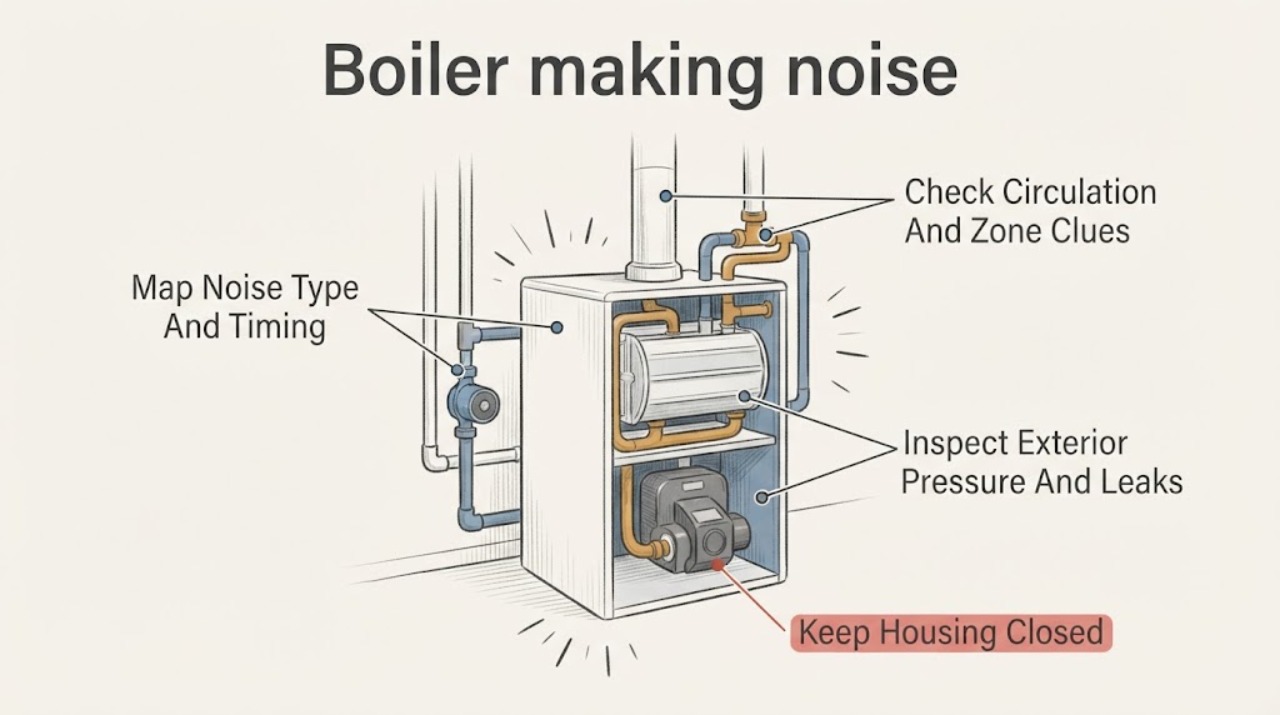
The timing and character of the sound are the best first clues. Gurgling or rushing can accompany air or poor circulation; a hum, whine, vibration, or grinding sound can involve the circulator or another motor; knocking or rumbling can accompany restricted flow, scale, or a loose pipe; and a sharp bang, delayed ignition, hissing, smoke, gas odor, or carbon-monoxide alarm is a combustion or safety warning. From a safe position, note whether the noise begins at ignition, when the pump starts, while water circulates, or as pipes heat and cool. Visually check only accessible exterior piping, vent and air-intake sections, condensate tubing, corrosion, leaks, and the pressure display or gauge according to the exact Rheem manual. Do not open the cabinet, touch a hot pump, bleed or refill the system, adjust gas settings, or clear venting. Stop operation and arrange qualified boiler service for a new, loud, worsening, or persistent sound, abnormal pressure, a leak, overheating, repeated lockout, smoke, gas odor, or a carbon-monoxide alarm.
Before you begin
Safety first
- This article supports safe listening, recording timing, visual inspection of accessible exterior water, vent, air-intake, and condensate sections, and reading an accessible pressure display according to the exact model documentation. It does not authorize cabinet access, gas or combustion adjustment, live electrical testing, pump disassembly, loop purging or refilling, relief or safety-device testing, vent clearing, or operation near a hazard.
Work through in order
Diagnostic checks
Use only checks that match the exact appliance or system and its official guide.
-
Check 1
From a safe position, listen during one normal heat call without opening the cabinet or touching the boiler. Describe the sound as gurgling, bubbling, rushing, ticking, knocking, banging, humming, whining, grinding, rattling, rumbling, hissing, or a sharp ignition sound. Record whether it begins at burner ignition, pump start, water circulation, heat-up, cool-down, or shutdown.
Expected result: Note whether the sound is brief and temperature-related, continuous while the pump runs, synchronized with ignition, accompanied by vibration, or becoming louder or more frequent. Record any error display, lockout, pressure change, leak, smoke, gas odor, or carbon-monoxide alarm.
Next step: Use the matching sound branch below. Stop immediately for gas odor, smoke, a carbon-monoxide alarm, a sharp ignition bang, active water, overheating, or repeated lockout.
Stop if: Do not repeatedly cycle the boiler to reproduce a dangerous sound, stand over the burner, touch hot surfaces, or operate equipment with a combustion, water, pressure, or electrical warning.
Why this matters
Why: Gurgling or rushing makes air or circulation more likely; pump-synchronized hum or grinding makes pump or motor trouble more likely; and ticking with heat-up can reflect pipe or casing expansion. A sharp bang, hissing, smoke, gas odor, or flame change raises a combustion hazard. Noise with pressure or leak evidence cannot be diagnosed safely by sound alone.
-
Check 2
Visually inspect accessible exterior boiler surfaces, water connections, hydronic piping, pressure display or gauge, vent or air-intake sections, and condensate tubing. Compare pressure only with the normal range or markings for the exact Rheem model. Do not remove panels, insulation, vent sections, or covers, and do not touch hot piping or a relief valve.
Expected result: Look for water, corrosion, discoloration, a loose or disconnected vent or condensate section, visible blockage, pressure outside the model's normal range, or a gauge that changes sharply as the boiler heats. Note whether the sound is nearest to the pump, pipe, vent, casing, or burner area.
Next step: Document the gauge and source area from a safe position. Keep the boiler off and arrange qualified service for a leak, abnormal pressure, damaged or blocked vent, damaged condensate path, or water near electrical or combustion components.
Stop if: Do not wipe around live parts, tighten hot or pressurized fittings, open the jacket, clear a vent, disconnect condensate tubing, or change pressure settings.
Why this matters
Why: Water or corrosion can accompany a connection, pressure, pump, heat-exchanger, or vessel problem. A vent or condensate defect can affect safe operation. Abnormal or rapidly changing pressure can accompany flow, expansion, relief, or water-loss problems. A clear exterior does not rule out an internal pump, burner, or control fault.
-
Check 3
From safe locations around the home, note whether radiators, baseboards, radiant zones, or other hydronic emitters warm unevenly and whether the noise follows a circulation call. Visually note any accessible valve that appears closed, but do not turn it. Do not touch the pump, loosen a vent screw, bleed a radiator, or enter the boiler cabinet.
Expected result: Record gurgling in radiators or pipes, cool zones with a hot boiler, a pump hum or vibration, a visibly closed valve, or normal heat distribution despite the noise. Note whether the sound changes when a heating zone calls.
Next step: Give the professional the affected zone and sound timing. Arrange qualified service for persistent gurgling, poor heat transfer, a pump-related noise, a suspected closed valve, or any need to purge, test, or replace a circulation component.
Stop if: Do not touch a hot pump, bleed or purge the hydronic loop, adjust valves by guesswork, or continue firing with an overheating or flow warning.
Why this matters
Why: Gurgling, cool zones, and a pump-related sound make air, flow restriction, a closed valve, or pump trouble more likely. Rheem's installation guidance calls for air management, pump purge, supported piping, and correctly sized piping and pump; an owner observation cannot determine which needs correction.
-
Check 4
Record any Rheem control-panel alert, lockout, temperature or pressure message, recent refill, maintenance, pump or vent work, power event, or change in thermostat behavior. Locate the exact model from existing paperwork or a safe exterior label without removing a panel, and use the exact owner manual to identify only normal startup or shutdown indications.
Expected result: Note whether the noise began after service, a refill, a long shutdown, a cold-weather start, or a control change; whether an alert returns; and whether the manual describes a normal fan, pump, purge, or post-run sequence for that model.
Next step: Follow only documented owner-level observations in the exact manual. Give the model, alert, and history to a qualified heating professional if the noise or fault persists.
Stop if: Do not enter service mode, alter gas or control parameters, bypass a sensor or safety, open the cabinet, or repeat resets to suppress an alert.
Why this matters
Why: A noise after filling or service changes the likelihood of air, circulation, vent, or installation issues. A recurring alert or lockout points to protected operation rather than a harmless sound. Model identity matters because Rheem boiler pump, control, vent, condensate, and burner arrangements differ.
-
Check 5
Arrange qualified Rheem boiler or heating service when the noise is new, loud, continuous, worsening, synchronized with ignition or a pump, accompanied by poor heat, abnormal pressure, a leak, an alert, or a lockout, or remains after safe visual checks. Provide the exact model, sound description, timing, pressure observation, affected zones, and recent service history.
Expected result: The remaining possibilities include air or poor circulation, closed or restricted valves, a pump or motor, scale or heat-exchanger flow issue, vent or condensate problem, burner or ignition fault, control or sensor fault, loose casing or piping, or an installation issue.
Next step: Keep the boiler off when a hazard or repeated fault is present and have the professional inspect circulation, piping, pump, combustion, venting, controls, safety devices, and model-specific service history before approving a part.
Stop if: Do not open the boiler, measure gas or electricity, adjust combustion, purge the loop, replace a pump, or continue running a boiler with a dangerous or unexplained noise.
Why this matters
Why: These causes overlap in sound and can require pressure, flow, electrical, combustion, or vent testing. A replacement pump, valve, sensor, burner component, or heat exchanger cannot be selected safely from a noise description alone.
Use your observations
Decision map
Find the observation that best matches what you see, then follow the next safe action.
-
PATH 01Safety boundary
What you see
The boiler or radiators gurgle, bubble, or rush, heat is uneven, or the sound follows a circulation call while some zones remain cool.
Do this next
Do not bleed, purge, refill, or pressurize the system as a guess. Record the affected zones and arrange qualified heating service to check flow, pump condition, valves, air, pressure, and controls.
Why this path and its safety boundary
Why it matters: Air in the loop, a closed or restricted valve, poor circulation, or a pump problem is more likely than a loose casing alone. A hot boiler with cool zones can indicate that heat is not moving through the loop.
Safety stop: Do not touch a hot pump, loosen a vent screw, bypass low-water protection, or keep firing with an overheating or flow warning.
-
PATH 02Safety boundary
What you see
A hum, whine, vibration, or grinding sound follows the boiler or zone pump, or heating zones respond poorly.
Do this next
Keep hands away from the pump and boiler interior; arrange qualified service to test circulation, pump condition, valves, air, controls, and wiring. Provide the sound timing and affected zones.
Why this path and its safety boundary
Why it matters: A seized, worn, air-bound, restricted, or electrically abnormal pump or related control is possible. Rheem identifies a built-in boiler pump on some models, but exact pump arrangements and service procedures vary.
Safety stop: Do not open the pump housing, remove a vent screw, test voltage, turn a rotor, or keep running a pump that is hot, grinding, leaking, or not circulating.
-
PATH 03Safety boundary
What you see
Knocking, rumbling, or ticking follows heat-up or cool-down, and no gas odor, smoke, carbon-monoxide alarm, leak, abnormal pressure, or fault alert is present.
Do this next
Compare the sound with pressure, heat distribution, and water observations, then arrange service if it is new, loud, worsening, or associated with poor heat or abnormal pressure. Do not remove covers or alter system components.
Why this path and its safety boundary
Why it matters: Pipe or casing expansion, restricted flow, scale, trapped air, or a loose support is possible. Timing makes expansion plausible but does not clear an overheating or circulation condition.
Safety stop: Stop operation for a sharp ignition bang, overheating, a leak, abnormal pressure, smoke, gas odor, or repeated lockout.
-
PATH 04Safety boundary
What you see
The sound is a sharp bang, delayed ignition, abnormal burner rumble, or hissing, or it occurs with gas odor, smoke, flame abnormality, a blocked vent, carbon-monoxide alarm, or lockout.
Do this next
Stop using the boiler. If gas is smelled, do not operate electrical switches or use a phone in the odor area; leave if needed and follow gas-supplier or emergency instructions from a safe location. Arrange qualified service before restarting.
Why this path and its safety boundary
Why it matters: A combustion, ignition, fuel, venting, or safety-control hazard is possible. This is not a circulation adjustment and should not be reproduced.
Safety stop: Do not attempt ignition, adjust gas controls, clear a flue, reset safety devices repeatedly, or enter the boiler cabinet.
Helpful context
Understand the symptom
Classify the sound before touching the boiler
Brief ticking as pipes expand can differ from a new hum, gurgle, knock, grinding sound, or ignition bang. The same noise can have several causes, so note its location and timing: ignition, pump start, water circulation, heat-up, cool-down, or shutdown. A sound accompanied by poor heat, a leak, pressure change, or a fault display deserves professional diagnosis rather than a guessed part.
Keep owner checks visual
Rheem's maintenance information supports visual checks for exterior damage, water connections, venting, condensate, corrosion, and pressure. It also says that damaged components should be replaced before operation and that qualified professionals should handle gas-fired boiler work. Do not access the burner, wiring, pump internals, relief valve, or combustion controls.
Noise plus a safety symptom is a stop condition
Turn the boiler off from a safe accessible control when possible if there is a leak, overheating, abnormal pressure, repeated lockout, water near electrical parts, or a dangerous mechanical sound. For gas odor, smoke, a carbon-monoxide alarm, or suspected combustion trouble, leave the area or follow emergency instructions from a safe location. Do not keep cycling the boiler to reproduce the noise.
Safety boundary
Stop conditions
- For gas odor, smoke, a carbon-monoxide alarm, flame abnormality, a sharp ignition bang, suspected blocked combustion vent, or water at combustion controls, stop using the boiler and follow emergency or gas-supplier instructions from a safe location.
- Keep the boiler off and arrange qualified service for a leak, abnormal or rapidly changing pressure, overheating, repeated lockout, water near electrical parts, a blocked or damaged vent, or a pump that is hot, grinding, or not circulating.
- Do not open the Rheem cabinet, adjust gas or combustion settings, test live electrical parts, bypass low-water or safety devices, or perform technician-only pump, sensor, vent, or control procedures.
- Do not bleed, purge, refill, or pressurize the hydronic loop, loosen hot or pressurized fittings, clear a flue, or disconnect condensate components as a sound experiment.
- Arrange qualified heating service when a new, loud, continuous, or worsening noise remains after safe visual observations, or when its source cannot be identified without opening the boiler.
Only after diagnosis
Potential parts
- Rheem boiler circulation pump or pump seal
Consider this category only when qualified testing confirms pump noise, seized or worn pump operation, a pump seal leak, or inadequate circulation after valves, air, controls, and system pressure are evaluated.
Match the exact Rheem model, pump group, electrical and flow requirements, system fluid, and approved installation; do not replace a pump from noise alone. - Rheem boiler valve, gasket, or piping seal
Consider this category only when inspection identifies a specific leaking, loose, vibrating, or restricted valve, gasket, or connection as the source of the noise or related water loss.
Confirm the exact model, connection, temperature and pressure requirements, material, and approved service method before replacement; do not tighten hot or pressurized fittings as a trial. - Rheem boiler ignition, burner, or vent component
Consider this category only after a qualified professional identifies a burner, ignition, vent, or combustion component fault from the sound, fault history, and safety testing.
Match the exact Rheem model, fuel type, vent system, and manufacturer-approved component; never adjust combustion or substitute a part based on sound alone. - Rheem boiler sensor or control component
Consider this category only when model-specific testing shows a sensor or control is causing abnormal firing, circulation, lockout, or temperature behavior associated with the noise.
Verify the exact model, control configuration, electrical specification, and safety procedure before replacement; a fault code or noise does not prove a particular board or sensor is bad.
When checks do not resolve it
Need a professional?
Arrange qualified Rheem boiler service for any new, loud, continuous, or worsening noise; noise with poor heat, uneven zones, abnormal pressure, water, corrosion, an alert, or lockout; or a sound synchronized with a pump or burner. Treat gas odor, smoke, a carbon-monoxide alarm, a sharp ignition bang, a blocked vent, overheating, flooding, or water near combustion or electrical components as urgent safety conditions.
Safety scope: This article supports safe listening, recording timing, visual inspection of accessible exterior water, vent, air-intake, and condensate sections, and reading an accessible pressure display according to the exact model documentation. It does not authorize cabinet access, gas or combustion adjustment, live electrical testing, pump disassembly, loop purging or refilling, relief or safety-device testing, vent clearing, or operation near a hazard.
Common questions
FAQ
Why is my Rheem boiler making a gurgling or rushing sound?
Air in the hydronic loop, restricted circulation, a closed valve, or a pump problem can make gurgling or rushing more likely, especially if radiators or zones heat unevenly. Do not bleed, purge, refill, or open the boiler as a guess. Record the affected zones and arrange qualified heating service if the sound persists or heat transfer is poor.
What does a humming or grinding Rheem boiler sound indicate?
A sound synchronized with circulation can point toward a pump, motor, air, valve, or flow issue, but the sound cannot identify the failed part. Keep hands away from the pump and boiler interior, especially if it is hot or vibrating, and have a qualified professional test circulation, controls, and the pump.
Is knocking or ticking from a Rheem boiler always dangerous?
Not always. Brief ticking as pipes or casing heat and cool can be expansion, but new, loud, worsening, or repeated knocking can also accompany restricted flow, air, scale, overheating, or a loose support. Stop for a sharp ignition bang, abnormal pressure, leak, smoke, gas odor, overheating, or lockout and arrange qualified service.
Can I bleed the radiators to stop a noisy Rheem boiler?
Do not bleed or purge the system from a generic instruction. Hydronic pressure, low-water protection, radiator type, and refill procedures vary by installation, and a noise may be caused by a pump, valve, control, or combustion fault instead. Have a qualified heating professional evaluate air, flow, pressure, and the affected zones.
When should I stop using a noisy Rheem boiler?
Stop and obtain qualified or emergency help for gas odor, smoke, a carbon-monoxide alarm, a sharp ignition bang, flame abnormality, a blocked vent, overheating, active water, abnormal pressure, repeated lockout, or water near electrical or combustion parts. Even without those hazards, arrange service for a new, loud, continuous, or worsening noise that remains after safe visual observations.
Read the exact guide
Official sources
- Quick Reference Installation GuideRheem Manufacturing Company · Rheem high-efficiency condensing boiler quick-reference guide; installation and control details vary by model.
- Spring Cleaning for Your Boiler: Essential Maintenance TipsRheem Manufacturing Company · Rheem homeowner boiler maintenance guidance; exact model and service procedures vary.
- ThermaForce FTRheem Manufacturing Company · Rheem FT and ThermaForce product information; the assigned boiler model is unspecified, so component details are conditional examples only.
Community feedback
Share a repair observation
Share a plain-text repair observation. Accepted observations are published automatically; this page may take a moment to update.