
On this page
Start here
Quick answer
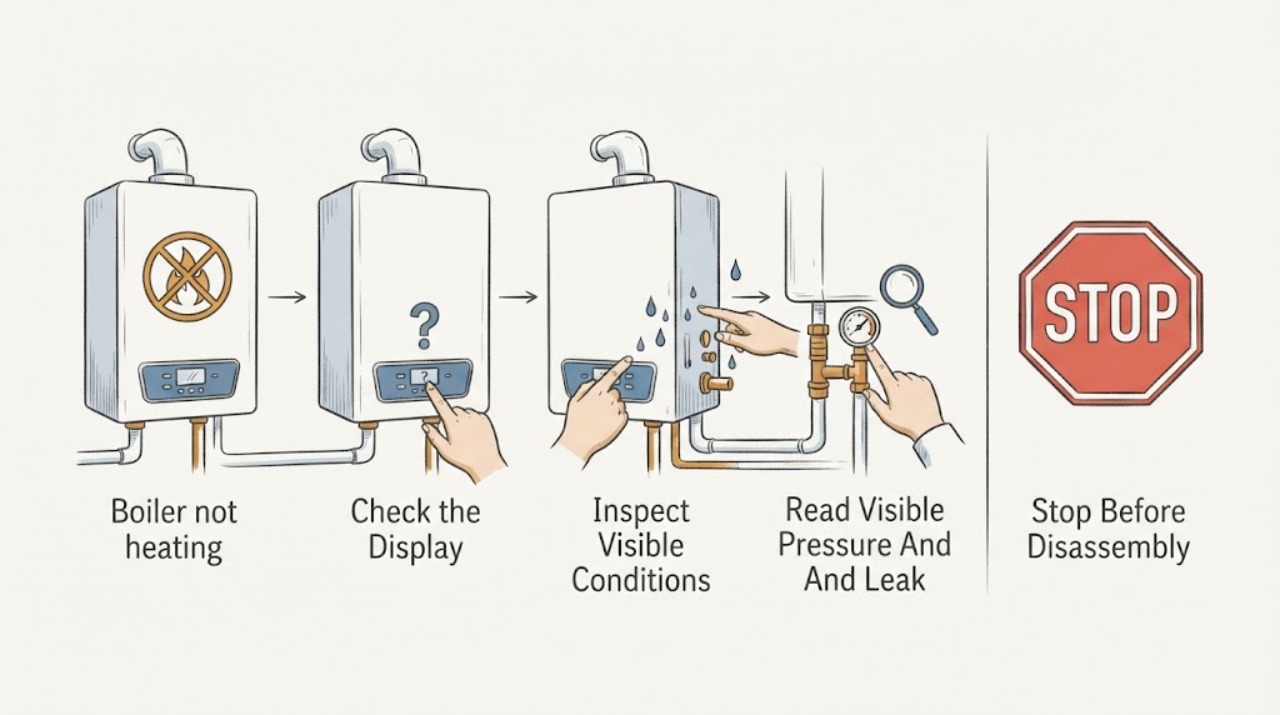
First separate a boiler that is not firing from a boiler that fires but does not deliver heat to the home. Check the thermostat or zone control's call for heat, the Rheem display for a warning or alarm, and the visible supply and return temperatures or pressure indication without opening the cabinet. Rheem's FT Series and ThermaForce platforms use touchscreen status and diagnostics, a boiler pump, outdoor-reset control, and low-water or high-limit safety functions, so the display and heat-demand pattern can point to the next safe step. From outside the unit, look for blocked combustion-air or vent terminations, leaks or corrosion, and obvious zone or pump symptoms; do not adjust gas, combustion, wiring, relief valves, pressure, or sealed components. If there is a gas odor, carbon-monoxide alarm, smoke, scorching, water leak, abnormal pressure, repeated lockout, or no heat after the basic observations, turn the boiler off when safe and call a qualified boiler technician.
Work through in order
Diagnostic checks
Use only checks that match the exact appliance or system and its official guide.
-
Check 1
Raise the thermostat only enough to confirm a normal heat call, verify the affected zone is selected, and read the Rheem boiler display without opening the cabinet.
Expected result: Record no heat call, a heat call with a normal status display, a dark display, a warning or alarm, or a safety lockout indication.
Next step: Keep the displayed code or status for the technician and follow only the exact user-manual instruction for that model. Do not repeatedly reset an alarm or change hidden settings.
Stop if: Stop if there is a gas odor, carbon-monoxide alarm, smoke, scorching, water near electrical equipment, or another immediate safety warning.
Why this matters
Why: No call points toward thermostat or zone control; a call with no response points toward power, lockout, fuel, control, or flow; a visible alarm needs model-specific interpretation.
-
Check 2
From a safe position, note whether the boiler starts during the heat call and whether the affected zone's pump, valve, radiators, baseboards, radiant floor, or air handler shows any heat response.
Expected result: Record no boiler response, boiler operation with all zones cold, boiler operation with one zone cold, or boiler operation with the affected zone warming slowly.
Next step: Document the affected zone and timing. Leave internal controls, pumps, valves, and wiring to a qualified technician when the visual response is abnormal.
Stop if: Do not remove covers, touch hot pipes, force a valve, purge a zone, or test gas or electrical components.
Why this matters
Why: No boiler response makes demand, power, lockout, fuel, venting, or control relevant; one cold zone makes flow, zone control, air, valve, or pump more relevant than the burner alone.
-
Check 3
Without touching valves or removing panels, read any visible pressure or temperature indication and inspect accessible piping, joints, relief discharge, and the floor around the boiler.
Expected result: Record a stable-looking indication, an abnormal or rapidly changing indication, water or corrosion, relief-pipe moisture, or no visible gauge or leak.
Next step: Leave the boiler off for active leakage or abnormal pressure and arrange qualified service. Give the technician the reading trend and first wet point without adjusting the system.
Stop if: Do not refill, bleed, drain, operate a relief valve, tighten pressurized fittings, or touch hot discharge.
Why this matters
Why: Abnormal pressure, leakage, or corrosion can prevent safe heating or indicate a system fault; a normal-looking gauge does not rule out a pump, zone, control, or combustion problem.
-
Check 4
From outside the appliance, look at the vent and combustion-air terminations, condensate outlet, and surrounding area for an obvious obstruction, disconnection, ice, debris, water, or combustible storage.
Expected result: Record clear terminations and outlet, an obstruction or ice, a disconnected or overflowing condensate route, water or corrosion, or no safe view of the terminations.
Next step: Keep the boiler off and call a qualified technician for an obstruction that cannot be safely cleared from the ground, a disconnected condensate route, water, or any combustion concern.
Stop if: Do not climb, dismantle venting, open the combustion cabinet, clean a burner, or alter a condensate trap or gas connection.
Why this matters
Why: An obstructed air or vent path or a condensate problem can affect safe operation and heat delivery; a clear exterior path does not prove the internal vent, burner, or drain is sound.
-
Check 5
If the Rheem unit is a combi boiler, note whether domestic hot water works while space heating does not; for any boiler, compare the affected zone with another zone if the system has more than one.
Expected result: Record both functions unavailable, domestic hot water available but space heat absent, all zones cold, or only one zone cold.
Next step: Provide the function comparison to the technician and avoid changing zone settings or opening the combi block or control compartment.
Stop if: Do not run the boiler continuously to force heat, bypass a zone control, or touch hot-water or heating piping.
Why this matters
Why: A combi unit that makes domestic hot water but not space heat makes the space-heating demand, zone, pump, or control path more relevant; one cold zone is different from an entire boiler failure.
-
Check 6
Record the Rheem model and serial information if safely visible, display status or error, thermostat and zone behavior, boiler start response, pump or zone observations, visible pressure or leak signs, vent and condensate observations, outdoor conditions, and which functions still work.
Expected result: Confirm that the handoff contains labels and external observations only, with no cover removed, safety defeated, gas or electrical test, valve adjustment, or pressure change.
Next step: Contact the installer, qualified boiler contractor, or Rheem support route and provide the model, status, timing, photos of visible conditions, and any safety warning.
Stop if: Stop homeowner troubleshooting when diagnosis requires combustion measurement, electrical testing, gas work, cabinet access, pressure adjustment, or internal component access.
Why this matters
Why: A complete symptom record helps a qualified technician distinguish demand, control, flow, venting, combustion, safety, and heat-exchanger paths without unsafe homeowner tests.
Use your observations
Decision map
Find the observation that best matches what you see, then follow the next safe action.
-
PATH 01Safety boundary
What you see
The thermostat or zone is not calling for heat, or the Rheem display is dark when the boiler should be available.
Do this next
Verify only the normal thermostat and zone selection, record display status, and call a qualified technician if the demand or display remains abnormal.
Why this path and its safety boundary
Why it matters: Demand, power, control, or lockout is more likely than a confirmed heat-exchanger failure, but the cause cannot be isolated safely from the outside.
Safety stop: Do not open the electrical compartment, reset a breaker repeatedly, or bypass thermostat or safety wiring.
-
PATH 02Next step
What you see
The boiler responds to a heat call and another zone or domestic-hot-water function works, but one heating zone remains cold or warms slowly.
Do this next
Leave internal pumps and valves untouched, record the affected zone and timing, and arrange qualified hydronic service.
Why this path and its safety boundary
Why it matters: Zone demand, circulation, air, valve, pump, or flow is more likely than a complete burner failure.
-
PATH 03Safety boundary
What you see
All zones are cold and the boiler shows a warning, alarm, lockout, or repeated failed-start behavior.
Do this next
Turn the boiler off when safe, preserve the exact display message, and call a qualified Rheem boiler technician. Do not repeatedly reset or open the unit.
Why this path and its safety boundary
Why it matters: A model-specific safety, ignition, fuel, venting, low-water, high-limit, sensor, control, or circulation condition is possible; the displayed status is more useful than guessing a part.
Safety stop: Stop immediately for gas odor, smoke, scorching, carbon-monoxide alarm, water near electrical equipment, or a hot or leaking relief path.
-
PATH 04Safety boundary
What you see
There is an obstructed or disconnected vent or combustion-air termination, condensate overflow, leak or corrosion, relief-pipe moisture, or abnormal pressure indication.
Do this next
Keep the boiler off and request qualified service. Provide photographs and the first location or indication observed without touching the affected component.
Why this path and its safety boundary
Why it matters: Safe operation, water circulation, venting, or system integrity is in question; a thermostat adjustment will not establish the cause.
Safety stop: Do not climb, dismantle venting, adjust pressure, operate a relief valve, or open sealed combustion or condensate components.
-
PATH 05Safety boundary
What you see
A carbon-monoxide detector alarms, there is a gas odor, smoke, scorching, flame concern, electrical water exposure, flooding, or an unsafe high-temperature or pressure symptom.
Do this next
Leave the area or keep clear, do not operate the boiler, and use the appropriate emergency, gas, electrical, or plumbing response from a safe location.
Why this path and its safety boundary
Why it matters: The immediate risk is fire, gas, carbon monoxide, electric shock, scalding, or property damage rather than identifying a failed boiler part.
Safety stop: Do not touch the boiler, gas piping, wiring, hot discharge, or wet equipment, and do not restore operation to reproduce the symptom.
Helpful context
Understand the symptom
Start with the heat demand and the boiler display
Confirm that the thermostat or zone control is requesting heat and that the boiler is intended to heat the affected zone. Record whether the Rheem display is dark, showing normal status, showing a warning or alarm, or showing a lockout. Rheem describes touchscreen status, troubleshooting information, and historical or diagnostic data on its boiler platforms. A no-display condition, a clear heat demand with no response, and a displayed alarm are different service paths; do not repeatedly reset an alarm without the model instructions.
Determine whether the boiler is firing or the heat is not circulating
From a safe position, note whether the boiler starts during a heat call, whether the boiler pump or zone pump appears to operate, and whether the radiators, baseboards, radiant floor, or air handler in the affected zone warm at all. A boiler that never starts points toward demand, power, lockout, fuel, venting, or control conditions; a boiler that runs while one zone stays cold points more toward flow, a zone control, air, valve, or pump issue. These observations do not authorize opening the cabinet or testing gas or electrical components.
Use visible system condition as evidence
Look only at accessible exterior piping, gauges or display indications, relief discharge piping, condensate outlet, and the vent and combustion-air terminations. Rheem's winter guidance calls for visual checks for leaks or corrosion, obstructions at vent and combustion-air terminations, relief-valve moisture, and condensate-route issues. A leak, abnormal pressure indication, blocked termination, or disconnected condensate route warrants service rather than a homeowner adjustment.
Treat outdoor reset and safety states as model-specific
Rheem describes outdoor-reset control as adjusting the boiler supply temperature with outdoor conditions, and its products include low-water cutoff, high-limit, flame, and reverse-flow protections. A cooler home on a mild or changing day can therefore have a control or zone symptom without proving a failed burner. Record the outdoor conditions, thermostat setting, display state, and whether domestic hot water still works on a combi model. Do not defeat a safety, change combustion settings, or bypass a lockout.
Know when a heating call is required
Call a qualified boiler professional when the boiler does not respond to a confirmed heat call, the display shows a recurring warning or lockout, the pump or zone is not circulating, the system has a leak or abnormal pressure, the vent or combustion-air path may be obstructed, or internal diagnosis is needed. Rheem provides model documentation and service-oriented support, but a general symptom cannot identify a safe replacement part. If a carbon-monoxide detector alarms, there is a gas odor, smoke, scorching, or a rapidly worsening leak, leave the area and use the appropriate emergency response.
Safety boundary
Stop conditions
- Stop immediately for gas odor, carbon-monoxide alarm, smoke, scorching, flame concern, water near electrical equipment, flooding, an unsafe relief discharge, or an unstable vent or appliance.
- Leave the Rheem boiler off for a recurring lockout, abnormal pressure, active leak, condensate overflow, blocked combustion-air or vent path, or no heat after a confirmed demand and safe external checks.
- Do not open the cabinet or electrical compartment, adjust gas or combustion settings, bypass a safety or thermostat, refill or drain the system, operate a relief valve, dismantle venting, or test live wiring as a homeowner.
Only after diagnosis
Potential parts
- boiler or zone pump assembly
Consider this only after a qualified technician confirms that a required pump is not circulating, is electrically or mechanically failed, or is leaking after the demand, controls, and system flow are assessed.
Match the exact Rheem model, pump position, electrical and hydronic connections, and manufacturer-approved part; do not infer a pump replacement from a cold zone alone. - thermostat or zone-control component
Consider this only when a qualified technician confirms that the thermostat or zone control is not passing a valid heat demand and the boiler and wiring paths are otherwise sound.
Confirm the installed Rheem boiler, control scheme, zone arrangement, and approved low-voltage component before ordering or changing controls. - temperature sensor or safety-control component
Consider this only after the exact display status and professional testing identify a failed sensor or safety-control component; a generic no-heat symptom does not establish the part.
Use the exact model documentation and qualified service procedure. Never bypass or substitute a safety control based on appearance.
When checks do not resolve it
Need a professional?
Call a qualified boiler technician for no response to a confirmed heat call, a dark or alarmed Rheem display, repeated lockout, one or more cold zones, pump or flow symptoms, abnormal pressure, leaks or corrosion, a vent or condensate concern, or any diagnosis requiring cabinet, combustion, gas, electrical, pressure, or sealed-component access. Use emergency, gas, carbon-monoxide, electrical, or plumbing help for odor, alarm, smoke, fire, flooding, water near energized equipment, or unsafe hot or pressure discharge.
Have this ready
- Provide the Rheem model and serial information if safely visible, display status or exact error, thermostat and zone behavior, boiler start response, which zones or domestic-hot-water functions work, pump observations, visible pressure or leak signs, vent and condensate observations, outdoor conditions, recent service or changes, photos, and any gas, carbon-monoxide, electrical, smoke, or water warning.
Common questions
FAQ
Why is my Rheem boiler running but the house is still cold?
If the boiler starts but one zone stays cold, flow, a zone control, pump, valve, or air problem is more likely than a complete burner failure. Record which zones respond and leave pump, valve, pressure, and internal work to a qualified boiler technician.
What should I check on a Rheem boiler that will not start?
Confirm a normal thermostat or zone heat call and read the Rheem display for a warning or lockout. Do not repeatedly reset an alarm or open the cabinet; preserve the status message for a qualified technician if the boiler does not respond.
Can a blocked vent or condensate problem stop a Rheem boiler from heating?
An obstructed vent or combustion-air termination, disconnected condensate route, or visible water or corrosion can affect safe operation. Inspect only from a safe exterior position and arrange qualified service rather than dismantling venting or opening the appliance.
When should I turn off a Rheem boiler that is not heating?
Turn it off when safe for a recurring lockout, abnormal pressure, active leak, condensate overflow, blocked vent path, or persistent no-heat condition. Leave immediately and use appropriate emergency help for gas odor, a carbon-monoxide alarm, smoke, fire, flooding, or water near electrical equipment.
Read the exact guide
Official sources
- Now Available! Rheem FT Series Combi BoilerRheem Manufacturing Company · Rheem's official combi-boiler article supports comparing space heat with domestic hot water and identifying model-specific control and safety boundaries; it does not diagnose an installed unit.
- Comfort Starts Here: Key Signs Your Boiler Is Due for ReplacementRheem Manufacturing Company · Rheem's official boiler article supports the safety escalation and service-handoff language; it is not a model-specific diagnosis.
- Rheem FT Series Super High Efficiency Condensing Gas BoilersRheem Manufacturing Company · Rheem's official related-documents page is used to direct model-specific documentation selection without inventing a model or procedure.
- Rheem FT Series Super High Efficiency Condensing Gas BoilersRheem Manufacturing Company · Rheem's official FT product page supports the general control and safety context; exact model status and service instructions must come from the installed manual and a qualified technician.
- Winter-Proofing Your Home's Water Heating System: A Complete Guide for Heat Pumps, Tankless Units and BoilersRheem Manufacturing Company · Rheem's official seasonal guide supports safe external observations for FT Series and ThermaForce boilers; it does not replace the installed manual or authorize internal service.
- ThermaForce FTRheem Manufacturing Company · Rheem's official boiler portfolio page supports the product-level distinctions used here; the installed model's user and installation manuals govern all exact settings and procedures.
Community feedback
Share a repair observation
Share a plain-text repair observation. Accepted observations are published automatically; this page may take a moment to update.