
On this page
Start here
Quick answer
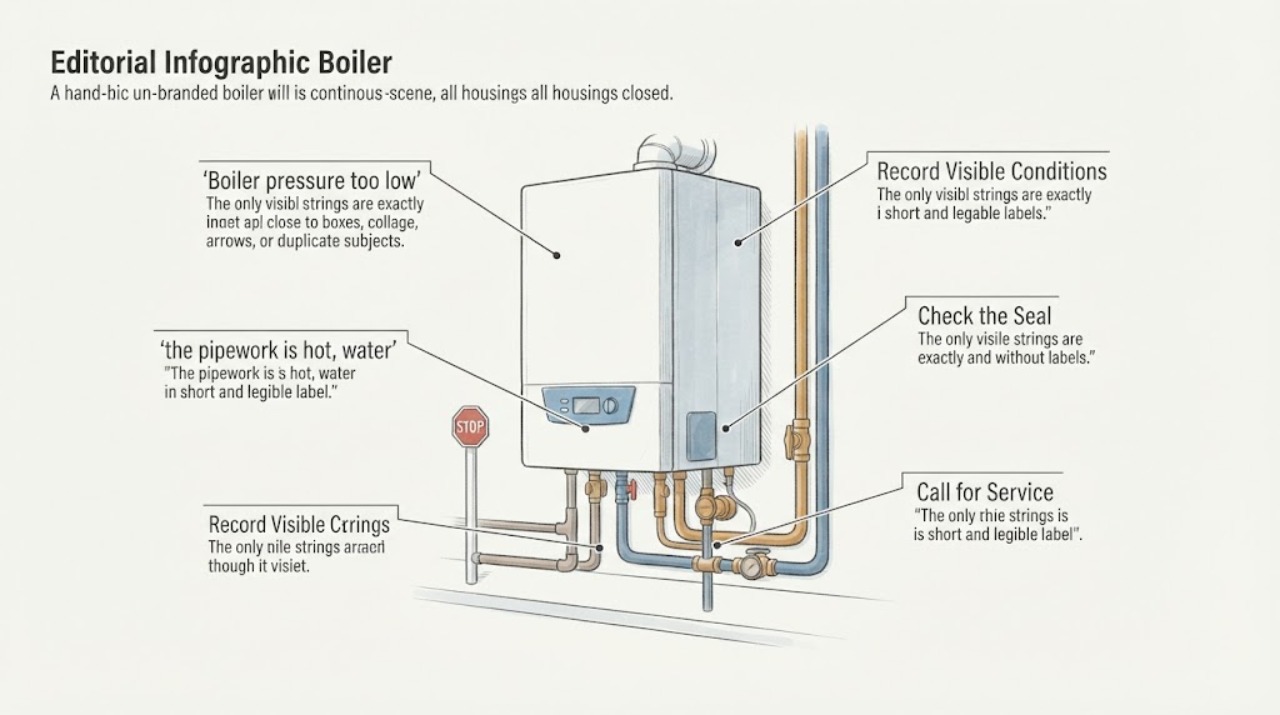
A Rheem boiler showing low pressure may have lost water through a visible or concealed leak, discharged through a relief path, or developed an expansion-vessel, filling-device, pressure-sensor, or gauge problem. Let the system cool, compare the gauge and display with the exact Rheem model manual, and inspect only accessible pipework and discharge points for water. If the manual identifies a homeowner filling procedure and there is no active leak, follow that procedure once and stop at the manual's marked range. If the reading will not rise, falls again, rises sharply while heating, or the boiler locks out, leave it off as appropriate and arrange qualified boiler service.
Before you begin
Safety first
- A professional should handle internal boiler work, gas and electrical components, pressure sensors and gauges, expansion vessels, relief devices, filling and pressure-reducing assemblies, concealed leaks, and any low-water safety control. Keep homeowner work to cool-system readings, visible checks, and a clearly documented manual procedure.
Work through in order
Diagnostic checks
Use only checks that match the exact appliance or system and its official guide.
-
Check 1
If the boiler is firing, the pipework is hot, water is escaping, or the floor is wet near electrical equipment, stop the heating call and isolate power or fuel only as the Rheem instructions permit; do not touch hot surfaces or open the casing.
Expected result: There is steam, very hot water, active dripping, a gas odor, smoke, a carbon-monoxide alarm, water near electrics, or none of these immediate hazards.
Next step: Leave the appliance out of service and use emergency or qualified help for gas odor, smoke, a carbon-monoxide alarm, scalding water, or an active unsafe leak. Otherwise allow the system to cool before reading pressure.
Why this matters
Why: Heat, combustion, gas, electrical, and uncontrolled-water hazards make pressure troubleshooting unsafe. The absence of those signs permits only external observation and manual-directed checks.
-
Check 2
With the heating system cool or idle, record the Rheem model, the analog gauge position, any controller pressure value, the displayed fault text, and whether the reading is inside the range marked in that exact manual.
Expected result: The gauge is below the manual range, the display reports low pressure, the reading changes substantially only when heating, or the gauge and display disagree.
Next step: Keep the readings and operating condition for the service record. Continue with the external leak check; if the manual range is unavailable or the indicators disagree, do not guess a target or open the appliance.
Why this matters
Why: A low cool reading or matching low-pressure message supports insufficient water in the heating circuit. A hot-only change may reflect thermal expansion, while disagreement keeps a gauge or pressure-sensor fault in consideration.
-
Check 3
Inspect accessible radiator or baseboard valves, exposed heating joints, the floor below the boiler, nearby walls or ceilings, and the outlet of any visible relief-discharge pipe for dampness, rust, staining, mineral marks, or a drip; do not loosen or tighten fittings.
Expected result: A valve, pipe, wall, ceiling, floor, or discharge point is wet or stained, or all accessible areas are dry.
Next step: For active water loss, protect the area from damage without blocking a discharge pipe and arrange qualified heating service. If no leak is visible, continue only with the model manual's permitted checks and monitor recurrence.
Why this matters
Why: A wet or stained location identifies a likely water-loss path or relief event. Dry accessible surfaces do not exclude a concealed pipe leak, internal boiler leak, or intermittent discharge.
-
Check 4
If the Rheem manual identifies the installed filling loop, key, or automatic fill control and allows homeowner use, confirm externally that the device is identifiable and not obviously damaged; do not force an unknown valve or alter a pressure-reducing or backflow assembly.
Expected result: The correct device and instructions are clear, the device is absent or uncertain, the device is damaged, or the system has an active leak or discharge.
Next step: Use the manual's exact procedure only when the system is cool, no active leak is present, and the user boundary is explicit. Otherwise keep the fill path closed and arrange qualified service.
Why this matters
Why: A documented filling arrangement may allow one controlled recovery. An unknown or damaged arrangement, or a system already losing water, makes blind filling unsafe and can hide the cause or overfill the circuit.
-
Check 5
When the manual permits a homeowner top-up and the external checks show no active leak, perform that filling step slowly while watching the gauge or display, then close and secure every valve, key, cap, or removable link exactly as instructed.
Expected result: Pressure rises into the manual's marked range and stays there, rises slowly but then falls, will not rise, or overshoots the marked range.
Next step: Stop filling immediately for failure to rise, immediate loss, or overshoot. Do not leave the device open or repeat top-ups; arrange qualified boiler service and report the observed pattern.
Why this matters
Why: A stable rise can restore a gradual one-time loss. Immediate fall or failure to rise suggests a significant leak, filling-device fault, relief issue, or sensor problem. Overshoot suggests overfill or pressure-control trouble and is not corrected by adding more water.
-
Check 6
After a permitted top-up, observe one attended heating cycle from outside the appliance and recheck the pressure under the same cool or operating condition used earlier; note whether the change is stable, gradual, or sharp.
Expected result: The pressure remains near the manual range, gradually declines over later cycles, rises sharply as the system heats, or the boiler locks out again.
Next step: Stop compensating with repeated filling. Arrange a qualified heating professional for any recurring decline, sharp rise, relief discharge, or lockout, and keep the recorded readings for diagnosis.
Why this matters
Why: A stable result supports a temporary loss that may have been corrected. A repeated decline supports ongoing water loss. A sharp rise or recurring lockout points toward expansion, relief, sensor, circulation, or another system fault.
-
Check 7
Compare the physical gauge, controller status, and any low-water or pressure-related fault message without resetting repeatedly or removing a panel.
Expected result: All indicators agree on low pressure, the controller reports low pressure while the gauge appears normal, or the gauge appears low while the controller does not.
Next step: Use the exact Rheem manual and arrange qualified service for a persistent mismatch or recurring fault. Never bridge a sensor, defeat the low-water cutoff, or adjust internal wiring as a homeowner test.
Why this matters
Why: Agreement supports genuinely low system water pressure. A mismatch makes a gauge, pressure sensor, wiring, or model-specific interpretation issue more likely than a simple need for water.
Use your observations
Decision map
Find the observation that best matches what you see, then follow the next safe action.
-
PATH 01Next step
What you see
The cooled-system reading is low and an accessible valve, pipe, wall, floor, or relief-discharge area is damp, stained, corroded, or actively dripping.
Do this next
Keep the boiler off as appropriate, avoid tightening or blocking anything, protect nearby materials, and arrange qualified heating service before relying on another top-up.
Why this path and its safety boundary
Why it matters: Water loss is more likely than a harmless gauge fluctuation, and the visible location may be only the first accessible clue to a larger leak.
-
PATH 02Next step
What you see
The pressure rises into the Rheem manual's marked range using the documented filling method and remains stable under comparable readings.
Do this next
Record the final reading and watch for a later decline or discharge. Do not turn a successful one-time recovery into a routine of repeated filling.
Why this path and its safety boundary
Why it matters: A gradual one-time loss or prior air bleeding is more plausible, although the underlying system still needs observation for recurrence.
-
PATH 03Next step
What you see
The reading falls again shortly after filling, frequent top-ups are needed, or the filling device cannot raise pressure.
Do this next
Stop repressurising and arrange a qualified boiler inspection. Leave the filling path closed and tell the technician how quickly the pressure changes.
Why this path and its safety boundary
Why it matters: A leak, relief-path problem, filling-device fault, concealed loss, or sensor issue is more likely than normal temperature variation.
-
PATH 04Next step
What you see
Pressure rises sharply during heating, exceeds the Rheem manual's marked range, or a relief outlet discharges water.
Do this next
Stop adjusting the fill device and arrange qualified heating service. Do not lift, cap, block, or replace the relief device, and do not remove the boiler casing.
Why this path and its safety boundary
Why it matters: Overfill, an expansion-vessel problem, pressure-control fault, or relief-device operation is more likely; bleeding or adding water without diagnosis can worsen the condition.
-
PATH 05Next step
What you see
The gauge and Rheem controller disagree, or a low-water fault returns while the gauge appears within the manual range.
Do this next
Leave safety controls intact and arrange qualified diagnosis. Provide the model, both readings, fault text, and whether each reading was taken cold or while heating.
Why this path and its safety boundary
Why it matters: A pressure sensor, gauge, wiring, display, or model-specific control interpretation is more likely than a simple low-water condition.
Helpful context
Understand the symptom
Start with the exact Rheem model and a cool-system reading
Rheem sells more than one boiler platform, and its product pages provide model-specific installation, operating, and use-and-care documents. Pressure marks, displays, filling arrangements, and fault behavior can differ, so use the manual for the serial or model number on the appliance. A reading changes as the heating water warms; compare the gauge at a similar cool or idle condition and note whether a digital display agrees.
Low pressure usually means water has left the heating circuit
The boiler, radiators or baseboards, valves, and connecting pipework form a water-filled heating circuit. A damp valve, corrosion mark, relief discharge, concealed pipe leak, or internal leak can lower its pressure. A system that was recently bled may also need the model-approved refill procedure. Dry visible surfaces do not rule out a hidden loss.
Treat a top-up as a controlled recovery, not a diagnosis
Some sealed systems have a filling loop, key, or automatic filling arrangement, but the correct device and target are model and installation dependent. Only use a homeowner procedure that the Rheem manual explicitly provides. Do not force an unknown valve, leave a filling link open, bypass a low-water cutoff, or keep adding water when pressure does not stabilize.
A pressure swing can point away from a simple low reading
Pressure that rises sharply when the boiler heats can indicate overfilling, an expansion-vessel problem, or pressure-control trouble. A physical gauge that disagrees with the controller can indicate a gauge, sensor, wiring, or model-specific display issue. These patterns need diagnosis, not a guessed setting or repeated resets.
Keep internal boiler and fuel work professional
The homeowner-safe boundary is reading the controls, documenting conditions, looking for accessible water, and using a clearly documented model-specific filling step when permitted. Do not remove the Rheem casing, adjust gas controls, open electrical compartments, loosen heating connections, service a relief device, or replace a sensor, pump, or expansion vessel without qualified service.
Safety boundary
Stop conditions
- Stop and arrange qualified service if pressure will not rise, falls immediately or repeatedly, rises sharply during heating, exceeds the Rheem manual's range, or a relief outlet discharges water.
- Do not remove the boiler casing, adjust gas or electrical controls, loosen heating joints, open a relief valve, block a discharge pipe, bypass the low-water cutoff, or replace an internal part as an ordinary homeowner task.
- If there is gas odor, smoke, a carbon-monoxide alarm, steam or scalding water, active water near electrical equipment, or an uncontrolled leak, leave the area as appropriate and use emergency or qualified professional help.
- Do not repeatedly reset a low-pressure lockout or keep adding water when the model-specific filling method, pressure range, or cause is uncertain.
Only after diagnosis
Potential parts
- boiler pressure gauge
Consider this only after a qualified comparison confirms the physical gauge is inaccurate or damaged; a low reading can represent real water loss or another system fault.
Match the exact Rheem boiler model, connection, pressure range, and approved service procedure. - boiler pressure sensor
Consider this only when the controller and gauge disagree or a qualified diagnosis confirms a sensor, connector, or wiring fault.
Confirm the exact Rheem model, sensor type, connector, calibration, and installation instructions; do not bypass the sensor or low-water protection. - hydronic expansion vessel
Consider this only after a qualified diagnosis of sharp pressure rise, relief discharge, or loss of pressure associated with expansion behavior.
Confirm the installed system design, vessel capacity and connection, isolation and drain procedure, and exact Rheem documentation before replacement. - automatic fill or pressure-reducing valve
Consider this only when the filling path does not maintain the manual's specified pressure and a professional has ruled out leaks and other causes.
Match the exact installed hydronic assembly, water-supply connection, relief requirements, and Rheem-approved service parts.
When checks do not resolve it
Need a professional?
Safety scope: A professional should handle internal boiler work, gas and electrical components, pressure sensors and gauges, expansion vessels, relief devices, filling and pressure-reducing assemblies, concealed leaks, and any low-water safety control. Keep homeowner work to cool-system readings, visible checks, and a clearly documented manual procedure.
Common questions
FAQ
Why is my Rheem boiler pressure too low?
The heating circuit may have lost water through a radiator or pipe leak, relief discharge, concealed leak, or internal fault. A gauge or pressure sensor can also misread. Check the cooled-system reading and accessible water clues, then use the exact Rheem manual before any permitted top-up.
Can I refill a Rheem boiler with low pressure?
Only when the exact Rheem manual identifies the installed filling arrangement and provides a homeowner procedure, the system is cool, and there is no active leak or discharge. Follow the marked range once, close the device exactly as instructed, and stop if pressure does not stabilize.
Why does my boiler pressure keep dropping after I refill it?
A recurring drop points to water loss, a relief-path problem, a filling-device fault, a concealed leak, or an internal component issue. Repeated filling only masks the symptom; document how quickly the reading falls and arrange qualified service.
Why does the pressure rise when my Rheem boiler heats?
Some change as water warms is expected, but a sharp rise, relief discharge, or reading outside the Rheem manual's range can indicate overfill, expansion-vessel trouble, or pressure-control failure. Stop adjusting the fill path and have the system assessed.
What if the Rheem gauge and display do not agree?
Treat the mismatch as a diagnostic clue rather than proof that water is needed. A gauge, pressure sensor, wiring, display, or model-specific control issue may be involved. Do not bypass a safety device or open the casing; provide both readings to a qualified technician.
Read the exact guide
Official sources
- How to repressurise a boilerVaillant · Homeowner guidance for compatible sealed boiler systems; filling device and target must be taken from the installed Rheem manual
- How often should I need to top up the pressure in the heating system?Worcester Bosch · Worcester Bosch sealed heating systems; use only as general hydronic guidance and follow the Rheem manual for targets
- What do I do if my boiler had no pressureVaillant · General sealed residential boiler guidance; Vaillant-specific procedures and pressure markings do not replace a Rheem manual
- Why is my boiler losing pressure?Vaillant · General residential central-heating pressure-loss guidance; brand and model behavior varies
- ThermaForce FT - Rheem Manufacturing CompanyRheem · Rheem ThermaForce and FT boiler families; use the exact product manual for the installed model
- Boiler fault codes listVaillant · Vaillant fault-code guidance only; do not map its codes to Rheem or infer a Rheem repair from a similar symptom
- Rheem FT Series Super High Efficiency Condensing Gas BoilersRheem · Rheem FT series condensing gas boilers; other Rheem models require their own manual and controls
Community feedback
Share a repair observation
Share a plain-text repair observation. Accepted observations are published automatically; this page may take a moment to update.