
On this page
Start here
Quick answer
When a Rheem central air conditioner suddenly makes a loud noise, turn cooling off and identify where and when the sound occurs: indoor air handler, outdoor condenser, duct or register, startup, steady operation, shutdown, or only after rain or debris. A brief normal operating change can differ from rattling, scraping, grinding, buzzing, humming, banging, or a fan that is striking something. Check only the thermostat, filter, registers, and loose debris outside the cabinet with power left off; keep electrical and refrigerant panels closed. Rheem startup guidance says to listen for unusual noises and locate the source, while its technical tips list a loose blower wheel, motor or capacitor faults, restricted ducts, and dirty coils among equipment conditions. Stop for burning odor, smoke, sparking, a repeat breaker trip, compressor banging, fan contact, exposed wiring, or a unit that shakes or overheats, and arrange qualified HVAC service.
Before you begin
Safety first
- This article supports thermostat shutoff, ordinary-access filter and airflow observations, exterior debris observation with power left off, and recording sound timing from a safe distance. A qualified person must handle electrical testing, panel removal, blower or fan access, compressor and refrigerant work, capacitor replacement, wiring, and final startup.
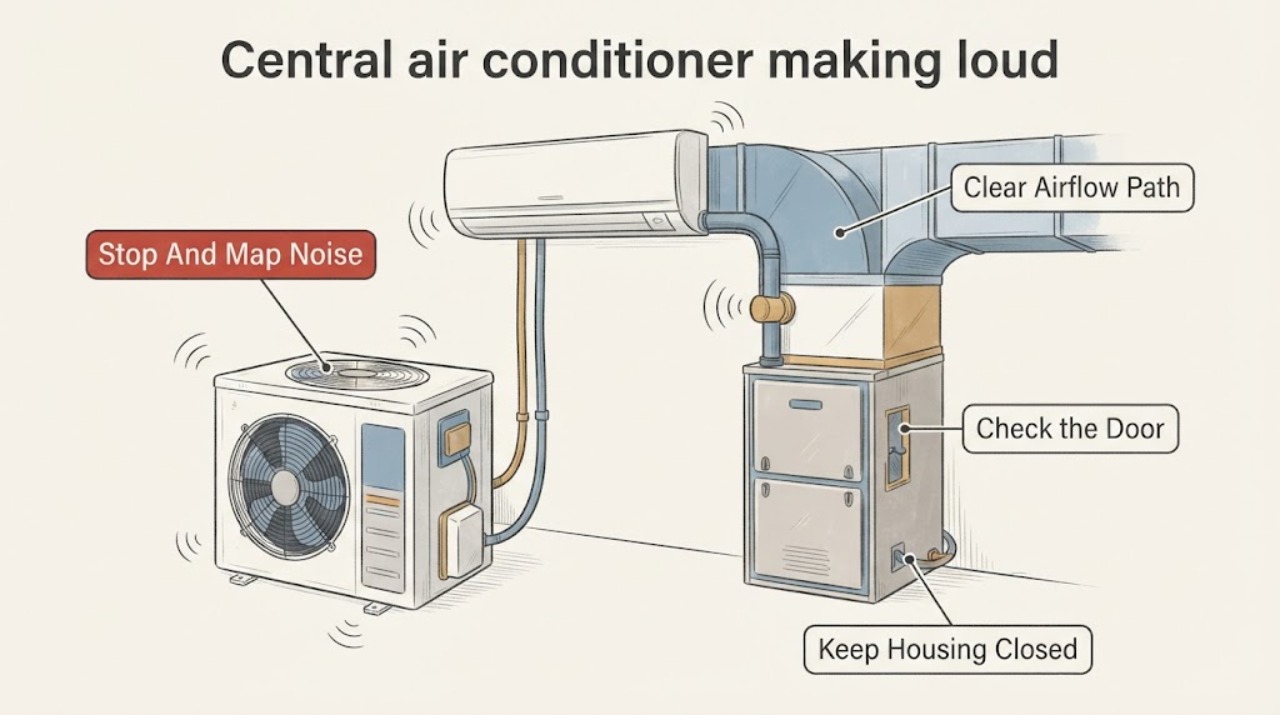
Work through in order
Diagnostic checks
Use only checks that match the exact appliance or system and its official guide.
-
Check 1
Set the thermostat to stop cooling and listen from a safe distance without opening a panel; note the first location and capture a short recording only if doing so does not put you near moving or energized parts.
Expected result: Classify the sound as indoor blower or duct noise, outdoor fan or cabinet noise, compressor-area noise, an electrical buzz, a bang or scrape, or a sound that occurs only at startup, shutdown, or after the unit stops.
Next step: Keep cooling off while the sound is new, loud, or unexplained and choose a branch below. If the source is near electrical equipment or the unit shakes, smokes, or smells hot, leave it off and arrange urgent qualified service.
Stop if: Stop immediately for burning odor, smoke, sparking, exposed wiring, a loud impact, refrigerant damage, or a breaker that trips again.
Why this matters
Why: Location and timing narrow the likely system area but do not prove a failed part. A scrape or bang tied to fan movement suggests contact or loose mechanical material; a buzz or hard hum tied to startup raises an electrical or motor concern; duct-only vibration may be transmitted noise rather than the source.
-
Check 2
With the system off, inspect the filter at its ordinary access point and look at return grilles, supply registers, and accessible duct openings; do not open the indoor cabinet.
Expected result: Record a clean or loaded filter, a wet or damaged filter, blocked returns, closed supplies, weak airflow, whistling at a grille, or a rattle that changes when a register grille is gently observed from outside.
Next step: Replace a disposable filter only with the exact specified size and type, reopen an accidentally closed register, and clear ordinary return obstructions. Keep cooling off and call service if the loud sound, weak airflow, ice, or abnormal cycling remains.
Stop if: Do not run without a filter, insert tools into a register, remove the blower panel, or continue operation when water, ice, smoke, or hot electrical odor is present.
Why this matters
Why: A dirty or restrictive filter and blocked airflow can make the blower work harder and can contribute to coil icing; a loose grille or duct can add a whistle or rattle. Weak airflow with a clean correct filter points toward a blower, coil, duct, or control issue that needs service.
-
Check 3
With cooling off and power left off for any clearing, look around the outdoor condenser for leaves, twigs, loose panels, damaged line insulation, or objects touching the cabinet; do not reach through the grille or wash the unit.
Expected result: Record a clear cabinet, loose debris outside it, a panel that visibly vibrates, a fan that is not turning during a normal call, a fan-blade contact mark, unusual vibration, or visible electrical or refrigerant-line damage.
Next step: Remove only loose objects that are clearly outside the cabinet, then leave cooling off if the noise returns or any damage or abnormal fan behavior remains. Arrange qualified service for fan contact, vibration, damage, or a persistent outdoor sound.
Stop if: Do not open the condenser, push the fan, straighten fins, spray inside, touch wiring, or operate after line, cabinet, or electrical damage is visible.
Why this matters
Why: Loose exterior debris or a vibrating panel can create a rattle, but a fan contact mark, non-running fan, abnormal vibration, line damage, or electrical damage points to a motor, fan, compressor, cabinet, or sealed-system concern. A visual check cannot prove that a fan or compressor is safe to operate.
-
Check 4
Look only at ordinary-access areas for frost, ice, water, or a wet filter and note whether the noise changes as the system runs; do not remove the coil panel or chip ice.
Expected result: Record no ice or water, frost on visible tubing, a heavily iced coil area, water after shutdown, wet insulation, or a condensate safety interruption visible without panel removal.
Next step: Turn cooling off and let ice melt naturally. Correct only an obvious filter or register obstruction; arrange service for recurring ice, water, wet insulation, or a noise that returns after thawing.
Stop if: Do not chip ice, use a heat source, bypass a float, add refrigerant, or restart while water is near electrical equipment.
Why this matters
Why: Ice can restrict airflow and change blower sound, and meltwater can create a separate safety or drainage event. Rheem lists low airflow, dirty coil, blower problems, low charge, mismatched components, and low ambient operation among possible freezing-coil causes; ice does not identify one of them.
-
Check 5
Only when there is no smoke, hot odor, visible damage, ice, water near electrical equipment, or repeat breaker trip, make one normal thermostat call from a safe distance and note the sound at startup, steady operation, and shutdown; do not cycle the unit repeatedly.
Expected result: Record a brief sound that disappears, a noise that persists with the indoor blower, a sound that begins when the outdoor fan or compressor starts, a bang at shutdown, a hard hum without normal operation, or repeated starts and stops.
Next step: Turn cooling off when the abnormal sound returns and report its timing, location, airflow, temperature response, and any vibration. Arrange service rather than changing controls or restarting to compare sounds.
Stop if: Stop immediately for grinding, scraping, loud impact, smoke, burning odor, sparking, abnormal shaking, or a breaker trip.
Why this matters
Why: A sound tied to one motor or phase of operation helps the technician separate indoor blower, outdoor fan, compressor, cabinet, control, and duct paths. A hard hum with no normal start, repeated bang, or recurrent start-stop pattern is not a harmless confirmation test.
-
Check 6
After an obvious filter, register, or exterior-debris issue has been corrected and the unit is dry and free of stop conditions, make at most one short normal call and compare the sound with the earlier recording; keep all panels secured.
Expected result: Record quiet stable operation, the same sound returning, a new vibration, weak airflow, warm air, ice, water, or a change in breaker behavior.
Next step: Stop the system and arrange qualified diagnosis for any recurrence or new symptom. Provide the audio timing, source location, filter condition, airflow, outdoor observations, and whether the sound changed after the visible correction.
Stop if: Do not keep cycling the unit, run it with panels removed, reset protection repeatedly, or continue after water, ice, smoke, odor, or abnormal mechanical movement returns.
Why this matters
Why: A quieter run after removing an obvious obstruction supports that obstruction as a contributor but does not rule out a loose blower wheel, motor, capacitor, dirty coil, fan, compressor, or electrical issue. Recurrence means the visible check did not resolve the cause.
Use your observations
Decision map
Find the observation that best matches what you see, then follow the next safe action.
-
PATH 01Safety boundary
What you see
The sound is loudest at the indoor air handler or register, airflow is weak or uneven, the filter is loaded, or a rattle follows blower operation.
Do this next
Keep cooling off, correct only an obvious filter, return, supply, or grille obstruction, and call qualified service if the sound or weak airflow remains. The technician should inspect blower, coil, duct, and control operation.
Why this path and its safety boundary
Why it matters: A filter or airflow restriction, loose grille or duct, blower wheel, motor, capacitor, or indoor coil condition is more likely than an outdoor compressor-only fault. Rheem lists restricted ducts, dirty coil, loose blower wheel, and motor or capacitor faults in its technical guidance.
Safety stop: Do not open the blower compartment, reach into a register, oil an unknown motor, or run without the correct filter.
-
PATH 02Safety boundary
What you see
The sound starts at the outdoor condenser, follows fan movement, includes scraping or rattling, or occurs with a loose-looking panel, debris, vibration, or a fan that does not run normally.
Do this next
Leave cooling off after removing only loose exterior debris and arrange qualified HVAC service for persistent noise, fan contact, non-running fan, vibration, or panel movement. Report whether the indoor blower still ran.
Why this path and its safety boundary
Why it matters: Outdoor debris, a loose cabinet part, fan blade or motor problem, capacitor issue, or compressor-side fault is more likely. Exterior observation cannot distinguish a safe fan repair from an energized motor or compressor problem.
Safety stop: Do not reach through the grille, push the fan, open the outdoor cabinet, or spray water into the unit.
-
PATH 03Safety boundary
What you see
A buzz or hard hum occurs at startup, the unit fails to reach normal operation, a breaker trips, or the sound comes with hot odor, smoke, or sparking.
Do this next
Turn cooling off, do not reset the breaker again, and arrange qualified electrical and HVAC diagnosis. Tell the technician whether the indoor blower ran, whether the outdoor fan moved, and how the breaker behaved.
Why this path and its safety boundary
Why it matters: A start or run capacitor, contactor, motor, compressor, wiring, disconnect, or protection fault is more likely than a simple airflow obstruction. Rheem lists bad capacitors, contactors, fan motors, locked or shorted compressors, and damaged power wiring among breaker-trip causes.
Safety stop: Do not remove covers, test live terminals, replace a capacitor, or touch a disconnect after smoke, heat, water, or sparking.
-
PATH 04Safety boundary
What you see
The loud sound occurs with weak airflow, frost or ice, wet insulation, or water after the unit stops.
Do this next
Keep cooling off, let ice melt naturally, correct only an obvious filter or register obstruction, and arrange service for any recurrence, water, or persistent noise.
Why this path and its safety boundary
Why it matters: A frozen indoor coil and meltwater are plausible, with airflow restriction, dirty coil, blower condition, low charge, mismatched components, or low ambient operation among Rheem's listed possibilities. The noise may be a symptom of restricted or changing airflow rather than the original fault.
Safety stop: Do not chip ice, heat the coil, add refrigerant, bypass a safety, or keep running to dry the water.
-
PATH 05Safety boundary
What you see
The sound is brief at startup or shutdown, no damage or abnormal operation is present, and it does not recur during steady operation.
Do this next
Compare with the owner's manual and prior normal behavior, keep a recording, and arrange service if the event is new, grows louder, affects airflow, or returns on every cycle. Do not alter controls to mask it.
Why this path and its safety boundary
Why it matters: A normal operating transition or cabinet or duct expansion is possible, but a new bang, scrape, or repeated change cannot be cleared solely because it is brief. The time pattern is useful evidence for a technician.
Safety stop: Stop for a sharp impact, grinding, smoke, hot odor, vibration, breaker trip, or any sound accompanied by a loss of cooling or airflow.
Helpful context
Understand the symptom
The sound's location changes the first check
A loud sound from the indoor air handler points toward airflow, the blower wheel or motor, a filter, duct vibration, or a loose cabinet part. A sound from the outdoor condenser points toward the fan, compressor, cabinet, debris, or electrical operation. A register or duct can amplify a vibration that starts at the equipment. Record the location and timing before moving anything, because a sound that occurs only at startup or shutdown has a different diagnostic path from a scrape that continues while the fan runs.
Do not treat every hum as the same failure
A steady low operating sound can be normal for a large motor or compressor, but a new rattle, grinding sound, repeated bang, high-pitched squeal, electrical buzz, or hard-start hum is a change worth stopping for. Rheem's technical material lists a loose blower wheel, bad motor or capacitor, restricted duct, dirty coil, bad fan motor or capacitor, locked compressor, and damaged electrical components among possible causes. Those categories cannot be separated safely by opening the cabinet or guessing at a part.
Keep owner checks outside energized equipment
Use the thermostat to stop cooling, inspect the filter at its normal access point, check for blocked returns or registers, and look for loose debris around the outdoor cabinet with power left off. Do not reach through a grille, oil a motor without model instructions, tighten live electrical connections, add refrigerant, or reset a breaker repeatedly. Rheem's manual warns that service requires electrical precautions and qualified skills; a sound that returns after a simple visible correction still needs diagnosis.
Safety boundary
Stop conditions
- Turn cooling off for burning odor, smoke, sparking, exposed or damaged wiring, water near electrical equipment, refrigerant-line damage, a loud impact, severe vibration, or a breaker that trips again.
- Stop for scraping, grinding, fan contact, a hard hum without normal operation, a locked-looking motor, or a compressor noise that is new or worsening.
- Do not open electrical, blower, compressor, or refrigerant panels, test live terminals, replace capacitors, add refrigerant, force a fan, or run with panels removed.
- Do not keep cycling the unit to compare sounds, run without the correct filter, chip ice, bypass protection, or use oil or chemicals without exact model instructions.
Only after diagnosis
Potential parts
- indoor blower wheel, motor, or capacitor
Consider this category only if measured airflow and qualified inspection identify a loose blower wheel, motor, capacitor, or related indoor-air-handling fault associated with the sound.
Confirm the exact Rheem air-handler or furnace model, wheel dimensions, motor characteristics, capacitor specification, mounting, and wiring before selecting a component. - outdoor fan motor, blade, or capacitor
Consider this category only when inspection confirms fan contact, motor or capacitor failure, or a damaged blade linked to the outdoor noise.
Match the exact outdoor-unit model, blade dimensions and rotation, motor characteristics, capacitor specification, mounting, and required clearances; do not infer fit from a hum or scrape. - cabinet panel, fan guard, or vibration isolation component
Consider this category only if a qualified inspection identifies a loose or damaged panel, guard, mounting point, or isolation component as the confirmed noise source.
Confirm the exact model, panel or guard geometry, fastener pattern, airflow clearance, and manufacturer installation requirements before replacing or securing a component. - compressor, electrical control, or refrigerant-circuit component
Consider this category only after qualified testing confirms a compressor, contactor, capacitor, wiring, metering, charge, or sealed-system fault associated with the noise.
Confirm exact model, electrical ratings, refrigerant designation, control arrangement, measured fault, and required qualified handling; do not select or service a sealed-system part from sound alone.
When checks do not resolve it
Need a professional?
Arrange qualified Rheem HVAC service for any new or loud noise that persists after an obvious filter, register, or loose exterior-debris correction; an indoor blower rattle, outdoor fan scrape, compressor hum or bang, repeated start-stop sound, weak airflow, ice, water, or abnormal vibration; and any breaker, odor, smoke, sparking, or wiring concern. Electrical, blower, compressor, motor, capacitor, coil, refrigerant, and cabinet-access diagnosis requires model-specific tools and a qualified person.
Safety scope: This article supports thermostat shutoff, ordinary-access filter and airflow observations, exterior debris observation with power left off, and recording sound timing from a safe distance. A qualified person must handle electrical testing, panel removal, blower or fan access, compressor and refrigerant work, capacitor replacement, wiring, and final startup.
Common questions
FAQ
Why is my Rheem central air conditioner suddenly so loud?
First identify whether the sound comes from the indoor blower or duct, outdoor fan or cabinet, compressor area, or an electrical control, and whether it starts at startup, during steady cooling, or at shutdown. A loaded filter, restricted duct, loose blower wheel, motor or capacitor fault, fan problem, compressor fault, or loose panel can all require different diagnosis. Turn cooling off for a new loud or unexplained sound.
Is a humming sound from a Rheem air conditioner dangerous?
A steady operating hum may be normal, but a new hard hum at startup, a hum without normal fan or compressor operation, heat, odor, smoke, vibration, or a breaker trip is a stop condition. Turn cooling off and arrange qualified service rather than replacing a capacitor or resetting protection from the sound alone.
Can a dirty filter make my Rheem air conditioner noisy?
It can change airflow and blower load. Rheem lists a dirty or restrictive filter, restricted duct, dirty coil, and a loose blower wheel among low-airflow conditions; airflow changes can produce whistle, rattle, or blower noise and can contribute to coil icing. Replace only with the specified filter and call service if the sound remains.
Can I oil or tighten a noisy Rheem air conditioner?
Do not open the cabinet or tighten live electrical parts from a sound symptom. Some motors have model-specific lubrication provisions, but a noise can also involve a loose blower wheel, fan, compressor, capacitor, wiring, or refrigerant condition. Keep panels secured and have a qualified technician identify the source before any repair.
What should I tell an HVAC technician about the noise?
Report the exact location, sound type, startup or shutdown timing, whether it follows the indoor blower, outdoor fan, or compressor, filter condition, airflow, ice or water, outdoor debris, vibration, odors, and any breaker event. A safe audio recording and Rheem model information can help when they can be obtained without opening panels or approaching moving parts.
Read the exact guide
Official sources
- Freezing Indoor CoilRheem Manufacturing Company · Rheem technical tip for HVAC professionals; it supports cause categories and does not authorize owner-side sealed-system or electrical work.
- Evaporator Coil SymptomsRheem Manufacturing Company · Rheem technical tip; use it to frame diagnostic possibilities, not as a substitute for model-specific measurements.
- Unit Trips Circuit BreakerRheem Manufacturing Company · Rheem technical tip for HVAC professionals; repeated breaker operation is a stop condition, not an owner repair path.
- 708244-C P4SN Elec Pkg ii2.PMDRheem Manufacturing Company · Official Rheem packaged-air-conditioner installation material; startup details vary by model and electrical configuration.
- Low Air FlowRheem Manufacturing Company · Rheem technical tip for HVAC professionals; it supports cause categories and not owner-side electrical or cabinet work.
- 708104-B P4 Single Pkg Conv AC ii COPY.PMDRheem Manufacturing Company · Official Rheem packaged-air-conditioner manual; exact equipment layout and access vary by model.
- Indoor Blower Does Not/Outdoor Unit RunsRheem Manufacturing Company · Rheem technical tip for HVAC professionals; it frames diagnostic categories without authorizing live testing by an owner.
Community feedback
Share a repair observation
Share a plain-text repair observation. Accepted observations are published automatically; this page may take a moment to update.