
On this page
Start here
Quick answer
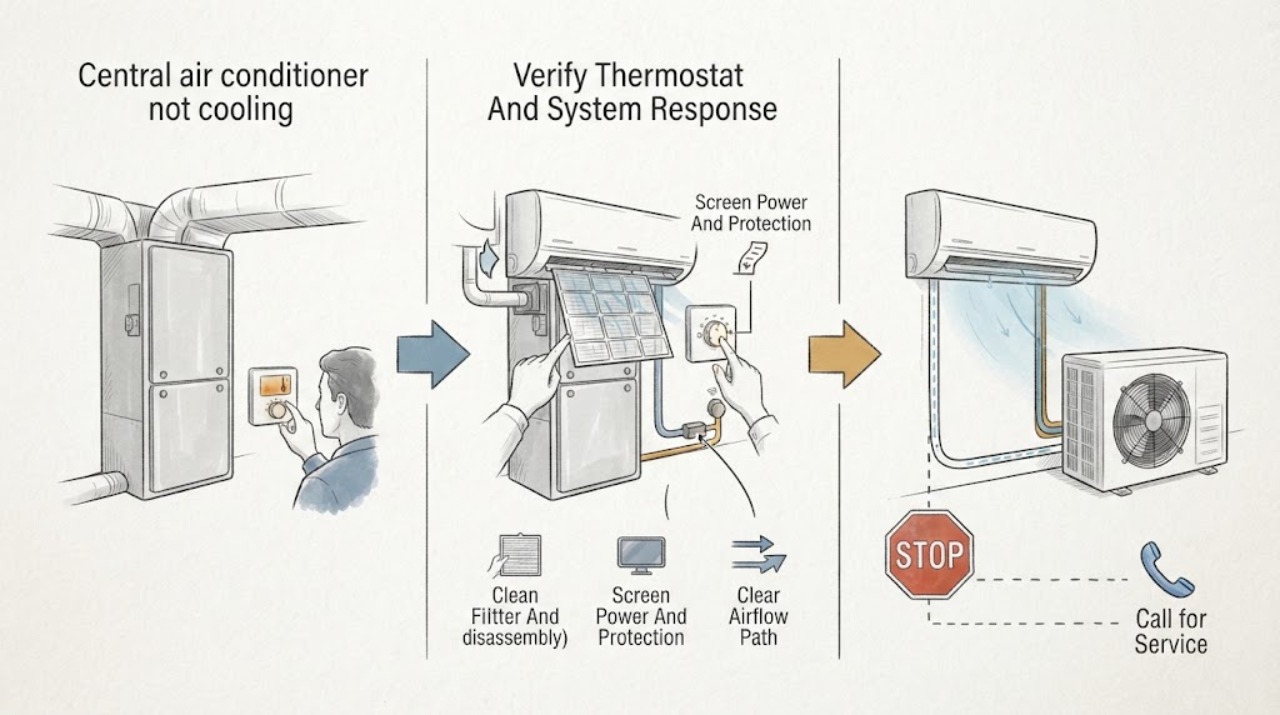
When a Rheem central air conditioner is not cooling, first confirm that the thermostat is calling for cooling and that the indoor blower and outdoor unit respond. Then check the filter, return and supply airflow, and visible debris around the outdoor condenser. A dirty filter, blocked return, closed register, dirty coil, blower problem, low refrigerant charge, mismatched system component, low outdoor temperature, or a condensate safety interruption can all produce weak or absent cooling; several require a qualified HVAC diagnosis. If the indoor coil is icing, water is overflowing, the breaker trips again, the outdoor unit hums without starting, or there is burning odor, smoke, damaged wiring, or refrigerant damage, turn cooling off and arrange service. Do not open electrical panels, add refrigerant, bypass a float or safety switch, or repeatedly reset protection.
Before you begin
Safety first
- This article supports thermostat observation and ordinary-access filter, airflow, outdoor-debris, ice, and condensate checks only. A qualified person must handle electrical testing, refrigerant, sealed-system work, cabinet access, component replacement, safety controls, and startup verification.
Work through in order
Diagnostic checks
Use only checks that match the exact appliance or system and its official guide.
-
Check 1
At the thermostat, select Cool, set the target below the room temperature, and leave the fan on Auto; observe the indoor supply air and whether the indoor blower and outdoor unit start during a normal call.
Expected result: Record whether the display is active, the thermostat shows a cooling call, the indoor blower runs, the outdoor fan runs, the compressor sounds normal, or the system is silent, warm-air-only, or repeatedly starting and stopping.
Next step: Keep the panels closed and continue only with the filter, airflow, and visible outdoor checks below; arrange qualified service when the call is absent, either section does not respond, or the unit short-cycles.
Stop if: Turn cooling off for smoke, burning odor, sparking, exposed wiring, a loud mechanical event, refrigerant damage, or a breaker that trips again.
Why this matters
Why: No call or a blank display points first to control power or thermostat setup. A blower without outdoor response points toward outdoor power, control, or compressor-side diagnosis. An outdoor unit without indoor airflow raises an indoor blower, control, or airflow concern. Warm air with both sections running needs airflow, coil, charge, or performance diagnosis.
-
Check 2
From outside the equipment enclosure, check whether the HVAC breaker or clearly labeled disconnect appears on and whether a thermostat or equipment display indicates a fault; do not remove covers or reset a tripped device repeatedly.
Expected result: Record a normal breaker position, a tripped breaker, an unavailable or unlabeled disconnect, a blank thermostat, or a protection device that trips again after one normal reset attempt.
Next step: If the area is dry and there is no odor or visible damage, make at most one normal reset as allowed by the home's equipment labeling; if it trips again or the control remains dead, leave cooling off and call qualified HVAC service.
Stop if: Do not open a disconnect, touch terminals, remove panels, defeat a fuse, or reset a device after smoke, heat, water intrusion, sparking, or a repeat trip.
Why this matters
Why: A tripped breaker or blank control can explain no cooling, but it does not identify why protection operated. A repeat trip suggests an electrical, motor, compressor, or wiring fault and is not a reset problem.
-
Check 3
With the system off, inspect the filter at its ordinary access point and look at return grilles, supply registers, and accessible duct openings; keep the filter installed and do not open the indoor cabinet.
Expected result: Classify the filter as clean, loaded with dust, wet, damaged, or the wrong size; note blocked returns, closed supplies, weak airflow, or ice on the accessible refrigerant tubing or indoor coil area.
Next step: Replace a disposable filter only with the exact size and type specified for the equipment, reopen blocked registers, clear ordinary return obstructions, and leave cooling off until visible ice has melted; arrange service for recurring ice, wet insulation, or weak airflow after the safe correction.
Stop if: Do not run without a filter, chip ice, use heat or sharp tools to defrost, remove the evaporator panel, or continue cooling with water near electrical equipment.
Why this matters
Why: A dirty or restrictive filter, blocked return, closed supply, or weak airflow can reduce cooling and can contribute to a frozen indoor coil. Wet or damaged filter material, extensive ice, or clean-filter weak airflow needs service rather than a higher-flow improvised filter or cabinet disassembly.
-
Check 4
With power left off for any clearing, look around the outdoor condenser for leaves, grass, snow, or stored items that obstruct the airflow path; do not wash fins, straighten coils, or reach through the grille.
Expected result: Record clear airflow space, loose debris outside the cabinet, a fan that does not run, unusual vibration, a persistent hum, burnt odor, or visible coil or line damage.
Next step: Clear only loose debris that can be removed without contact with the cabinet, then make one normal cooling observation. For a non-running fan, hum, vibration, odor, or damaged coil or line, turn cooling off and arrange qualified service.
Stop if: Do not open the condenser, touch the fan, spray water into the cabinet, bend fins, or operate the unit after refrigerant-line damage or electrical damage is visible.
Why this matters
Why: Ordinary debris outside the unit can restrict heat rejection, while a silent fan, persistent hum, vibration, odor, or damage points to an electrical, motor, compressor, or refrigerant-circuit issue. Outdoor operation alone does not prove that the compressor is cooling correctly.
-
Check 5
Inspect only visible condensate tubing, an accessible drain outlet, and the area below the indoor unit for water; also look for frost or ice without opening the cabinet or bypassing a safety device.
Expected result: Record a dry drain outlet, standing water, a full pan, a wet filter or insulation, an obstructed-looking outlet, or ice on the coil or refrigerant line; note whether a float or other safety has stopped the cooling call if the equipment exposes that status without access-panel removal.
Next step: Turn cooling off, protect nearby materials, and let ice melt naturally. Do not pour chemicals into an unknown drain or bypass a float; arrange service for standing water, a full pan, recurrent ice, or any safety interruption.
Stop if: Stop immediately for water near electrical equipment, ceiling or wall damage, overflowing condensate, refrigerant-line damage, or any need to remove a panel or defeat a safety.
Why this matters
Why: Water or ice can interrupt cooling and can damage building materials. Ice is consistent with restricted airflow or other refrigeration faults, while a condensate interruption can be a protection response; neither observation identifies a safe owner repair.
-
Check 6
After only safe visible corrections are complete, all ice has melted, the filter is installed, and no water or damage is present, make one normal cooling call and observe the system for a short period; do not keep cycling it to force a result.
Expected result: Record cool supply air with steady airflow, warm air despite both sections running, return of ice or water, a breaker trip, a new odor or sound, or an outdoor unit that stops and restarts abnormally.
Next step: Use the observed pattern to select a branch below and give the technician the timeline, filter condition, airflow, outdoor response, ice, water, sounds, and any prior service history.
Stop if: Turn the system off and stop the retest for smoke, burning odor, sparking, refrigerant damage, water near electrical equipment, repeated breaker operation, or loud compressor or fan noise.
Why this matters
Why: Stable cool air after a clear airflow obstruction supports that obstruction as a contributor, but it does not rule out a dirty coil or developing fault. Persistent warm air, recurrent ice or water, abnormal sound, or protection operation requires diagnosis beyond owner checks.
Use your observations
Decision map
Find the observation that best matches what you see, then follow the next safe action.
-
PATH 01Safety boundary
What you see
The thermostat does not show a cooling call, the display is blank, both indoor and outdoor sections are silent, or the breaker trips again.
Do this next
Leave cooling off after one normal safe check and arrange qualified HVAC service; provide the display, breaker behavior, and whether water or odor was present.
Why this path and its safety boundary
Why it matters: Control power, thermostat setup, an open protection device, or an electrical fault is more likely than a simple dirty outdoor coil; a repeat trip does not identify a safe reset.
Safety stop: Do not open panels, test live wiring, bypass protection, or continue resetting a breaker.
-
PATH 02Safety boundary
What you see
The blower runs but airflow is weak, the filter is loaded, returns or supplies are obstructed, or ice appears on the coil or refrigerant line.
Do this next
Turn cooling off, correct only an obvious filter or register obstruction, let ice melt naturally, and call qualified service if airflow stays weak or ice returns.
Why this path and its safety boundary
Why it matters: Restricted airflow is plausible, but Rheem also lists dirty coil, blower condition, charge, component matching, and low outdoor temperature among freezing-coil causes; ice should not be treated as a filter-only diagnosis.
Safety stop: Do not chip ice, run without a filter, open the evaporator cabinet, or add refrigerant.
-
PATH 03Safety boundary
What you see
The indoor blower runs but the outdoor unit is silent, only hums, has a fan that does not turn, vibrates, smells hot, or shows visible damage.
Do this next
Turn cooling off, keep the outdoor cabinet closed, and arrange HVAC service with the sound, timing, weather, and visible condition recorded.
Why this path and its safety boundary
Why it matters: The outdoor power, control, fan motor, compressor, or refrigerant circuit needs qualified diagnosis; moving air indoors does not make continued cooling safe.
Safety stop: Do not push the fan, remove the grille, spray the cabinet, or repeatedly cycle the system.
-
PATH 04Safety boundary
What you see
Water is standing in a pan or near the indoor unit, a drain appears blocked, a float or safety has interrupted cooling, or ice melts into an overflow area.
Do this next
Turn cooling off, protect nearby surfaces, avoid chemicals and safety bypasses, and request service for drain, pan, float, airflow, and coil diagnosis.
Why this path and its safety boundary
Why it matters: Condensate drainage or a safety response may be stopping operation, and continued cooling can damage the building or electrical equipment; the underlying cause can also be a frozen coil.
Safety stop: Stop for active overflow, ceiling or wall damage, water near electrical equipment, or any need to open a panel.
-
PATH 05Safety boundary
What you see
The filter and visible airflow path are clear, both indoor and outdoor sections run, there is no ice or water, but supply air remains warm or the room does not cool.
Do this next
Stop further experimentation and arrange qualified Rheem central-air diagnosis. Give the technician the thermostat setting, airflow comparison, outdoor response, weather, filter history, and any recent service details.
Why this path and its safety boundary
Why it matters: A refrigeration-performance, indoor-coil, blower, compressor, charge, metering, or matched-component problem is more likely than a visible blockage; the available checks cannot establish which part is at fault.
Safety stop: Do not adjust refrigerant, wiring, controls, or metering components based on symptoms alone.
Helpful context
Understand the symptom
Start with the complete central-air response
A cooling call should produce a sequence: the thermostat calls, the indoor blower moves air across the evaporator, the outdoor fan and compressor reject heat, and condensate drains away. Rheem owner manuals tell the owner to check the thermostat setting, filter, return grille, outdoor condenser, and electrical protection, then contact the distributor or service provider if the unit still does not operate. Check only visible, ordinary-access items and keep all access panels closed.
Weak airflow and ice are connected clues
Rheem technical notes group a frozen indoor coil with low airflow from a dirty or restrictive filter, blocked return or supply path, duct or blower problems, a dirty indoor coil, low refrigerant charge, mismatched components, and low outdoor temperature. Ice is not a reason to keep running the system or to chip at the coil. Turn cooling off, let ice melt without tools, and use the pattern of airflow, water, and outdoor-unit operation to guide service.
Keep electrical and refrigerant work out of owner checks
The archived Rheem installation material reserves installation and startup work for qualified personnel. An owner can record thermostat response, airflow, sounds, visible ice, water, and debris, but should not remove electrical covers, test live terminals, handle refrigerant, alter wiring, bypass a condensate safety, or force a fan. A repeat breaker trip, burning smell, smoke, damaged insulation, or an outdoor unit that only hums is a stop condition.
Safety boundary
Stop conditions
- Turn cooling off for smoke, burning odor, sparking, exposed or damaged wiring, refrigerant-line damage, a loud mechanical event, water near electrical equipment, or a breaker that trips again.
- Stop for visible ice, overflowing condensate, a full pan, ceiling or wall water damage, or a safety interruption; let ice melt naturally and do not bypass a float or other protection.
- Do not open electrical or refrigerant panels, test live terminals, add refrigerant, alter wiring, force a fan, chip ice, or run the system without a filter.
- Do not keep cycling a unit that hums, vibrates, short-cycles, produces warm air, or returns to an abnormal sound or water condition.
Only after diagnosis
Potential parts
- thermostat or cooling control
Consider this category only if a qualified control check confirms that the thermostat or low-voltage cooling circuit is not issuing or carrying the required call.
Confirm the exact Rheem system, thermostat wiring, control arrangement, and required configuration before selecting a replacement; symptom alone does not establish fit. - indoor blower motor or capacitor
Consider this category only if measured airflow and qualified electrical testing identify a blower motor, capacitor, or related indoor-air-handling fault.
Match the exact air-handler or furnace model, motor characteristics, capacitor specification, mounting, and manufacturer instructions; do not infer a part from fan noise or weak airflow alone. - condensate float switch or drain component
Consider this category only when inspection and testing confirm a blocked drain, failed float, damaged pan, or related condensate component after the water source is identified.
Confirm the exact drain and safety arrangement, switch behavior, pan geometry, wiring, and local installation requirements; never select a part to bypass protection. - refrigerant-circuit or metering component
Consider this category only after a qualified technician confirms a leak, charge problem, metering fault, or sealed-system failure through equipment-specific diagnosis.
Confirm exact model, refrigerant designation, metering arrangement, repair procedure, and qualified handling requirements; do not add refrigerant or replace a sealed-system part from a symptom.
When checks do not resolve it
Need a professional?
Arrange qualified Rheem HVAC service when the thermostat call or power check is unresolved, a breaker trips again, airflow remains weak after a correct filter and visible-path check, ice returns, the outdoor unit is silent or only hums, condensate stands or overflows, a safety interrupts cooling, or the system runs with normal airflow but produces warm air. Refrigerant, compressor, blower, electrical, indoor-coil, metering, matched-component, and condensate diagnoses require equipment-specific testing.
Safety scope: This article supports thermostat observation and ordinary-access filter, airflow, outdoor-debris, ice, and condensate checks only. A qualified person must handle electrical testing, refrigerant, sealed-system work, cabinet access, component replacement, safety controls, and startup verification.
Common questions
FAQ
Why is my Rheem central air conditioner running but not cooling?
If the indoor blower and outdoor unit run but supply air stays warm, a visible filter or airflow obstruction is only one possibility. A frozen or dirty indoor coil, blower issue, refrigerant or metering problem, compressor issue, component mismatch, or condensate protection can also be involved. Check only the filter, returns, supplies, outdoor debris, ice, and water; arrange qualified diagnosis if the airflow path is clear and cooling remains weak.
What should I check first when a Rheem air conditioner is not cooling?
Confirm the thermostat is in Cool with a target below room temperature, observe whether the indoor blower and outdoor unit respond, then inspect the installed filter, return and supply paths, and visible outdoor debris. Keep panels closed and stop for ice, water, odor, smoke, damaged wiring, or a repeat breaker trip.
Can a dirty filter make a Rheem central air conditioner stop cooling?
Yes, a dirty or restrictive filter can reduce airflow and contribute to a frozen indoor coil, but it does not prove the filter is the only cause. Replace it only with the exact specified size and type, leave cooling off while ice melts, and call for service if weak airflow or ice returns.
Why is my Rheem outdoor unit humming but not cooling?
A hum without normal outdoor-fan or compressor operation can indicate an electrical, motor, control, or compressor-side fault. Turn cooling off, do not push the fan or open the cabinet, and arrange qualified HVAC service, especially if the breaker trips, the cabinet is hot, or there is a burning odor.
Should I add refrigerant when my Rheem air conditioner is not cooling?
No. Low charge is only one possible cause and requires qualified leak and system diagnosis. Do not open the refrigerant circuit or add refrigerant based on warm air or ice alone; provide the technician with the airflow, ice, outdoor-response, and service history.
Read the exact guide
Official sources
- USER'S MANUAL AND INSTALLATION (708108A)Rheem Manufacturing Company · Official Rheem archived owner and installation manual; equipment details and access points can vary by exact model.
- Freezing Indoor CoilRheem Manufacturing Company · Rheem technical tip for HVAC professionals; it supports cause categories and does not authorize owner-side sealed-system or electrical work.
- USER'S MANUAL AND INSTALLATIONRheem Manufacturing Company · Official Rheem archived manual; use the exact manual supplied with the installed unit when instructions differ.
- 3 Spring Maintenance Tasks for Your HVAC SystemsRheem Manufacturing Company · Rheem consumer maintenance article; exact maintenance intervals and procedures remain model-specific.
- Tech Tips Freezing of Indoor CoilRheem Manufacturing Company · Rheem technical tip; use it to frame diagnostic possibilities, not as a substitute for model-specific measurements.
Community feedback
Share a repair observation
Share a plain-text repair observation. Accepted observations are published automatically; this page may take a moment to update.