
On this page
Start here
Quick answer
A steady thermostat setpoint does not prove that the temperature reading or call signal is steady. Short cycling can come from a mispositioned or inaccurate sensor, low thermostat power, a control signal that drops out, a normal compressor-protection delay, restricted airflow, an HVAC safety shutdown, or equipment that reaches the set temperature too quickly. First record what the thermostat is calling for and whether the equipment actually stops; then check only the thermostat display, its surrounding location, accessible registers, and the user-accessible filter. Turn the system off and arrange qualified HVAC service for rapid repeated cycles, exposed wiring, a tripped breaker that repeats, ice, water near electrical parts, gas or burning odor, smoke, or a furnace that lights and shuts down quickly.
Work through in order
Diagnostic checks
Use only checks that match the exact appliance or system and its official guide.
-
Check 1
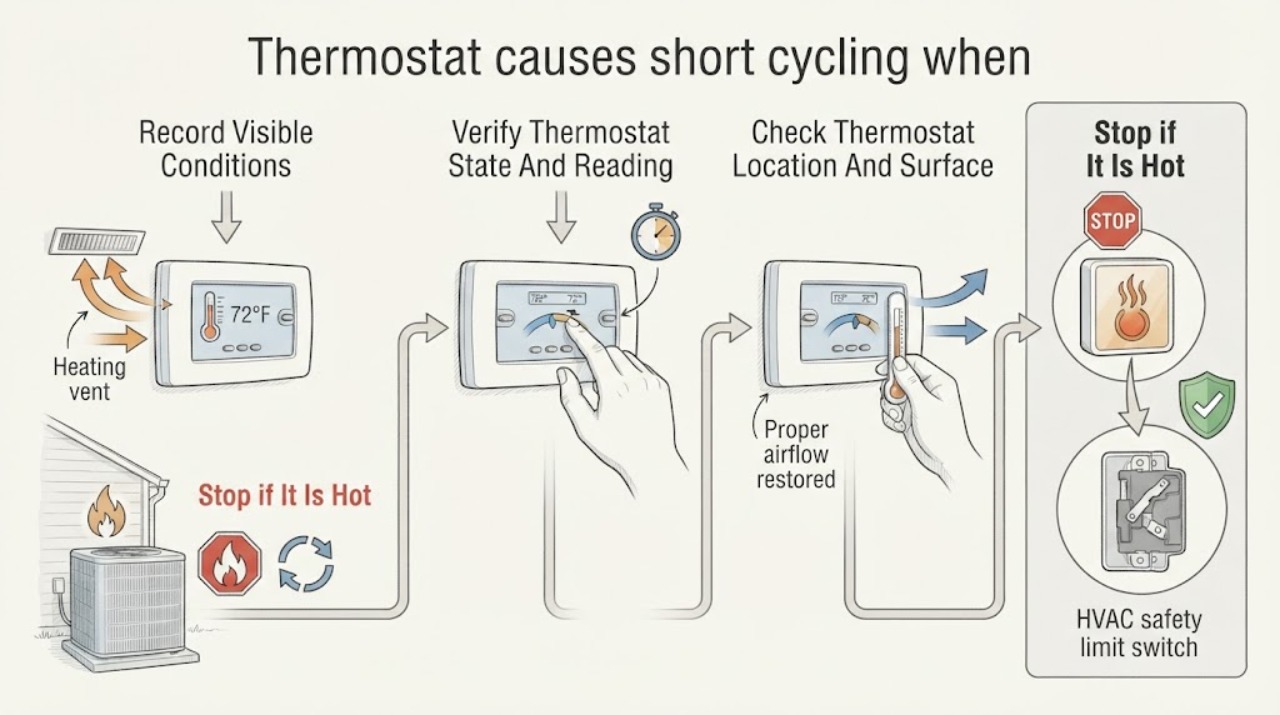
From a safe position, observe two or three ordinary heating or cooling cycles without repeatedly changing the setpoint. Note the mode, the call or flame icon, the start and stop times, whether the room is near the target, and whether the blower or outdoor unit stops with the call.
Expected result: Record a complete cycle, a call that disappears while the room is still away from target, a call that stays present while equipment stops, a brief protective delay, or rapid repeated starts.
Next step: Keep the record and continue only with the external checks below. Turn the system off for a harsh or worsening sound, smoke, burning odor, gas odor, ice, water near electrical equipment, or rapid furnace ignition-and-shutdown.
Stop if: Do not keep restarting the system to reproduce a fault, and do not continue if there is smoke, burning odor, gas odor, exposed wiring, water at electrical equipment, or a repeated breaker trip.
Why this matters
Why: A call that disappears unexpectedly makes thermostat sensing, power, scheduling, or control signaling more relevant. A call that stays present while equipment stops makes an equipment safety, airflow, motor, ignition, or capacity issue more likely. A single delay can be protective; repeated rapid starts are not explained by a stable setpoint alone.
-
Check 2
Read the thermostat without removing its cover. Confirm the intended Heat or Cool mode, Fan set to Auto unless the system instructions say otherwise, a steady setpoint, any low-battery or alert message, and the displayed room temperature. If available, compare that reading with a separate room thermometer placed nearby and away from a vent or sun.
Expected result: Record a blank or flickering display, low-power alert, room readings that differ materially, an unexpected schedule or mode, a call icon that flickers, or a stable reading and call.
Next step: Replace batteries only if this thermostat is designed for user-replaceable batteries and the display requests it; otherwise leave wiring and the cover alone. Correct only an obvious mode or schedule error, then document whether the cycling returns.
Stop if: Do not remove a wired thermostat from its base, move wires, bridge terminals, test live voltage, or bypass a control or safety delay.
Why this matters
Why: A power alert, flicker, unexpected schedule, or call icon that changes by itself points toward thermostat power, sensing, configuration, or signal trouble. A stable reading and call make a filter, airflow, equipment safety, or capacity problem more likely, especially when the equipment stops before the target is reached.
-
Check 3
Inspect the thermostat location and exterior without opening it. Look for direct sun, a nearby supply or return grille, an oven or other heat source, an exterior door draft, unusual dust, or a recent change in the room that could affect the sensor.
Expected result: Record a clear central location, direct sun, airflow striking the thermostat, a heat source or draft, visible dust, or a location that cannot be changed safely without moving the device.
Next step: Close a nearby door or shade that is plainly causing the condition and gently wipe only the exterior with a dry, soft cloth. Do not relocate the thermostat or spray into it; arrange service if the location is unsuitable or cycling continues.
Stop if: Do not drill, reroute thermostat cable, remove the wall plate, or place a heater, fan, or other device against the thermostat to change its reading.
Why this matters
Why: Sun, drafts, nearby heat, or supply airflow can make the sensor reach its target early or call at the wrong time, even when the selected setpoint never changes. A clean, central location makes placement less likely, but does not rule out sensor calibration or a control fault.
-
Check 4
With the HVAC call off, inspect the filter through its normal user access and look at accessible return and supply grilles. Note whether the filter is heavily loaded, wet, or the wrong size, and whether grilles are blocked by furniture or closed.
Expected result: Record a clean dry filter with clear grilles, a loaded filter, blocked or closed grilles, weak airflow, or a wet filter and visible ice or water.
Next step: Open an accidentally closed grille and replace a loaded filter only with the exact user-accessible type specified for the system. If the filter is wet, ice is visible, airflow is weak, or cycling continues after the safe filter check, turn the call off and request HVAC service.
Stop if: Do not open an equipment cabinet, remove a blower or coil panel, touch a fan, chip ice, handle refrigerant, or run the system with a wet filter or water near electrical parts.
Why this matters
Why: Restricted airflow can make a furnace overheat and trip its limit control or can contribute to a cooling coil freezing; that shutdown may look like a thermostat short-cycle fault. Clear airflow with a clean filter makes an airflow restriction less likely, but does not rule out a blower, refrigerant, compressor, ignition, control, or sizing issue.
-
Check 5
Record any waiting or anti-short-cycle message, the time between an equipment stop and restart, and whether the thermostat keeps calling after the equipment stops. From a dry location, note any known breaker trip without opening an electrical enclosure.
Expected result: Record one brief delay followed by a normal cycle, a recurring delay with rapid cycling, a call that remains active while equipment stops, a call that drops out, or a repeated breaker trip or warning.
Next step: Do not change cycle settings, defeat a delay, reset a repeatedly tripping breaker, or alter wiring. Leave the system off when the pattern repeats or any warning appears and give the technician the recorded timeline.
Stop if: Stop immediately for exposed or hot wiring, arcing, smoke, burning or gas odor, a repeated breaker trip, water at electrical equipment, or a furnace that repeatedly lights and shuts down.
Why this matters
Why: A single manufacturer-designed delay can protect compressor operation. A recurring delay with rapid cycling, a persistent call with equipment shutdown, or a repeated power interruption points beyond a stable setpoint toward controls, airflow, limit protection, motors, refrigerant, ignition, or electrical faults. A thermostat that drops the call unexpectedly remains a thermostat or control signal possibility.
Use your observations
Decision map
Find the observation that best matches what you see, then follow the next safe action.
-
PATH 01Next step
What you see
The setpoint and call remain steady, the system completes a normal cycle, and there are no alerts, weak airflow, ice, water, odor, or harsh sound; or the thermostat shows one brief start delay and then operates normally.
Do this next
Monitor the next few cycles without changing the setpoint repeatedly. Arrange service if rapid starts return or comfort declines.
Why this path and its safety boundary
Why it matters: This pattern is more consistent with normal control timing or a completed cycle than a thermostat-caused short-cycle fault.
-
PATH 02Next step
What you see
The displayed setpoint is stable but the room reading differs from a nearby thermometer, the thermostat is exposed to sun, a draft, a vent, or a heat source, the call icon changes without a matching room change, or the display is low-power or unstable.
Do this next
Correct only an obvious mode, schedule, shade, or user-replaceable battery issue. If the mismatch or cycling remains, request thermostat and HVAC control diagnosis; do not move the wall plate or alter wires.
Why this path and its safety boundary
Why it matters: Thermostat sensing, location, power, scheduling, or the control signal becomes more likely than an oversized or mechanically failing HVAC unit, although the observation does not prove a failed thermostat.
-
PATH 03Next step
What you see
The thermostat continues to call while the furnace, heat pump, or air conditioner stops before the room reaches target, especially with weak airflow, a loaded or wet filter, visible ice, or a rapid furnace ignition-and-shutdown.
Do this next
Turn the HVAC call off, leave panels and moving parts untouched, and arrange qualified HVAC service. Provide the call status, cycle timing, filter and airflow observations, and any ice, water, or ignition pattern.
Why this path and its safety boundary
Why it matters: An airflow restriction, furnace limit response, frozen coil, blower problem, refrigerant condition, ignition fault, control issue, or other equipment protection path is more likely than a setpoint problem. Carrier identifies a furnace limit response and restricted airflow as causes of rapid furnace shutdown.
-
PATH 04Next step
What you see
The thermostat reading and call appear stable, airflow is strong, the filter and grilles are clear, the equipment reaches target very quickly, and there is no power or safety warning.
Do this next
Request an HVAC evaluation of cycle settings, equipment sizing, controls, and operating temperatures. Do not change installer settings or replace the thermostat solely to compensate for a possible sizing problem.
Why this path and its safety boundary
Why it matters: An oversized system, incorrect cycle setting, or an equipment-control problem becomes more plausible; the homeowner cannot confirm sizing or internal controls from the thermostat display.
-
PATH 05Next step
What you see
There is exposed or hot wiring, arcing, smoke, burning or gas odor, water at electrical equipment, a repeated breaker trip, a loud worsening mechanical sound, or another immediate hazard.
Do this next
Stop using the system, keep clear of the equipment, and obtain qualified HVAC or electrical help as appropriate. For a strong gas odor or smoke, leave the area and follow local emergency guidance.
Why this path and its safety boundary
Why it matters: The symptom is no longer a home thermostat check. Continuing operation or repeated resets can increase shock, fire, equipment, or combustion risk.
Helpful context
Understand the symptom
A stable setpoint is not the same as a stable thermostat call
The setpoint is the target you selected; the sensor reading and the equipment call determine when heating or cooling starts and stops. A thermostat beside sunlight, a supply vent, an oven, or a draft can sense a local condition rather than the room average. Low batteries, dust, calibration trouble, loose wiring, or an internal fault can also make the call intermittent even while the number on the display looks unchanged. Carrier identifies inaccurate readings, short cycling, wiring, safety switches, filters, and frozen coils as separate possibilities, so do not replace the thermostat based on the symptom alone.
Separate a protective delay from a fault
Some systems intentionally wait before restarting, especially after a cooling call, to protect the compressor. A brief message such as a waiting or delay notice can be normal for the installed control. It should not be defeated, and it does not explain repeated starts and stops after the protection interval. If the call remains active but the furnace, heat pump, or air conditioner stops early, the equipment may be responding to airflow, temperature-limit, refrigerant, motor, or control conditions rather than a thermostat setting.
The safest home checks are observations, not thermostat rewiring
Use the thermostat face and ordinary filter or grille access only. A clean filter and strong airflow make a simple airflow restriction less likely, but they do not prove that the thermostat, control board, refrigerant circuit, compressor, burner, or limit control is healthy. Keep a short record of the call indicator, cycle times, airflow, mode, room reading, and visible warnings so a technician can compare the thermostat request with the equipment response.
Only after diagnosis
Potential parts
- thermostat batteries
Consider only when the specific thermostat is battery powered and the display shows low power, flickers, or recovers after fresh batteries; a stable display does not justify a battery diagnosis.
Follow the thermostat maker's battery type and polarity instructions; do not remove a wired thermostat from its base to reach batteries unless the model instructions explicitly permit it. - HVAC air filter
Consider only when the user-accessible filter is visibly loaded or damaged and the system documentation identifies a replacement filter.
Match the installed system's exact size, airflow rating, and orientation; a filter does not correct a blower, coil, refrigerant, limit, or control fault. - compatible thermostat
Consider only after a qualified diagnosis confirms the thermostat sensor, power, or call output is faulty; short cycling alone can originate in the HVAC equipment.
Confirm system type, wiring, stages, heat-pump or auxiliary-heat needs, and manufacturer compatibility before selection or installation.
When checks do not resolve it
Need a professional?
Arrange qualified HVAC service when rapid cycling continues after the safe display, location, grille, and filter checks; when the call remains active while equipment stops; when the thermostat reading is unreliable; or when there is weak airflow, ice, water, a repeated breaker trip, or a persistent delay. Stop operation for smoke, burning or gas odor, arcing, exposed or hot wiring, water near electrical equipment, a harsh worsening sound, or repeated furnace ignition and shutdown. Do not open cabinets, alter wires, bypass delays or safeties, touch refrigerant, or reach into moving equipment.
Have this ready
- Give the technician the thermostat mode and displayed reading, call-icon behavior, cycle times, separate thermometer comparison if available, thermostat location, filter and grille observations, airflow, delay messages, equipment response, ice or water, odors, and breaker history.
Common questions
FAQ
Can a thermostat cause short cycling even when the setpoint does not change?
Yes. The sensor can read a local heat source or draft, or the thermostat can have low power, calibration, scheduling, wiring, or control trouble while the selected setpoint stays unchanged. Compare the displayed room reading with a nearby thermometer and observe whether the call icon changes.
Does a brief waiting message mean the thermostat is broken?
Not necessarily. Many systems use a restart delay to protect compressor operation. Allow one normal delay, but do not defeat it. Repeated rapid starts, a persistent call while equipment stops, or a delay that never resolves needs HVAC diagnosis.
What if the thermostat keeps calling but the furnace or air conditioner stops?
That pattern points away from the selected setpoint and toward airflow restriction, a furnace limit response, frozen coil, blower or outdoor equipment fault, refrigerant condition, ignition, control, or another safety shutdown. Turn the call off and arrange qualified service rather than opening the equipment.
Should I change the thermostat cycle setting to stop short cycling?
Do not change installer or equipment settings as a first response. A cycle setting can affect timing, but short cycling can also signal airflow, sizing, refrigerant, motor, ignition, control, or safety trouble. Record the symptom and have the system evaluated if it persists.
Read the exact guide
Official sources
- What is a Furnace Limit Switch? | Ultimate Guide & TroubleshootingCarrier · Carrier furnace guidance used only for the heating branch where a furnace starts and stops rapidly; it does not identify a thermostat fault.
- Bad Thermostat: How to Identify the Problem and Fix ItCarrier · Carrier thermostat guidance used for general sensor and control-symptom reasoning; no brand-specific replacement is recommended.
- What Is AC Short Cycling: Causes, Effects, and TroubleshootingCarrier · Carrier cooling guidance used for the cooling branch of a general HVAC short-cycle article; heating-specific conclusions are not inferred from this page.
- Thermostat Troubleshooting: Solutions for Common IssuesTrane · Trane homeowner troubleshooting used for general control triage, not as permission to change wiring or model settings.
- Common Thermostat Issues and How to TroubleshootCarrier · Carrier homeowner guidance used for general HVAC symptom triage; it is not a model-specific wiring or repair instruction.
- HVAC Short Cycling: Causes and SolutionsTrane · Trane residential HVAC guidance used for general thermostat-placement, delay, and sizing branches; exact cycle limits vary by equipment.
Community feedback
Share a repair observation
Share a plain-text repair observation. Accepted observations are published automatically; this page may take a moment to update.