
On this page
Start here
Quick answer
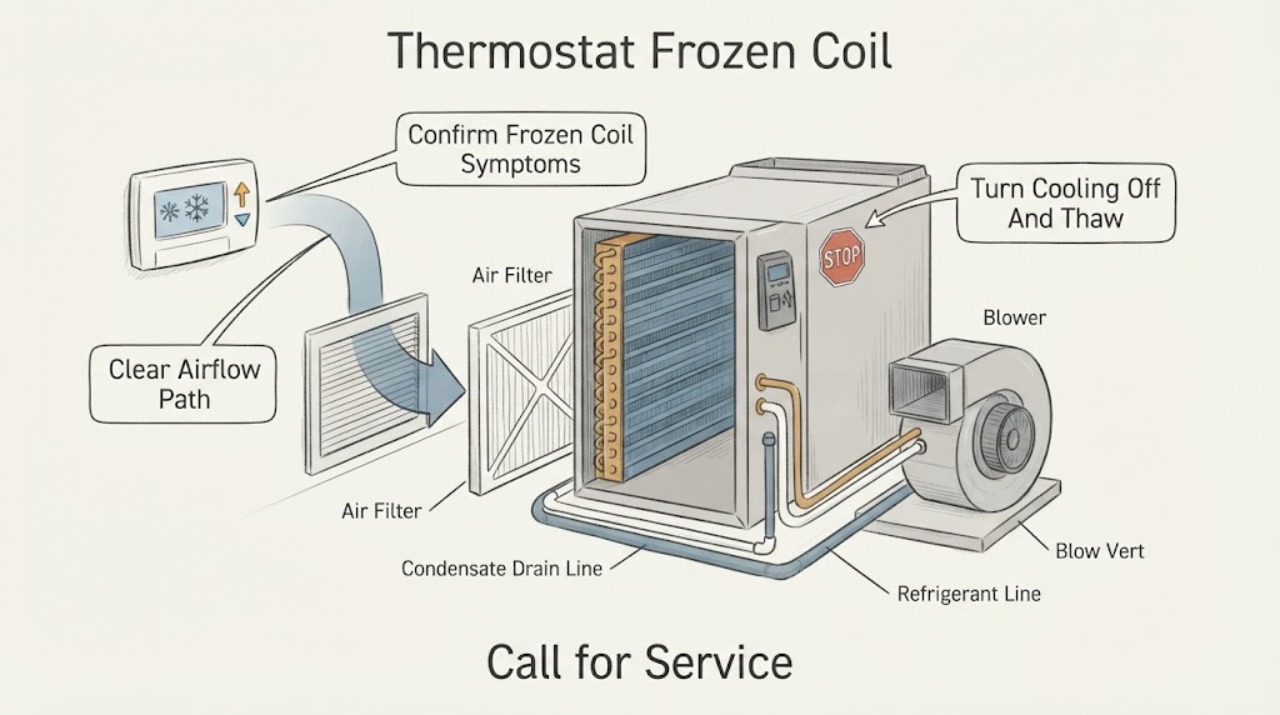
A thermostat does not freeze; the part usually meant by “thermostat frozen coil” is the indoor air conditioner's evaporator coil or refrigerant line. If you see ice, turn the thermostat from COOL to OFF and let the ice thaw naturally. Do not chip it or keep running cooling. Once the system is off, check the air filter and make sure supply and return vents are not blocked; look for water around the indoor unit as the ice melts. If the coil freezes again, airflow stays weak, water leaks, the outdoor unit or blower is abnormal, or you suspect low refrigerant, stop and arrange qualified HVAC service. Do not open the air handler, handle refrigerant, or test thermostat wiring.
Before you begin
Safety first
- The reader-level scope is thermostat mode observation, natural thaw with COOL off, accessible filter and vent checks, and external water or equipment observation. Refrigerant, sealed-system, coil, blower, condensate, thermostat wiring, electrical, and air-handler work require qualified professionals.
Work through in order
Diagnostic checks
Use only checks that match the exact appliance or system and its official guide.
-
Check 1
From a safe position, look for frost or ice on the accessible refrigerant line near the indoor or outdoor equipment, the air-handler cabinet, or the visible coil area; note whether supply-airflow is weak and whether water is collecting below the indoor unit.
Expected result: Record visible ice, weak airflow without visible ice, water around the indoor unit, normal airflow, or no repeatable ice or water sign.
Next step: If ice is present, switch COOL to OFF before further checks; if there is no ice, check thermostat mode and filter without opening the air handler.
Stop if: Do not touch refrigerant lines, enter an attic or crawlspace to reach equipment, wipe inside the cabinet, or continue if water is reaching electrical equipment.
Why this matters
Why: Ice plus weak cooling or airflow is consistent with a frozen evaporator coil. Water below the indoor unit may appear as ice melts. No visible ice means the thermostat or airflow complaint may have another cause and should not be treated as a confirmed frozen coil.
-
Check 2
At the thermostat, change the mode from COOL to OFF and leave the system off long enough for the ice to thaw naturally; do not chip, scrape, or apply a heater to the coil or lines.
Expected result: Record ice that gradually clears, water appearing below the indoor unit, ice that remains, or a system that continues calling for cooling after COOL is OFF.
Next step: Keep nearby flooring protected and continue only with external filter and vent checks after the ice has cleared and the area is dry; arrange HVAC service if the ice does not clear or water threatens the equipment.
Stop if: Do not restart cooling while ice remains, force the thermostat controls, use a hair dryer or heat source, or remove panels to speed thawing.
Why this matters
Why: Clearing ice confirms a frozen condition but does not identify the cause. Persistent ice, uncontrolled water, or cooling that continues despite the OFF setting points to a control, drain, or equipment issue requiring service.
-
Check 3
With cooling off, inspect the accessible air filter and the return and supply vents; replace a dirty filter with the correct type for the system and clear furniture, dust, or other obstructions from vent openings.
Expected result: Record a clean filter and open vents, a visibly loaded filter, blocked return or supply airflow, or weak airflow that remains after the accessible restrictions are corrected.
Next step: Let the system remain off until all ice has cleared, then use one normal cooling test only if there was no leak or electrical warning; call HVAC service if airflow remains weak or ice returns.
Stop if: Do not remove the air-handler cover, clean the evaporator coil internally, change ductwork, or use an unverified filter that restricts airflow.
Why this matters
Why: A loaded filter or blocked airflow can contribute to coil icing. Persistent weak airflow after those external checks points toward the blower, coil, ductwork, or another HVAC fault rather than a thermostat set-point issue.
-
Check 4
After the ice has cleared and the filter and vents are addressed, verify from the thermostat display that the mode and set point are intentional and observe whether the indoor blower and outdoor unit respond normally when cooling is requested.
Expected result: Record a thermostat that changes mode normally with steady airflow, a blank or unresponsive display, cooling that never starts, a blower or outdoor unit that does not run, or rapid cycling.
Next step: Use the model instructions for a single normal control reset only if no hazard exists; arrange HVAC or electrical service for an unresponsive control, missing blower or outdoor response, rapid cycling, or any repeat freeze.
Stop if: Do not remove the thermostat faceplate, bridge terminals, adjust hidden wiring, or repeatedly reset a breaker to force operation.
Why this matters
Why: A normal thermostat response with renewed freezing shifts attention to airflow, coil cleanliness, refrigerant, drain, or mechanical causes. A blank or unresponsive thermostat or abnormal equipment response may be a power, control, or safety fault.
-
Check 5
During and after thawing, observe the area around the indoor unit, condensate outlet if visible from outside, and nearby flooring or ceiling for water, staining, or repeated ice formation; do not open the drain pan or cabinet.
Expected result: Record no water and no recurrence, a contained amount of meltwater, active leakage or overflow, or ice that reforms after cooling resumes.
Next step: Keep cooling off if water is active or ice reforms, protect the area from damage, and arrange HVAC service with the observed locations and timing.
Stop if: Do not pour water into a drain, clear a concealed condensate line with pressure or chemicals, open the air handler, or restart cooling while leakage or ice remains.
Why this matters
Why: A little meltwater can occur as ice clears, but active leakage, overflow, or recurring ice suggests a drain, airflow, refrigerant, coil, or control problem that basic thermostat changes will not resolve.
Use your observations
Decision map
Find the observation that best matches what you see, then follow the next safe action.
-
PATH 01Safety boundary
What you see
Ice or frost is visible on the indoor coil, air-handler cabinet, or refrigerant line and cooling is weak or warm.
Do this next
Switch COOL to OFF, allow natural thaw, check the accessible filter and vents, and arrange HVAC service before continued operation if the cause is not clearly corrected.
Why this path and its safety boundary
Why it matters: This is a frozen-coil condition, not proof that the thermostat itself has failed.
Safety stop: Do not chip the ice, use heat, open panels, or handle refrigerant lines.
-
PATH 02Safety boundary
What you see
The filter is loaded, return or supply vents are blocked, or airflow is weak while the system is cooling.
Do this next
Replace the filter with the system-appropriate type and clear accessible vents; keep cooling off until any ice has thawed, then call service if airflow is still weak or ice returns.
Why this path and its safety boundary
Why it matters: Restricted airflow can make the evaporator coil too cold and contribute to icing, but a corrected filter does not rule out a deeper fault.
Safety stop: Do not run with a removed or wet filter, close needed return vents, or inspect the coil behind the cabinet.
-
PATH 03Safety boundary
What you see
The thermostat is blank or unresponsive, cooling continues when OFF is selected, the blower or outdoor unit does not respond, or the system rapidly cycles.
Do this next
Leave the system off if it behaves abnormally and arrange qualified HVAC or electrical diagnosis; provide the thermostat display and equipment response.
Why this path and its safety boundary
Why it matters: A control, power, safety, or equipment problem may be present; changing the set point is not a safe repair.
Safety stop: Do not remove the thermostat, bridge terminals, open electrical panels, or repeatedly reset a breaker.
-
PATH 04Safety boundary
What you see
Water appears around the indoor unit, flooring, ceiling, or condensate area while the frozen coil thaws.
Do this next
Keep cooling off, protect the surrounding area without opening equipment, and arrange prompt HVAC service if water continues, reaches electrical components, or leaves staining.
Why this path and its safety boundary
Why it matters: Meltwater may be present, but active leakage or overflow can damage the structure and may indicate a blocked drain or equipment fault.
Safety stop: Do not restart cooling into active water, use chemicals or pressure in a concealed drain, or touch wet electrical parts.
-
PATH 05Safety boundary
What you see
The coil freezes again after thawing and external airflow checks, or ice appears with weak cooling despite a clean filter and open vents.
Do this next
Stop operating the cooling system and arrange qualified HVAC service to diagnose airflow, coil, drain, controls, and refrigerant condition.
Why this path and its safety boundary
Why it matters: A dirty coil, blower or fan fault, low refrigerant or leak, thermostat issue, or another mechanical problem is possible; refrigerant diagnosis is professional work.
Safety stop: Do not add refrigerant, open sealed refrigeration tubing, clean the coil internally, or keep restarting a system that repeatedly freezes.
Helpful context
Understand the symptom
The thermostat is the control point, not the frozen part
Ice normally forms on the indoor evaporator coil or the refrigerant lines serving it. The thermostat matters because switching COOL to OFF stops the cooling call while the ice thaws. A frozen coil can reduce airflow, leave the home warm, and create water as it melts, so the first decision is to stop cooling rather than lower the set point again.
Airflow is the safest homeowner-level lead
A dirty filter or blocked return or supply vent can reduce the warm-air flow that normally passes over the coil. Check those accessible items after the system is off. If airflow is still weak, if the coil freezes again after thawing, or if the filter and vents are clear, the cause may be a blower, coil, drain, or refrigerant problem that needs HVAC diagnosis.
Let ice melt without forcing or opening the equipment
Do not chip, scrape, or heat the ice. Water may collect around the indoor unit as it thaws, so protect nearby flooring and observe from outside the cabinet. Refrigerant, electrical connections, the blower, and the evaporator coil are not user-level test points. A repeat freeze or leak is a stop-and-call condition.
Safety boundary
Stop conditions
- Switch COOL to OFF and stop operation when ice is visible; do not run cooling with a frozen evaporator coil.
- Do not chip, scrape, or heat the ice and do not open the air handler to reach the coil, blower, drain, or wiring.
- Do not handle refrigerant, add a charge, open sealed lines, bridge thermostat terminals, or perform live electrical tests.
- Stop for active water leakage, water near electrical equipment, smoke, burning odor, sparks, shock, or a repeatedly tripping breaker.
- Arrange qualified HVAC service for a repeat freeze, persistent weak airflow, no cooling after thawing, abnormal blower or outdoor-unit behavior, or an unresponsive thermostat.
When checks do not resolve it
Need a professional?
Arrange urgent HVAC or electrical help for water reaching electrical equipment, smoke, burning odor, sparks, shock, or a repeatedly tripping breaker. Arrange prompt HVAC service for any coil that refreezes, a leak or overflow, persistent weak airflow, no cooling after thawing, abnormal blower or outdoor-unit response, or suspected low refrigerant. A homeowner-level check is limited to switching COOL off, letting ice thaw naturally, checking the accessible filter and vents, and observing the thermostat and equipment from outside.
Safety scope: The reader-level scope is thermostat mode observation, natural thaw with COOL off, accessible filter and vent checks, and external water or equipment observation. Refrigerant, sealed-system, coil, blower, condensate, thermostat wiring, electrical, and air-handler work require qualified professionals.
Common questions
FAQ
Is the thermostat itself frozen when my HVAC coil is frozen?
Usually no. The frozen part is the indoor evaporator coil or a refrigerant line; the thermostat is the control point used to switch COOL off. Ice on the coil or line needs airflow and equipment diagnosis, not a thermostat replacement by assumption.
What should I do first when I see a frozen AC coil?
Switch the thermostat from COOL to OFF and let the ice thaw naturally. Do not chip, scrape, or heat it. Afterward, check the accessible air filter and make sure return and supply vents are open; arrange service if the ice returns or water is active.
Can a dirty air filter cause a frozen coil?
Yes. Restricted airflow from a dirty filter or blocked vents can contribute to an evaporator coil freezing. Replace a loaded filter with the correct system type and clear accessible vents, but call HVAC service if airflow stays weak or the coil refreezes.
Can I add refrigerant to stop a frozen coil?
No. Low refrigerant or a leak is a professional diagnosis and repair issue. Do not open sealed lines or add a charge yourself. Turn cooling off and arrange qualified HVAC service when the coil refreezes after basic airflow checks.
When is a frozen coil an HVAC emergency?
Stop operation and arrange urgent help when thaw water reaches electrical equipment, there is smoke, a burning odor, a spark, shock, or a repeatedly tripping breaker. Prompt service is also needed for recurrent ice, persistent weak airflow, no cooling after thawing, or abnormal blower or outdoor-unit behavior.
Read the exact guide
Official sources
- Energy Saver 101: Everything You Need to Know About Home CoolingU.S. Department of Energy · DOE home-cooling guidance used to distinguish thermostat, filter, airflow, drainage, and refrigerant concerns; it does not diagnose a particular installation.
- Troubleshoot an Air Conditioner: 6 Steps to Fix an AC Not WorkingCarrier · Carrier residential air-conditioner guidance used for general frozen-coil safety and diagnostic boundaries; installed-system instructions and qualified service control.
- Air Handler Freezing Up: Causes and SolutionsTrane · Trane residential HVAC guidance used for general frozen-coil symptom triage; system design and the installed equipment manual control exact details.
Community feedback
Share a repair observation
Share a plain-text repair observation. Accepted observations are published automatically; this page may take a moment to update.