
On this page
Start here
Quick answer
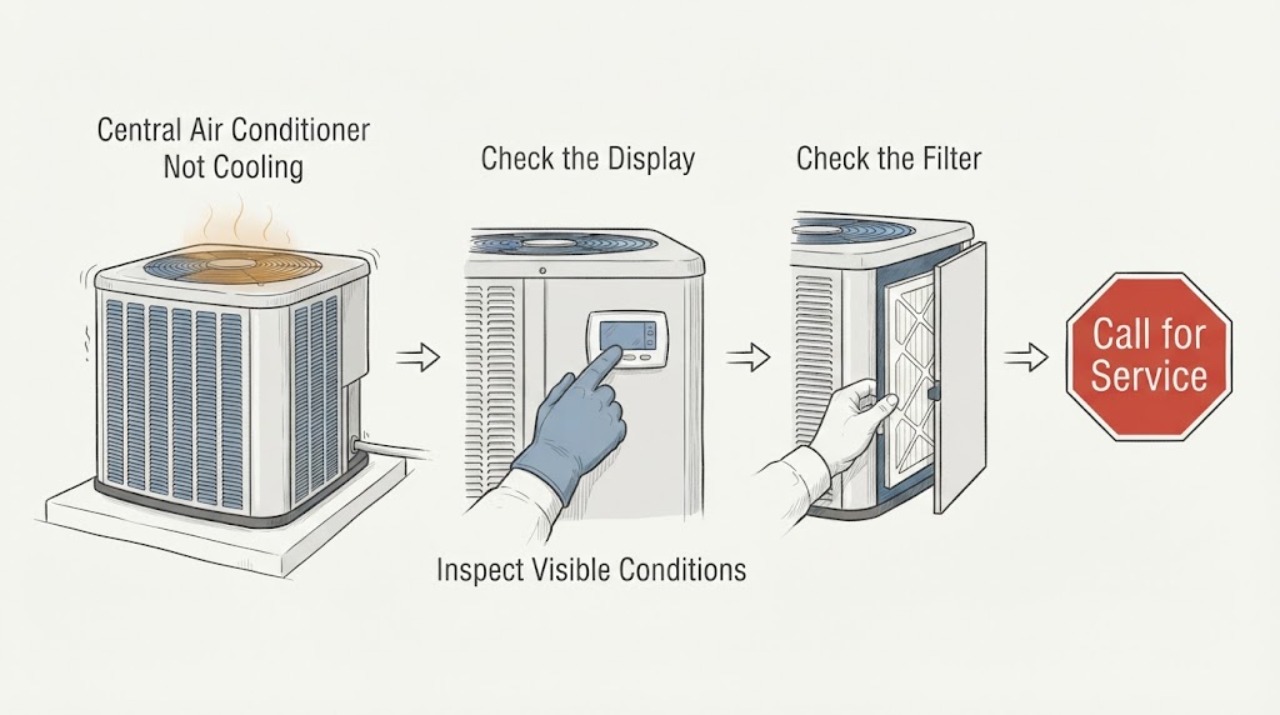
When a Trane central air conditioner is not cooling, first verify the thermostat is calling for cooling and the indoor fan is set appropriately, then check the accessible air filter, supply and return airflow, visible outdoor-unit debris, and any visible condensate overflow. A tripped breaker, incorrect thermostat mode, dirty filter or coil, blocked outdoor coil, frozen evaporator coil, clogged condensate drain, low refrigerant, or motor fault can produce similar symptoms. Make only low-risk external checks with the system off where the manufacturer's guidance calls for it; do not open electrical panels, handle capacitors, clean an indoor coil, add refrigerant, or bypass a condensate safety switch. If the breaker trips again, the outdoor unit is silent, the coil is frozen, water is overflowing, the system smells hot or burned, or it runs without cooling after the basic checks, turn it off and arrange qualified HVAC service.
Before you begin
Safety first
- Electrical, capacitor, motor, compressor, refrigerant, coil, condensate safety, control, duct, and system-sizing diagnosis or repair should be performed by a qualified HVAC professional using the exact Trane documentation.
Work through in order
Diagnostic checks
Use only checks that match the exact appliance or system and its official guide.
-
Check 1
Check the thermostat display and visible settings: select cooling, set the target below the current room temperature, and use the fan mode specified by the system or owner's manual. Note whether the thermostat shows a cooling call, whether the indoor blower starts, and whether the display is blank or reports an alert.
Expected result: The thermostat is off or blank, is not calling for cooling, calls while the blower is silent, or calls and the blower responds.
Next step: Correct only the visible mode or setpoint and replace thermostat batteries if the model uses them. If the display remains blank, the blower is silent, or an alert persists, arrange service without removing the thermostat or air-handler cover.
Stop if: Stop if wiring is exposed, the thermostat is damaged, the system smells burned, or an electrical or water hazard is visible.
Why this matters
Why: No call can be a mode, setpoint, battery, or thermostat issue; a call with no indoor airflow points toward power, blower, door-switch, filter, or control conditions. A normal call and blower response shifts attention to airflow and the outdoor cooling path.
-
Check 2
From a safe position, inspect the accessible electrical disconnect or breaker status without opening equipment covers. If the cooling breaker is clearly tripped and there is no odor, water, smoke, or visible damage, follow the manufacturer's normal reset guidance once; then observe whether it trips again when cooling is requested.
Expected result: The breaker or disconnect is on, is tripped once and stays on after a reset, or trips again immediately or during startup.
Next step: Leave a repeatedly tripping breaker off and arrange qualified HVAC or electrical service. Do not remove the disconnect cover, test voltage, handle a capacitor, or keep resetting the breaker.
Stop if: Stop immediately for smoke, burning odor, arcing, water near electrical equipment, damaged wiring, or any repeated breaker trip.
Why this matters
Why: A single tripped breaker can follow a power event, but a repeated trip suggests overload, short, compressor, fan, or other electrical trouble and is not a thermostat fix. A breaker that stays on does not prove that the outdoor unit has power or that cooling is operating.
-
Check 3
Turn the system off before checking the accessible air filter and visible supply and return grilles. Replace or clean the filter only as the owner's manual directs, and make sure reachable registers and return grilles are not covered or closed; do not clean an indoor coil or open the air handler.
Expected result: The filter is visibly loaded, airflow is weak at several registers, one room has restricted airflow, a coil appears frosted, or the filter and grilles are clear.
Next step: Restore a clean, correctly seated filter and open accessible registers, then allow the system to remain off if frost is present and arrange service. Do not scrape ice, wash an indoor coil, or bypass an airflow or condensate safety device.
Stop if: Stop if ice is present, water is overflowing, the filter access exposes wiring, or the air handler requires panel removal.
Why this matters
Why: A dirty filter or blocked return can reduce airflow and may contribute to a frozen evaporator coil; one-room restriction can be duct or register-specific. Frost or ice means the system should not continue running, while clear airflow shifts attention to the outdoor unit, condensate, refrigerant, or controls.
-
Check 4
With cooling off and from outside the cabinet, inspect the outdoor unit for leaves, grass, or other debris blocking the surrounding air path, and note whether the fan starts when a normal cooling call is made. Clear only loose debris that is safely reachable outside the unit; do not reach through the grille, remove panels, or spray internal coils.
Expected result: The outdoor area is obstructed, the fan and unit operate, the fan is silent while cooling is called, or the unit starts and then stops.
Next step: Remove only loose external debris and make one normal observation of the next cooling call. If the fan is silent, repeatedly stops, or warm air continues, turn the system off and arrange HVAC service.
Stop if: Do not open the outdoor cabinet, touch the fan or wiring, use a hose on a powered unit, or continue operation with a frozen coil, burned odor, or unusual noise.
Why this matters
Why: External debris can restrict condenser airflow; an outdoor unit that is silent or stops can involve power, controls, fan, capacitor, compressor, or a safety condition. A running outdoor unit with warm indoor air does not prove that the refrigerant charge or coil is correct.
-
Check 5
Inspect the visible indoor condensate area or drain-pan access only if the model provides a safe owner view, without removing covers. Note standing water, an overflowing pan, a wet floor, or a drain line that visibly backs up; also compare the air at a register with the thermostat call without touching refrigerant tubing.
Expected result: The pan or floor has water, the condensate drain appears blocked, the system has weak or warm airflow, or there is no visible condensate clue while cooling remains ineffective.
Next step: Turn the system off for overflow, keep water away from electrical parts, and arrange qualified service for the drain, safety switch, coil, refrigerant, or cooling circuit. Do not pour chemicals or boiling water into an unknown drain, reset a safety switch, or add refrigerant.
Stop if: Stop for a wet floor near electrical equipment, active overflow, a frozen coil, refrigerant-oil residue, or any need to open the air handler or access refrigerant lines.
Why this matters
Why: A rising pan or blocked condensate path can activate a safety switch and stop cooling; weak or warm air without visible water can instead involve airflow, coil, refrigerant, compressor, or control issues. No visible water does not rule out an internal drain problem.
Use your observations
Decision map
Find the observation that best matches what you see, then follow the next safe action.
-
PATH 01Next step
What you see
Do this next
Correct only the visible thermostat setting or batteries. If the call or blower remains abnormal, stop and arrange qualified HVAC service without opening the equipment.
Why this path and its safety boundary
Why it matters: A thermostat setting, battery, power, blower, door-switch, or control issue is more likely than a refrigerant problem at this stage.
-
PATH 02Next step
What you see
Do this next
Leave the affected circuit off, keep clear of the equipment, and obtain qualified HVAC or electrical service. Do not test live wiring or handle the outdoor cabinet.
Why this path and its safety boundary
Why it matters: An electrical, motor, capacitor, compressor, control, or safety fault is possible; repeated resets can worsen damage.
-
PATH 03Next step
What you see
Do this next
Turn the system off, replace only the accessible filter as directed, do not scrape ice or open the coil compartment, and arrange HVAC service if frost or warm air remains.
Why this path and its safety boundary
Why it matters: Restricted airflow or a refrigeration-system fault is more likely, and continued operation can worsen icing or reduce cooling.
-
PATH 04Next step
What you see
Do this next
Turn the system off if cooling is ineffective or the unit is icing, and have a qualified HVAC technician inspect airflow, coils, refrigerant circuit, controls, and system sizing. Do not add refrigerant yourself.
Why this path and its safety boundary
Why it matters: A blocked or dirty coil, low refrigerant or leak, compressor-side problem, incorrect airflow, or undersized system is more plausible than a thermostat setting alone.
-
PATH 05Next step
What you see
Do this next
Switch the system off, keep clear of wet electrical equipment, contain water only if safe, and arrange qualified service for the drain, pan, switch, and cooling system.
Why this path and its safety boundary
Why it matters: A condensate restriction or safety switch may be stopping cooling, with a water and electrical hazard that should not be bypassed.
Helpful context
Understand the symptom
Start at the thermostat and follow the cooling path
A cooling call must reach the system, air must move through the filter and ducts, and the outdoor and indoor coils must transfer heat. A blank or incorrectly set thermostat can stop the call; a clogged filter can reduce airflow and contribute to a frozen evaporator coil; and an outdoor unit that runs without cooling may have a coil, refrigerant, or compressor-side problem. The same warm-air symptom can therefore require very different next steps.
Keep refrigerant and electrical work out of homeowner checks
Trane's homeowner guidance supports checking visible settings, filters, registers, and debris around the outdoor unit. Refrigerant leaks, capacitors, motors, electrical panels, indoor coils, condensate safety devices, and control faults require trained service. A visible frost pattern or repeated breaker trip is a stop signal, not an invitation to keep running the equipment.
Safety boundary
Stop conditions
- Stop immediately for smoke, burning odor, arcing, exposed or damaged wiring, a repeatedly tripping breaker, water near electrical equipment, or a carbon monoxide alarm; follow emergency guidance as applicable.
- Turn the air conditioner off for a frozen coil, active condensate overflow, refrigerant-oil residue, severe leak, loud mechanical noise, or an outdoor unit that starts and stops abnormally.
- Do not open electrical or refrigerant panels, handle capacitors, test live wiring, add refrigerant, clean an indoor coil, bypass a condensate safety switch, or scrape ice.
- Do not repeatedly reset a breaker or safety device, run the system with a missing filter or open panel, or spray a powered outdoor unit through its grille.
- Arrange qualified HVAC service when the system runs without cooling after thermostat, filter, airflow, and visible-debris checks, when the blower or outdoor fan is silent, or when a fault returns.
Only after diagnosis
Potential parts
- central air conditioner air filter
Consider this only when the accessible filter is visibly loaded and the exact model or filter documentation identifies the correct replacement or cleaning method.
Filter dimensions, type, and access vary by system; confirm the model and owner's manual rather than choosing from a warm-air symptom. - thermostat or cooling control
Consider this only after a qualified technician confirms that the thermostat or control is not sending or maintaining the cooling call and rules out power and equipment faults.
Wiring, staging, sensors, and system compatibility are model-specific; do not order a control from a blank display or no-cooling symptom alone. - condensate drain or safety-switch component
Consider this only when diagnosis confirms a blocked or failed condensate drain, pan, pump, or safety switch is stopping the Trane system.
Drain routing, switch type, pump, and control wiring depend on the installation; confirm the exact system and local requirements before ordering.
When checks do not resolve it
Need a professional?
Contact a qualified HVAC professional when a Trane central air conditioner does not cool after basic thermostat, filter, airflow, and visible-debris checks, or when the blower or outdoor unit is silent, a breaker trips, the coil freezes, condensate overflows, or the system runs with warm air.
Safety scope: Electrical, capacitor, motor, compressor, refrigerant, coil, condensate safety, control, duct, and system-sizing diagnosis or repair should be performed by a qualified HVAC professional using the exact Trane documentation.
Have this ready
- Provide the exact Trane model if safely visible, thermostat mode and call, indoor and outdoor fan response, breaker behavior, filter and airflow condition, visible frost or water, outdoor debris, any display alert, sound or odor, and what changed after each safe check.
Common questions
FAQ
Why is my Trane central AC running but not cooling the house?
Common possibilities include a dirty filter, blocked airflow or outdoor coil, frozen evaporator coil, low refrigerant, condensate safety shutdown, thermostat issue, or a system-size problem. Check the thermostat, filter, registers, and visible outdoor debris; leave refrigerant and coil work to a professional.
What should I check when the Trane outdoor unit does not turn on?
Confirm the thermostat is calling for cooling and inspect the accessible breaker or disconnect. A single clearly tripped breaker may be reset once only if there is no hazard; if it trips again or the unit remains silent, turn it off and arrange service.
Can a dirty filter make a Trane AC stop cooling?
Yes. A loaded filter can reduce airflow and contribute to a frozen evaporator coil. Turn the system off and replace or clean the accessible filter as directed; do not scrape ice or open the coil compartment.
Should I add refrigerant to a Trane AC that is not cooling?
No. Low refrigerant commonly indicates a leak or charging problem and requires trained HVAC diagnosis, leak repair when possible, and proper recharge. Do not open refrigerant lines or use an unverified charge as a test.
When should I stop troubleshooting a Trane central air conditioner?
Stop for repeated breaker trips, a frozen coil, condensate overflow, water near electrical equipment, burning odor, smoke, exposed wiring, unusual mechanical noise, or an outdoor unit that starts and stops abnormally. Turn the system off and arrange qualified HVAC service.
Read the exact guide
Official sources
- The Problem SolverTrane · Trane outdoor-unit homeowner problem-solving document; the equipment manual and qualified service control exact repair work.
- AC Not Blowing Cold AirTrane · Trane residential guidance for central air conditioners blowing warm or insufficiently cool air.
- Air Conditioner Troubleshooting: 5 Common IssuesTrane · Trane residential air-conditioner troubleshooting overview; exact equipment manual and trained service control model-specific work.
- HVAC Troubleshooting - Schedule an Online AppointmentTrane · Trane interactive troubleshooting overview for low-risk homeowner checks and escalation; equipment-specific instructions still govern.
Community feedback
Share a repair observation
Share a plain-text repair observation. Accepted observations are published automatically; this page may take a moment to update.