
On this page
Start here
Quick answer
Treat water around a Weil-McLain boiler as a system problem, not as proof that one part needs replacement. If it is safe to do so, photograph the wet area and visually trace the highest accessible point around the boiler, piping, valves, pump, radiators, baseboards, and—on a high-efficiency unit—the condensate drain. Do not open the jacket, adjust a relief valve, add repeated makeup water, or use stop-leak compound. Arrange qualified heating service promptly; stop the boiler and get urgent help for a rapid leak, hot water or steam, gas odor, smoke, or water near electrical equipment.
Before you begin
Safety first
- Internal boiler, fuel, combustion, electrical, pressure-control, relief-valve, and condensate repairs should be performed by a qualified heating professional.
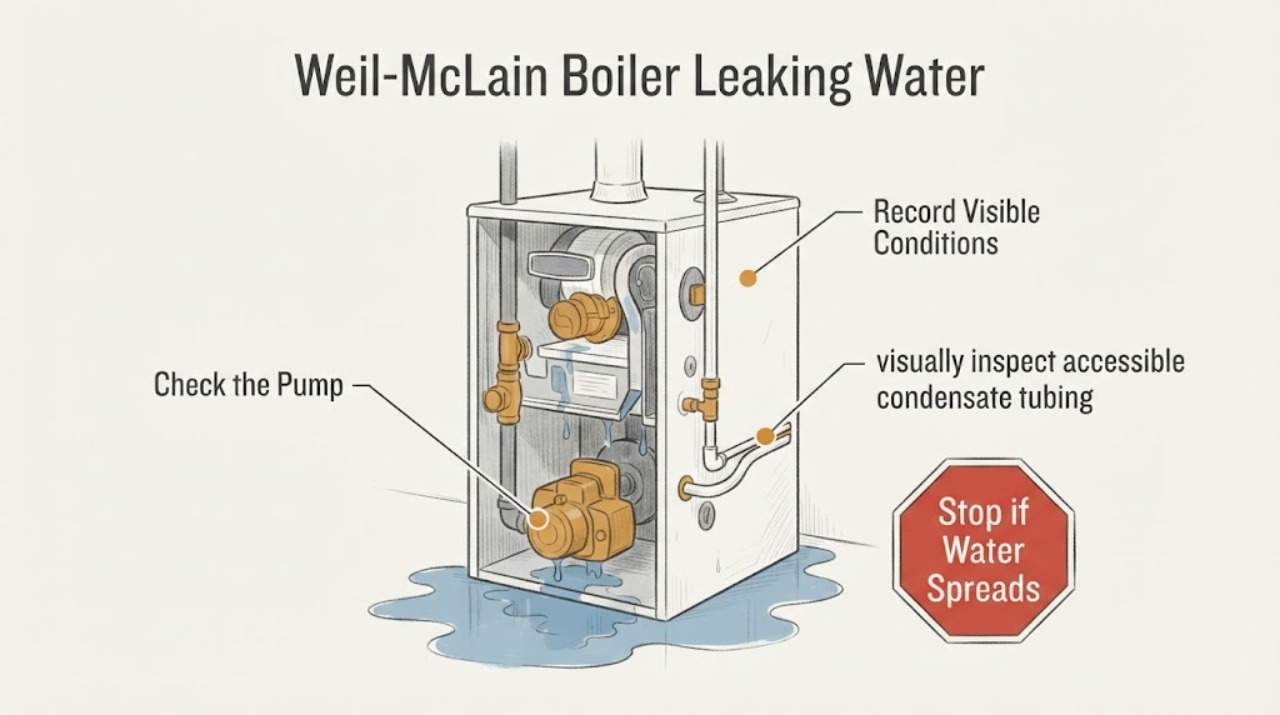
Work through in order
Diagnostic checks
Use only checks that match the exact appliance or system and its official guide.
-
Check 1
Without removing panels or touching hot surfaces, look around the accessible boiler jacket, nearby piping, valves, circulator or pump, radiators, and baseboards. Use a dry paper towel only on a cool, accessible exterior surface if needed to distinguish an active drip from an old stain.
Expected result: Water is actively appearing at a fitting, valve, pump, relief-valve discharge pipe, boiler casing, condensate connection, or only on the floor with no visible source.
Next step: Photograph the source area and the path of the water, then arrange qualified heating service. If the water is hot, rapidly increasing, or near electrical equipment, stop troubleshooting and follow the urgent stop guidance.
Stop if: Do not touch hot water or steam, open the boiler jacket, or handle a wet electrical area.
Why this matters
Why: The location narrows the system area but does not identify the failed part; water may travel along piping or the jacket before reaching the floor.
-
Check 2
Read the boiler pressure gauge from a safe position and record whether the reading is stable, repeatedly falling, repeatedly rising, or outside the normal range stated in the exact boiler manual. Do not turn fill, drain, or pressure-control valves to correct the reading.
Expected result: Pressure changes along with the leak, the system repeatedly needs makeup water, or the pressure appears normal while a localized drip continues.
Next step: Record the gauge trend and leak timing for the technician. If pressure is abnormal or keeps changing, do not keep refilling the system or attempt to adjust controls yourself.
Stop if: Stop if the gauge rises rapidly, the relief-valve discharge becomes active, or the appliance shows an unsafe operating condition.
Why this matters
Why: A falling reading or repeated need for makeup water supports water loss somewhere in the heating system; a localized leak with stable pressure can still be an external fitting, valve, pump, condensate, or other component issue.
-
Check 3
If the boiler is a high-efficiency condensing model, visually inspect accessible condensate tubing, the drain line, fittings, and trap for pooling, leakage, damage, or an obvious blockage. Do not disconnect, flush, or modify the condensate assembly unless the model manual or a technician directs it.
Expected result: The water is concentrated at a condensate tube, PVC fitting, drain, or trap, or the condensate path looks clear while the leak is elsewhere.
Next step: Take a photo and arrange service, especially if drainage recurs or the boiler locks out. Keep the inspection visual only.
Stop if: Do not disconnect condensate components or work inside the boiler enclosure.
Why this matters
Why: A condensate leak or drainage problem is a separate path from a hydronic piping leak and can affect boiler operation; visual evidence is enough to report but not to select a replacement part.
-
Check 4
Observe the relief-valve discharge pipe and surrounding floor from a safe distance while the system is cool enough to view safely. Do not lift the relief-valve lever, cap the discharge, or place a hand under the outlet.
Expected result: Water is coming from the discharge path, or the discharge remains dry while another accessible connection is wet.
Next step: Stop adjusting or testing the valve and have a qualified heating professional inspect the boiler and system. Keep the discharge path unobstructed.
Stop if: Treat hot discharge, steam, a rapidly worsening leak, or a blocked or damaged discharge path as an urgent professional-service condition.
Why this matters
Why: Discharge at the relief path can involve system pressure, an expansion tank, a limit control, or the relief valve itself; the discharge location does not prove which one is at fault.
-
Check 5
Find the boiler model and CP or serial information from the exterior label if it can be read without opening the jacket. Note whether it is a steam or water system, the fuel type if known, when the leak started, and whether the boiler is firing or calling for heat.
Expected result: The model and system details are available, or the label cannot be read without removing a cover or entering the equipment area.
Next step: Give those details and photos to the installer or qualified heating professional. If identifying the label requires opening the cabinet, leave that task to the technician.
Stop if: Do not remove covers, enter a combustion or electrical compartment, or continue operating a boiler with a worsening leak.
Why this matters
Why: Weil-McLain manuals and component identification are model-specific; service can be more accurate when the technician receives the model, system type, leak location, photos, and timing.
Use your observations
Decision map
Find the observation that best matches what you see, then follow the next safe action.
-
PATH 01Next step
What you see
Do this next
Leave the connection undisturbed, document it, and arrange qualified heating service. Do not tighten fittings or refill the system as a repair.
Why this path and its safety boundary
Why it matters: An external hydronic connection or component is more likely than a confirmed leak from the boiler heat-exchange section, but water tracking can make the first wet point misleading.
-
PATH 02Next step
What you see
Do this next
Stop repeated top-ups and give the pressure trend and operating timing to a heating professional for a full system inspection.
Why this path and its safety boundary
Why it matters: The system is losing water or discharging it; the underlying leak or pressure-control cause needs correction rather than repeated refilling.
-
PATH 03Next step
What you see
Do this next
Do not block or test the discharge path. Keep clear of hot water or steam and arrange prompt qualified service.
Why this path and its safety boundary
Why it matters: The relief path is responding to or experiencing a pressure or safety-control condition; the relief valve, expansion tank, limit control, or system condition cannot be distinguished safely by sight alone.
-
PATH 04Next step
What you see
Do this next
Keep the condensate system intact, document the location, and have a qualified technician inspect it; do not disconnect or modify the drain.
Why this path and its safety boundary
Why it matters: A condensate drainage or fitting problem is more likely than a conventional system-pipe leak, but it still requires model-specific evaluation if it recurs or affects operation.
-
PATH 05Next step
What you see
Do this next
Stop using the boiler and keep people away from the hazard. If it can be done without entering a wet or dangerous area, use the normal appliance shutdown or disconnect described by the manual, then obtain urgent qualified help; follow local emergency guidance for an active gas or fire hazard.
Why this path and its safety boundary
Why it matters: The situation has moved beyond a safe homeowner visual check and may involve scalding, electrical, combustion, flooding, or equipment-damage risk.
Helpful context
Understand the symptom
A leak is a symptom, not a part diagnosis
Water can come from a boiler section, an external threaded or flanged connection, a valve or pump, a relief-valve discharge path, or a condensate drain on a high-efficiency model. Water can also run along tubing before it drips, so the wettest spot on the floor may not be the source. Weil-McLain's guidance is to look for leakage and deterioration, then have recurring leaks evaluated by a qualified heating professional.
Protect the system while you document it
Repeatedly adding fresh water can shorten boiler life and can mask how quickly the system is losing water. Record when the leak appears, whether the boiler is firing, what the pressure gauge does over time, and whether the water is coming from an accessible pipe, valve, pump, relief-valve discharge, or condensate connection. This information helps a technician separate a system-pressure problem from a localized plumbing or component leak.
Safety boundary
Stop conditions
- Stop and obtain urgent help for a rapid leak, hot water or steam, smoke, a fuel odor, water near electrical equipment, or a flooding risk.
- Do not open the boiler jacket, remove service panels, adjust system valves or controls, lift the relief-valve lever, or block a discharge pipe as an ordinary-user repair.
- Do not repeatedly add makeup water or use petroleum-based stop-leak compounds; recurring water loss needs professional diagnosis and repair.
- Arrange qualified heating service for any visible boiler leak, persistent pressure change, relief-valve discharge, condensate leak, or leak whose source cannot be confirmed visually.
Only after diagnosis
Potential parts
- boiler relief valve
Consider this only if a qualified technician confirms the relief valve itself is defective after evaluating system pressure, expansion control, and limit protection.
Confirm the exact boiler model, system type, and approved rating with the manufacturer or technician before ordering; a discharge does not prove the valve alone failed. - boiler expansion tank
Consider this only when professional testing links pressure rise and relief discharge to an incorrectly sized, flooded, or failed expansion tank.
Sizing and connection depend on the complete heating system and boiler model; do not choose a tank from the leak symptom alone. - condensate drain or trap component
Consider this only for a high-efficiency model when diagnosis confirms the condensate drain, fitting, or trap is the source of the leak or drainage fault.
Verify the exact boiler model and the manufacturer's service requirements; do not disconnect or modify condensate parts based only on a wet floor.
When checks do not resolve it
Need a professional?
Contact a qualified heating professional for any Weil-McLain boiler leak, especially when the pressure changes, the relief path discharges, the leak recurs, or the source is inside the casing or not visible.
Safety scope: Internal boiler, fuel, combustion, electrical, pressure-control, relief-valve, and condensate repairs should be performed by a qualified heating professional.
Have this ready
- Provide the boiler model and CP or serial information if safely visible, steam or water system type, fuel type if known, photos, leak location, pressure trend, and whether it occurs during firing or circulation.
Common questions
FAQ
Is a Weil-McLain boiler leak always a sign that the boiler must be replaced?
No. Water may come from an external connection, valve, pump, relief path, condensate assembly, or the boiler itself. Have the source and system condition evaluated before choosing repair or replacement.
Can I keep adding water to a leaking boiler?
Do not use repeated makeup water as a repair. Continuing water loss can damage the system and can hide how quickly the leak is progressing; arrange qualified service.
What if water is coming from the relief-valve discharge pipe?
Do not cap the pipe or lift the valve lever. Discharge can involve pressure, expansion control, a limit control, or the valve, so keep clear of hot water or steam and have a qualified professional inspect it.
Could a high-efficiency Weil-McLain boiler leak from the condensate drain?
Yes, condensate tubing, fittings, and the drain or trap are distinct places to inspect visually on a condensing model. Do not disconnect or modify them; recurring drainage problems need professional evaluation.
What information should I give the heating technician?
Share the model and CP or serial information if safely visible, system type, fuel type if known, photos, the highest visible wet point, pressure trend, and when the leak occurs. Do not remove a cover to find a label.
Read the exact guide
Official sources
- Boiler Winter Maintenance ChecklistWeil-McLain · Manufacturer checklist for safe visual checks of pressure, leaks, piping, valves, pumps, condensate, and professional escalation.
- Boiler FAQs & Common Questions - Weil-McLainWeil-McLain · Manufacturer FAQ covering leaking boilers, model-specific manuals, CP identification, and the professional service boundary.
- A Guide to Maintaining High-Efficiency BoilersWeil-McLain · Manufacturer maintenance guide for high-efficiency boilers, including water loss, dripping, piping leakage, condensate, and service checks.
- Seven Telltale Signs Your Boiler Needs To Be ReplacedWeil-McLain · Manufacturer guidance that leaks and safety-control symptoms require inspection and do not alone identify a replacement part.
Community feedback
Share a repair observation
Share a plain-text repair observation. Accepted observations are published automatically; this page may take a moment to update.