
On this page
Start here
Quick answer
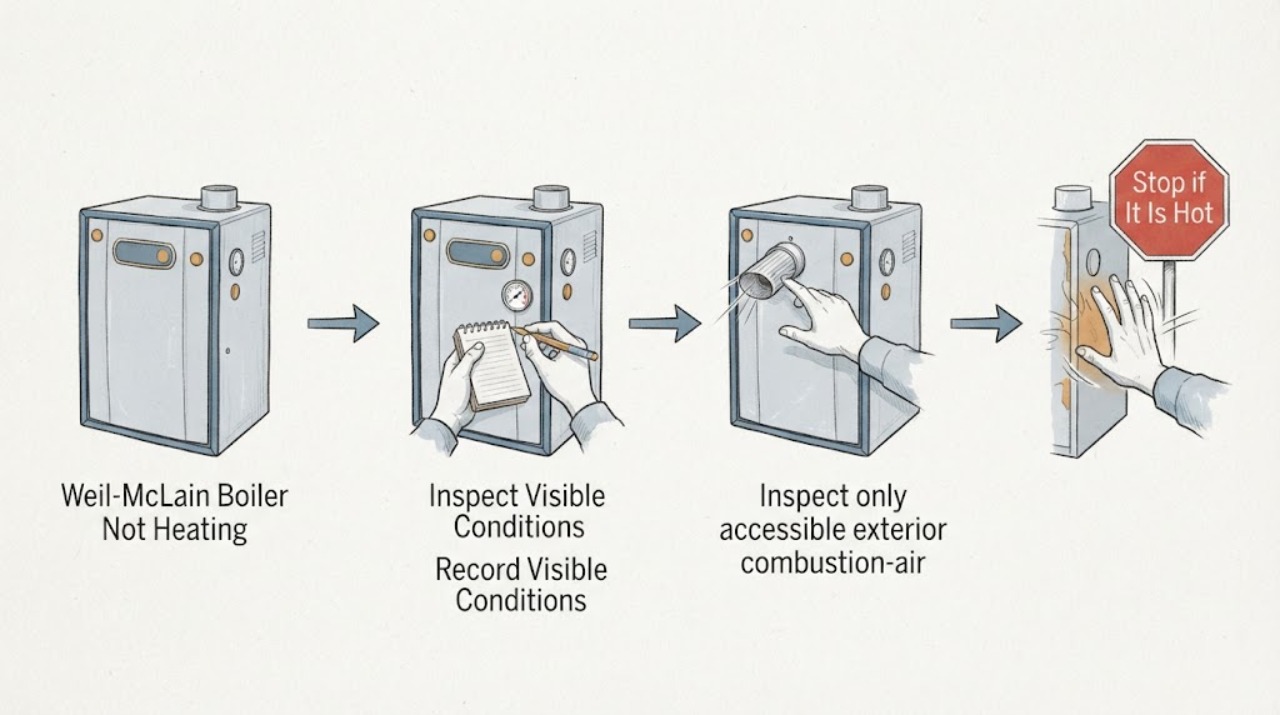
When a Weil-McLain boiler is not heating, start at the thermostat and zone call, then observe the boiler display or indicator, pressure gauge, burner or circulator response, and the radiators or baseboards. Check only accessible air and vent openings and, on a high-efficiency model, the condensate path; do not open the jacket or adjust gas, electrical, pressure, or combustion controls. A boiler that is silent, locked out, losing pressure, leaking, or producing no heat after an ordinary thermostat call needs a qualified heating professional. Leave immediately for a gas odor or carbon monoxide alarm.
Before you begin
Safety first
- Boiler startup sequence, fuel, combustion, venting, electrical, pressure, water chemistry, safety controls, and internal circulation repairs should be performed by a qualified heating professional.
Work through in order
Diagnostic checks
Use only checks that match the exact appliance or system and its official guide.
-
Check 1
Set the thermostat or zone control above the current room temperature and confirm the correct heating mode and schedule are active. Observe the boiler area without opening it to see whether a normal heat call produces any display, indicator, ignition, burner, or circulator response.
Expected result: The boiler responds, remains silent, or starts and then stops before a zone warms.
Next step: Record the response and exact timing, then continue to the gauge and heat-distribution checks. If there is no response after the ordinary thermostat check, arrange qualified service rather than opening the control compartment.
Stop if: Do not remove thermostat wires, jumper controls, or open the boiler jacket.
Why this matters
Why: A response shows that the call is reaching at least part of the system; no response makes thermostat, zone control, power, or an active safety condition more plausible, while a start-then-stop pattern needs sequence diagnosis.
-
Check 2
Read the boiler pressure or pressure-temperature gauge from a safe position and note whether it is within the range specified by the exact model manual. Record whether the reading is stable, falling, rising, or accompanied by a leak, relief discharge, or frequent need for makeup water.
Expected result: Pressure is outside the model's normal range, changes repeatedly, or remains stable while the home is still cold.
Next step: Give the pressure trend and any leak evidence to a qualified heating professional. Do not refill repeatedly or adjust pressure-control components yourself.
Stop if: Stop if the gauge rises rapidly, a relief path discharges, water is leaking, or the gauge is damaged or unreadable.
Why this matters
Why: Abnormal or changing pressure can prevent reliable operation and can indicate water loss, expansion, or another system issue; stable pressure shifts attention toward controls, firing, circulation, or the heat emitters.
-
Check 3
Inspect only accessible exterior combustion-air openings, vent terminations, and the area around the boiler for obvious leaves, lint, stored items, loose sections, or deterioration. Do not remove panels or alter the venting; remove only loose debris from an exterior opening when the exact manual clearly permits it.
Expected result: An opening or termination is visibly blocked or damaged, or the accessible air and vent areas look clear while the boiler still does not heat.
Next step: Keep the boiler off if the vent or air path is damaged or remains blocked, and arrange qualified service. If a permitted exterior debris removal changes operation, monitor the next cycle and still report the event if the fault returns.
Stop if: Do not enter the vent, disconnect piping, bypass a pressure or spill switch, or test combustion yourself.
Why this matters
Why: Air or vent restrictions can cause a boiler to shut down or lock out, but a clear exterior does not rule out an internal or control fault.
-
Check 4
Walk through the heated areas and compare radiators, baseboards, or radiant zones after a heat call. Note whether every zone stays cold, one zone is cold, a section is noisy, or heat begins at the boiler but does not reach the room; look for accessible water, corrosion, or staining.
Expected result: No zone warms, only one zone or emitter is affected, or heat is uneven with noise, a leak, or a changing pressure reading.
Next step: Record the affected zones and symptoms for service. Do not bleed hot radiators, adjust balancing valves, or manipulate a leaking or pressurized component unless the model instructions and a professional direct you.
Stop if: Stop if water is hot or escaping, a pipe is damaged, or the area has a combustion or electrical hazard.
Why this matters
Why: No heat anywhere points back toward the call, boiler startup, safety, or circulation; one cold zone or emitter makes a valve, air, flow, or local distribution issue more likely.
-
Check 5
If the unit is a high-efficiency condensing boiler, visually inspect accessible condensate tubing, the trap, and drain fittings for a dry trap, pooling, damage, or an obvious blockage. Also note any boiler display alert or lockout without repeatedly resetting it.
Expected result: The condensate path is damaged, dry, blocked, or leaking, or the path looks intact and the boiler shows a persistent alert or remains in lockout.
Next step: Do not disconnect or modify the condensate system. Keep the boiler off when the path is unsafe or the manual directs service, and provide the exact alert, model, and observations to a qualified technician.
Stop if: Do not operate a boiler with a dry, damaged, or obstructed condensate path, and do not enter the cabinet to clear it.
Why this matters
Why: A condensate problem can stop a high-efficiency boiler or create a venting safety concern; a persistent alert or lockout requires the exact model sequence and professional diagnosis.
Use your observations
Decision map
Find the observation that best matches what you see, then follow the next safe action.
-
PATH 01Next step
What you see
Do this next
Check only the normal thermostat mode and visible status. If the boiler still does not respond, arrange qualified service without removing covers or checking live wiring.
Why this path and its safety boundary
Why it matters: A thermostat or zone-control signal, power, standby state, or safety-control issue is more likely than a distribution-only problem.
-
PATH 02Next step
What you see
Do this next
Record the boiler response, gauge behavior, and whether the circulator sound is present, then have a technician inspect flow and controls. Do not refill or adjust valves repeatedly.
Why this path and its safety boundary
Why it matters: Circulation, water level or pressure, a system valve, control sequence, or a heat-transfer problem is more likely than a thermostat setting alone.
-
PATH 03Next step
What you see
Do this next
Document the affected zone and any leak or pressure clue. Have a qualified professional evaluate the distribution system; do not work on hot or pressurized components.
Why this path and its safety boundary
Why it matters: Air, a local valve or circulation restriction, low pressure, or distribution issue is more plausible than a complete boiler failure.
-
PATH 04Next step
What you see
Do this next
Leave the boiler off when the manual directs it, avoid repeated resets, and arrange qualified heating service with the exact alert and observations.
Why this path and its safety boundary
Why it matters: A safety, water, venting, condensate, or control condition is preventing normal heating and needs the model-specific service sequence.
-
PATH 05Next step
What you see
Do this next
Leave the hazard area and follow gas-supplier, detector, or emergency guidance. Do not operate switches or re-enter to reset the boiler; obtain emergency or qualified service help.
Why this path and its safety boundary
Why it matters: This is an immediate combustion, electrical, scalding, flooding, or property-safety condition, not a routine no-heat check.
Helpful context
Understand the symptom
Follow the heat path from the call to the room
No heat can be caused by a thermostat or zone-control issue, a boiler that never starts, a safety lockout, inadequate water or circulation, air in the system, a vent or combustion-air problem, or a fault at the heat emitters. The useful distinction is whether the boiler responds to a heat call and whether heat reaches any zone. A Weil-McLain model manual is the authority for the specific operating sequence.
A control light is a clue, not a part diagnosis
A display or indicator can show standby, a lockout, or a safety condition, but the same symptom can involve several components. Record the exact light or message and the point in the startup sequence where it stops. Do not bypass a safety device, repeatedly reset an unexplained lockout, or replace a control from an indicator alone.
Safety boundary
Stop conditions
- Stop immediately and follow emergency guidance for gas odor, a carbon monoxide alarm, smoke, flame rollout, fire, severe overheating, or water contacting electrical parts.
- Do not open the boiler jacket, remove burner or vent panels, jumper safety controls, test live wiring, or adjust gas, combustion, pressure, or limit controls.
- Do not repeatedly reset a lockout, repeatedly add makeup water, or operate a high-efficiency boiler with a dry, damaged, or blocked condensate path.
- Arrange qualified heating service for no response to a thermostat call, persistent lockout or alert, abnormal pressure, leaks, no circulation, or a zone that remains cold after basic external checks.
Only after diagnosis
Potential parts
- thermostat or zone-control component
Consider this only after testing confirms the thermostat or zone-control signal is not reaching the boiler and the problem is not a schedule, wiring, power, or boiler safety condition.
Confirm the complete heating system, control type, and boiler model with a qualified technician before ordering. - boiler circulator or circulation component
Consider this only when a technician confirms that the boiler fires but flow to the affected zone is inadequate and identifies a failed circulator or related component.
Flow requirements and control connections depend on the boiler and system design; a cold zone alone does not establish fit or failure. - condensate drain or trap component
Consider this only on a condensing model when diagnosis confirms that the condensate trap, drain, or fitting is causing the shutdown or no-heat condition.
Verify the exact boiler model and manufacturer service requirements; do not select a condensate part from a generic no-heat symptom.
When checks do not resolve it
Need a professional?
Contact a qualified heating professional when the Weil-McLain boiler does not respond to a thermostat call, starts but does not circulate heat, locks out, has abnormal pressure or water, or remains without heat after the model's ordinary external checks.
Safety scope: Boiler startup sequence, fuel, combustion, venting, electrical, pressure, water chemistry, safety controls, and internal circulation repairs should be performed by a qualified heating professional.
Have this ready
- Provide the exact boiler model and CP information if safely visible, thermostat and zone behavior, display or indicator pattern, pressure trend, burner or circulator response, affected zones, vent or condensate observations, and any leak or safety symptom.
Common questions
FAQ
Why is my Weil-McLain boiler not heating at all?
Start by confirming a thermostat or zone call and observing whether the boiler responds. If it remains silent, locks out, has abnormal pressure, or does not circulate heat, it needs qualified diagnosis rather than a guessed part replacement.
What if the boiler runs but one room or zone stays cold?
A local air, valve, flow, pressure, or distribution issue is more likely than a complete boiler failure. Record the affected zone and have a technician evaluate hot or pressurized components.
Should I add water when my Weil-McLain boiler is not heating?
Do not repeatedly add makeup water or add cold water to a hot boiler. A changing pressure or frequent need for water is evidence for professional diagnosis of a leak, flow, or expansion problem.
Can a blocked vent or condensate drain cause no heat?
Yes, especially on applicable high-efficiency or vented models. Inspect only obvious external conditions allowed by the model manual; do not disconnect the vent or condensate path, and arrange service for a blockage or recurring shutdown.
When should I stop troubleshooting a Weil-McLain boiler?
Stop for gas odor, a carbon monoxide alarm, smoke, fire, severe overheating, water on electrical parts, abnormal pressure, leaks, persistent lockout, or no response after an ordinary thermostat check. Follow emergency guidance or call a qualified heating professional.
Read the exact guide
Official sources
- CGa, CGi, EG, PEG, & LGB USER MANUALWeil-McLain · Manufacturer user manual for several Weil-McLain gas boiler families; the exact model manual controls the operating sequence.
- A Guide to Maintaining High-Efficiency BoilersWeil-McLain · Manufacturer guide for high-efficiency models, used for condensate, water-level, pressure, and air or vent checks.
- Boiler Winter Maintenance ChecklistWeil-McLain · Manufacturer checklist for safe external checks when a boiler or heating zone is not heating.
- Boiler FAQs & Common Questions - Weil-McLainWeil-McLain · Manufacturer FAQ directing homeowners to model-specific manuals and qualified heating professionals for nonworking systems.
Community feedback
Share a repair observation
Share a plain-text repair observation. Accepted observations are published automatically; this page may take a moment to update.