
On this page
Start here
Quick answer
A low reading on a Weil-McLain boiler is a symptom, not a reason to open a fill valve or replace a part immediately. First identify whether the appliance is a hot-water boiler with a pressure/temperature gauge or a steam boiler with a gauge glass and pressure control, then record the reading from a safe position and compare it with the exact model manual. Look for visible water at the boiler, relief discharge, piping, pumps, radiators, or baseboards and note whether pressure falls again, heat is uneven, or the boiler locks out. Do not use a universal pressure target, vent a hot system, operate a relief valve, alter gas or combustion controls, or add makeup water unless the exact manual and a qualified heating professional direct that procedure. Weil-McLain says continually abnormal pressure or leakage calls for a qualified heating professional; a repeated drop commonly needs leak, expansion, air, gauge, feed-water, or control diagnosis rather than a blind board or valve replacement.
Before you begin
Safety first
- Owner checks are limited to safe visual observation, reading labels and gauges without opening equipment, and documenting trends and visible leaks. A qualified professional must handle filling, draining, bleeding, pressure or gas controls, relief and expansion components, low-water controls, electrical or combustion testing, concealed leaks, and parts replacement.
Work through in order
Diagnostic checks
Use only checks that match the exact appliance or system and its official guide.
-
Check 1
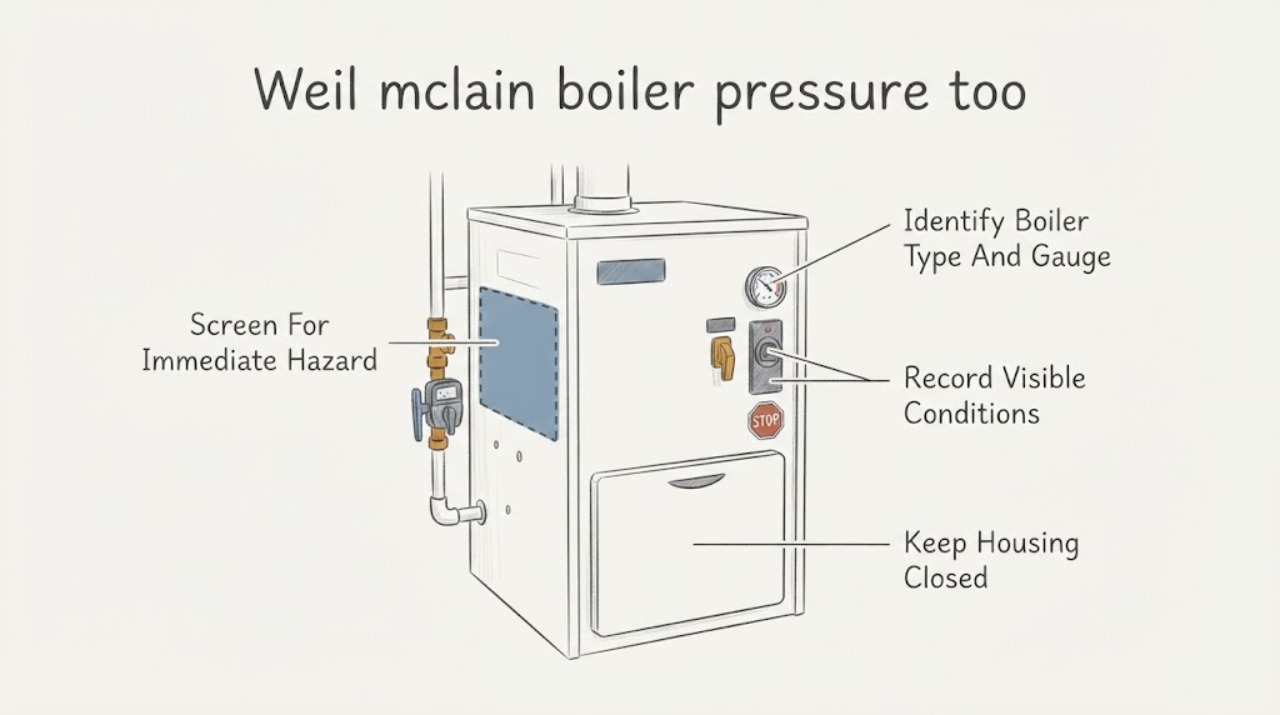
From a dry, stable position, check for gas odor, a carbon-monoxide alarm, smoke, flame or flue-gas concern, steam, hot spray, a forceful relief discharge, fast flooding, or water touching electrical equipment. Do not touch the boiler, controls, piping, or relief discharge to judge temperature.
Expected result: Record no immediate hazard, or record gas odor, an alarm, smoke, steam, hot discharge, active flooding, exposed wiring, or water near electrical equipment.
Next step: For gas odor or a carbon-monoxide alarm, leave as appropriate and contact emergency services or the gas utility from a safe location. For steam, smoke, hot discharge, electrical contact, or flooding, keep clear and request urgent qualified service. Do not restart or adjust the boiler.
Stop if: Stop immediately for gas odor, a carbon-monoxide alarm, smoke, steam, hot spray, forceful discharge, flooding, or water reaching electrical equipment.
Why this matters
Why: A combustion or electrical warning, steam, hot pressurized water, or active flooding is not a low-pressure troubleshooting step. It can cause fire, poisoning, burns, shock, or property damage.
-
Check 2
From the boiler label and a safe viewing position, identify whether the system is a hot-water boiler with a pressure or pressure/temperature gauge, or a steam boiler with a gauge glass and steam pressure control. Record the model, fuel type, gauge label, needle position, gauge-glass waterline if visible, and whether the reading was taken when cool or operating.
Expected result: The appliance type and gauge are clear, the gauge is unreadable or damaged, the gauge glass is low or empty, the needle is fixed or implausible, or the model information cannot be read safely.
Next step: Use the exact model manual or give the label and photos to a qualified heating professional. If the gauge glass appears empty, a low-water control is active, or the gauge is damaged, do not fire the boiler or manipulate valves.
Stop if: Stop if reading the label requires opening a panel, if the gauge glass is cracked or leaking, or if the boiler is hot, steaming, or locked out.
Why this matters
Why: The same phrase, pressure too low, can describe different equipment and should not be assigned a universal target. A damaged or implausible gauge is evidence for gauge and system diagnosis, not for opening a fill valve; an abnormal steam waterline can involve low-water controls.
-
Check 3
Record the pressure reading and time without tapping the gauge, removing its cover, connecting another gauge, or starting the boiler solely to create a comparison. If the system has a safe, readable display, note whether the pressure is stable, slowly falling, rising unusually, or changing only when the boiler operates.
Expected result: The reading is stable within the model's documented range, repeatedly falls, rises sharply during operation, fluctuates more than usual, or cannot be trusted because the gauge is stuck or damaged.
Next step: Compare only with the exact owner manual. If the trend is abnormal or the gauge is questionable, leave the boiler in its current safe state and schedule qualified service; do not compensate by repeatedly adding water.
Stop if: Stop if pressure changes rapidly, a relief path discharges, the boiler shuts down, the gauge fogs or leaks, or any live/hot measurement would be required.
Why this matters
Why: Weil-McLain says operating requirements vary by system and that pressure repeatedly rising, falling, or fluctuating outside its normal range should be professionally evaluated. A trend is more useful than one unverified needle position and can point toward leakage, expansion, gauge, or control issues.
-
Check 4
With the boiler off or cool enough to approach and without moving insulation or opening panels, visually inspect accessible piping, valves, circulator or pump areas, radiators, baseboards, the boiler floor, and the relief discharge end for water, staining, corrosion, or mineral trails. Do not loosen fittings or wipe a hot surface.
Expected result: There is no visible moisture, or there is a drip, pooling, staining, corrosion, wet insulation, relief discharge, or a concealed source that cannot be viewed safely.
Next step: Photograph the first wet point and arrange qualified service promptly. If water is actively spreading, isolate the system only using a clearly identified safe control and the exact manual; never cap a relief discharge or tighten a hot fitting.
Stop if: Stop for hot water, steam, forceful discharge, water near electrical parts, a gas or combustion-area leak, unstable flooring, or any need to open the boiler.
Why this matters
Why: Visible water or a mineral trail supports water loss as a cause of falling pressure. A relief discharge can involve pressure, temperature, expansion, or a valve problem; a concealed or inaccessible leak cannot be safely characterized by an owner inspection.
-
Check 5
Ask whether radiators or baseboards are partly cold, noisy or gurgling, whether a heating zone no longer warms, whether a low-water cutoff or lockout is displayed, and whether the thermostat calls without heat. Observe only; do not bleed radiators, reset a safety repeatedly, or enter the burner compartment.
Expected result: Heat is uneven with air-like noise, a zone is cold, a low-water control has interrupted operation, the thermostat calls normally, or the symptom is absent despite a low reading.
Next step: Record the affected zones and control indication and request a heating professional to check water level, air elimination, leaks, circulation, and safety controls. Do not force operation to test the diagnosis.
Stop if: Stop for a low-water lockout, hot radiator or pipe, unusual banging, steam, gas odor, or any need to open a control or combustion compartment.
Why this matters
Why: Weil-McLain lists air in the system and low system pressure among causes of noisy or poorly heated radiators, but circulation, controls, gauge error, and water loss can look similar. A low-water cutoff is a protective condition, not a component to defeat.
-
Check 6
From a safe distance, note whether pressure rises and falls with heating, the relief discharge pipe has been wet, the expansion tank or nearby piping shows corrosion or leakage, or the system needs frequent makeup water. Do not lift the relief lever, tap the expansion tank, adjust an air charge, or operate a feeder as a test.
Expected result: Pressure cycles unusually, the relief path has discharged, the expansion tank area is wet or corroded, makeup water is frequently needed, or none of these signs is present.
Next step: Arrange qualified service for any relief discharge, frequent makeup, or expansion-tank concern. Keep the relief path unobstructed and do not use stop-leak chemicals or a guessed tank pressure.
Stop if: Stop for hot or forceful relief discharge, a blocked or altered relief pipe, water near electrical equipment, or any request to alter a pressure-control or expansion component.
Why this matters
Why: Weil-McLain associates frequent relief release with expansion-tank or limit-control concerns and frequent makeup water with leaks and possible mineral deposits. The absence of visible signs does not rule out a concealed leak, failed tank, or inaccurate gauge.
-
Check 7
Prepare a service record with the exact model and CP or serial information, hot-water or steam type, fuel, gauge and waterline readings, cool or operating state, pressure trend, first wet point, affected zones, noises, lockouts, relief observations, recent maintenance, and safe photos.
Expected result: The record contains direct observations and timing, or key information is missing because it could not be read safely.
Next step: Contact a qualified heating professional for repeated low pressure, any leak, abnormal gauge trend, low-water lockout, uneven heat, relief discharge, or an unresolved reading. Keep the boiler out of service when safe operation cannot be confirmed.
Stop if: Stop owner troubleshooting when the next step requires filling, draining, bleeding, live electrical testing, gas adjustment, panel removal, or combustion or relief-component work.
Why this matters
Why: The model identity and symptom pattern let a professional choose the correct manual and distinguish gauge error, water loss, air, expansion, feed-water, circulation, low-water, relief, or control problems. Missing information is safer than opening equipment to obtain it.
Use your observations
Decision map
Find the observation that best matches what you see, then follow the next safe action.
-
PATH 01Next step
What you see
Gas odor, a carbon-monoxide alarm, smoke, steam, hot pressurized discharge, active flooding, or water near electrical equipment is present.
Do this next
Leave as appropriate and contact emergency services, the gas utility, or urgent qualified heating service from a safe location. Do not operate switches in a suspected gas leak, touch wet electrical equipment, or restart the boiler.
-
PATH 02Next step
What you see
The label, gauge type, gauge glass, or reading cannot be identified safely, or the needle is stuck or implausible.
Do this next
Use the exact manual or provide the model and photos to a qualified heating professional. Do not connect a test gauge, open a panel, or open the fill path as a guess.
-
PATH 03Next step
What you see
The gauge falls again and water, staining, corrosion, or a wet relief discharge is found at the boiler, piping, pump, radiator, baseboard, or relief path.
Do this next
Keep the path clear, document the first wet point, and arrange prompt qualified service. Do not cap the relief path, tighten a hot fitting, add stop-leak chemical, or keep refilling without diagnosis.
-
PATH 04Next step
What you see
Low pressure accompanies gurgling or noisy emitters, partly cold radiators or baseboards, a cold zone, or a low-water cutoff indication, without an immediate combustion or flooding emergency.
Do this next
Stop forcing operation and request a heating professional to check system water level, air elimination, leaks, circulation, gauge, and safety controls. Do not bleed a hot system or defeat a cutoff.
-
PATH 05Next step
What you see
Pressure rises or falls unusually as the boiler heats, the relief path has discharged, or the expansion-tank area is wet or corroded.
Do this next
Have a qualified professional evaluate expansion and relief operation and confirm the gauge and control settings. Do not adjust an expansion charge or relief control yourself.
-
PATH 06Next step
What you see
The reading is stable, no leak or safety sign is visible, heat is normal, and the number only seems low compared with a generic internet value.
Do this next
Check the exact Weil-McLain manual and monitor the trend. If it is outside that manual's range, repeatedly changes, or the boiler shuts down, schedule qualified service rather than adding water based on a universal number.
Helpful context
Understand the symptom
Low pressure means different things on water and steam boilers
Do not transfer a hot-water boiler pressure rule to a steam system. Weil-McLain's user manual identifies a pressure or pressure/temperature gauge, a relief valve, and, for steam equipment, a gauge glass and low-water controls. A low waterline in the glass and a low pressure reading on a hydronic gauge are different observations with different service paths. Read the model and fuel-type information from a dry, safe position and use that model's manual before taking any action.
A low gauge is not permission to keep adding water
A temporary change after service or air removal is different from pressure that repeatedly falls. Repeated makeup water can hide a leak and introduce minerals; Weil-McLain links frequent makeup water with deposits and section damage. A qualified technician may need to locate a concealed leak, assess the expansion tank, verify the gauge, inspect the feeder and low-water controls, and evaluate the relief path before deciding whether the system should be refilled.
Keep hot water, steam, gas, and relief devices out of the DIY path
Boiler pressure is connected to hot water, steam, combustion, and safety controls. Do not open the jacket, adjust a gas valve or pressure control, lift a relief lever, drain a hot boiler, or loosen a fitting to see whether pressure changes. If there is steam, a forceful discharge, gas odor, carbon-monoxide alarm, smoke, or water near electrical equipment, leave the area as appropriate and obtain urgent help from a safe location.
Pressure and comfort symptoms should be read together
Low pressure becomes more actionable when paired with noisy or cool radiators, a low-water cutoff, repeated relief discharge, visible leakage, frequent shutdowns, or a pressure trend that changes as the boiler heats. Weil-McLain's guidance treats those combinations as a system diagnosis: air, water loss, expansion-tank trouble, circulation, relief, control, or gauge issues can overlap. The safe objective is to document the pattern and give it to the heating professional, not to force the gauge into a number.
Safety boundary
Stop conditions
- Stop immediately for gas odor, a carbon-monoxide alarm, smoke, steam, hot or forceful discharge, active flooding, exposed wiring, or water near electrical equipment; leave as appropriate and obtain urgent help from a safe location.
- Do not use a universal pressure target, open a fill valve, drain or bleed a hot system, or repeatedly add makeup water without the exact model procedure and professional direction.
- Do not lift or cap a relief valve, obstruct its discharge, adjust gas or pressure controls, change an expansion-tank charge, defeat a low-water cutoff, or open the combustion compartment.
- Do not remove panels, perform live electrical tests, loosen hot or pressurized fittings, or replace a gauge, feeder, valve, tank, sensor, or control based only on a low reading.
Only after diagnosis
Potential parts
- boiler pressure or pressure-temperature gauge
Consider only when a qualified technician verifies that the gauge reading is inaccurate or the gauge is leaking or damaged after comparing the system condition with safe test evidence.
Confirm the exact model, gauge type, scale, connection, temperature and pressure ratings, and boiler type; a different gauge or scale can mislead diagnosis. - automatic water feeder or pressure-reducing fill assembly
Relevant only when a professional confirms the heating system is designed for that assembly and finds that it is not maintaining the model-required water pressure after leaks and gauge accuracy are evaluated.
Verify exact model, system design, connection, pressure setting, backflow and local code requirements; do not install or adjust a feeder to hide a leak. - expansion tank or expansion-tank service component
Relevant only when pressure changes with heating or relief discharge and a qualified technician confirms the expansion tank is failed, waterlogged, incorrectly sized, or otherwise part of the cause.
Confirm boiler type, system volume, design conditions, tank capacity, precharge procedure, and isolation requirements; do not adjust an air charge yourself. - boiler relief valve or discharge assembly
Relevant only after a professional confirms relief-path leakage or discharge and diagnoses the pressure, temperature, expansion, or valve-seating cause.
Match the exact boiler type, relief rating, discharge requirements, and local code; never cap, plug, obstruct, or substitute the safety assembly based on appearance. - low-water cutoff or water-level control
Relevant only when a qualified technician confirms a low-water or gauge-glass condition and testing identifies the cutoff or water-level control as failed or fouled.
Confirm hot-water versus steam design, exact model, control type, wiring, and required testing; never defeat or reset a safety control as a workaround.
When checks do not resolve it
Need a professional?
Call a qualified heating professional for pressure that repeatedly falls, rises or fluctuates outside the exact model's normal range; any visible leak, relief discharge, low-water lockout, uneven heat, unusual noise, gauge uncertainty, frequent makeup-water need, or any need to fill, drain, bleed, adjust, open, or electrically test the boiler. Weil-McLain directs homeowners to heating professionals for troubleshooting and strongly recommends professional maintenance and part changes.
Safety scope: Owner checks are limited to safe visual observation, reading labels and gauges without opening equipment, and documenting trends and visible leaks. A qualified professional must handle filling, draining, bleeding, pressure or gas controls, relief and expansion components, low-water controls, electrical or combustion testing, concealed leaks, and parts replacement.
Have this ready
- Provide the model and CP or serial information, fuel and hot-water or steam type, gauge and gauge-glass readings with cool or operating state, pressure trend, first wet point, relief observations, affected zones, noises, lockouts, recent service, and safe photos.
Common questions
FAQ
What pressure should a Weil-McLain boiler have?
There is no safe universal number for every Weil-McLain system. Hot-water and steam boilers use different gauges and operating rules, and Weil-McLain says to consult the exact owner manual. Record the trend and have a professional evaluate readings outside that model's normal range.
Can I open the boiler fill valve because the pressure is low?
Do not open it as a guess. A falling reading may be caused by a leak, gauge problem, expansion issue, air, feeder fault, or low-water condition. Repeated makeup water can contribute to mineral deposits and boiler damage. Follow only the exact manual and qualified professional direction.
Why does my boiler pressure keep dropping?
Visible or concealed leaks, relief discharge, air, a feeder problem, gauge error, expansion issues, or system changes can contribute. Look only for safe visible moisture and document the trend. Weil-McLain recommends prompt professional repair when leaks or repeated abnormal pressure are present.
Does low pressure mean the Weil-McLain boiler is broken?
Not by itself. The reading may be normal for that system, the gauge may be inaccurate, or the system may have air, water loss, circulation, expansion, feed-water, or safety-control issues. The boiler type, trend, heat pattern, and visible evidence matter.
Is low pressure different on a steam boiler?
Yes. Steam equipment uses a gauge glass and steam pressure controls, while a hot-water boiler uses a pressure or pressure-temperature gauge. Do not apply a hydronic pressure rule to a steam system. If the gauge glass is low, empty, cracked, or leaking, stop and call a qualified professional.
What does low pressure with noisy radiators mean?
Air, insufficient water, circulation trouble, or a leak can cause noisy or partly cold emitters. Weil-McLain lists air and low system pressure among possible causes, but the combination does not identify one part. Do not bleed a hot system or defeat a low-water control.
Why is water coming from the boiler relief pipe?
Relief discharge can relate to pressure, temperature, expansion, a limit control, or the valve itself. Keep the discharge path unobstructed and do not operate or cap it. Hot or forceful discharge needs urgent qualified service.
Can I test the boiler by turning it on when pressure is low?
Do not fire a boiler solely to test a questionable pressure reading, especially when a low-water control, empty gauge glass, leak, or abnormal gauge is involved. Record the safe state and ask a qualified professional to determine whether operation is safe.
Should I replace the pressure gauge first?
Only after professional diagnosis confirms the gauge is inaccurate or damaged. Replacing it without checking leaks, gauge type, relief behavior, expansion, water level, and the exact model can hide the real fault or install an unsuitable scale.
What should I tell the heating technician?
Give the model and CP or serial information, fuel and boiler type, gauge or gauge-glass reading, cool or operating state, pressure trend, visible wet point, relief observations, cold zones, noises, lockouts, recent work, and safe photos. This is more useful than reporting only that the pressure seems low.
Read the exact guide
Official sources
- Weil-McLain CGi Series 3 User’s Information ManualWeil-McLain · Official user manual covering gauge and gauge-glass identification, low-water safety, visible leak inspection, relief discharge, frequent makeup water, and low system pressure symptoms for listed Weil-McLain gas boiler families
- Boiler FAQs & Common Questions - Weil-McLainWeil-McLain · Manufacturer FAQ directing homeowners to model manuals and qualified heating professionals and warning that parts and maintenance should be handled by a heating professional
- Boiler Winter Maintenance ChecklistWeil-McLain · Manufacturer homeowner checklist for checking pressure against the specific equipment manual and recognizing conditions requiring a qualified heating professional
- Boiler manual: Installation, Start-Up, Maintenance, PartsWeil-McLain · Official installer manual used here only for pressure-test warnings, controls, relief, and hot-water or steam safety boundaries; it is not a homeowner refill procedure
Community feedback
Share a repair observation
Share a plain-text repair observation. Accepted observations are published automatically; this page may take a moment to update.