
On this page
Start here
Quick answer
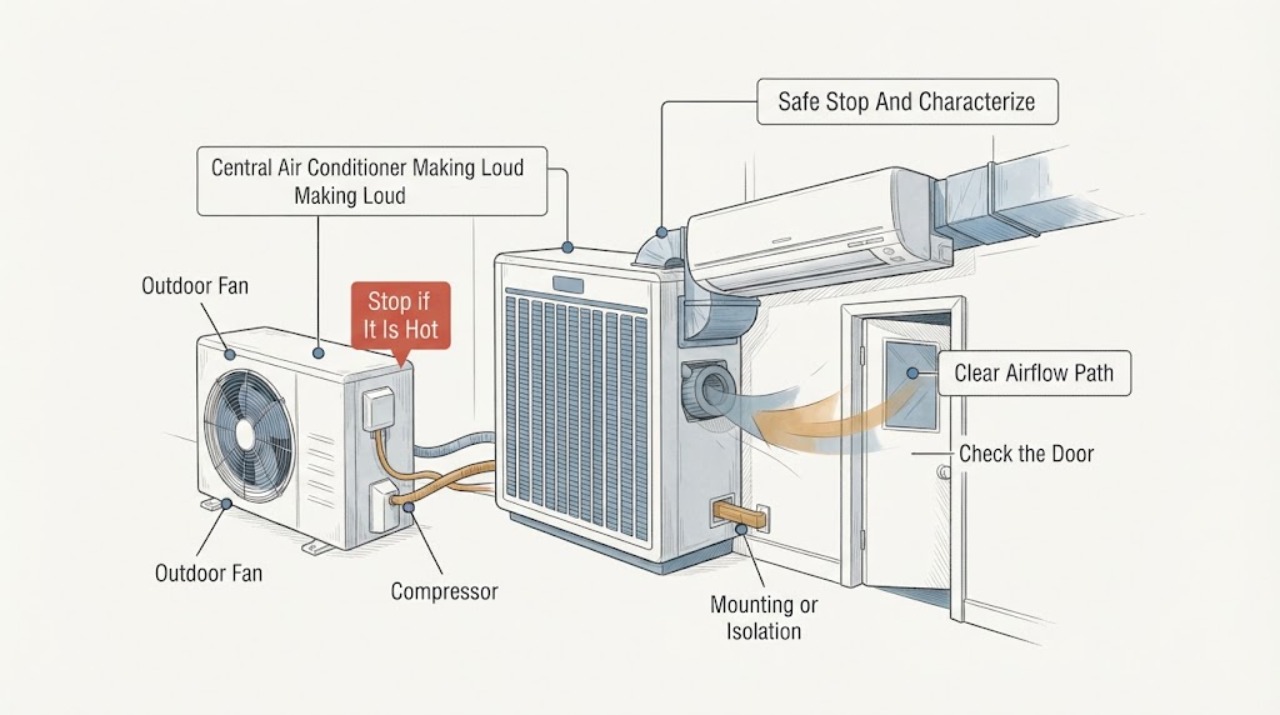
A York central air conditioner that suddenly becomes loud should not be treated as normal background hum. First switch cooling off for banging, scraping, squealing, clanging, severe vibration, burning odor, smoke, or electrical symptoms, then identify whether the sound is indoors, outdoors, in the ductwork, or at the thermostat and whether it occurs at startup, during operation, or shutdown. From a safe position, you can replace a filter if the exact manual allows it, keep supply and return openings clear, and look for leaves or a loose exterior panel without opening the unit. A rattle or scrape can involve a loose panel, debris, fan blade, blower wheel, bearing, or mounting; a loud outdoor hum or changed startup sound can involve the fan motor, capacitor, contactor, or compressor; hissing near the coil or refrigerant lines can indicate a refrigerant problem. Do not remove panels, reach through a guard, handle a capacitor, test live wiring, or add refrigerant. Arrange qualified HVAC service for a new, persistent, or worsening loud noise.
Work through in order
Diagnostic checks
Use only checks that match the exact appliance or system and its official guide.
-
Check 1
Set the thermostat to stop cooling and keep people and pets away from the equipment. From safe locations, record the sound type, its indoor or outdoor location, whether it occurs at startup, while running, or shutdown, and any loss of cooling, weak airflow, odor, visible ice, smoke, or breaker activity.
Expected result: The noise stops when cooling stops; it is a new bang, scrape, squeal, rattle, hum, or hiss; or it continues despite the thermostat not calling for cooling.
Next step: Keep the system off for a new or severe noise and arrange qualified HVAC service. For a mild, unchanged operating sound with no other symptom, continue only with the external checks below and document the result.
Stop if: Do not restart the system to reproduce banging, scraping, hissing, smoke, burning odor, electrical arcing, severe vibration, or a suspected loose or damaged rotating part.
Why this matters
Why: A sound tied to a cooling cycle is associated with the blower, outdoor fan, compressor, ductwork, or their mounting. A continuing sound, burning odor, smoke, electrical activity, or severe vibration raises the safety concern beyond a routine observation.
-
Check 2
With the system off, inspect the return filter, supply registers, and visible return path. Replace a dirty filter only with the size and type specified by the exact York documentation; do not remove duct panels or reach into the blower compartment.
Expected result: The filter is visibly loaded, a return or supply opening is blocked, airflow is weak, or the air path is clear and the loud sound remains.
Next step: Correct only the external filter or opening issue permitted by the model manual, then let a qualified technician assess persistent noise, weak airflow, or a damaged blower. Do not keep operating through a squeal, scrape, or overheating odor.
Stop if: Stop if the filter is wet, there is a burning smell, the blower area is inaccessible without removing a panel, or the system has smoke, arcing, repeated breaker trips, or water near electrical equipment.
Why this matters
Why: A restricted filter or blocked air path can make the blower work harder and can contribute to airflow noise or reduced delivery, but it does not prove that the blower is the failed part. A clear path with a persistent new noise makes a mechanical, electrical, or installation cause more likely.
-
Check 3
From a stable ground-level position and with cooling off, look through the outdoor guard for leaves or other loose material, an obviously damaged fan blade, a displaced panel, a shifted base, or visible line-set or duct contact. Do not remove the guard or panel, insert a tool, touch the fan, or move the unit.
Expected result: Debris is visibly obstructing the intake or discharge, a blade appears damaged, a panel or base is visibly loose or shifted, or nothing external explains the noise.
Next step: Keep cooling off for a damaged blade, severe vibration, loose structure, or a noise that began suddenly; provide photographs from a safe distance to the service technician. Only remove loose leaves that are fully outside the unit and can be lifted away without reaching through the guard, if the manual permits it.
Stop if: Do not approach a rotating fan, open the cabinet, straighten a blade, tighten hardware, disconnect wiring, or attempt a capacitor or compressor check.
Why this matters
Why: A visible obstruction, damaged rotating part, loose hardware, or transmitted vibration can create rattling or vibration, but the safe remedy and any blade or mounting diagnosis are model- and installation-specific. A clear exterior does not rule out a motor, capacitor, compressor, bearing, or internal fault.
-
Check 4
Using the recorded observations, classify the sound by system section without touching the equipment: indoor blower or duct registers, outdoor fan area, compressor area, or structure/ductwork. Compare whether the sound follows airflow or fan speed, occurs only at motor start, or is strongest through a wall, ceiling, or duct hanger.
Expected result: The sound follows indoor airflow, is a rattle or scrape outdoors, is a loud hum with little or no outdoor-fan movement, is strongest at startup or shutdown, or is transmitted through the building.
Next step: Use the pattern to tell the technician which area and operating phase to inspect; do not select a replacement part from the sound label alone. Keep the unit off for a new loud noise, a stopped fan with humming, or severe vibration.
Stop if: Do not bypass controls, cycle the thermostat repeatedly, reach into a guard, remove panels, or test electrical components to confirm a suspected motor, capacitor, contactor, or compressor.
Why this matters
Why: Indoor airflow-linked noise makes filter, blower wheel, blower bearing, or duct restriction more plausible. Outdoor rattling or scraping makes debris, blade, bearing, or loose fastener more plausible. A hum with a stopped fan or changed start/stop sound can involve the fan motor, capacitor, contactor, or compressor. Structure-borne noise can involve mounting, isolation, or duct connections.
-
Check 5
Before requesting service, photograph the model and serial label if it can be read without opening the equipment, note the thermostat setting and outdoor conditions, and record a brief sound description only from a safe location. Include whether the filter or visible air path was changed and whether cooling or airflow changed.
Expected result: The noise is intermittent, the system still cools, the noise is persistent, or the system has weak cooling, weak airflow, ice, odor, vibration, a fault display, or breaker events.
Next step: Give the technician the exact York model, noise location and phase, photos, filter status, cooling result, and safety symptoms. Keep the system off until service when the noise is new, loud, worsening, or accompanied by any stop condition.
Stop if: Do not make a diagnostic recording from inside the cabinet, remove a panel for a closer sound, or continue operation to collect evidence when there is smoke, burning odor, hissing, arcing, severe vibration, or a damaged blade.
Why this matters
Why: Timing and associated symptoms help distinguish an airflow or installation complaint from a rotating-part, electrical, compressor, or refrigerant-path concern, but they cannot safely identify a part without model-specific testing.
Use your observations
Decision map
Find the observation that best matches what you see, then follow the next safe action.
-
PATH 01Next step
What you see
Do this next
Use the exact York filter guidance for a permitted filter change and arrange service if weak airflow or noise remains. Do not open the blower compartment.
Why this path and its safety boundary
Why it matters: A restricted air path or indoor blower, wheel, bearing, or duct issue is more plausible than an outdoor compressor-only fault; a filter alone cannot explain every loud sound.
-
PATH 02Next step
What you see
Do this next
Keep cooling off and have qualified service inspect the fan, bearings, fasteners, base, and isolation. Do not straighten blades or reach through the guard.
Why this path and its safety boundary
Why it matters: A foreign object, rotating component, loose fastener, bearing, fan imbalance, or mounting or isolation problem is more likely; the exterior observation does not identify which internal component is safe to repair.
-
PATH 03Next step
What you see
Do this next
Turn cooling off, do not reset or repeatedly retry it, and arrange qualified HVAC service with the exact sound timing and cooling result.
Why this path and its safety boundary
Why it matters: A fan motor, run capacitor, contactor, compressor, or related electrical problem is possible. A charged capacitor and live outdoor circuit are not homeowner checks.
-
PATH 04Next step
What you see
Do this next
Stop cooling and arrange HVAC service. Do not add refrigerant, loosen a fitting, or attempt to thaw or repair the sealed system as a homeowner check.
Why this path and its safety boundary
Why it matters: A refrigerant-path or expansion-device problem is possible, and the noise is not a routine fan sound. Refrigerant handling and leak diagnosis require qualified service.
-
PATH 05Next step
What you see
Do this next
Record the location and phase of the transmitted sound and ask a qualified technician to inspect mounts, isolators, duct supports, and operating conditions. Do not wedge, lift, or alter the unit or ductwork.
Why this path and its safety boundary
Why it matters: Mounting, isolation, duct connection, fan speed, airflow, or building acoustics may be transmitting otherwise normal equipment vibration; York notes that the installation and structure affect sound transmission.
Helpful context
Understand the symptom
Start with where and when the sound occurs
A central system has an indoor blower and an outdoor fan and compressor, so the same word—loud—can describe different faults. Stand clear of moving equipment and note whether the sound is a rattle, scrape, squeal, hum, bang, hiss, or vibration; whether it begins at startup, continues while cooling, or happens at shutdown; and whether airflow, temperature, or breaker behavior changed at the same time. This record is more useful than guessing a part from the sound alone. York's own fan guidance separates aerodynamic noise from mechanical vibration, and its equipment guidance notes that fan speed, airflow, installation, structure, and ductwork all affect sound transmission.
Keep checks external and model-specific
With cooling off, replace or inspect the air filter only as the exact York manual permits, and confirm that return grilles and supply registers are not blocked. From ground level, look through the outdoor guard for leaves or an obviously damaged blade, and look for a loose panel, shifted base, or displaced insulation without touching the equipment. York maintenance instructions state that its units are not user-serviceable and that unusual noises should be investigated by competent personnel. A residential split system may have different access points and service limits, so do not transfer a check from a different York model.
What the sound can suggest—and what it cannot prove
A rattle or scrape that follows fan speed makes debris, an unbalanced or damaged blade, a blower wheel, a bearing, or loose hardware more plausible. A loud hum while a fan does not start can involve a motor, capacitor, contactor, or compressor, but the charged capacitor and electrical circuit require a technician. A sudden bang or a new high-pitched sound at startup or shutdown should be treated as a change in operation, not as proof of a particular component. Hissing near the indoor coil or refrigerant lines is a stop-and-service symptom, especially when cooling is weak or ice appears. These are decision branches, not a reason to open the cabinet.
Safety boundary
Stop conditions
- Turn cooling off and keep it off for new banging, scraping, squealing, clanging, severe vibration, a stopped outdoor fan with loud humming, or a damaged or visibly unbalanced blade.
- Stop immediately for smoke, burning electrical or plastic odor, arcing, a hot or damaged electrical connection, repeated breaker trips, or water near electrical equipment; seek qualified HVAC or emergency help as appropriate.
- Stop for hissing or whistling near the indoor coil or outdoor refrigerant lines, especially with weak cooling or ice; do not loosen fittings, add refrigerant, or handle the sealed system.
- Do not remove panels or guards, reach into a rotating assembly, straighten a blade, tighten internal hardware, handle a capacitor or contactor, test live wiring, or bypass a control.
- Do not repeatedly restart a noisy unit just to reproduce the sound; use safe observations and provide the model, timing, location, and associated symptoms to the technician.
Only after diagnosis
Potential parts
- outdoor condenser fan blade or motor
Consider this part class only if qualified diagnosis confirms an outdoor fan blade, motor, bearing, or related rotating assembly is damaged or not operating after external airflow and obstruction checks.
Blade dimensions, motor specifications, rotation, mounting, and electrical ratings are model-specific; confirm the complete York model and service documentation before ordering. - indoor blower wheel or blower motor
Consider this part class only when reduced airflow and an indoor squeal, rattle, or bang are traced by a qualified technician to the blower assembly rather than a filter, duct, or control issue.
Blower wheel dimensions, motor type, speed control, connector, and mounting vary by York air-handler or furnace model; use the exact model documentation. - run capacitor, contactor, or compressor isolation component
Consider this part class only after qualified electrical and mechanical diagnosis confirms that a loud hum, changed startup sound, compressor vibration, or fan-start problem comes from that component.
Electrical ratings, control configuration, compressor model, and isolation hardware are specific to the installed unit; do not select or handle a charged electrical component from the symptom alone.
When checks do not resolve it
Need a professional?
Call qualified HVAC service when the noise is new, persistent, worsening, or accompanied by weak airflow, weak cooling, ice, a stopped fan, a changed startup or shutdown sound, repeated breaker trips, or visible damage. Turn the system off and seek urgent help for smoke, burning electrical odor, arcing, a damaged rotating part, severe vibration, or suspected refrigerant leakage.
Have this ready
- Exact York model and serial information if readable without opening the unit
- Where the sound is strongest and whether it occurs at startup, during cooling, or shutdown
- Sound description such as rattle, scrape, squeal, hum, bang, vibration, hissing, or whistling
- Filter and visible air-path condition, outdoor obstruction or damage observed from a safe distance, and whether cooling or airflow changed
- Any odor, ice, smoke, fault display, breaker event, or other stop condition
Common questions
FAQ
Is a loud York central air conditioner noise normal?
Normal startup, shutdown, and operating hum vary by model, but a new or noticeably louder sound is not something to diagnose by guesswork. Turn cooling off for banging, scraping, squealing, clanging, hissing, severe vibration, smoke, burning odor, or electrical symptoms and arrange qualified HVAC service.
What does a York AC rattling or scraping sound usually mean?
A visible obstruction, loose panel or fastener, damaged or unbalanced fan, blower wheel, bearing, mounting, or duct-transmitted vibration is possible. Look only from a safe position with cooling off; do not remove guards or panels or reach into the unit. Persistent or new rattling needs qualified diagnosis.
Why is the outdoor York unit humming loudly but the fan is not spinning?
A fan motor, run capacitor, contactor, compressor, or related electrical issue is possible. Do not touch or test the capacitor or wiring and do not keep restarting the system; turn cooling off and arrange qualified HVAC service.
Can a dirty filter make a York air conditioner loud?
A restricted filter or blocked return can reduce airflow and make the blower work harder, but it does not prove that the blower is the failed part. Replace the filter only as the exact York manual permits; if the noise, weak airflow, or odor remains, keep the system off and request service.
What should I do if I hear hissing near the York coil or refrigerant lines?
Turn the air conditioner off and arrange HVAC service, especially if cooling is weak or ice is visible. Hissing can indicate a refrigerant-path problem; do not loosen fittings, add refrigerant, or attempt sealed-system work as a homeowner check.
Read the exact guide
Official sources
- AC Fan Not Working? Reasons Why It Stopped SpinningTrane · Manufacturer troubleshooting guidance used for distinguishing indoor and outdoor fans and keeping a unit off for a damaged blade or charged capacitor; exact York model procedures control.
- Daily maintenance checks - YORK - Scroll Air-CooledYORK / Johnson Controls · Official YORK maintenance guidance used for the safe boundary and external-observation principle; equipment construction and homeowner checks vary by installed York model.
- YORK STACK FANYORK / Johnson Controls · Official YORK fan technical guidance used for general fan-noise and vibration mechanisms; the installed residential central air-conditioner manual controls model-specific procedures.
- What is an HVAC Blower MotorLennox · Manufacturer consumer guidance used for the indoor-blower branch; it is not a York-specific part or fitment claim.
- Is This Normal? HVAC Smells and Sounds, ExplainedTrane · Manufacturer consumer guidance used for general HVAC sound triage; it does not establish a York model-specific diagnosis or repair procedure.
- AC Expansion ValveTrane · Manufacturer troubleshooting guidance used for the hissing, whistling, banging, squealing, and clanging stop-and-service branch; exact York system diagnosis requires a qualified technician.
- Sound and vibration transmission - YORK - YPALYORK / Johnson Controls · Official YORK packaged-unit installation guidance used for the general relationship between fan speed, airflow, structure, and duct transmission; not a substitute for the exact York split-system manual.
- YLUA0248-YLUA0498, Style A 50 Hz Air-Cooled Scroll Condensing Units Installation, Operation & MaintenanceYORK / Johnson Controls · Official YORK condensing-unit guidance used for general outdoor fan/compressor and installation-noise distinctions; exact residential unit documentation controls the procedure.
Community feedback
Share a repair observation
Share a plain-text repair observation. Accepted observations are published automatically; this page may take a moment to update.