
On this page
Start here
Quick answer
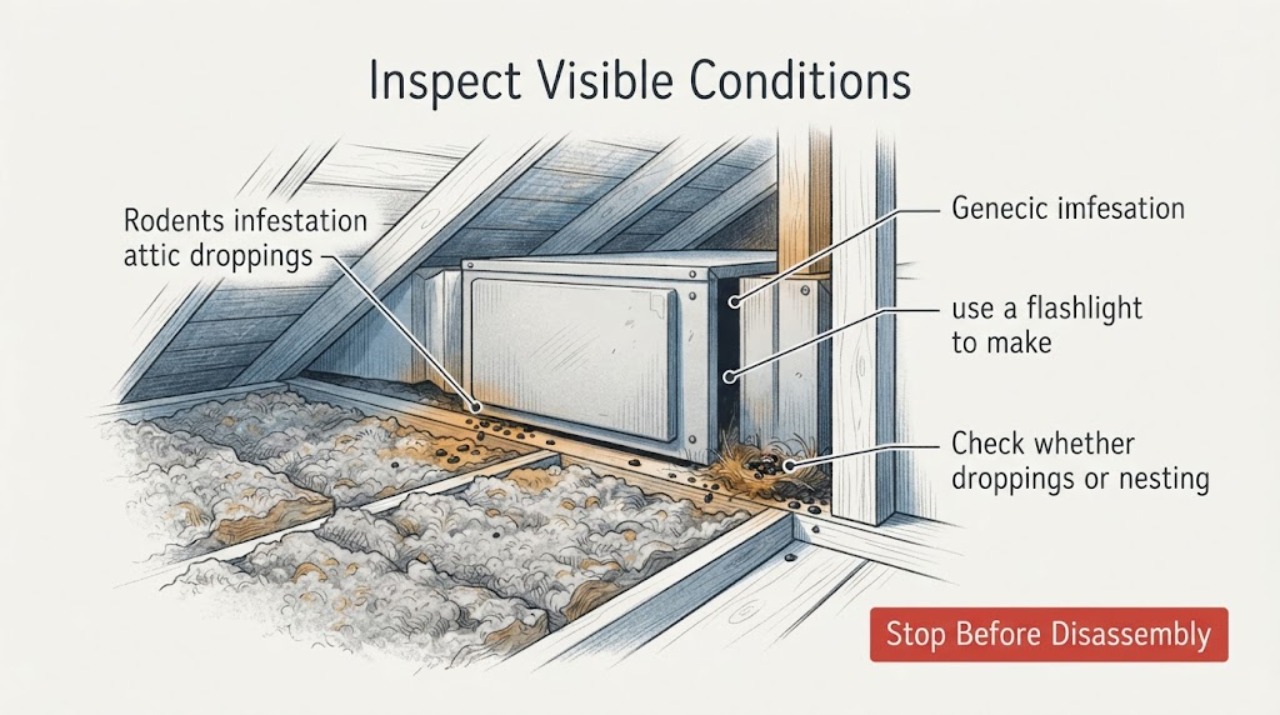
Droppings in an attic are evidence of rodent activity, but the safest next step depends on how much material is present and what it touches. From a safe standing point, look for additional droppings, nests, gnaw marks, urine staining, damaged insulation, and paths toward vents or the roofline. Do not sweep or vacuum droppings, disturb nests, or enter an attic with widespread contamination, unsafe flooring, or contaminated insulation. A small, localized amount on a hard surface can be wet-cleaned with gloves and an appropriate disinfectant according to CDC guidance; widespread waste, HVAC access, or repeated new signs should be handled by a pest-control professional, with health-department advice when needed.
Work through in order
Diagnostic checks
Use only checks that match the exact appliance or system and its official guide.
-
Check 1
From the attic access or another safe standing point, use a flashlight to make a visual map of droppings, nests, gnaw marks, urine staining, odors, and any travel line along walls, beams, or roof framing; do not touch or move the material.
Expected result: The signs are one small cluster on a hard surface, spread across several areas, concentrated near insulation, or close to a vent, duct, roofline, or electrical equipment.
Next step: Photograph or note the locations from the safe access point, then choose the matching branch. Leave the attic if the floor is unstable, the space is hot or poorly ventilated, or the signs are widespread.
Why this matters
Why: A small isolated cluster is a narrower cleanup problem. Multiple areas, nests, porous insulation, or building-system access indicate a larger contamination or entry problem that should not be handled as ordinary sweeping.
-
Check 2
Check whether droppings or nesting material are present in or around heating and cooling ducts, returns, air handlers, or other openings that could move contaminated material through the home; inspect visually without opening the system.
Expected result: There is no sign near the air system, or rodents or nesting material appear to have entered a duct or ventilation component.
Next step: If the air system may be contaminated, do not run it to test the theory and contact a pest-control professional familiar with rodent cleanup and duct-related contamination. Do not remove registers or insulation as a first step.
Why this matters
Why: No visible air-system access keeps the problem localized to the attic for the moment. Evidence of duct access raises both exposure and cleaning complexity because contaminated material can be distributed through the ventilation system.
-
Check 3
Judge the extent without disturbing it: compare the size of the visible area with the surrounding insulation and look for multiple nests, repeated travel paths, dead rodents, or contamination spread beyond a single hard surface.
Expected result: There are only a few droppings in a contained area, or there is a heavy infestation with many droppings, nests, dead rodents, or contaminated insulation.
Next step: For widespread signs, close the access and arrange professional assessment and cleanup. Do not enter again just to estimate the count or to pull out insulation.
Why this matters
Why: Heavy infestation and contaminated insulation require additional protective measures beyond ordinary household cleanup. The absence of a live sighting does not prove that rodents have left.
-
Check 4
If the signs are a small amount on a hard, nonporous surface and there is no heavy infestation, wear rubber or plastic gloves and apply an appropriate disinfectant until the material is thoroughly wet; follow the product label's contact time.
Expected result: The droppings can be fully wetted without creating dust and the surface can be wiped, or the material is loose, dry, embedded in insulation, or too extensive to wet safely.
Next step: For a contained hard-surface spot, let the disinfectant work as directed, wipe with paper towels, seal the waste in a covered container, and wash gloved and bare hands afterward. Do not sweep or vacuum. Stop and call a professional if the spot is not truly contained.
Why this matters
Why: Wet cleaning of a small hard-surface area reduces dust. Dry or porous contamination, a large amount of waste, and material that cannot be fully wetted are outside a simple spot-cleaning situation.
-
Check 5
After a safe spot cleanup, inspect from the ground or another safe location around eaves, soffits, roof vents, wall penetrations, and utility openings for visible gaps or gnaw damage; do not climb onto the roof or reach into an opening.
Expected result: A visible gap, damaged screen, or chewed opening connects the exterior to the attic, or no accessible entry point is apparent.
Next step: Record the location and have a pest-control or building professional choose an exclusion repair that will not trap animals inside. Do not seal a suspected active opening blindly before the infestation is assessed.
Why this matters
Why: An opening can explain repeated attic signs and must be addressed as part of control. No visible opening does not rule out a concealed route through the roof, wall, or building envelope.
-
Check 6
Monitor the previously marked areas from a safe distance after cleanup or assessment, looking for new droppings, fresh nesting material, odor, or renewed gnawing without disturbing the attic materials.
Expected result: New signs appear after cleanup, or no new signs are visible but the original contamination remains in insulation or inaccessible areas.
Next step: Have a pest-control professional revisit active or recurring signs. Keep people and pets away from the attic access until contaminated material has been assessed and cleaned.
Why this matters
Why: New signs indicate that control or exclusion is incomplete. No new visible signs do not make contaminated insulation or inaccessible spaces safe to disturb.
Use your observations
Decision map
Find the observation that best matches what you see, then follow the next safe action.
-
PATH 01Next step
What you see
Do this next
Use gloves and an appropriate disinfectant according to the CDC cleanup sequence, wipe the area, seal the waste, wash hands, and then arrange rodent control or exclusion if entry signs remain.
-
PATH 02Next step
What you see
Do this next
Close the attic access and arrange professional rodent control and cleanup. Ask the local or state health department about site-specific precautions if the extent or exposure is uncertain.
-
PATH 03Next step
What you see
Do this next
Do not run the affected system to test it. Contact a professional rodent exterminating service and a qualified duct-cleaning provider, following CDC guidance for ventilation-system access.
-
PATH 04Next step
What you see
Do this next
Have a pest-control professional identify the entry route, control the infestation, and complete exclusion after confirming the animals are no longer trapped inside.
Helpful context
Understand the symptom
Treat the attic as a contamination and access problem
Droppings are only one part of the picture. Shredded paper or fabric, gnaw marks, holes, stale odors, and repeated signs along beams or the roofline can show where rodents are traveling and whether entry is still possible. An attic also commonly contains porous insulation and may connect to heating or cooling ducts, so a visual survey should come before any cleanup.
Do not make dust before you know the extent
Rodent urine, droppings, and nesting materials can carry pathogens. Do not sweep or vacuum them, and do not handle a nest or dead rodent with bare hands. If the attic has widespread signs, contaminated insulation, poor ventilation, or an unsafe walking surface, close the access and arrange professional cleanup and exclusion.
Only after diagnosis
Potential parts
- rodent exclusion screen or seal
Consider an exclusion material only after a professional confirms the opening, the rodent activity is controlled, and sealing will not trap animals inside the attic.
Match the repair material to the vent, roof, soffit, or wall opening and local building requirements; a pest-control or building professional should confirm the repair method. - EPA-registered disinfectant
Use only for a small, localized amount on a hard surface that can be fully wetted; do not treat contaminated insulation or heavy infestation as a spot-cleaning job.
Follow the product label and CDC cleanup guidance, and confirm that the product is intended for the surface and contamination being cleaned.
When checks do not resolve it
Need a professional?
Stop and call a pest-control professional for widespread droppings, multiple nests, dead rodents, contaminated insulation, an unsafe or poorly ventilated attic, suspected access to heating or cooling ducts, or any cleanup that would create dust. Do not sweep, vacuum, handle nests or carcasses bare-handed, climb onto the roof, or seal an active opening before the infestation is assessed. Seek medical advice and mention rodent exposure if anyone becomes ill after contact with the contaminated area; contact the local or state health department when site-specific cleanup guidance is needed.
Common questions
FAQ
Can I vacuum rodent droppings from the attic?
No. Do not sweep or vacuum dry droppings, urine, or nesting material because disturbing them can put contaminated particles into the air. Wet-clean only a small, contained hard-surface area according to CDC guidance, and have heavy or porous contamination handled professionally.
What does it mean if I find droppings in attic insulation?
Insulation is porous and difficult to clean safely. Do not pull it out or disturb it just to investigate; close the access and arrange professional assessment and cleanup, especially if the contamination is widespread.
Should I seal the attic opening immediately?
Do not seal a suspected active opening blindly. Have the infestation and entry route assessed first so animals are not trapped inside or redirected into another part of the building; exclusion follows control and safe assessment.
When should I call a professional for attic droppings?
Call for widespread droppings, nests, dead rodents, contaminated insulation, unsafe attic access, suspected duct entry, recurring new signs, or any cleanup that would create dust. Ask the local or state health department for site-specific advice when exposure or the scale is uncertain.
Read the exact guide
Official sources
- Hantavirus PreventionCenters for Disease Control and Prevention · Supports the health-protection boundary for attic rodent droppings and the need to control and exclude wild rodents from homes.
- Identify and Prevent Rodent InfestationsU.S. Environmental Protection Agency · Supports identifying attic-related droppings, nesting material, gnawing, odors, entry holes, and basic exclusion and sanitation checks.
- How to Clean Up After RodentsCenters for Disease Control and Prevention · Directly applicable to attic droppings, nests, dead rodents, contaminated insulation, and suspected heating or cooling duct access.
Community feedback
Share a repair observation
Share a plain-text repair observation. Accepted observations are published automatically; this page may take a moment to update.