
On this page
Start here
Quick answer
Rodent signs in attic insulation need a contamination and access assessment, not ordinary surface pest treatment alone. From a safe location, document whether insulation is displaced or soiled, whether droppings or nesting are visible, and whether ducts, wiring, roof leaks, or entry gaps are nearby. Do not enter an attic, move or remove insulation, sweep or vacuum rodent waste, handle a nest, or disturb insulation of unknown type. If insulation is contaminated, rodent activity continues, building services are involved, or safe access is unclear, keep people out and call a qualified pest-control professional; ask whether a separate remediation or building-trade assessment is needed.
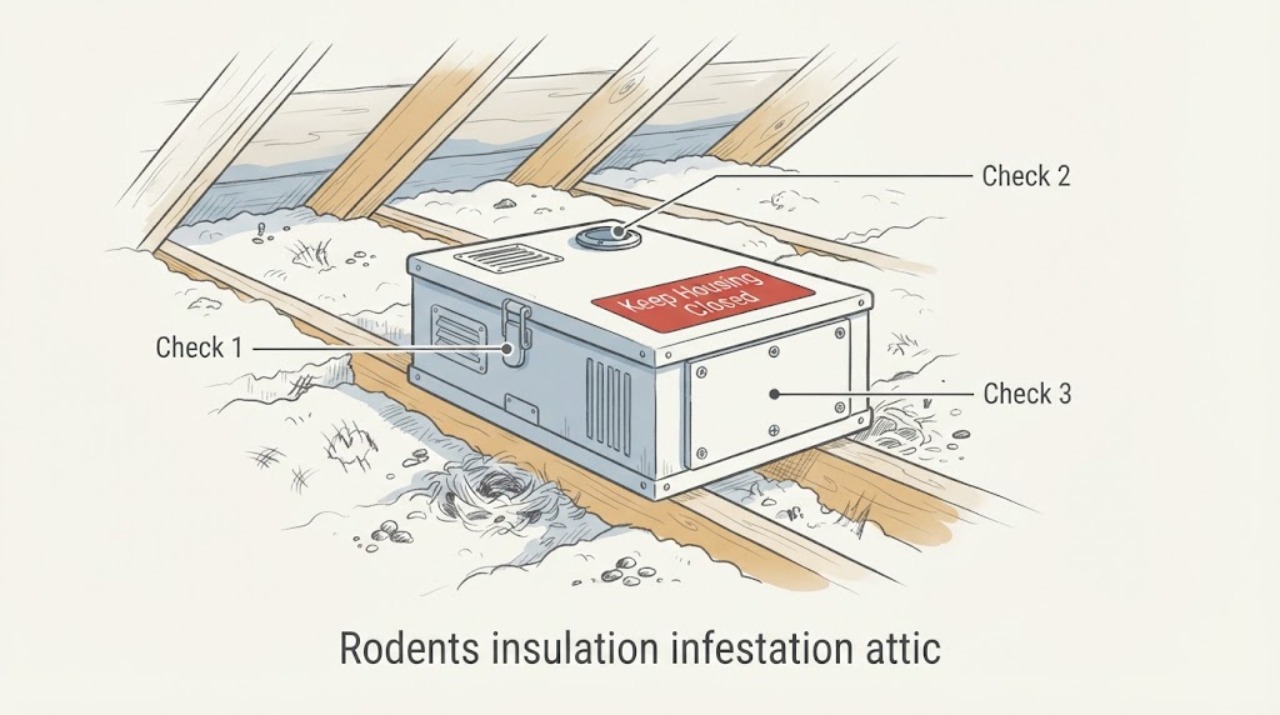
Work through in order
Diagnostic checks
Use only checks that match the exact appliance or system and its official guide.
-
Check 1
From the floor, doorway, or another already safe access point, record where rodent signs appear relative to the attic insulation: droppings or urine staining, nests, disturbed or flattened insulation, gnawing, odor, or a new opening. Do not climb into the attic or move the insulation.
Expected result: Classify the visible condition as no sign from the safe viewpoint, isolated droppings or odor, a nest or dead rodent, visibly soiled or disturbed insulation, or an active animal or repeated noise.
Next step: Photograph only what is visible and mark the room or edge where it was seen. Tell the pest-control professional whether the material looks clean, displaced, or contaminated rather than trying to expose more of it.
Stop if: Stop and call a professional for any need to climb, kneel on insulation, touch rodent waste or nests, or enter an area with unsafe access, heat, exposed wiring, or structural concerns.
Why this matters
Why: Signs on or within insulation make contamination and a concealed entry route central to the diagnosis; no visible sign from below does not clear insulation that cannot be safely seen.
-
Check 2
Without stepping into the attic or opening a concealed assembly, inspect the ceiling below and any visible attic edges or penetrations for staining, sagging, moisture, gaps around vents or utility penetrations, or sounds that line up with the affected insulation.
Expected result: The area is dry with no visible opening, shows moisture or staining, has a visible gap or damaged vent, or has signs that may involve a concealed cavity.
Next step: Record the room, approximate visible area, moisture or staining, and nearby opening. Request coordinated pest-control and roofing or building assessment when a leak or exterior opening is suspected.
Stop if: Do not seal a suspected entry gap, climb toward a roof opening, or disturb wet, sagging, or damaged building materials yourself.
Why this matters
Why: A roof or moisture issue can damage insulation while a gap can explain how rodents reached it; either condition changes the service scope and is not proved or repaired by a surface observation.
-
Check 3
From a safe viewpoint, note whether air ducts, HVAC returns, electrical wiring, plumbing, or other building services run through or beside the affected insulation. Do not touch, disconnect, probe, or uncover any service.
Expected result: No service is visible nearby, a duct or return is nearby, wiring or another utility is nearby, or the service relationship cannot be seen safely.
Next step: Give the professional the service type and location. Ask for a qualified inspection before any insulation removal, duct cleaning, wiring work, or treatment near the service.
Stop if: Stop immediately for exposed or gnawed wiring, an electrical smell, a gas or combustion concern, a damaged duct, or any instruction to open or handle a service enclosure.
Why this matters
Why: Rodent evidence near a duct or building service can spread contamination or add an HVAC, electrical, plumbing, or access boundary; insulation disturbance alone cannot show whether a service is affected.
-
Check 4
Record whether the insulation type and age are known, including any label or building history visible without disturbing it, and compare that with the rodent timeline. Do not pull, rake, bag, or sample the insulation.
Expected result: The insulation type is known and appears undisturbed, the type is unknown or older, the material is visibly disturbed or soiled, or the timeline is uncertain.
Next step: Provide the material uncertainty, photos, timing, and suspected access route to pest control. Let the qualified service decide whether insulation remediation, asbestos assessment, or another building trade is required.
Stop if: Do not disturb vermiculite or other unknown insulation, and do not enter the attic to identify it by touch or sampling.
Why this matters
Why: Unknown or older insulation may require a material-safety assessment before disturbance, while a recent or recurring rodent timeline helps the professional plan exclusion and contamination control.
Use your observations
Decision map
Find the observation that best matches what you see, then follow the next safe action.
-
PATH 01Safety boundary
What you see
Droppings, urine staining, a nest, a dead rodent, or visibly soiled insulation is present.
Do this next
Keep people and pets away, avoid sweeping or vacuuming, photograph from a safe position, and call a qualified pest-control or remediation professional.
Why this path and its safety boundary
Why it matters: The insulation may be a contaminated porous material and needs a controlled assessment; visible signs do not establish the full extent.
Safety stop: Do not touch, bag, remove, spray, sweep, or vacuum contaminated insulation or rodent waste as a household cleanup.
-
PATH 02Safety boundary
What you see
No sign is visible from a safe viewpoint, but rodent sounds, odor, recurring activity, or a ceiling mark continues.
Do this next
Leave the area undisturbed and give the professional the time, room, sound, odor, and visible-mark details for a targeted inspection.
Why this path and its safety boundary
Why it matters: The activity may be concealed below or within insulation or a building cavity, so the absence of a visible surface sign is not a clearance.
Safety stop: Do not climb into the attic, lift insulation, open the ceiling, or set treatment in a concealed cavity.
-
PATH 03Safety boundary
What you see
A duct, HVAC return, electrical or plumbing service, roof leak, damaged vent, or structural access concern is near the affected insulation.
Do this next
Keep clear and request the appropriate pest-control, HVAC, electrical, plumbing, roofing, or building professional as indicated by the observation.
Why this path and its safety boundary
Why it matters: The job crosses a building-trade or contamination boundary and may require coordinated inspection before insulation or rodent work.
Safety stop: Stop all handling near the service, leak, damaged structure, or exposed wiring.
-
PATH 04Safety boundary
What you see
The insulation is of unknown type, appears older, or may be vermiculite, and inspection would disturb it.
Do this next
Tell the professional what is known about the insulation and request a qualified material assessment before any removal or remediation plan.
Why this path and its safety boundary
Why it matters: Material safety is unresolved; disturbance can create a separate exposure risk and cannot be authorized from a symptom alone.
Safety stop: Do not disturb, sample, sweep, vacuum, or remove unknown insulation.
Helpful context
Understand the symptom
Why attic insulation changes the assessment
Rodents can use attic insulation as hidden nesting or travel space, but a visible disturbance does not identify the entry route or the full contamination boundary. For this topic, the useful first distinction is whether signs are on or near insulation and whether the affected area is close to ducts, wiring, roof openings, moisture, or another building service.
Safe boundary around contaminated insulation
Keep the inspection observation-only from a safe location. CDC guidance says not to sweep or vacuum rodent urine, droppings, or nesting materials and specifically addresses insulation contaminated with rodent waste. Do not enter the attic, handle a nest, remove insulation, disturb unknown material, or work near a service; a qualified pest-control or remediation professional should set the safe containment and removal plan.
Use the result to scope service
The rodent-access route, insulation condition, moisture, and nearby building services determine what happens next. Pest exclusion may need to be coordinated with roof, HVAC, electrical, plumbing, or material-safety work. A single quiet night or a clear view from below does not prove the insulation is clean or the entry route is closed.
Safety boundary
Stop conditions
- Stop for unsafe attic access, unstable or wet materials, exposed or gnawed wiring, gas or combustion concerns, active leaks, or structural damage.
- Do not enter the attic, handle rodent waste or nests, disturb unknown insulation, sweep or vacuum, or alter concealed building services.
- If signs persist, recur, or involve insulation or a concealed cavity, leave the area undisturbed and call a qualified professional.
When checks do not resolve it
Need a professional?
Call a qualified pest-control professional when rodent signs involve insulation, continue or recur, have no visible safe entry route, or require attic access. Ask whether remediation or another building trade must assess contaminated insulation, ducts, roof openings, wiring, plumbing, or unknown material.
Have this ready
- Room, attic-edge, and visible insulation locations
- Timing of sounds, odor, droppings, nests, or disturbed material
- Photos and observations from safe positions
- Moisture, roof-opening, duct, HVAC, wiring, plumbing, or access concerns
- Insulation type or age if known, and what was not opened, moved, or tested
Common questions
FAQ
What should I check first when rodents are in attic insulation?
From a safe location, document where signs appear relative to the insulation and note droppings, urine staining, nests, disturbed material, odor, moisture, entry gaps, and nearby ducts or wiring. Do not enter the attic or move insulation.
Should I remove insulation contaminated by rodents?
No. Do not enter the attic, handle rodent waste or nests, sweep or vacuum, or pull out insulation. A qualified pest-control or remediation professional should assess contamination, access, and safe removal.
What should I tell a pest-control professional?
Mention the room and visible area, the rodent timeline, photos from safe positions, moisture or roof observations, nearby ducts or services, insulation type if known, and anything you did not touch or open.
Read the exact guide
Official sources
- Pest Control: Resources for Housing ManagersU.S. Environmental Protection Agency · Supports observation-only rodent infestation assessment, exclusion of access routes, and avoiding unqualified treatment or cleanup around attic insulation; exact building conditions determine the service scope.
- How to Clean Up After RodentsCenters for Disease Control and Prevention · Supports the article's boundary around rodent waste, nests, and contaminated insulation; it does not authorize attic entry or household removal when access, contamination, or material safety is uncertain.
Community feedback
Share a repair observation
Share a plain-text repair observation. Accepted observations are published automatically; this page may take a moment to update.