
On this page
Start here
Quick answer
Scratching, stale odor, droppings, nesting material, or gnaw marks near an attic can indicate rodent activity, but one sign does not prove that animals are still present. Do not enter the attic, touch an animal, droppings, nests, insulation, or wiring, and do not put out poison or traps for this professional-service topic. Keep people and pets away, record what can be seen or heard from safe living areas and ground level, and arrange a pest-control inspection that can identify the entry route, assess contamination, and plan exclusion safely.
Work through in order
Diagnostic checks
Use only checks that match the exact appliance or system and its official guide.
-
Check 1
From the occupied rooms below the attic, note the location and timing of scratching, scurrying, stale odor, ceiling staining, or any sign visible without opening a surface or touching material.
Expected result: Record whether the sound or odor repeats, which room it is nearest to, and whether the sign is new, recurring, or isolated.
Next step: Write down the dates and times and request a professional inspection; do not investigate from the attic side.
Stop if: Stop the observation and keep everyone away if an animal, droppings, nest, dead rodent, strong odor, or contaminated surface is visible.
Why this matters
Why: A repeated pattern gives the professional a starting area, while a single noise or odor can have other causes and does not confirm an active rodent population.
-
Check 2
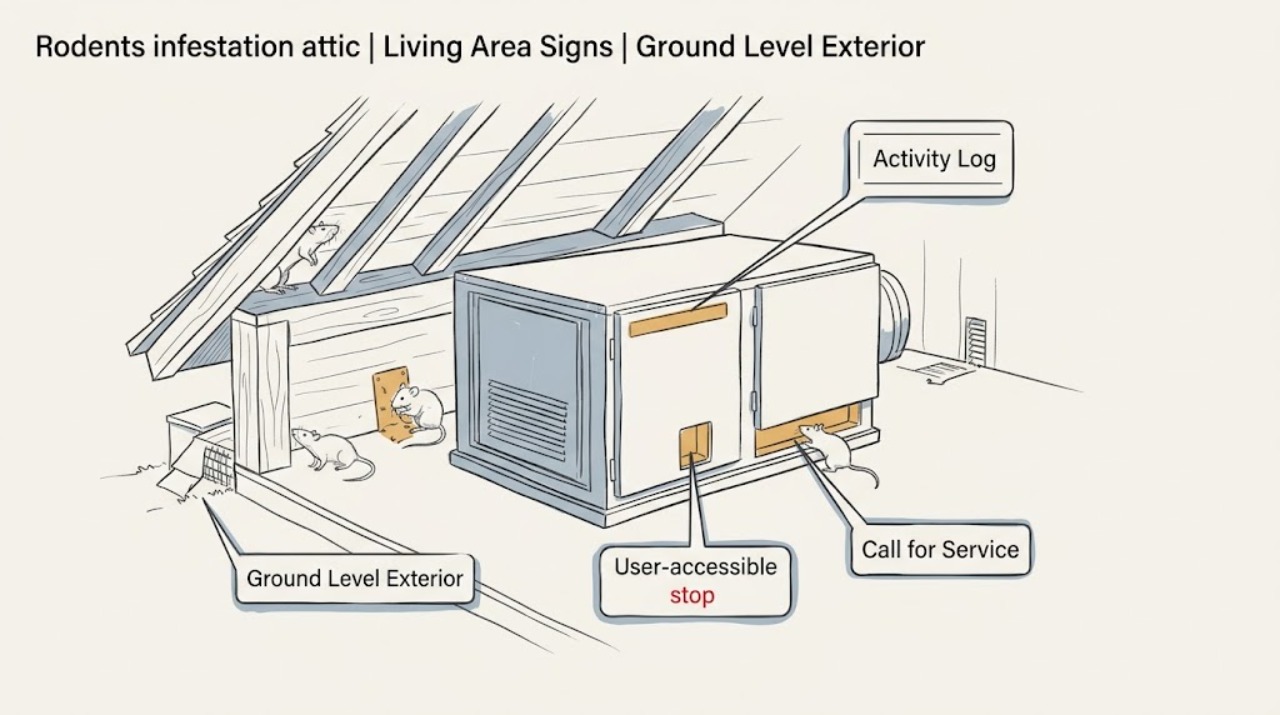
From ground level, visually scan the accessible exterior around eaves, soffits, attic vents, gables, doors, and utility penetrations without climbing, reaching, or moving debris.
Expected result: Look for a visible gap, damaged screen, hole, gnawing mark, displaced vent cover, or a route that lines up with the room where sounds are heard; do not assume an opening is unused.
Next step: Photograph the location from the ground with a reference for orientation and give it to the pest professional for an exclusion plan.
Stop if: Stop if the check would require a ladder, roof access, contact with wiring, disturbing a nest, or approaching an animal.
Why this matters
Why: An exterior defect can be a possible entry route, but closing it before occupancy is assessed can trap an animal or leave another route unaddressed.
-
Check 3
Keep a short activity log from normal living areas, recording the time, duration, apparent direction, weather, and whether the sound coincides with heating, cooling, plumbing, or other household equipment.
Expected result: Compare repeated events rather than relying on one sound; note whether the report is confined to the attic area or also occurs in walls, vents, or occupied rooms.
Next step: Send the log with the request for service and ask the provider to consider both the suspected entry route and any affected ventilation or wiring area.
Stop if: Stop and leave the area normally if there is smoke, a burning odor, sparking, a warm outlet, a CO alarm, or another immediate electrical or life-safety concern; use the appropriate emergency or utility service.
Why this matters
Why: A consistent pattern supports a targeted inspection, while a noise that tracks equipment operation may need a building or mechanical assessment as well as pest evaluation.
-
Check 4
From safe indoor or ground-level locations, note accessible food, pet-food bowls left out, open garbage, bird feed, standing water, brush, leaf piles, or sheltered storage close to the house.
Expected result: Record which attractants are present and whether the concern began after a change in food storage, landscaping, weather, or nearby construction; do not handle anything that may be contaminated.
Next step: Keep ordinary food and garbage in closed containers and keep pets away from suspected contamination while the professional assesses the property; do not attempt attic work or chemical control.
Stop if: Stop if securing an item would require contact with droppings, a nest, a dead animal, an unknown chemical, or an aggressive live animal.
Why this matters
Why: Food, water, and shelter can help sustain rodents, but an attractant by itself does not show that the attic is occupied or identify an entry point.
-
Check 5
From a safe location, record any visible sign near a vent, light, electrical fixture, or HVAC register and note whether anyone in the home has symptoms after possible rodent exposure.
Expected result: Separate a visible utility concern, heavy accumulation of waste, or direct animal sighting from a vague sound or odor, and tell the provider exactly what was observed without touching it.
Next step: Arrange prompt pest-control service and disclose the location, occupants, pets, and any possible duct or electrical involvement before the visit.
Stop if: Keep people and pets out and seek urgent help for smoke, fire, exposed energized wiring, a bite, or serious illness; do not re-enter a contaminated area to investigate.
Why this matters
Why: Duct access, heavy infestation, possible wiring damage, or exposure concerns require coordinated professional and, when appropriate, health or electrical guidance rather than resident cleanup.
Use your observations
Decision map
Find the observation that best matches what you see, then follow the next safe action.
-
PATH 01Next step
What you see
Only one unexplained sound or odor is present and no visible sign is accessible.
Do this next
Keep an activity log from living areas and arrange service if it repeats; do not enter the attic to confirm it.
-
PATH 02Next step
What you see
Sounds repeat, or droppings, nesting material, gnawing, or a stale odor are visible from a safe location.
Do this next
Treat the report as a professional inspection request, isolate the area from people and pets, and provide the timing and location history.
-
PATH 03Next step
What you see
A possible opening or damaged vent is visible from ground level.
Do this next
Document it and leave it for the provider to assess; do not climb, reach, disturb an animal, or close an opening before occupancy and routes are evaluated.
-
PATH 04Next step
What you see
A sign is near HVAC ducting, electrical equipment, or a large amount of waste.
Do this next
Stop resident investigation, keep the area isolated, and tell the pest professional and the relevant qualified service about the potential secondary hazard.
-
PATH 05Next step
What you see
A live or dead rodent, nest, or contaminated material is visible.
Do this next
Do not touch, sweep, vacuum, clean, bait, or trap it; keep people and pets away and obtain professional or local-health guidance.
Helpful context
Understand the symptom
Why an attic report needs a professional assessment
A repeated nighttime sound, stale odor, visible exterior gap, or stain can help locate the concern, but it cannot identify the animal or establish whether the attic is occupied. Rodents may leave droppings, nesting material, chewing marks, or an odor before anyone sees an animal. An attic can also contain fall hazards, contaminated material, insulation, and electrical or ventilation equipment, so this page limits the reader to observations from occupied rooms and the exterior ground level.
Safety boundary
Keep children and pets away from any visible waste, nest, dead animal, or opening. Do not sweep or vacuum suspected rodent waste, handle an animal, disturb insulation, open a ceiling or wall, climb to the roofline, enter the attic, or apply bait, poison, or a chemical mixture. If a professional later finds heavy contamination or access to heating and cooling ducts, tell them before work begins so the inspection and cleanup plan can use appropriate controls.
What to give the pest professional
Share the exact room or exterior side, when sounds occur, whether signs repeat, and photographs taken from a safe distance. Note pets, children, occupants with respiratory concerns, any visible electrical or HVAC concern, and whether anyone has already disturbed the area. This history helps the provider decide where to inspect without sending a resident into the attic.
When checks do not resolve it
Need a professional?
Call a pest-control professional when attic sounds repeat, signs are visible, an entry route is suspected, or the area cannot be safely reached. Request an inspection and exclusion plan rather than attempting attic entry or DIY chemical control.
Have this ready
- Give the provider the room or exterior side, activity times, safe-distance photos, visible sign type, weather or construction context, household occupants and pets, and any HVAC, electrical, or contamination concern.
Common questions
FAQ
Does scratching in the attic prove that rodents are still there?
No. Repeated sounds increase the reason to request an inspection, but one sound can have another source and does not establish occupancy. Record timing and location from a living area and let a professional inspect safely.
Should I close an attic opening as soon as I see it?
Do not climb or reach to close it for this professional-service topic. A provider should assess whether an animal is present, whether other routes exist, and whether sealing would trap an animal or worsen contamination.
Can I clean droppings or a nest in the attic myself?
Not when the suspected infestation is in an inaccessible attic or may be heavy. Keep people and pets away, do not sweep or vacuum or touch the material, and ask a qualified professional or local health department for the appropriate cleanup path.
What should I do if I see a possible chewed wire?
Do not touch or test it. Keep the area isolated, stop using the affected equipment if safe to do so, and arrange qualified pest and electrical assessment; use urgent services for smoke, fire, sparking, or a CO alarm.
Read the exact guide
Official sources
- Hantavirus PreventionCenters for Disease Control and Prevention · Official health guidance supporting isolation, no-contact precautions, and escalation after possible rodent exposure.
- How to Seal Up to Prevent RodentsCenters for Disease Control and Prevention · Official public-health guidance for observing and preventing rodent access around homes, including attic vents and roofline openings.
- Identify and Prevent Rodent InfestationsU.S. Environmental Protection Agency · Official environmental guidance describing droppings, nesting material, chewing, holes, and stale smells as signs that support professional assessment.
- How to Clean Up After RodentsCenters for Disease Control and Prevention · Official public-health cleanup guidance used here to set the no-contact boundary and the professional escalation for inaccessible or heavy contamination.
Community feedback
Share a repair observation
Share a plain-text repair observation. Accepted observations are published automatically; this page may take a moment to update.