
On this page
Start here
Quick answer
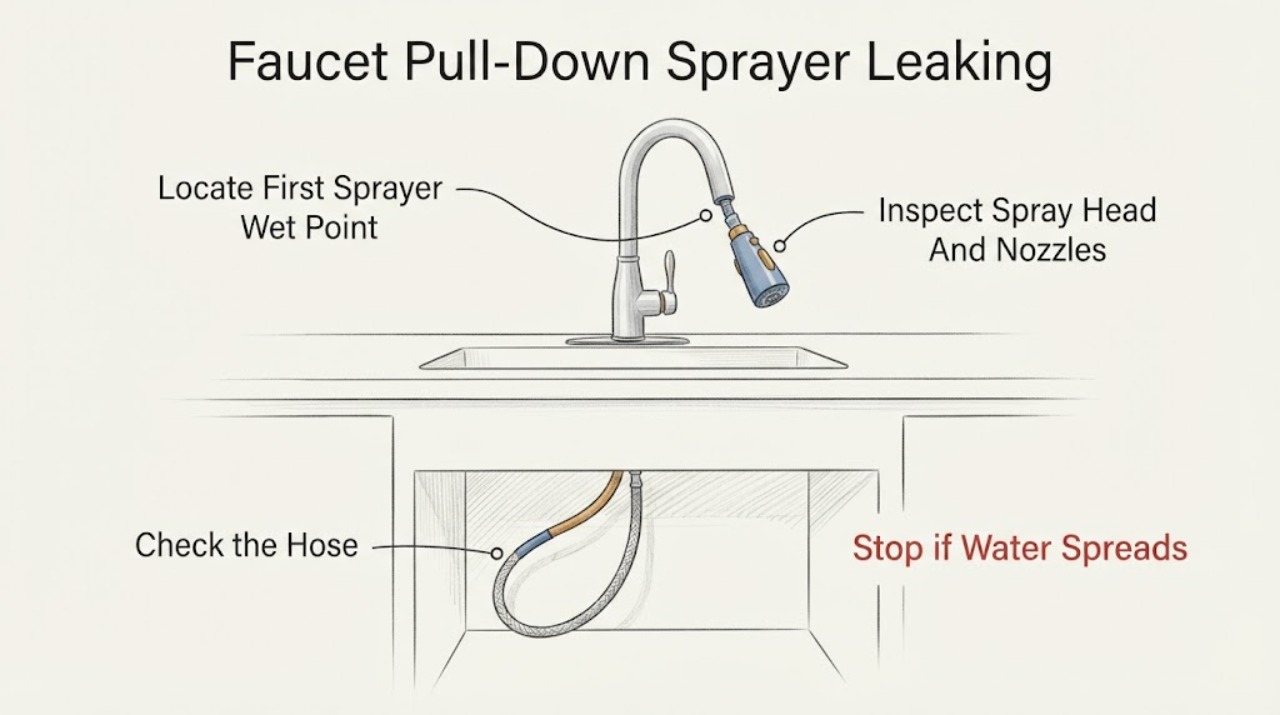
When an American Standard pull-down sprayer leaks, first identify whether water starts at the spray face, the spray-head connection, the pull-down hose, the hose-to-valve connection under the sink, or the faucet body. A spray head that leaks only while spray mode is running can have a worn seal, clogged or damaged outlet, or a connection that is not seating; water under the sink during spray use points more toward the hose, O-ring, washer, or adapter. Turn the faucet off and close the hot and cold supplies before disconnecting a hose or opening a connection. Use the exact American Standard model and parts diagram because pull-down hoses, spray assemblies, connectors, and cartridges are model-specific. Clean only a removable spray face or visible debris that the manual allows, and do not force a fitting. Stop for a pressurized leak, corroded or seized connection, water reaching electrical equipment, a hose that cannot reconnect watertight, or leakage that remains after the model-directed repair, and arrange plumbing service.
Work through in order
Diagnostic checks
Use only checks that match the exact appliance or system and its official guide.
-
Check 1
Dry the American Standard spray head, hose, faucet body, and visible under-sink connections. Aim the head into the sink, turn the faucet on briefly, and activate spray mode while watching where the first drop appears.
Expected result: Water exits the spray face, appears around the spray-head seam or button, runs from the hose, appears at the hose-to-valve connection, or starts at the faucet body or handle.
Next step: Continue with the matching spray-head or hose check only when that area is the first wet point. For a body, handle, supply, or uncertain leak, turn the faucet off, isolate it if safe, and arrange plumbing diagnosis.
Stop if: Stop if water sprays outside the sink, reaches an electrical outlet, the faucet body is cracked, or a pressurized connection moves or leaks heavily.
Why this matters
Why: The first wet point narrows the repair: spray-face or head leakage keeps the head seal or assembly possible; hose or adapter leakage points to a hose, O-ring, washer, or connector; body or handle leakage is a faucet valve path rather than a sprayer-only fault.
-
Check 2
If the wet point is the spray head or spray face, turn the faucet off and inspect the removable face, stream/spray selector, seam, and inlet screen for visible debris, cracks, or a displaced washer. Clean only a removable face or screen when the model instructions permit it.
Expected result: A nozzle or screen is visibly blocked; the selector or head seam is cracked; a washer is displaced; the head is dry when off but leaks during spray; or the head looks intact.
Next step: Rinse only the permitted removable screen or face and reinstall it without force. If the head seam, selector, seal, or connection remains wet, identify the exact model and use its spray-assembly procedure rather than substituting a universal head.
Stop if: Do not drill nozzles, pry the head apart, use sharp tools on seals, or continue if the head or hose is cracked or cannot seat securely.
Why this matters
Why: Debris can disturb the spray pattern or sealing surface, while a crack, displaced seal, or leak at the head connection supports a spray assembly or seal problem. An intact head with water beginning on the hose side points away from the outlet face.
-
Check 3
With the faucet off, pull the spray head out only as far as normal use allows and visually inspect the exposed hose for cuts, flattening, kinks, abrasion, or a counterweight that catches. From a dry position below the sink, look for moisture along the hose without pulling on its connections.
Expected result: The hose is wet along its braid, cracked, kinked, or abraded; it catches during retraction; the hose stays dry but an end connection is wet; or the hose and routing appear intact.
Next step: Do not continue using a hose that is visibly damaged or leaks. Isolate the supplies before any model-directed hose work, and arrange service if the routing, weight, or connection cannot be corrected without force.
Stop if: Do not cut, clamp, twist, stretch, or pull a pressurized hose, and do not reach into a moving retractable mechanism.
Why this matters
Why: A wet or damaged hose can leak only when the sprayer is pulled down or spray flow is active. A dry hose with a wet end points to a washer, O-ring, adapter, or fitting; smooth, dry routing makes the spray head or valve path more likely.
-
Check 4
If water starts at a hose end or adapter, close both hot and cold shutoffs, open the faucet briefly to release pressure, and inspect the accessible connection for a displaced washer, O-ring, cross-threading, corrosion, or a connector that does not seat. Keep removed pieces organized and follow the exact model instructions.
Expected result: The connection is loose but undamaged; a washer or O-ring is displaced or damaged; the fitting is cross-threaded, corroded, or seized; or the connection looks dry and correctly seated.
Next step: Re-seat only a visibly displaced seal or connector when the model instructions clearly allow it; otherwise use the model-specific replacement procedure. For corrosion, seizure, damaged threads, or uncertainty, leave supplies off and call a plumber.
Stop if: Do not loosen a fitting while pressurized, force a plastic connector, use sealant where the model does not call for it, or leave an incomplete connection under pressure.
Why this matters
Why: A seal or seating problem can leak under spray pressure, while corrosion, cross-threading, or a seized fitting can fail when disturbed. A dry, correctly seated connection shifts suspicion toward the hose wall, spray assembly, or faucet valve.
-
Check 5
Record the complete American Standard faucet model from the product label, paperwork, or official product page and compare the spray head, hose, connector, washer, O-ring, and valve path with the model's repair-parts diagram before selecting a replacement.
Expected result: The model identifies an exact spray assembly or hose; the observed part differs from the listed part; the model is missing; or the leak starts at the faucet body or handle instead of the sprayer.
Next step: Use only the part and procedure documented for the exact model. If the model or leak boundary is uncertain, stop before ordering or disassembling and obtain manufacturer or plumber assistance.
Stop if: Do not mix spray heads, hoses, O-rings, or cartridges from different faucet families, and do not use a generic adapter to force a connection.
Why this matters
Why: American Standard's product pages list selected model compatibility for spray assemblies and hoses, so a similar finish or connector does not establish fit. A body or handle leak can require a valve or cartridge path rather than a sprayer part.
-
Check 6
After complete model-directed reassembly, keep the spray head pointed into the sink, reopen the supplies slowly, and test stream and spray modes while checking the head seam, hose, adapter, valve body, and cabinet for new moisture.
Expected result: Both modes remain dry; only spray mode leaks; the hose connection leaks; water appears at the faucet body or handle; the hose does not retract; or the connection sprays or will not hold.
Next step: Close the supplies again for any leak, binding, incomplete assembly, or water outside the sink. Provide the plumber the model, first wet point, part inspected, and test result rather than repeatedly cycling the faucet.
Stop if: Stop immediately for an uncontrolled leak, a fitting that will not seal, water near electrical equipment, or a spray head or hose that cannot be secured.
Why this matters
Why: A dry controlled test supports a successful repair. Spray-only leakage keeps the head, selector, or flow path possible; hose-end leakage indicates sealing or seating; body leakage indicates a different valve path. A connection that sprays or will not hold is unsafe to keep testing.
Use your observations
Decision map
Find the observation that best matches what you see, then follow the next safe action.
-
PATH 01Next step
What you see
The spray face, selector, or head seam gets wet first while the hose and under-sink connections remain dry.
Do this next
Clean only a permitted removable face or screen, then use the exact model spray-assembly procedure. Replace the spray assembly only when the model documentation and inspection support it.
Why this path and its safety boundary
Why it matters: A spray-head seal, selector, screen, or assembly is more likely than a hose leak.
-
PATH 02Next step
What you see
Water begins along the pull-down hose, appears only when the head is extended, or the hose is cut, flattened, kinked, or abraded.
Do this next
Stop using the sprayer, close both supplies before any connection work, and identify the exact model hose. Arrange service if the hose cannot be replaced or routed without force.
Why this path and its safety boundary
Why it matters: The hose itself or its routing is more likely than the spray face or faucet cartridge.
-
PATH 03Next step
What you see
The hose remains dry, but water starts at the spray-head connection or the hose-to-valve adapter and a washer or O-ring is displaced or damaged.
Do this next
With supplies isolated, re-seat or replace only the documented seal or connector. Stop for corrosion, cross-threading, seizure, or a fitting that will not hold pressure.
Why this path and its safety boundary
Why it matters: A model-specific seal, connector, or seating problem is more likely than a damaged hose wall.
-
PATH 04Next step
What you see
The spray head and hose are dry, but water starts at the faucet body, base, or handle, or the faucet leaks when the sprayer is not being used.
Do this next
Stop the sprayer diagnosis, identify the faucet model, and follow the model-specific valve procedure or call a plumber. Do not replace the spray hose to treat a body or handle leak.
Why this path and its safety boundary
Why it matters: A faucet valve or cartridge path is more likely than the pull-down spray assembly. American Standard product pages identify ceramic valve components separately from the spray hose and head.
-
PATH 05Next step
What you see
The leak continues after a model-directed spray or hose repair, the part does not match, the connection cannot be isolated or resealed, or water reaches the cabinet or electrical equipment.
Do this next
Close the hot and cold supplies or main supply if safely accessible, leave the faucet out of service, and arrange a plumber. Provide the model, first wet point, parts inspected, and controlled test result.
Why this path and its safety boundary
Why it matters: A hidden valve, body, connector, wrong part, or pressurized plumbing fault remains possible. Continued testing can cause water damage.
Helpful context
Understand the symptom
Find the first wet point
A pull-down sprayer has several possible leak boundaries. Dry the spray head and hose, aim the head into the sink, and use the spray function briefly while watching from above and below the counter. Water from the nozzle or head seam is different from water at the hose end or the connection under the sink. A leak that appears only when the spray head is pulled down can also expose a hose or connector that remains hidden when docked.
American Standard parts are model-specific
American Standard lists pull-down spray assemblies, hoses, connectors, and ceramic valve components for selected faucet families. Product pages can show similar-looking parts with different model applicability, so do not select a hose or spray head by finish or appearance. Record the faucet model and use its repair-parts diagram before ordering or disconnecting anything.
Isolate water before opening a connection
Turn the faucet off and close both hot and cold shutoffs before removing a spray head, hose, washer, O-ring, or adapter. Open the faucet briefly to relieve residual pressure, then keep a towel or container under the connection. If a shutoff or fitting is seized, corroded, or still pressurized, stop and have a plumber isolate the faucet.
Safety boundary
Stop conditions
- Stop before disconnecting the sprayer if the faucet cannot be isolated, a shutoff or connector is seized or leaking, water sprays or reaches electrical equipment, the hose or spray head is cracked, or the model and replacement part are uncertain. Do not open a pressurized connection, force a connector, cut or clamp the hose, mix American Standard parts from different faucet families, or keep testing after a leak. Arrange professional service for a body or handle leak, corroded or cross-threaded fitting, hose that cannot seat watertight, or persistent leakage after model-directed repair.
Only after diagnosis
Potential parts
- pull-down spray head or spray assembly
Consider this only when water starts at the spray face, selector, or head seam and the exact model documentation identifies a failed or damaged spray assembly.
American Standard spray assemblies are for select faucet models. Confirm the full faucet model, connection, finish, and official parts diagram before selection; do not choose by appearance alone. - pull-down spray hose
Consider this only when the hose wall or hose connection is confirmed to leak, kink, crack, or fail to retract after the model-specific inspection.
Hose length, connector, washer, O-ring, adapter, and routing vary by faucet family. Confirm the complete model and official fit information before selection. - spray-hose washer, O-ring, or adapter
Consider this only when a model-directed inspection finds a displaced or damaged seal or adapter at the spray-head or valve connection while the hose wall remains intact.
Seal size, connector style, and adapter design are model-specific. Verify the official model diagram and do not force or seal a damaged fitting with an improvised part. - faucet cartridge or valve assembly
Consider this only when the spray head and hose remain dry and the leak is confirmed at the faucet body or handle by the exact model service procedure.
American Standard valve and cartridge components vary by model and faucet family. Do not select this part for a sprayer leak without confirming the body or handle as the first wet point.
When checks do not resolve it
Need a professional?
Call a plumber when the supply cannot be isolated, the hose or adapter is corroded, seized, cross-threaded, or leaking heavily, the faucet body or handle leaks, the model-specific part is uncertain, the spray head or hose will not seat watertight, or the leak remains after complete reassembly. Use urgent service for flooding, uncontrolled water, or water near electrical equipment.
Have this ready
- Provide the American Standard faucet model or collection, sink location, pull-down head type, first wet point, whether the leak occurs only in spray mode or also while off, hose and connection observations, shutoff behavior, parts inspected, and the result of the controlled stream and spray test.
Common questions
FAQ
Why is my American Standard pull-down sprayer leaking?
Find the first wet point. Water at the spray face or head seam keeps the spray assembly or seal possible; water along the hose points to the hose; and water at an under-sink connection points to a washer, O-ring, adapter, or fitting. A leak at the faucet body or handle is a separate valve path.
Why does the sprayer leak only when I pull it down?
Extending the head can expose a damaged or kinked hose, a connection that leaks under flow, or a seal that remains hidden while the head is docked. Inspect the exposed hose and visible under-sink path without pulling on connections, then isolate the supplies before model-directed hose work.
Can I replace an American Standard pull-down hose with any similar hose?
No. American Standard lists hoses for selected faucet families and may include a specific washer, O-rings, nuts, barb, or bearing. Confirm the complete faucet model, connector, hose routing, and official parts information before selection.
What should I check when water leaks from the sprayer connection?
Turn the faucet off, close both hot and cold supplies, and release residual pressure. Inspect the connection for a displaced washer or O-ring, cross-threading, corrosion, or a connector that does not seat. Re-seat or replace only what the exact model instructions identify; stop for a seized or damaged fitting.
Should I replace the cartridge for a pull-down sprayer leak?
Not unless the first wet point is the faucet body or handle and the exact model procedure confirms a valve or cartridge fault. A spray-head, hose, or adapter leak should be diagnosed in that spray path first; American Standard lists valve and spray components separately on product pages.
Can I keep using the faucet if the pull-down hose is leaking?
Avoid using the sprayer when the hose, head, or connection leaks. Close the supplies if the leak is uncontrolled or reaches the cabinet, and arrange service. Continued flow can cause cabinet damage and can turn a small connector leak into a larger water release.
When should I call a plumber for an American Standard sprayer leak?
Call when the faucet cannot be isolated, a hose or connector is corroded, seized, cross-threaded, or leaking heavily, the faucet body or handle leaks, the exact model part is uncertain, the spray head will not seat watertight, or leakage continues after model-directed reassembly. Use urgent service for flooding or water near electrical equipment.
Read the exact guide
Official sources
- Spray AssemblyAmerican Standard · Official American Standard parts page identifying a spray assembly for select kitchen faucets and directing compatibility decisions through the model-specific product context.
- Raviv® Single-Handle Pull-Down Kitchen FaucetAmerican Standard · Official American Standard product page showing a pull-down dual-spray head, retraction system, ceramic valve, and separate model-listed cartridge and spray-hose parts; these details are examples for that model, not universal fitment.
- M920529-0020A-SPRAY HOSEAmerican Standard · Official American Standard parts page showing a pull-down spray hose with its hose, washer, nuts, O-rings, hose barb, and bearing, and stating that it is compatible with a selected faucet family.
- American Standard Kaleta High-Spout Pull-Down Kitchen Faucet with Soap DispenserAmerican Standard · Official American Standard product page showing a pull-down spray head, Re-Trax retraction, ceramic disc valve, and model-specific Speed Connect hose connections described as watertight.
Community feedback
Share a repair observation
Share a plain-text repair observation. Accepted observations are published automatically; this page may take a moment to update.