
On this page
Start here
Quick answer
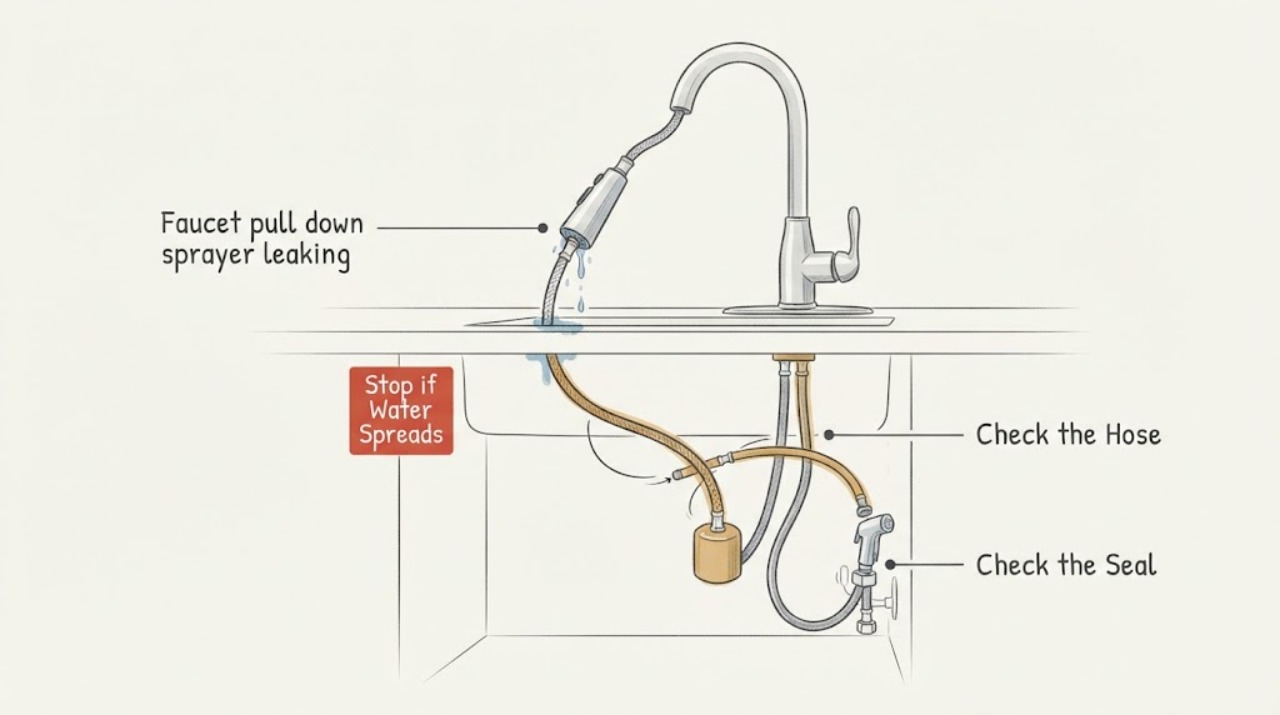
A pull-down wand can leave a small amount of water in its long flexible hose after shutoff, but an active leak, water under the sink, a cracked wand or hose, or a connection that leaks while the faucet runs needs attention. Dry the cabinet, place a container under visible connections, and identify whether water comes from the wand-to-hose joint, hose, quick connection, faucet base, or spout. Check only visible hose routing: a kink, snag, cabinet item, displaced weight, or support can prevent retraction. Shut off the faucet's water supplies if the leak continues, do not pull or force the hose, and arrange model-specific repair when a seal, hose, weight, or internal valve is damaged.
Before you begin
Safety first
- The homeowner scope is limited to drying and observing accessible parts, moving loose cabinet items, checking visible hose routing, and shutting off the faucet supplies when the leak persists. Do not work on pressurized connections, pry seals, cut or lubricate the hose, add an improvised weight, remove the faucet or cartridge, or work near wet electrical equipment.
Work through in order
Diagnostic checks
Use only checks that match the exact appliance or system and its official guide.
-
Check 1
Dry the spray wand, faucet body, hose, and cabinet below. Place a container under visible under-sink connections, then run the faucet briefly and use the sprayer only if the cabinet and connections are dry and safe to observe. Do not reach into a wet electrical area.
Expected result: Water reappears at the wand-to-hose joint, along the flexible hose, at a quick connection, below the faucet base, or only as a brief spout drip after shutoff.
Next step: If water is under the sink or the leak continues, shut off the faucet's hot and cold supplies and arrange repair. If it is only a short spout drip, continue with safe retraction and routing checks.
Stop if: Stop testing if water reaches electrical equipment, the cabinet floor is unstable, the hose sprays under pressure, or a connection is cracked or damaged.
Why this matters
Why: The first wet point separates a hose or connection leak from a base, valve, or residual-drain condition. A brief spout drip can be stored hose water; continued wetness or under-sink water is an active leak.
-
Check 2
With the water off, pull the wand out only as far as it moves easily and look under the sink for a kink, twist, cabinet item, shutoff valve, supply line, or other obstruction catching the hose. Move only an ordinary loose item that is clearly not part of the plumbing assembly.
Expected result: The hose rubs or catches on a cabinet item or valve, bends sharply, twists, or hangs freely without a visible obstruction.
Next step: Clear only the loose obstruction and route the hose in the path shown by the model instructions. If it remains kinked, damaged, or inaccessible, shut off supplies and arrange service rather than forcing it.
Stop if: Do not disconnect pressurized fittings, move shutoff valves to gain clearance, cut the hose, or pull against a snag.
Why this matters
Why: A snag, kink, or twist can impede retraction and stress the hose or connection. A freely routed hose with a poor return makes the weight, guide, support, spout friction, or internal hose condition more relevant.
-
Check 3
Inspect the visible wand connection and hose ends for a crack, split, bulge, abrasion, displaced retainer, missing seal, or water bead that returns while the faucet runs. Do not pry out an O-ring or disassemble the wand unless the exact model instructions identify that step as user-serviceable.
Expected result: The hose or spray assembly is cracked or split; the connection seal or retainer is visibly displaced; or the connection is dry and intact.
Next step: Shut off water and identify the exact faucet model before selecting a matching hose, spray assembly, seal, or retainer. Arrange service if the connection cannot be restored without disassembly.
Stop if: Stop if the fitting is stuck, the plastic is cracked, the hose is pressurized, water is spraying, or the repair requires removing the faucet or supply connections.
Why this matters
Why: A cracked hose or wand cannot be made reliable by improving retraction. A displaced O-ring or retainer can leak at the connection. A dry intact end shifts attention to routing, weight, support, base, or valve conditions.
-
Check 4
Look for the model's visible hose weight, guide, support, or friction piece under the sink and compare its position with the installation instructions. Confirm that it has not slid into a corner, caught on a drain line, or been removed during cabinet work; do not add or relocate a weight without model guidance.
Expected result: The weight or support is missing, displaced, caught, or present and freely moving in the intended path.
Next step: Restore only a clearly loose component to the position specified by the model instructions. If a part is missing, rusted, or uncertain, keep the wand supported by hand, shut off water for any leak, and arrange model-specific service or parts identification.
Stop if: Do not use an improvised weight, tape, adhesive, lubricant, or sharp tool, and do not work around water lines or electrical equipment in a cramped wet cabinet.
Why this matters
Why: A missing or obstructed support can reduce return force or pull the hose sideways into a snag. A correctly positioned support makes a kink, hose damage, spout friction, or model-specific design limitation more likely.
-
Check 5
Record whether water leaks only while spraying, when the wand is moved, after shutoff, or continuously with the handle closed. Also record whether the hose retracts poorly only in one cabinet position, whether the faucet base leaks, and whether flow or spray selection changes the symptom.
Expected result: The leak follows wand movement or spray pressure; continues with the handle closed; appears at the base or spout; or retraction fails independently of water flow.
Next step: Shut off the supplies for any active leak and give the pattern, model, and photos to a plumber or faucet service technician. Do not replace the cartridge or hose until the leak location and model are confirmed.
Stop if: Stop if the faucet body is loose at the counter, a supply connection leaks, water reaches cabinetry or electrical equipment, or the handle or cartridge requires invasive disassembly.
Why this matters
Why: Movement-related leakage points to the hose, wand connection, or routing. Continuous leakage with the handle closed may involve the valve or cartridge. Base or spout leakage is not identified by hose retraction, and an independent return problem points to support or friction.
Use your observations
Decision map
Find the observation that best matches what you see, then follow the next safe action.
-
PATH 01Safety boundary
What you see
Only a small amount of water drips briefly from the spout after shutoff, the under-sink hose and connections stay dry, and the wand retracts normally.
Do this next
Treat it as residual hose water and monitor; use the exact faucet instructions if the drip becomes prolonged or changes to a connection leak.
Why this path and its safety boundary
Safety stop: Escalate if water appears under the sink, continues beyond a brief period, or returns while the faucet is running.
-
PATH 02Safety boundary
What you see
Water leaks from the wand-to-hose joint or a quick connection while spraying, and the hose or seal shows a split, displaced retainer, or damaged O-ring.
Do this next
Shut off the water supplies, identify the exact model, and arrange a matching hose, seal, retainer, or spray-assembly repair according to the model instructions.
Why this path and its safety boundary
Safety stop: Do not continue using the sprayer, pry the connection under pressure, or force a generic part into the fitting.
-
PATH 03Safety boundary
What you see
The hose is dry but catches on a cabinet item, shutoff valve, drain, supply line, kink, or twist and the wand returns after the obstruction is safely cleared.
Do this next
Keep the hose in the model's free path and verify gentle extension and return without force; monitor for abrasion or a new leak.
Why this path and its safety boundary
Safety stop: Stop if the hose remains kinked, rubbed through, stuck, or must be pulled hard to retract.
-
PATH 04Safety boundary
What you see
The hose retracts poorly even with a clear path, and the visible weight, guide, or support is missing, displaced, rusted, or caught.
Do this next
Use the exact model documentation to identify the intended support arrangement, then arrange model-specific part replacement or service if it is missing or damaged.
Why this path and its safety boundary
Safety stop: Do not add an arbitrary weight, adhesive, lubricant, or substitute support that could stress the hose or plumbing connections.
-
PATH 05Safety boundary
What you see
Water continues with the handle closed, or the leak is at the faucet base, spout outlet, or supply connection rather than the pull-down hose.
Do this next
Shut off the faucet supplies and arrange plumbing service to assess the valve, cartridge, base seals, supply connections, and cabinet damage separately from hose retraction.
Why this path and its safety boundary
Safety stop: Do not keep the faucet pressurized, remove the faucet from the counter, or open a cartridge without model-specific instructions and safe water isolation.
-
PATH 06Safety boundary
What you see
The leak and retraction problem began after faucet, counter, cabinet, or hose work, and the connection or support was disturbed.
Do this next
Shut off water if wetness persists, document the before-and-after routing and connection, and have the installation checked against the exact faucet instructions.
Why this path and its safety boundary
Safety stop: Do not force the wand, reuse a displaced seal, or tighten plastic fittings beyond the model instructions.
Helpful context
Understand the symptom
Separate residual water from an active leak
A pull-down hose stores water. Delta's installation guidance notes that a small amount may run from the spout or drip briefly after shutoff because of the long flexible hose. Water that continues, appears under the sink, or emerges from a hose or connection while the faucet is running is a different condition. Dry every accessible surface first so the next wet point identifies the source.
Retraction is a routing and support problem until proven otherwise
A pull-down hose may be caught on a shutoff valve, cabinet item, supply line, or the faucet's support opening. Delta's hose guidance calls out a kink or something underneath the sink, while its installation parts list shows that some models use a steel weight and support pieces. Check only visible routing and model-provided support; do not add an arbitrary weight, oil the hose, or force the wand.
The leak location determines the repair category
A leak at the wand-to-hose joint can involve an O-ring or retainer; a split hose needs a matching hose assembly; a leak at the faucet base or spout outlet can involve the valve or cartridge. Delta advises shutting off water when a leak persists and notes that exact repair parts depend on the faucet model and age. Do not select a generic hose or assume the retraction problem and leak share one failed part.
Only after diagnosis
Potential parts
- exact-model pull-down hose assembly
Consider a hose assembly only when the hose is split, abraded, leaking internally, or the exact model documentation identifies it as the correct repair for the leak.
Match the faucet model, hose ends, connection style, length, routing, and any required clip or support; pull-down and pull-out hoses are not universally interchangeable. - hose connection seal or retainer
Consider this category only when the leak is localized to a confirmed hose connection and the model diagram identifies a replaceable seal or retainer.
Match the exact connection profile and seal material or retainer design; do not substitute a visually similar O-ring or force a fitting. - hose weight, guide, or support component
Consider this category only when retraction is poor because the model's weight or support is missing, damaged, displaced, or unable to move freely after routing is corrected.
Match the exact faucet model and intended support location; an improvised weight can cause snagging, hose wear, or stress at the faucet connection.
When checks do not resolve it
Need a professional?
Escalate for a continuing leak, cracked hose or wand, displaced connection seal, water under the sink, a loose faucet base, supply-line leakage, leakage with the handle closed, or any repair requiring pressurized fitting or valve disassembly.
Safety scope: The homeowner scope is limited to drying and observing accessible parts, moving loose cabinet items, checking visible hose routing, and shutting off the faucet supplies when the leak persists. Do not work on pressurized connections, pry seals, cut or lubricate the hose, add an improvised weight, remove the faucet or cartridge, or work near wet electrical equipment.
Have this ready
- Provide the faucet make and exact model if available, leak location and timing, photos of the wand connection and under-sink routing, hose and weight position, whether the hose catches or kinks, recent cabinet or faucet work, and whether the water supplies were shut off.
Common questions
FAQ
Why does my pull-down faucet hose retract poorly?
The hose may be kinked, twisted, caught on a cabinet item or shutoff valve, or obstructed by a drain or supply line. A missing, displaced, or damaged model-specific weight or support can also affect return. Clear only loose obstructions and do not force, lubricate, or add an arbitrary weight.
Is a brief drip after shutting off a pull-down sprayer normal?
A small, brief spout drip can be residual water from the long flexible hose. Water that continues, appears under the sink, or comes from the hose or connection while the faucet runs is an active leak and needs the supplies shut off and the source assessed.
Where does a leaking pull-down sprayer usually leak?
Check the wand-to-hose joint, hose under the sink, quick connection, faucet base, and spout separately. A displaced retainer or O-ring can leak at a connection, while a split hose or base or valve leak needs a different model-specific repair.
Should I add a heavier weight to make the hose retract?
No. Some faucets use a specified weight or support, but an arbitrary weight can cause snagging, abrasion, or stress at the connection. Confirm the exact model's intended component and position before replacing a missing or damaged part.
When should I shut off the water and call a plumber?
Shut off the faucet supplies when water continues, appears under the sink, sprays from a hose or connection, or leaks with the handle closed. Arrange service for a cracked hose or wand, displaced connection seal, missing support, loose faucet base, supply leak, or any repair requiring pressurized fitting or valve disassembly.
Read the exact guide
Official sources
- Sprayer Hose - Service & Parts FAQDelta Faucet · Delta Faucet service FAQ; the mechanical checks are relevant to pull-down faucet hose symptoms, while exact parts and repair steps vary by faucet model.
- 63235 High-Rise Pull-Down Kitchen Faucet Installation and Parts GuideDelta Faucet · Delta installation guide for a specific high-rise pull-down family; it is used for general mechanism and safety boundaries, not to assert compatibility with an unspecified faucet.
Community feedback
Share a repair observation
Share a plain-text repair observation. Accepted observations are published automatically; this page may take a moment to update.