
On this page
Start here
Quick answer
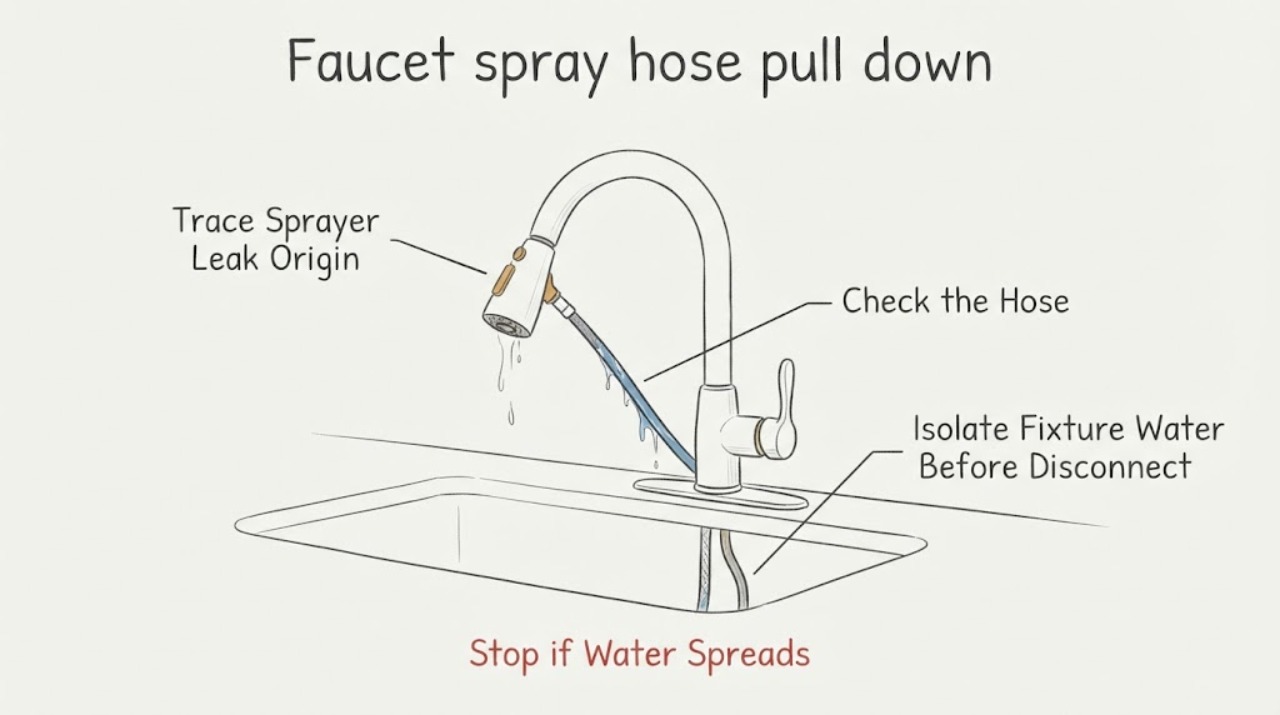
A leaking American Standard pull-down sprayer can be caused by the spray head, the hose, an O-ring or washer at a connection, a quick-connect fitting, or a leak elsewhere in the faucet. Dry the sprayer and the underside of the sink, run the faucet briefly, and identify where water first appears: at the spray-head seam, where the hose joins the head or valve, or at a supply line or faucet body. Record the exact model before choosing a hose or seal; American Standard lists different hose assemblies and says to check the specific model for compatibility. Before disconnecting any hose or fitting, close the hot and cold fixture stops, relieve residual pressure, and verify that water has stopped. Keep the faucet off and call a qualified plumber if the stops do not isolate the water, a hose sprays or splits, water reaches the cabinet or wall, a connection is corroded or seized, or the leak returns after a model-compatible repair.
Before you begin
Safety first
- This article supports drying and tracing the leak, identifying the model, closing and verifying fixture stop valves, and making ordinary-access observations. A qualified plumber should handle failed isolation valves, seized or corroded fittings, concealed leaks, cracked faucet bodies, forceful disassembly, supply-line work, and diagnosis when hose or sprayer compatibility is uncertain.
Work through in order
Diagnostic checks
Use only checks that match the exact appliance or system and its official guide.
-
Check 1
Dry the spray head, hose, underside of the faucet, quick-connect area, and supply lines. Run the pull-down faucet briefly in its normal stream and spray positions, then turn it off while watching from a safe position with a dry tissue near—but not inside—the connections.
Expected result: Record whether water first appears at the spray-head seam or button, along the exposed hose, where the hose joins the spray head, at a quick connector or hose end under the sink, at the faucet body or shank, or at a hot/cold supply connection; note whether it leaks only while flowing or continues after shutoff.
Next step: Photograph the first wet point and the hose routing, then use that location to choose the model-specific diagnostic path. Keep the faucet off if water is entering the cabinet.
Stop if: Stop for a spray, fast leak, split hose, water reaching the wall or electrical equipment, a cracked faucet body, or any connection that cannot be viewed safely; close the fixture stops if they work and arrange qualified plumbing service.
Why this matters
Why: A spray-head seam or button leak makes the sprayer head or its seal more likely. A wet hose or hose-end connection supports a hose, O-ring, washer, or connector path. A dry sprayer with water at the faucet body or supply line is not established as a spray-hose failure.
-
Check 2
Read the American Standard faucet model from the product label, paperwork, or installation record, and inspect the hose routing and connection style from ordinary access without disconnecting it.
Expected result: Record the model number, whether the faucet is a single-handle pull-down design, how the hose attaches to the spray head and valve or quick connector, the hose-end shape, and whether a counterweight, bearing, washer, or O-ring is visible in the model documentation.
Next step: Match the model to its official installation guide or parts diagram before selecting a pull-down faucet hose, sprayer head, or seal. Save a photo of the model and connection for service.
Stop if: Do not order or force a hose based only on color, length, thread appearance, or an American Standard label, and do not continue if the model or connection cannot be identified without pressurized disassembly.
Why this matters
Why: American Standard's pull-down collection includes many faucet families, while individual hose listings identify particular compatible models and different included hardware. A similar-looking hose can have the wrong end, seal, length, or connection even when the brand matches.
-
Check 3
Before disconnecting the spray hose, quick connector, spray head, or seal, close both hot and cold fixture stop valves under the sink, open the faucet briefly, and verify that water flow has stopped.
Expected result: Check whether both stops close fully, only a short residual flow remains, water continues under pressure, or a stop valve and connection is seized, corroded, leaking, or inaccessible.
Next step: Proceed only when the exact model instructions permit the work and isolation is verified. If a stop fails, leave the faucet closed and have a plumber isolate or repair the supply.
Stop if: Do not disconnect a hose under pressure, force a corroded stop or connector, or use the faucet handle or spray-head button as a water shutoff.
Why this matters
Why: A fully isolated fixture provides the necessary boundary for model-directed hose inspection. Continued flow means the hose is not safe to disconnect; forcing a valve or fitting can turn a localized sprayer leak into an uncontrolled cabinet leak.
-
Check 4
With the water isolated and the model instructions available, inspect the accessible spray head, hose ends, quick connector, washer, and O-ring area for a split, kink, abrasion, displaced seal, mineral debris, cracked plastic, or a loose-looking connection; do not pry or enlarge any fitting.
Expected result: Record whether the hose jacket is cut or swollen, the hose-end seal is flattened or missing, the connector is wet or damaged, the spray head leaks at its seam or button, the counterweight has pulled the hose against an obstruction, or all visible parts are intact.
Next step: Follow the exact model procedure for cleaning, reseating, or replacing an accessible seal or hose assembly. If the guide does not cover the observed connection, reassemble only what can be secured and arrange qualified service.
Stop if: Stop for a cracked body, damaged quick connector, seized fitting, hose pulled into a sharp edge, stripped fastener, or any need to twist the faucet body or force the spray head apart.
Why this matters
Why: A split hose or damaged hose-end seal supports a compatible hose or seal repair. A spray-head seam or button leak points toward the sprayer head rather than the hose below the deck. A kink or counterweight obstruction can stress the hose without proving that the hose is the only failed part.
-
Check 5
Compare any replacement pull-down hose or sprayer part against the exact model documentation and the removed part only after the water is isolated; preserve hose routing, connection orientation, seals, and any counterweight or bearing position shown by the model guide.
Expected result: Confirm that the replacement category, hose ends, seal locations, connector, length or routing, and spray-head attachment match the model documentation; record any mismatch, missing hardware, or uncertain orientation.
Next step: Use only the model-approved installation sequence. If fit, orientation, or sealing method is uncertain, keep the water isolated and have a plumber or manufacturer-qualified technician identify the part.
Stop if: Do not substitute a generic pull-down hose, sprayer head, or O-ring, modify connector ends, cut the hose, overtighten a plastic fitting, or pressurize an incomplete assembly.
Why this matters
Why: A model-matched hose assembly or spray head can address the observed failed component. A mismatch means the leak may worsen, the hose may not retract or dock correctly, or the connector may not seal; it is not permission to stretch a seal, add tape where the model does not call for it, or force threads.
-
Check 6
After a model-approved hose, seal, or sprayer repair is fully reassembled, reopen the fixture stops slowly, keep the cabinet accessible, and test normal stream, spray, shutoff, pull-down extension, and retraction while checking every disturbed connection.
Expected result: Record whether the spray head and hose remain dry, the hose retracts without rubbing, the sprayer shuts off, water appears only when the hose is extended, the leak shifts to the faucet body or supply line, or the original leak returns immediately.
Next step: Close the stops again for any returning or relocated leak, preserve the model and part information, and arrange qualified service rather than repeatedly tightening the connector or continuing to test.
Stop if: Do not keep testing a spray, fast leak, cabinet leak, cracked body, damaged hose, or fitting that twists the faucet or supply line; isolate the water and call a qualified plumber.
Why this matters
Why: A dry hose and sprayer through both spray modes supports a successful repair. A leak only when the hose moves suggests routing, strain, or an end-connection issue; a leak at a different point means the original source was incomplete or another connection was disturbed.
Use your observations
Decision map
Find the observation that best matches what you see, then follow the next safe action.
-
PATH 01Safety boundary
What you see
The hose and under-deck connections stay dry, but water continuously escapes from the pull-down spray head seam, button, or spray-to-hose joint while that mode is pressurized.
Do this next
Use the exact model documentation to identify a compatible faucet sprayer head or hose-and-seal assembly; isolate the water before disconnecting the head or joint.
Why this path and its safety boundary
Why it matters: The sprayer head or its seal is more likely than the hose section below the deck, although a damaged hose-end seal can still be involved at the joint.
Safety stop: Do not pry the sprayer head apart, glue a pressurized seam, or continue using it if water sprays toward the cabinet or nearby electrical equipment.
-
PATH 02Safety boundary
What you see
The spray head is dry, but water first appears at the hose end, quick connector, washer, or O-ring under the sink when the faucet is on or the sprayer is pulled down.
Do this next
Close and verify both fixture stops, then follow the exact model procedure to inspect or replace the compatible hose, washer, or seal; preserve the routing and counterweight arrangement.
Why this path and its safety boundary
Why it matters: The hose-end seal, connector, or hose assembly is more likely than a cartridge or faucet-body fault. Movement can expose a damaged seal or a hose that is rubbing or under strain.
Safety stop: Do not disconnect the connector under pressure, stretch an O-ring, add an unapproved washer, or force a quick-connect fitting that is corroded or damaged.
-
PATH 03Safety boundary
What you see
The hose jacket is visibly split, swollen, abraded, or kinked and the wet point follows the hose while the spray head and supply lines remain dry.
Do this next
Keep the faucet off, isolate the water, and use the model diagram to identify the complete compatible pull-down faucet hose and any associated seals or hardware before replacement.
Why this path and its safety boundary
Why it matters: The pull-down hose assembly is a strong suspect, but a counterweight, sharp opening, or routing problem may have caused the damage and can ruin a new hose if left unchanged.
Safety stop: Do not patch, cut, splice, tape, or operate a split hose, and do not pull it through the faucet body against resistance.
-
PATH 04Safety boundary
What you see
The spray head and hose remain dry, but water first appears at a hot/cold supply connection, faucet shank, mounting area, or faucet body beneath the deck.
Do this next
Close the affected fixture stop, protect the cabinet, and arrange plumbing service if the source cannot be safely isolated and identified from ordinary access.
Why this path and its safety boundary
Why it matters: The problem is not established as a pull-down spray-hose leak. A supply line, mounting seal, valve body, or faucet casting can leak independently of the sprayer.
Safety stop: Do not replace the spray hose to treat an unrelated body or supply leak, and do not tighten a connection while the faucet or flexible supply line twists.
-
PATH 05Safety boundary
What you see
The model number is missing, the hose or seal does not match the official diagram, the replacement leaks immediately, or the leak returns only when the sprayer is extended or docked.
Do this next
Close the fixture stops, preserve the old and replacement parts and photos, and obtain model-specific or qualified plumbing diagnosis before another repair attempt.
Why this path and its safety boundary
Why it matters: Fit, orientation, routing, or the original diagnosis is unresolved. A brand-matched part can still have the wrong connection, seal, or model application.
Safety stop: Do not force the connector, add unverified parts, repeatedly tighten the fitting, or pressurize an uncertain assembly where water can reach the cabinet.
Helpful context
Understand the symptom
Separate the pull-down hose from the spray head and supply path
Water can run along the pull-down hose and make a fitting below the sink look like a leak at the sprayer. Dry the hose, spray head, quick-connect area, faucet shank, and supply lines, then run the faucet briefly while watching from a safe position. A continuous bead from the spray-head seam, a wet hose end under the deck, and water at a supply connection are different repair paths. A few drops that drain from the spray head immediately after use are not the same observation as a stream that continues while the faucet is pressurized.
Model and connection details control the replacement choice
American Standard sells pull-down hose and seal parts for particular faucet families. One hose listing identifies a Porcini-compatible nylon-braid hose with a washer, nuts, O-rings, hose barb, and bearing; another hose-and-seal listing expressly says to check the specific faucet model. Those details are not universal dimensions. Record the model, hose-end shape, connection style, spray-head attachment, and any counterweight or docking arrangement before ordering or removing the hose.
Isolate the water before disconnecting a wet hose
If the inspection requires disconnecting a spray hose, quick connector, or seal, close both fixture stop valves and briefly open the faucet to relieve trapped pressure; verify that flow has stopped. American Standard's published faucet service sequence likewise starts by turning off water before removing the handle or cartridge. A spray hose is under the sink and can release water into the cabinet when disconnected, so a stop valve that will not close, a corroded fitting, or an inaccessible connection is a reason to stop and call a plumber.
Safety boundary
Stop conditions
- Identify whether the first wet point is the spray head, hose end, quick connector, faucet body, or supply line before selecting a hose or sprayer part.
- Close and verify the hot and cold fixture stop valves before disconnecting any pull-down hose, spray head, connector, washer, or seal; do not use the handle as a shutoff.
- Do not force corroded stops, quick connectors, hose ends, spray heads, or mounting hardware, and do not twist the faucet body or flexible supply lines.
- Do not patch, cut, splice, tape, stretch, or substitute a pull-down hose, sprayer head, washer, or O-ring without exact model confirmation.
- Keep the faucet off for a spray, fast leak, split hose, water entering the cabinet or wall, damaged body, or any fitting that cannot be safely isolated.
- If a model-compatible repair leaks during verification or the leak changes location, close the stops and arrange qualified plumbing service instead of repeating pressure tests.
Only after diagnosis
Potential parts
- pull-down faucet hose
Consider this category only when the wet point follows a split, abraded, kinked, or leaking hose or hose-end connection and the exact model diagram supports a compatible hose assembly.
Confirm the exact faucet model, hose-end connectors, seals, routing, counterweight or bearing arrangement, and model-specific installation method before ordering or installing. - faucet sprayer head
Consider this category only when the hose remains dry but the spray head, button, spray seam, or head-to-hose joint leaks and the model documentation identifies the head or assembly as replaceable.
Confirm the exact faucet model, spray modes, attachment, seals, finish-independent fit, and docking or retraction arrangement before ordering. - faucet diverter valve
Consider this category only when the exact model uses a diverter and the spray/stream behavior or model-specific diagnosis indicates an internal flow-routing fault rather than a leaking hose or head.
Confirm the exact American Standard model, diverter location, connector arrangement, and qualified diagnosis before ordering or opening the faucet body.
When checks do not resolve it
Need a professional?
Arrange qualified plumbing service when the fixture stops will not isolate the faucet, the spray hose is split or sprays, water reaches the cabinet or wall, a quick connector or supply fitting is corroded or seized, the faucet body is cracked, the model or part fit is uncertain, the hose cannot be routed without force, or a compatible repair does not hold. A slow pull-down sprayer leak still warrants prompt attention because water can accumulate beneath the sink.
Safety scope: This article supports drying and tracing the leak, identifying the model, closing and verifying fixture stop valves, and making ordinary-access observations. A qualified plumber should handle failed isolation valves, seized or corroded fittings, concealed leaks, cracked faucet bodies, forceful disassembly, supply-line work, and diagnosis when hose or sprayer compatibility is uncertain.
Common questions
FAQ
Why is my American Standard pull-down sprayer leaking?
The leak may be at the spray head, hose, hose-end O-ring or washer, quick connector, counterweight path, faucet body, or a supply line. Dry each area and identify where water first appears before selecting a part.
How can I tell whether the spray hose or spray head is leaking?
With the faucet dry, run it briefly and watch the spray-head seam, head-to-hose joint, exposed hose, and under-deck connector separately. A wet spray head with a dry hose points toward the head or its seal; a wet hose or hose-end connection supports a hose or seal path.
Do I need to shut off water before disconnecting a pull-down faucet hose?
Yes. Close both hot and cold fixture stop valves, briefly open the faucet to relieve residual pressure, and verify that flow has stopped before disconnecting a hose, connector, spray head, washer, or seal. If a stop will not close, have a plumber isolate the water.
Can I use any American Standard pull-down spray hose?
No. American Standard lists hose assemblies for particular faucet families and says to check the specific model for compatibility. Confirm the model, hose ends, seals, routing, and counterweight or bearing arrangement before ordering.
What if the pull-down hose is split or abraded?
Keep the faucet off, isolate the fixture water, and identify a model-compatible hose assembly. Also inspect the routing, counterweight, and sharp edges that may have damaged it; do not patch, splice, tape, or pull a damaged hose through by force.
What if water is leaking under the sink but the sprayer is dry?
The source may be a supply line, faucet shank, mounting area, or faucet body rather than the pull-down hose. Close the affected fixture stop if it works, protect the cabinet, and arrange plumbing service if the source or isolation is uncertain.
When should I call a plumber for an American Standard pull-down sprayer leak?
Call when the fixture stops cannot isolate the faucet, the hose sprays or water reaches the cabinet or wall, a fitting is corroded or seized, the faucet body is cracked, the model or part fit is uncertain, or a compatible repair leaks again during testing.
Read the exact guide
Official sources
- M920529-0020A-SPRAY HOSEAmerican Standard · A specific American Standard Porcini pull-down hose listing; it demonstrates model-specific hose hardware and is not a universal fit claim.
- Pull-Down Kitchen FaucetsAmerican Standard · American Standard pull-down kitchen faucet collection; individual model documentation controls hose, sprayer, and connector compatibility.
- American Standard Parts StoreAmerican Standard · American Standard parts-store and support index; exact model parts diagrams and instructions determine the applicable repair.
- Spray Hose & SealAmerican Standard · American Standard spray hose and seal product page; it explicitly requires checking the specific faucet model for compatibility.
- How to Replace the Spout Seal Kit for Your Reliant FaucetAmerican Standard · American Standard Reliant faucet service guide; the exact pull-down faucet manual controls whether any analogous accessible step applies.
Community feedback
Share a repair observation
Share a plain-text repair observation. Accepted observations are published automatically; this page may take a moment to update.