
On this page
Start here
Quick answer
A fluctuating American Standard shower temperature can mean that the pressure-balancing cartridge or its check-valve system is not responding correctly, but the same symptom can come from a changing hot or cold supply, another fixture drawing water, a restricted inlet, the water heater, or a different shower-valve component. First compare the shower with other hot-water fixtures and note whether the temperature changes when another tap or toilet operates. Then identify the exact American Standard rough-in and cartridge before any service. American Standard describes its pressure-balancing unit as responding to changes in hot and cold supply pressure and lists specific compatible rough-in valve families, so a generic cartridge swap is not a safe diagnosis. Stop using the shower for scalding, abrupt hot-to-cold changes, a leak, water behind the trim, or any repair that requires opening the wall or valve body.
Before you begin
Safety first
- This article supports ordinary-access observation, fixture comparison, safe isolation, model identification, and one controlled test after authorized service. Do not open the wall or valve body, work on a water heater, loosen pressurized fittings, or bypass temperature-control features.
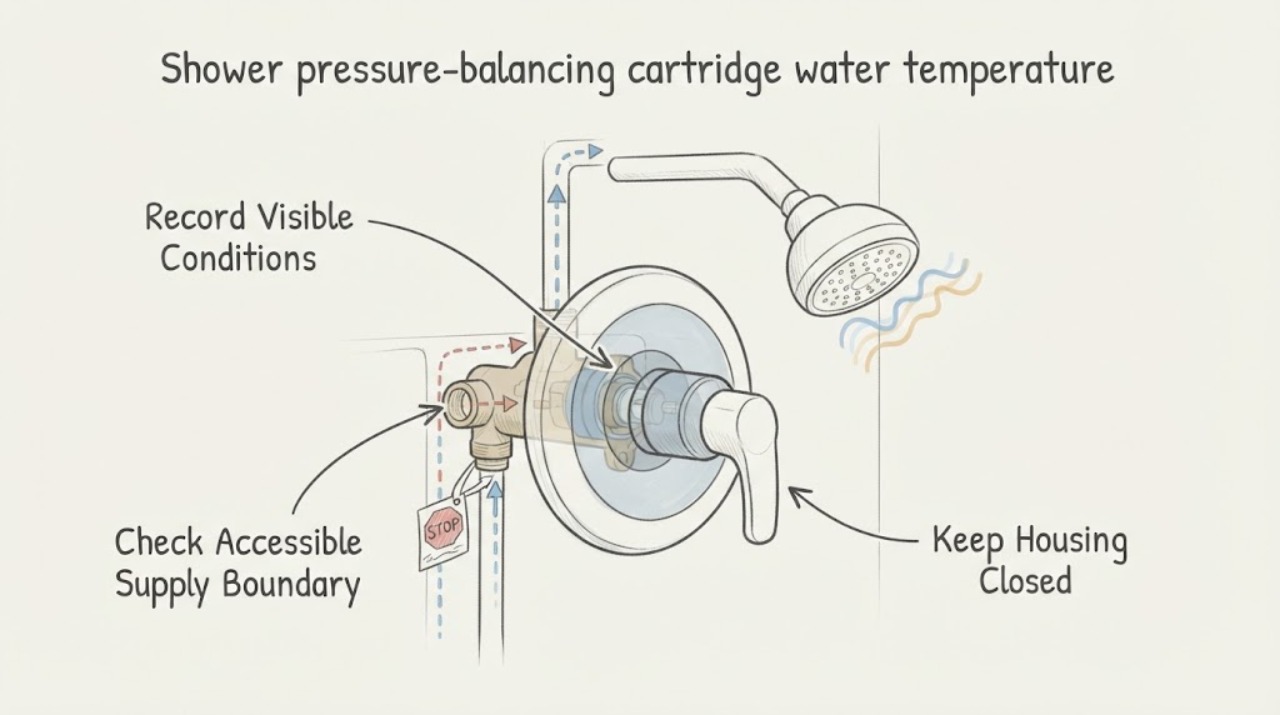
Work through in order
Diagnostic checks
Use only checks that match the exact appliance or system and its official guide.
-
Check 1
With the shower area clear and the handle operated normally, observe one brief shower cycle from outside the spray path; turn the control off when the water changes abruptly rather than trying to chase the temperature.
Expected result: Record whether the change is hot-to-cold, cold-to-hot, or a smaller oscillation; note whether it starts at opening, after a delay, during steady flow, or when the shower is turned off and on again.
Next step: Keep the pattern notes and continue to the whole-home comparison only if there is no leak, scalding risk, or hidden moisture; otherwise stop using the shower and arrange service.
Stop if: Stop immediately for an abrupt hot surge, a temperature that cannot be controlled, water behind the trim, a soft or stained wall, or any need to open the valve or wall.
Why this matters
Why: A repeatable fluctuation while the shower is the only fixture running focuses the check on the shower valve, cartridge, local supply, or inlet. A change tied to startup or another water event makes supply pressure, hot-water recovery, or building demand more plausible than a cartridge alone.
-
Check 2
When no immediate hazard is present, compare hot-water behavior at a nearby sink or tub without changing the shower valve or running several fixtures at once; then note whether the shower changes when a toilet fills or another tap is briefly used.
Expected result: Record whether hot water is stable elsewhere, whether only the shower fluctuates, and whether the shower changes when another fixture draws water; do not continue if the shower becomes dangerously hot or cold.
Next step: Give the comparison and timing to a plumber. Keep the shower control unchanged and do not assume a cartridge replacement will correct a whole-home hot-water or pressure problem.
Stop if: Stop if any fixture produces scalding water, a gas odor, uncontrolled flow, a leak, or if the comparison requires access to a boiler, heater, electrical equipment, or concealed plumbing.
Why this matters
Why: Stable hot water elsewhere with a shower-only fluctuation makes the shower valve, pressure-balancing cartridge, inlet, or local supply more likely. Fluctuation at several fixtures or only during a shared demand points toward the water heater, building supply, pressure, or another upstream issue.
-
Check 3
From ordinary safe access, check whether the shower's known accessible stops or the home's supply controls are fully open and whether a visible inlet or connection is leaking; operate a shutoff only as far as its instructions allow and never force it.
Expected result: Record whether a stop is partly closed, a visible connection is wet, the supply is fully open and dry, or the shutoff identity is unknown; note whether the temperature problem is accompanied by a flow change.
Next step: If a safe, documented adjustment corrects the condition, perform no further disassembly and monitor one controlled use. For a wet connection, unknown shutoff, or recurring fluctuation, isolate water as needed and arrange plumbing service.
Stop if: Do not loosen fittings, remove covers, disturb the wall, or continue if the stop will not close, water is spraying, or any leak can enter the wall or floor.
Why this matters
Why: A partly closed or obstructed local supply can limit or alter the pressure available to the balancing system, while a dry, fully open supply makes the cartridge or another valve component more relevant. A wet connection is a separate leak boundary, not evidence that the cartridge alone is at fault.
-
Check 4
Read the American Standard marking on the trim or documentation and identify the rough-in family and pressure-balance component from the installation record or model-specific parts information without pulling the handle, cartridge, or valve body.
Expected result: Record the exact model or family if available, whether the documentation describes a pressure-balancing cartridge, a combined pressure-balance trim cartridge, or another valve type, and whether the required rough-in is known; mark the identity unknown if any of these cannot be confirmed.
Next step: Use only the exact model instructions or give the markings and photos to a qualified plumber or American Standard support for identification before considering a part or opening the valve.
Stop if: Do not install a generic cartridge, remove a retaining clip under pressure, bypass the balancing or temperature-control system, or force a component that does not match the documentation.
Why this matters
Why: American Standard documents distinct pressure-balance components and rough-in relationships. An unknown or mismatched identity leaves compatibility unresolved, so a visually similar cartridge can fail to correct the fluctuation or damage the valve.
-
Check 5
Only after an authorized accessible adjustment or model-specific service has been completed and the trim is restored, place a dry tissue below the escutcheon, restore water slowly, and make one brief controlled test while watching the wall side and the area below.
Expected result: Record whether temperature remains steady and the tissue and wall stay dry, or whether the temperature still oscillates, flow changes, a leak appears, or water continues after the control is off.
Next step: If the symptom returns, isolate the water or stop using the shower, preserve the model and test notes, and arrange qualified service for the cartridge, valve, local supply, or upstream system as appropriate.
Stop if: Stop the test for an abrupt hot or cold surge, any wall or ceiling moisture, a recurring leak, uncontrolled flow, or a need to access the valve behind the wall.
Why this matters
Why: A stable dry test supports that the accessible service boundary is holding, but it does not prove the concealed rough-in or upstream supply is sound. A returning fluctuation or leak means the cause is unresolved and repeated adjustment is not a diagnosis.
Use your observations
Decision map
Find the observation that best matches what you see, then follow the next safe action.
-
PATH 01Safety boundary
What you see
Other hot-water fixtures are steady, the shower is the only fixture running, and the temperature fluctuates with a change in shower flow or pressure.
Do this next
Identify the exact American Standard valve and use model-specific service or qualified plumbing diagnosis; do not begin with a generic cartridge.
Why this path and its safety boundary
Why it matters: The shower valve, pressure-balancing cartridge, its check-valve path, an inlet restriction, or a local supply issue is more likely than a whole-home water-heater problem.
Safety stop: Stop for scalding, a leak behind the trim, or any need to open the valve body or wall.
-
PATH 02Safety boundary
What you see
The shower changes temperature when a toilet fills, a sink opens, or another fixture draws water, and the effect is not limited to a single steady shower condition.
Do this next
Arrange plumbing assessment of supply pressure, stops, building demand, and the shower valve together; keep the cartridge arrangement unchanged until the cause is established.
Why this path and its safety boundary
Why it matters: Changing relative hot and cold supply pressure or an upstream supply problem is more likely; a pressure-balancing cartridge may be responding to a larger pressure event rather than causing it.
Safety stop: Stop if the temperature becomes dangerously hot or cold, water flow is lost, or a leak appears.
-
PATH 03Safety boundary
What you see
The shower and other hot-water fixtures fluctuate, or the problem follows hot-water availability rather than another fixture's pressure demand.
Do this next
Stop treating the shower cartridge as the sole diagnosis and request qualified plumbing or water-heater assessment; report which fixtures were affected and when.
Why this path and its safety boundary
Why it matters: The water heater, hot-water distribution, supply, or building plumbing becomes more likely than a shower-only cartridge fault.
Safety stop: Do not open a gas or electric water heater, adjust combustion or wiring, or keep using the shower through scalding changes.
-
PATH 04Safety boundary
What you see
The American Standard trim or rough-in family cannot be identified, or the documented cartridge does not match the installed valve.
Do this next
Photograph markings and provide them to the manufacturer or a qualified plumber for exact identification before ordering, removing, or substituting a component.
Why this path and its safety boundary
Why it matters: Compatibility is unresolved. American Standard lists pressure-balance components for particular rough-in families, and another trim design can use a different cartridge arrangement.
Safety stop: Do not install a visually similar cartridge, remove balancing parts by force, or bypass temperature-control features.
-
PATH 05Safety boundary
What you see
Temperature fluctuation is accompanied by a wet escutcheon, wall, ceiling below, soft drywall, visible connection leak, or water that continues after shutoff.
Do this next
Stop using the shower, isolate the available water supply without forcing a stop, and arrange prompt qualified plumbing and water-damage assessment.
Why this path and its safety boundary
Why it matters: A seal, valve body, rough-in connection, or concealed supply leak is now a priority; continuing temperature tests can spread water damage.
Safety stop: Do not pry trim, open the wall, loosen pressurized fittings, or run more shower cycles to compare the symptom.
-
PATH 06Safety boundary
What you see
The exact model-specific service has been completed, but temperature still fluctuates or a dry controlled test becomes wet.
Do this next
Keep the shower out of use and give the technician the before-and-after pattern, other-fixture comparison, model identity, service performed, and leak observations.
Why this path and its safety boundary
Why it matters: The cartridge may not be the cause, the valve may have another component or supply issue, or a concealed problem remains; repeating a replacement without diagnosis is unlikely to clarify it.
Safety stop: Do not keep swapping cartridges, force retaining hardware, or bypass the pressure-balancing system.
Helpful context
Understand the symptom
A pressure-balancing cartridge is only one possible cause
Temperature that swings hot, cold, or back to warm is a symptom rather than proof that the balancing cartridge has failed. A pressure-balancing valve is intended to compensate when the relative hot and cold supply pressure changes, but a supply interruption, a partially closed stop, debris, another fixture using water, or a hot-water problem can create the same experience. Start with a safe comparison before disassembling the handle.
Separate pressure changes from a temperature-control fault
Write down when the fluctuation occurs: immediately at startup, only after several minutes, when a toilet fills, when a sink or appliance runs, or even when the shower is the only fixture open. If hot water is inconsistent at multiple fixtures, the shower cartridge is not established as the cause. If only this shower changes while the other fixtures are steady and its flow also pulses or changes, the shower valve, cartridge, inlet, or local supply becomes the more focused check.
Identify the valve before considering a cartridge
American Standard publishes more than one shower-valve arrangement. Its pressure-balance cartridge page describes a diaphragm and integrated check valves and gives a specific rough-in compatibility context; another American Standard pressure-balance trim page describes a cartridge incorporated with the trim and a separate rough-in valve. These distinctions matter. Do not order or force a cartridge based only on a similar handle or trim shape, and do not bypass the valve's temperature-control feature.
Make an unstable shower safe
An abrupt hot surge is a burn risk, while a cold surge can cause a slip or an unsafe attempt to adjust the handle. Turn the control off and step out of the spray path when the temperature changes unexpectedly. If the trim or wall is wet, isolate the available water supply without forcing a stop and arrange qualified plumbing service; Portland Water Bureau guidance similarly recommends locating the leak, using an accessible shutoff or main supply when needed, and checking for leaks after restoration.
Safety boundary
Stop conditions
- Stop using the shower for abrupt hot surges, uncontrolled cold changes, a temperature that cannot be regulated, or any symptom that creates a burn or slip risk.
- Stop for water behind the escutcheon, a wet or soft wall, a ceiling or floor stain below, visible flooding, or a leak that continues after the control is off.
- Do not install a generic pressure-balancing cartridge, bypass check valves or temperature control, or force a cartridge based only on trim appearance.
- Do not open a gas or electric water heater, access energized parts, loosen pressurized plumbing, open the wall, or remove the valve body as a user test.
- If a shutoff will not isolate the water or the leak is increasing, use the main shutoff if it can be operated safely and arrange prompt qualified plumbing service.
Only after diagnosis
Potential parts
- American Standard pressure-balancing cartridge
Consider this category only when the shower-only pattern and model-specific diagnosis point to the pressure-balancing component after supply and other-fixture checks are normal.
Confirm the exact American Standard rough-in family and cartridge version; the manufacturer's pressure-balance documentation lists specific valve families and does not establish universal fit. - American Standard shower valve cartridge or cartridge seal
Consider this category only when the installed valve documentation identifies a separate or combined shower cartridge and the symptom or leak is located at that component.
Confirm the installed trim and rough-in configuration before ordering; do not substitute a visually similar cartridge or alter the balancing system. - compatible rough-in valve or service seal
Consider this category only after qualified assessment locates the problem in the rough-in valve, connection, or concealed seal rather than an accessible cartridge alone.
A qualified plumber must confirm the exact valve, access method, connection type, and compatible replacement before wall or valve work.
When checks do not resolve it
Need a professional?
Arrange qualified plumbing service when a shower-only fluctuation persists with stable other fixtures, the exact cartridge or rough-in identity is uncertain, a model-specific service does not restore stable temperature, supply pressure changes affect the shower, or any leak accompanies the symptom. Request prompt assessment for scalding or uncontrolled temperature, water behind the trim or wall, a wet ceiling or floor below, an isolation valve that will not close, or an increasing leak. Provide the exact American Standard markings, rough-in family if known, timing pattern, other-fixture comparison, flow changes, shutoff result, photos, and any prior service.
Safety scope: This article supports ordinary-access observation, fixture comparison, safe isolation, model identification, and one controlled test after authorized service. Do not open the wall or valve body, work on a water heater, loosen pressurized fittings, or bypass temperature-control features.
Common questions
FAQ
Does fluctuating shower temperature prove the American Standard pressure-balancing cartridge is bad?
No. Compare other hot-water fixtures and note whether another fixture or a flow change triggers the symptom. A shower-only fluctuation makes the valve or cartridge more relevant, while whole-home or demand-related changes point toward supply pressure, the water heater, or building plumbing.
Can I use any American Standard cartridge that looks similar?
No. American Standard documents pressure-balance components for particular rough-in families and also shows trim designs with different cartridge relationships. Identify the exact model and rough-in before ordering or removing a part.
Why does another fixture make the shower go hot or cold?
Another fixture can change the relative hot and cold supply pressure. The pressure-balancing system is designed to respond to that change, but an unusually large supply event, a restriction, or a valve problem can still produce an unstable shower. Arrange plumbing assessment if it repeats or creates a scald risk.
Should I keep using the shower while testing the cartridge?
No when the temperature changes abruptly, the shower leaks, water is behind the trim, or the control cannot regulate the temperature. Turn it off, isolate water if needed without forcing a stop, and arrange qualified service rather than continuing cycles.
Read the exact guide
Official sources
- Temperature Control Pressure Balance Valve CartridgeAmerican Standard · Use for explaining how the pressure-balancing unit responds to hot and cold supply-pressure changes and why the exact rough-in family must be confirmed.
- How to fix a faucet leakPortland Water Bureau · General leak-safety guidance applied to the article's isolation and stop-use boundaries; it is not an American Standard shower-valve repair manual.
- Aspirations Pressure Balance Valve Trim With Double Ceramic Pressure Balance Cartridge and Lever HandleAmerican Standard · Use for the distinction between a pressure-balance trim cartridge and a separate rough-in valve; other American Standard models may use different arrangements.
Community feedback
Share a repair observation
Share a plain-text repair observation. Accepted observations are published automatically; this page may take a moment to update.