
On this page
Start here
Quick answer
Temperature that swings hot and cold in a GROHE shower is usually a change in hot or cold supply pressure, a valve or thermostat that is dirty, miscalibrated, or failing, a restricted shower device, or an upstream hot-water problem. First note whether the change happens when a toilet, washer, or faucet runs, whether only one shower outlet is affected, and whether the water is unstable from the first moment or after it warms. GROHE describes its thermostatic control as intended to keep the selected temperature stable even when pressure fluctuates, while EPA guidance explains that a suitable temperature-compensating shower valve reduces pressure and temperature swings and scald risk. Check only safe, exposed items: the showerhead or hand-shower inlet for scale or debris, the selected outlet, and any model-approved calibration procedure. Do not remove a cartridge, adjust a concealed valve or temperature limit stop, alter a pressure regulator, or continue showering through a hot surge. Stop use and arrange qualified plumbing service for unstable temperature, weak or changing flow, a leaking valve, a failed thermostat, or any moisture behind trim or in the wall.
Before you begin
Safety first
- A homeowner may observe temperature and flow from a safe position, compare outlets, inspect an exposed shower device, and follow a model-approved calibration check if it requires no valve disassembly. A qualified plumber should handle cartridges, thermostatic elements, pressure-balance parts, check stops, regulators, concealed supply, hot-water diagnosis, and wall or trim removal.
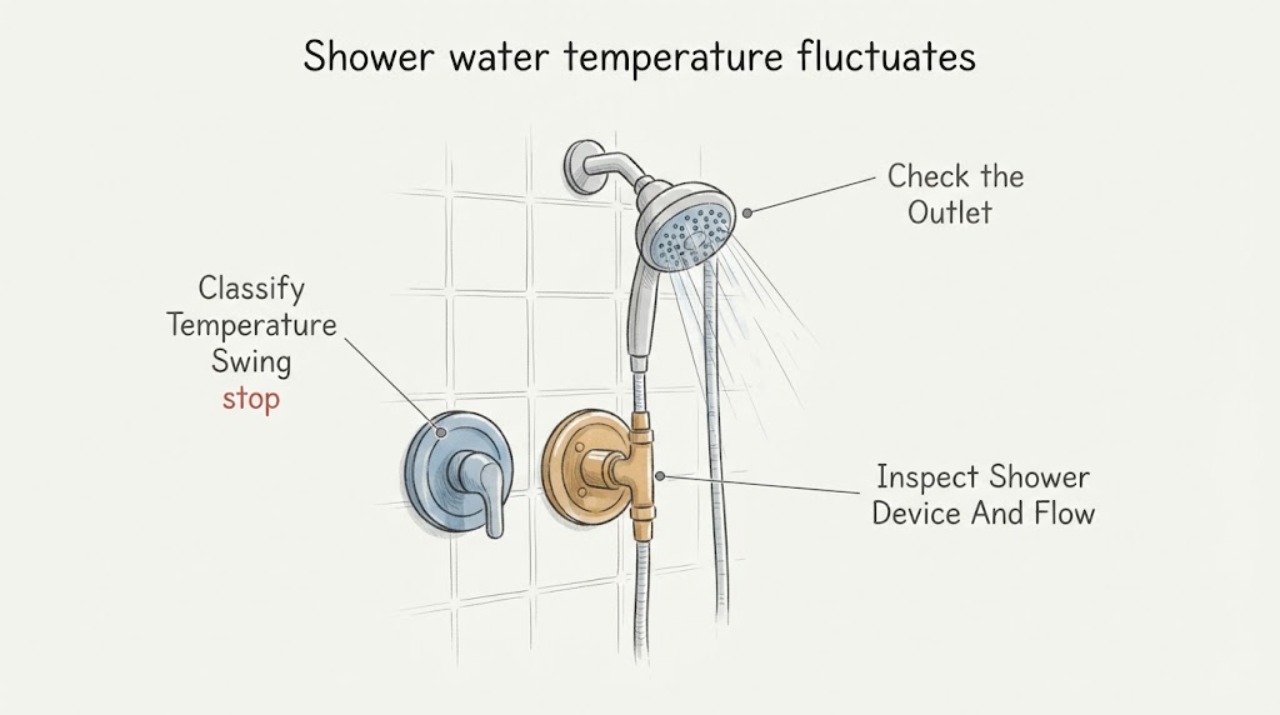
Work through in order
Diagnostic checks
Use only checks that match the exact appliance or system and its official guide.
-
Check 1
Stop standing under the spray if the temperature changes abruptly; from a safe position, record whether the water swings hot to cold, cold to hot, or merely drifts, and when the change occurs during the shower.
Expected result: Note whether the swing follows another fixture running, occurs when switching between the showerhead and hand shower, begins at startup, returns repeatedly, or affects only hot or only cold water.
Next step: Keep the shower unused while collecting the pattern and move to the safe comparison checks. Arrange prompt plumbing service for abrupt hot surges, unstable temperature, or a swing that repeats independently of other water use.
Stop if: Stop immediately for scalding, cold shock, a large pressure surge, water behind trim, an active leak, or a slippery or otherwise unsafe shower area.
Why this matters
Why: A change linked to another water demand suggests supply-pressure interaction. One-outlet behavior suggests a device or transfer path, while a temperature-specific or all-outlet swing suggests a mixing or thermostatic valve or hot-water supply issue.
-
Check 2
From outside the spray, compare a nearby faucet or tub outlet and each accessible GROHE shower outlet at separate times; do not change concealed trim or operate multiple outlets together if temperature is unstable.
Expected result: Record whether nearby fixtures are stable, whether the fixed head and handheld behave differently, whether only hot or cold flow is affected, and whether pressure changes when another fixture runs.
Next step: Use the comparison to choose the device or valve branch; do not infer a failed cartridge from temperature feel alone. Have a plumber assess supply pressure and valve compatibility when several fixtures or all outlets are affected.
Stop if: Do not continue testing if the temperature becomes dangerously hot or cold, the shower leaks, or a test would require opening the wall or valve trim.
Why this matters
Why: Stable nearby fixtures with one weak or unstable shower outlet narrows the issue to the shower device or transfer path. Instability at several fixtures points upstream to the home's supply, hot-water system, or pressure regulator. All shower outlets affected points toward the mixing or thermostatic valve.
-
Check 3
With the water off, inspect the visible GROHE showerhead, hand shower, hose, and inlet screen for scale, debris, kinks, or a displaced washer; clean only with the product's approved method and do not alter the flow-control arrangement.
Expected result: Classify the device as scaled or blocked, restricted by a kink or seal, clean with normal flow, or impossible to inspect without model-specific disassembly; note whether temperature changes only with one device selected.
Next step: Rinse or clean the accessible device according to GROHE instructions, restore the original parts, and compare once from a safe position. If temperature remains unstable or the device needs force to remove, arrange plumbing service.
Stop if: Do not drill spray holes, remove a restrictor, use sharp tools on the valve, apply unapproved chemicals, or test under the spray while the temperature is unpredictable.
Why this matters
Why: A device-specific restriction can change flow through the valve and affect the user-perceived temperature. A clean device or a temperature swing at every outlet makes the valve, supply, or hot-water path more likely. EPA treats spray force and pressure compensation as performance features, not defects to drill away.
-
Check 4
Identify whether the GROHE control is thermostatic or another valve type, and consult the exact model instructions for its temperature scale, handle stop, and calibration procedure; make no concealed adjustment while water is unstable.
Expected result: Note a consistently incorrect temperature, a calibration or temperature-stop setting that changed after service, a loose control, a recurring temperature error, or no obvious setting issue.
Next step: If the manual gives a model-approved calibration check that can be done safely, follow it once from outside the spray; otherwise provide the model and observations to a plumber. Do not change a temperature limit stop to mask a supply or valve fault.
Stop if: Do not remove the thermostat handle, cartridge, trim, check stop, or pressure-balancing parts, and do not make a calibration change that could increase maximum temperature without qualified guidance.
Why this matters
Why: A consistent offset may fit a calibration or control-setting issue, while rapid swings are more suggestive of pressure, flow, valve, cartridge, or hot-water behavior. A control that is loose or does not track temperature should not be forced or recalibrated by guesswork.
-
Check 5
Document the GROHE model, selected outlet, hot and cold behavior, flow changes, other fixture activity, visible scale or debris, calibration history, and any leak or wall moisture; do not remove the valve or open the wall to continue diagnosis.
Expected result: Record whether cleaning or an approved calibration changed the symptom, whether pressure is stable elsewhere, whether the temperature swing persists at every outlet, and whether water appears behind trim or below the shower.
Next step: Keep the shower off when the temperature is unpredictable and arrange qualified plumbing service. Give the plumber the timing log, fixture comparisons, product identity, and photographs from safe access.
Stop if: Do not continue using an unstable shower, hide moisture with caulk, adjust a regulator, or open trim or wall material as a homeowner troubleshooting step.
Why this matters
Why: Persistent swings after safe device and setting checks point toward the thermostatic or mixing valve, pressure balance, supply, hot-water capacity, or concealed plumbing. Wall moisture or a leak adds a separate property-damage risk.
Use your observations
Decision map
Find the observation that best matches what you see, then follow the next safe action.
-
PATH 01Safety boundary
What you see
The shower becomes hotter or colder when a toilet, faucet, washer, or other fixture changes the home's water demand.
Do this next
Stop using the shower until the swing is understood and have a plumber check the valve, supply, and pressure behavior; provide the other-fixture timing.
Why this path and its safety boundary
Why it matters: A supply-pressure interaction or valve-compensation problem is more likely than a simple temperature-scale setting.
Safety stop: Do not keep showering through a hot surge or adjust a pressure regulator without qualified guidance.
-
PATH 02Safety boundary
What you see
The fixed head is stable but the handheld or another selected GROHE outlet fluctuates, and the problem follows that outlet.
Do this next
Inspect and clean the affected device only as the model instructions allow, preserve seals and flow-control parts, and arrange service if the fluctuation remains.
Why this path and its safety boundary
Why it matters: A restricted shower device, hose, screen, transfer path, or outlet-specific component is more likely than the whole mixing valve.
Safety stop: Do not remove the transfer valve or force the device connection.
-
PATH 03Safety boundary
What you see
The fixed head and handheld or other shower outlets all fluctuate, while nearby non-shower fixtures are stable.
Do this next
Stop using the shower and arrange qualified plumbing diagnosis of the GROHE valve and supply; do not remove the trim to guess at a cartridge.
Why this path and its safety boundary
Why it matters: A mixing or thermostatic valve, cartridge, pressure balance, service stop, or shower supply path is more likely than a single showerhead.
Safety stop: Do not adjust the temperature limit stop, open the valve body, or continue use through unstable temperature.
-
PATH 04Safety boundary
What you see
The shower is consistently too hot or too cold rather than rapidly swinging, and the GROHE control or thermostat was recently installed, serviced, or adjusted.
Do this next
Follow only the exact GROHE calibration guidance for the installed model, or have a plumber perform the adjustment and verify safe operation.
Why this path and its safety boundary
Why it matters: A calibration or temperature-setting issue is plausible, but an exact model procedure and safe temperature check are required.
Safety stop: Do not increase the limit stop or remove a handle and cartridge by guesswork.
-
PATH 05Safety boundary
What you see
Temperature starts acceptable but falls as the shower continues, especially when other hot-water use occurs, while cold flow remains stable.
Do this next
Stop if temperature becomes unsafe and have a plumber or qualified water-heating professional assess the hot-water supply and valve compatibility.
Why this path and its safety boundary
Why it matters: Hot-water supply, heater recovery, a hot-side stop, or a mixing-valve path may be limiting the available hot water; the thermostat alone cannot be blamed.
Safety stop: Do not alter the water heater or valve limit setting, and do not continue use through an unstable hot-water condition.
-
PATH 06Safety boundary
What you see
Temperature changes are accompanied by moisture behind the escutcheon, a ceiling stain below, a leaking valve, or water that continues after the controls are off.
Do this next
Isolate the water supply as safely as possible, stop using the shower, protect nearby finishes, and arrange urgent qualified plumbing inspection.
Why this path and its safety boundary
Why it matters: A concealed connection, valve, pipe, or fixture leak creates a property-damage and possible electrical risk in addition to the temperature symptom.
Safety stop: Do not caulk over the moisture, open the wall, or keep testing the shower.
Helpful context
Understand the symptom
Start by recording when the temperature changes
A fluctuation that follows a toilet flush or another fixture using water points toward a supply-pressure interaction. A change that occurs only at one GROHE showerhead or handheld can begin with that device, its screen, or its selected outlet. A swing that continues with every shower outlet, or only on hot or only on cold, makes the mixing or thermostatic valve and the hot-water supply more important. Treat an abrupt hot surge as a safety event, not as a reason to keep adjusting the handle while standing under the spray.
A thermostatic control still needs correct calibration and flow
GROHE's thermostat materials describe a thermostatic control that combines hot and cold water and is intended to hold a selected temperature. GROHE also publishes a thermostat-calibration procedure, so a thermostat that is consistently offset or recently serviced may need the model-specific calibration procedure rather than a guessed handle adjustment. Low or uneven flow can undermine the observation: inspect the shower device for scale or debris and preserve any integral flow-control arrangement.
Do not trade temperature safety for more flow
EPA guidance links a properly matched temperature-compensating valve with reduced pressure and temperature fluctuations and lower thermal-shock risk. It also warns that scale can restrict showerhead flow and that integral flow-control parts should not be bored out or removed by guesswork. Do not defeat a GROHE temperature limit stop, bypass a valve, or change the home's pressure-regulating equipment because the shower feels weak.
Safety boundary
Stop conditions
- Stop using the shower for an abrupt hot or cold surge, unstable temperature, a leak behind trim, a ceiling stain, or water near an electrical fixture.
- Do not remove a cartridge, thermostat, pressure-balance part, check stop, valve trim, or wall material as a general homeowner check.
- Do not change a temperature limit stop, pressure regulator, flow-control insert, or valve setting to compensate for uncertain supply pressure.
- Do not drill the showerhead, force finished fittings, use sharp tools on a valve, or apply unapproved cleaners or sealants.
- Arrange qualified plumbing service when the fluctuation persists after safe device and setting checks, affects all outlets, follows another fixture, or involves a hot-water or concealed-pipe symptom.
When checks do not resolve it
Need a professional?
Arrange qualified plumbing service when a GROHE shower temperature fluctuates repeatedly, becomes unsafe, changes with other fixtures, affects all outlets, remains unstable after model-approved device checks, or involves a thermostatic valve, cartridge, transfer path, hot-water supply, pressure regulator, leak, or moisture behind trim. Stop using the shower during an abrupt hot or cold surge.
Safety scope: A homeowner may observe temperature and flow from a safe position, compare outlets, inspect an exposed shower device, and follow a model-approved calibration check if it requires no valve disassembly. A qualified plumber should handle cartridges, thermostatic elements, pressure-balance parts, check stops, regulators, concealed supply, hot-water diagnosis, and wall or trim removal.
Common questions
FAQ
Why does my GROHE shower go hot and cold?
A change in hot or cold supply pressure, a thermostatic or mixing valve issue, a restricted shower device, or a hot-water limitation can cause the swing. Note whether another fixture triggers it and stop using the shower if the change is abrupt.
Should a GROHE thermostatic shower stay at one temperature?
GROHE describes its thermostatic control as intended to keep the selected temperature stable even when pressure fluctuates. Repeated swings indicate that the device, valve, supply, or installation needs assessment rather than normal operation.
Can a clogged showerhead cause temperature fluctuations?
A scale or debris restriction can reduce or change flow through one shower device and alter the shower's behavior. Clean only as the model permits and do not drill or remove flow-control parts; if all outlets fluctuate, the valve or supply is more likely.
Can I recalibrate my GROHE thermostat myself?
GROHE publishes a calibration procedure, but the correct method depends on the installed model. Use it only when the exact instructions allow a safe adjustment without valve disassembly; do not increase a temperature limit stop by guesswork.
When should I call a plumber for fluctuating shower temperature?
Call when swings are repeated, abrupt, linked to other fixtures, present at all outlets, temperature-specific, accompanied by weak flow or a leak, or still present after safe device and model-approved setting checks. Provide the GROHE model and timing pattern.
Read the exact guide
Official sources
- Shower Faucet: Low Flow- Independent Transfer ValvesMoen Solutions · Shower-device versus mixing or transfer-valve flow diagnosis, temperature-specific flow, and supply-path distinctions applicable as general valve troubleshooting context
- GROHE Sense FAQGROHE · GROHE leak detection, pressure-drop monitoring, water shutoff, and certified installer boundary
- Home MaintenanceU.S. Environmental Protection Agency WaterSense · Household water-pressure context and safe showerhead connection and scale inspection
- How To — Calibrate the thermostat and whyGROHE X · GROHE thermostat calibration procedure and model-specific temperature setting context
- Aqua IntelligenceGROHE · GROHE TurboStat temperature stability, pressure fluctuation response, and shower safety positioning
- ThermostatsGROHE · GROHE thermostatic control, hot and cold mixing, stable set temperature, and concealed valve context
- WaterSense at Work Sanitary Fixtures and Equipment 3.4 Showerheads and Bath and Shower DivertersU.S. Environmental Protection Agency WaterSense · Shower valve compatibility, pressure and temperature fluctuation reduction, scald risk, scale, flow-control, and maintenance context
Community feedback
Share a repair observation
Share a plain-text repair observation. Accepted observations are published automatically; this page may take a moment to update.