
On this page
Start here
Quick answer
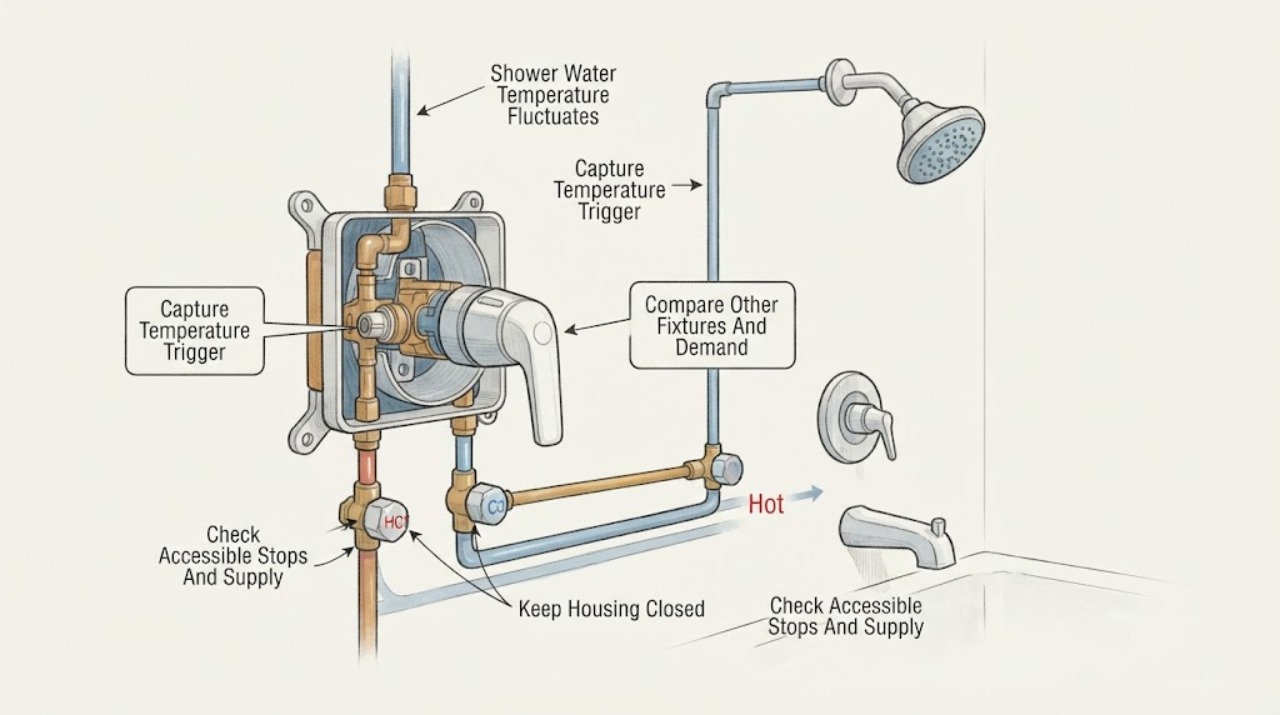
When a Kohler shower temperature swings hot and cold, first note whether the change occurs when another fixture runs, only after a long shower, only on one supply, or continuously with no other demand. Kohler explains that a pressure-balancing valve reacts to the hot and cold inlet pressures; unequal or changing supply pressure can make the outlet temperature fluctuate. Check only accessible supply conditions and stop positions, and do not remove trim or a cartridge to adjust the temperature without the exact model guide. If the shower becomes suddenly scalding or cold, the control cannot shut off, water is leaking behind trim, or the fluctuation persists after other water use stops, stop using the shower and arrange qualified plumbing service. A plumber can measure dynamic inlet pressure and determine whether the cause is supply pressure, hot-water delivery, a blocked screen, a misadjusted or damaged cartridge, or another valve or installation issue.
Before you begin
Safety first
- This article covers safe observation of triggers, comparison with other fixtures, visible stop checks, model identification, and one brief controlled retest only. Do not open concealed plumbing, remove internal valve components, measure or alter pressure without qualified service, bypass safety features, or continue using an unstable shower.
Work through in order
Diagnostic checks
Use only checks that match the exact appliance or system and its official guide.
-
Check 1
During one brief, controlled shower use, note when the water changes temperature, whether the flow changes with it, whether the swing is hot or cold, and whether another fixture or appliance starts at the same time. Keep the control in its normal position and do not continue if the water becomes unsafe.
Expected result: The temperature changes when another fixture runs, changes without another demand, drifts only after a long shower, changes with the handle or flow setting, or becomes suddenly scalding or cold.
Next step: Record the trigger and stop using the shower for sudden scalding or cold changes. For a repeatable but non-emergency pattern, continue only with external supply and demand observations.
Stop if: Stop immediately for scalding risk, inability to control temperature, steam or burns, uncontrolled flow, a leak, or water entering the wall or floor.
Why this matters
Why: A change tied to another fixture suggests an inlet-pressure or hot-water-demand event. A change without an external trigger makes the valve, cartridge, hot-water source, or supply restriction more likely. A long-use drift can involve hot-water delivery, while a sudden unsafe swing is a stop-use condition.
-
Check 2
With the shower off, check whether nearby faucets or other fixtures have stable hot and cold delivery. Then repeat one brief shower comparison with toilets, faucets, laundry, and dishwashing stopped. Do not deliberately create a high-demand event if the shower temperature can become unsafe.
Expected result: The shower stabilizes when other demand stops, other fixtures also fluctuate, only hot water is unstable, or the shower alone changes while other fixtures remain stable.
Next step: Document the affected fixtures and trigger. Arrange plumbing service for a whole-home issue or a shower-only pattern that returns with normal demand; do not compensate by forcing the handle or changing the limit stop.
Stop if: Do not run appliances to reproduce an unsafe swing, adjust pressure regulators, or keep using the shower when temperature changes are abrupt or hazardous.
Why this matters
Why: Improvement when demand stops supports changing building pressure or hot-water demand. Instability at several fixtures points toward the water heater, supply, pressure-control equipment, or broader plumbing. A shower-only symptom makes the Kohler valve, local stops, screens, cartridge, or shower-side installation more likely.
-
Check 3
Inspect only accessible hot and cold supply stops or service controls for a visibly partial position, leak, or damage. If a stop is clearly intended for user operation and turns without force, return it to its normal fully open position; otherwise leave it alone. Do not remove trim or reach behind the wall.
Expected result: A stop is partly closed, a stop or connection leaks, one supply appears absent, both visible stops are normal, or the valve location is inaccessible.
Next step: Retest once only if a safe, accessible stop was returned to its normal position and no leak is present. Otherwise keep the shower out of use and provide the observation to a plumber.
Stop if: Do not force a stop, remove a wall plate, open the valve body, or continue if water sprays, a connection is damaged, or the stop cannot isolate safely.
Why this matters
Why: A partly closed stop or missing supply can unbalance the pressure-balancing valve and cause unstable or reduced outlet flow. A leak or inaccessible valve requires service. Normal visible stops do not rule out a blocked inlet screen, pressure variation, or internal cartridge issue.
-
Check 4
Identify the Kohler shower collection, valve or trim markings, number of outlets, and whether the control appears to be Rite-Temp pressure-balancing, thermostatic, digital, or another design. Photograph markings and the control position without removing the handle, trim, cartridge, or temperature-limit parts.
Expected result: The valve family and model are clear, only the trim is identifiable, the shower has multiple outlets or a diverter, or the installation cannot be identified.
Next step: Use the exact Kohler product guide or support path for any permitted setting check. If the model is unclear or the problem is a recurring fluctuation, arrange service with the photos and model information rather than disassembling the valve.
Stop if: Do not remove trim, alter a temperature limit, reverse hot and cold connections, bypass pressure balancing, or order a cartridge from appearance alone.
Why this matters
Why: Kohler's pressure-balancing and thermostatic systems use different controls and service procedures. Multiple outlets, diverters, or digital controls add flow and configuration variables. An unidentified installation is not safe to troubleshoot by transferring instructions from a similar-looking valve.
-
Check 5
Observe whether the temperature swing occurs with one shower outlet, every outlet, or when a diverter or flow control changes position. Inspect only the visible showerhead, hose, and diverter for blockage, simultaneous outlet flow, or a kink; do not use a blocked outlet or pause function to force pressure.
Expected result: Only one head changes temperature, all outlets change together, water comes from the showerhead and tub spout at once, flow falls when another outlet is selected, or a hose or head is visibly blocked.
Next step: Clean only an accessible fitting according to its model guide and retest once if no leak or unsafe temperature is present. Keep the shower out of use and arrange service for diverter, valve, concealed, or recurring multi-outlet symptoms.
Stop if: Do not remove the flow control, force a diverter, open the wall, use unapproved fittings, or continue operating when water is directed behind trim or into the structure.
Why this matters
Why: A single-outlet pattern can involve that fitting, hose, or outlet restriction. All-outlet changes point more toward the valve or supplies. Simultaneous outlet flow or a blocked fitting can create back pressure and alter the valve's operating conditions; the installation and model guide determine the cause.
-
Check 6
Record the temperature trigger, hot and cold behavior, flow changes, other-fixture result, accessible stop position, valve model or markings, outlet configuration, and any leak or damage. Do not repeat shower tests once the pattern is established.
Expected result: The fluctuation stopped after a safe external correction, returns with normal demand, persists with all visible conditions normal, or is accompanied by leakage, unsafe temperature, or no shutoff.
Next step: Keep the shower out of use for a recurring, abrupt, or unsafe pattern and arrange qualified plumbing service. Provide the complete observation record and ask the technician to check dynamic hot and cold pressure and the exact valve procedure.
Stop if: Do not open concealed plumbing, test pressure without proper equipment, bypass safety features, reset a digital valve repeatedly, or continue testing a shower with unsafe temperature or uncontrolled flow.
Why this matters
Why: A lasting correction supports the observed external cause but does not prove the valve is fault-free. Recurrence with normal demand makes pressure measurement, screens, cartridge, hot-water supply, or valve service more likely. Leakage or unsafe temperature requires prompt escalation.
Use your observations
Decision map
Find the observation that best matches what you see, then follow the next safe action.
-
PATH 01Next step
What you see
The temperature changes when a toilet, faucet, washer, dishwasher, or another outlet starts or stops, and the shower is steadier when other demand stops.
Do this next
Avoid deliberately creating unsafe demand, document the affected fixtures, and arrange plumbing service to measure dynamic pressure and inspect pressure-control equipment or supply restrictions.
Why this path and its safety boundary
Why it matters: Changing or unequal hot and cold inlet pressure is more likely than a simple temperature-limit setting problem. Kohler says its pressure-balancing unit reacts to supplied inlet pressure.
-
PATH 02Next step
What you see
The shower starts stable but becomes cooler or hotter after extended use, while other fixtures and pressure are otherwise stable.
Do this next
Record shower duration, outlet setting, and hot-water behavior at another fixture, then arrange qualified plumbing or water-heating diagnosis. Do not raise a temperature limit to compensate for a supply problem.
Why this path and its safety boundary
Why it matters: Hot-water delivery, storage or heating capacity, a mixing condition, or a thermostatic/valve issue is more likely than an intermittent outside demand event.
-
PATH 03Safety boundary
What you see
Only hot or cold delivery is weak or unstable, an accessible stop is partly closed, or the issue began after water work.
Do this next
Correct only a clearly accessible stop that turns normally and has no leak, then retest once. If the symptom remains or the valve was recently installed or serviced, arrange model-specific plumbing diagnosis.
Why this path and its safety boundary
Why it matters: A supply restriction, blocked screen, misconnected inlet, or stop position can unbalance the valve and produce temperature changes or reduced flow.
Safety stop: Do not remove inlet screens, reverse connections, open the valve, or continue use when the control cannot provide stable safe temperature.
-
PATH 04Next step
What you see
The shower alone fluctuates with no other demand, visible stops are normal, and the pattern persists across ordinary uses or multiple outlets.
Do this next
Keep the shower out of use if the swing is abrupt or unsafe and arrange qualified service. Provide the exact model, trim photos, outlet configuration, and trigger record; do not transfer a different Kohler valve's repair steps.
Why this path and its safety boundary
Why it matters: A cartridge, pressure-balancing unit, thermostatic component, blocked internal screen, diverter, or installation/configuration issue is more likely than a simple user setting.
-
PATH 05Safety boundary
What you see
The water becomes suddenly scalding or cold, the valve will not shut off, water leaks behind trim, or a connection directs water into the wall or floor.
Do this next
Leave the shower, isolate the water only at a safe accessible shutoff, keep people away from wet electrical areas, and contact qualified plumbing or emergency help as appropriate.
Why this path and its safety boundary
Why it matters: This is a safety and plumbing event requiring immediate stop-use action, not an adjustment or cleaning problem.
Safety stop: Do not continue testing, remove trim, bypass pressure balancing, or handle electrical equipment in a wet area.
Helpful context
Understand the symptom
Record what triggers the temperature swing
A temperature change when a toilet, faucet, washer, or other water-using device starts is a different clue from a gradual change after a long shower. Note whether the shower gets hotter or colder, whether flow changes at the same time, and whether the issue occurs on every use or only at certain times. Kohler describes Rite-Temp pressure-balancing valves as reacting to the pressure supplied to their hot and cold inlets, so the trigger pattern helps separate a supply event from a valve or hot-water problem.
Pressure balancing does not replace stable supplies
Kohler's support material says the pressure-balancing unit needs hot and cold inlet pressure and that pressure differences can cause temperature fluctuations. A partially closed stop, blocked inlet screen, supply restriction, or building pressure change can therefore show up as a shower-temperature complaint. These checks are model-dependent, and a pressure gauge or internal valve access is a plumber's job when the accessible observations do not identify the cause.
Temperature-limit adjustment is not a cure for cycling
A maximum-temperature setting controls how hot the shower can become; it does not correct a temperature that repeatedly swings during use. Kohler publishes a separate Rite-Temp adjustment procedure that involves removing trim and using a thermometer. Do not change that setting, reverse supplies, bypass the pressure-balancing function, or remove the cartridge as a generic fix on an unidentified installation.
Safety boundary
Stop conditions
- Stop using the shower for sudden scalding or cold water, inability to control temperature, uncontrolled flow, water behind trim, visible damage, or water near electrical equipment.
- Do not remove trim, a cartridge, pressure-balancing unit, thermostatic component, inlet screen, or service-stop parts as a generic temperature test on an unidentified Kohler valve.
- Do not change the maximum-temperature limit, reverse hot and cold connections, bypass pressure balancing, or force a handle or diverter to compensate for a fluctuation.
- Do not deliberately run other fixtures to reproduce an unsafe temperature swing, and do not use a pressure regulator or gauge unless the work is within qualified plumbing service.
- Do not order a Kohler cartridge, PBU, thermostatic component, seal, or valve from appearance alone; confirm the exact model and diagnosis first.
Only after diagnosis
Potential parts
- Kohler pressure-balancing unit
Consider this category only when qualified diagnosis confirms that the installed Kohler valve's pressure-balancing unit is damaged, blocked, or no longer regulating the documented temperature fluctuation.
Confirm the exact Kohler valve series, PBU design, seals, and installation procedure before ordering; do not substitute a similar-looking unit or bypass it. - Kohler thermostatic or flow-control cartridge
Consider this category only when model-specific testing isolates the temperature cycling to a thermostatic or flow-control cartridge after supplies and external demand are assessed.
Confirm the exact Kohler valve, cartridge position, temperature function, seals, and manufacturer fit information before ordering or disassembly. - Kohler inlet screen, check valve, or service seal
Consider this category only when qualified inspection finds a blocked, damaged, or leaking inlet screen, check valve, or seal that explains one-sided supply or temperature instability.
Confirm the exact valve model, screen and seal dimensions, flow direction, and service instructions; do not choose by appearance alone. - shower pressure regulator or supply component
Consider this category only when pressure measurements show a persistent supply imbalance or building-pressure condition requiring a qualified plumbing correction.
Confirm the plumbing system, measured dynamic pressure, connection type, applicable code, and Kohler installation requirements before selecting a component.
When checks do not resolve it
Need a professional?
Arrange qualified plumbing service when a Kohler shower temperature fluctuates with normal water use, when the pattern persists after other demand stops, when one hot or cold supply is weak, when a cartridge, screen, pressure-balancing unit, thermostatic component, or diverter may need service, or when the valve model is unclear. Seek prompt help for abrupt scalding or cold water, a valve that will not shut off, water behind trim, a failed shutoff, flooding, or water near electrical equipment.
Safety scope: This article covers safe observation of triggers, comparison with other fixtures, visible stop checks, model identification, and one brief controlled retest only. Do not open concealed plumbing, remove internal valve components, measure or alter pressure without qualified service, bypass safety features, or continue using an unstable shower.
Common questions
FAQ
Why does my Kohler shower temperature fluctuate when another faucet runs?
A pressure change in the hot or cold supply is more likely. Kohler explains that its Rite-Temp pressure-balancing unit reacts to the supplied inlet pressure, and its guidance identifies hot-cold pressure differences as a cause of temperature fluctuation. Stop using the shower if the change is abrupt or unsafe and arrange pressure diagnosis.
Can a partially closed Kohler shower stop cause temperature swings?
It can contribute to an unbalanced supply. Check only a clearly accessible stop for a normal position and do not force it; a leaking, seized, or concealed stop needs plumbing service. Normal visible stops do not rule out an internal screen, cartridge, or building-pressure issue.
Does a Kohler pressure-balancing valve guarantee constant temperature?
It is designed to reduce the effect of water-pressure changes, but it still depends on adequate and reasonably balanced hot and cold supplies. Kohler says changing or unequal inlet pressure can cause temperature fluctuations, so a pressure-balancing valve does not replace supply diagnosis.
Should I adjust the temperature limit to fix a Kohler shower that cycles hot and cold?
No. A temperature-limit setting controls the maximum temperature; it does not correct repeated cycling. Kohler's adjustment procedure is model-specific and involves removing trim and testing temperature. Have a qualified plumber diagnose supply pressure, cartridge, screens, and valve operation first.
Why does my Kohler shower get cooler after a long shower?
A gradual change after extended use can involve the hot-water source, storage or heating capacity, flow, or valve behavior rather than an intermittent pressure event. Record the duration and compare another hot fixture without creating an unsafe demand, then arrange plumbing or water-heating diagnosis if it repeats.
When should I stop using a Kohler shower with fluctuating temperature?
Stop for sudden scalding or cold water, inability to control temperature, uncontrolled flow, leaks behind trim, water damage, or water near electrical equipment. For a recurring but less severe fluctuation, stop after the trigger is documented and arrange qualified service rather than repeatedly testing the shower.
Read the exact guide
Official sources
- Rite-Temp Valve Dripping from Showerhead or SpoutKohler Assist · Kohler Rite-Temp valve guidance; exact valve model and installation determine whether a condition applies.
- Recirculating Shower SystemKohler Co. · Kohler recirculating shower system guide; used for general trigger logic only when a system has comparable multi-outlet or digital behavior.
- Customer Service & Product SupportKOHLER · Kohler official support entry point; exact model identification is required before applying an adjustment or parts procedure.
- Shower ValvesKOHLER · Kohler product overview for valve-system families; it is not a substitute for the exact installed model instructions.
- K-11748 Valve - Additional OutletsKohler Assist · Kohler K-11748 Rite-Temp valve with additional outlets; it is not a universal multi-outlet shower procedure.
- Adjust the Temperature on a Rite-Temp Shower ValveKohler Assist · Kohler K-304-** Rite-Temp valve adjustment only; it does not establish a universal procedure for every Kohler shower.
Community feedback
Share a repair observation
Share a plain-text repair observation. Accepted observations are published automatically; this page may take a moment to update.