
On this page
Start here
Quick answer
A fluctuating American Standard shower temperature is not automatically a water-heater failure. First note whether the change happens only when another fixture uses water, throughout the home, or only at this shower. American Standard explains that a pressure-balance valve is intended to keep shower temperature relatively constant when hot or cold supply pressure changes, and its pressure-balance cartridges reduce dramatic temperature changes. Compare the shower with another hot-water outlet, observe the shower at one outlet at a time, and identify the visible trim or rough-in family without removing anything. If the shower becomes scalding or cold, a wall connection leaks, the water heater shows a leak or combustion concern, or the fluctuation persists after these observations, stop using the shower and arrange qualified plumbing service.
Before you begin
Safety first
- Keep the shower off for scalding or cold-shock swings, active or concealed-looking leaks, smoke, combustion odor, arcing, electrical warnings, or uncontrolled flow. Do not open heater or valve covers, bypass safety features, or perform live electrical or gas work.
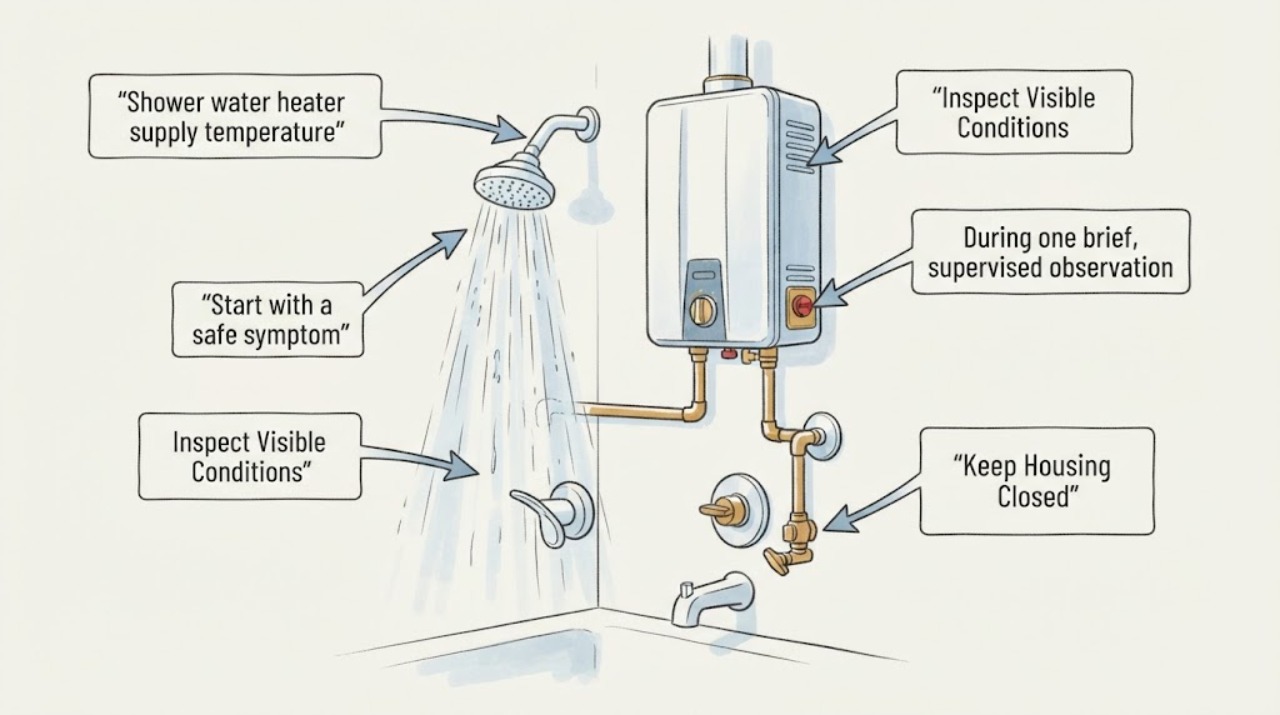
Work through in order
Diagnostic checks
Use only checks that match the exact appliance or system and its official guide.
-
Check 1
Start with a safe symptom log during normal shower use: note whether the water swings hotter, colder, or both; whether the flow changes at the same moment; how long after opening the shower the first swing occurs; and whether the handle was moved. Keep the shower off if the water is suddenly scalding or cold.
Expected result: The temperature change is a brief surge, a repeating hot-cold cycle, a gradual fade after a long draw, or an immediate change when the handle is touched; record any simultaneous flow change.
Next step: Use the pattern in the next checks. Stop and arrange service for a scalding or cold-shock event rather than trying repeated shower tests.
Why this matters
Why: A pressure-triggered surge, a shower-control response, and a gradual loss of hot supply are different patterns. The observation does not by itself identify a failed water-heater supply or cartridge.
-
Check 2
Without changing heater controls or opening any panel, compare a normal hot-water outlet elsewhere in the home with the shower at a similar time. Observe whether the other outlet also changes temperature, whether the shower alone fluctuates, and whether the home's hot water is otherwise available.
Expected result: Only the American Standard shower fluctuates, or the same hot-water change appears at multiple fixtures; note whether the shower's flow also changes.
Next step: Keep the distinction in the service record. Do not infer a heater repair from a shower-only result or infer a cartridge repair from a whole-home result.
Why this matters
Why: A shower-only symptom makes the shower valve, cartridge, spool, outlet, or local supply path more relevant. A matching change at several fixtures makes the upstream hot-water supply or water-heater operation more relevant than a shower-only part.
-
Check 3
During one brief, supervised observation, note whether the shower temperature changes when another person flushes a toilet or opens a nearby faucet, or when a household appliance normally takes water. Do not create a dangerous demand, alter valves, or continue if the shower becomes unsafe.
Expected result: The shower swings hotter or colder at the same time as the other fixture changes flow, the flow at the shower changes too, or no repeatable relationship is seen.
Next step: If the interaction is repeatable, report it as a pressure-related symptom for valve and supply diagnosis. Do not remove or adjust the balancing mechanism yourself.
Why this matters
Why: American Standard says a pressure-balance valve is intended to reduce temperature changes caused by hot or cold supply-pressure fluctuations. A repeatable fixture interaction makes that supply/pressure-balancing path more likely; no interaction keeps water-heater behavior, local restriction, or a control fault in consideration.
-
Check 4
If the shower has a tub spout, hand shower, or diverter, observe each normal outlet separately at the same handle setting and note whether the temperature swing follows one outlet or all of them. Do not unscrew the showerhead or diverter trim for this observation.
Expected result: The fluctuation occurs only in one outlet or diverter position, occurs at every outlet, or is accompanied by a broad flow reduction.
Next step: Record the affected outlet and position. Have a plumber evaluate the outlet, diverter, and valve in the model-specific order rather than replacing a water-heater component based on the shower symptom alone.
Why this matters
Why: One-outlet behavior makes an outlet or diverter flow path more relevant than the home's water heater. All-outlet behavior keeps the common shower valve and supply path in consideration; a flow reduction alongside temperature movement can also point to pressure-balancing response or restriction.
-
Check 5
Identify the American Standard shower trim family from visible labels, the handle or escutcheon markings, installation paperwork, or the home's records. Record any visible model text and whether the setup appears to use a pressure-balance or thermostatic control; do not remove the trim to look behind the wall.
Expected result: The model or trim family is clear, only a broad collection name is known, or no identification is available; do not assume a cartridge based on handle shape.
Next step: Give the model evidence and the symptom log to a qualified plumber. If identification is uncertain, request model-specific confirmation before any cartridge, thermostatic cartridge, or pressure-balancing spool is selected.
Why this matters
Why: American Standard's published trims and repair parts are tied to particular rough-in and cartridge arrangements. The exact model can change the safe service procedure and part compatibility.
-
Check 6
Inspect only visible, dry areas around the shower valve and water heater for active water, staining, unusual heat, smoke, combustion odor, or an electrical warning. Note whether the fluctuation remains after the safe comparisons; do not open heater covers or valve trim and do not adjust gas, electrical, or temperature controls.
Expected result: There is water at a wall or heater connection, a heater leak or combustion/electrical concern, an unsafe temperature swing, or a persistent fluctuation with no clear trigger.
Next step: Stop using the affected shower. If safe, keep clear of the area and use only an accessible, dry shutoff; arrange qualified plumbing or emergency service. Do not restart the heater or shower to test an unsafe condition.
Why this matters
Why: These conditions exceed user observation and can involve scalding, fire, shock, concealed water damage, or a failed shower or upstream control. A persistent unexplained symptom also needs model-specific diagnosis.
Use your observations
Decision map
Find the observation that best matches what you see, then follow the next safe action.
-
PATH 01Next step
What you see
The shower temperature changes when a toilet, faucet, washer, or dishwasher changes flow, and the shower flow changes at the same time.
Do this next
Keep the shower off if the swing is unsafe and provide the timing and affected fixtures to a qualified plumber for pressure-balance valve and supply evaluation. Do not remove the cartridge or spool.
Why this path and its safety boundary
Why it matters: A supply-pressure interaction is more likely than a water-heater-only diagnosis. American Standard describes pressure-balance valves as the shower-side response to this type of hot/cold pressure change.
-
PATH 02Next step
What you see
Several hot-water outlets change temperature during the same period, even when no other fixture is being used.
Do this next
Stop using the heater or affected fixtures for any leak, combustion, electrical, or scalding warning and arrange qualified service. Otherwise provide the whole-home pattern, timing, and heater type to the plumber without opening the heater.
Why this path and its safety boundary
Why it matters: The upstream hot-water supply or water-heater operation is more likely than a shower-only cartridge. The shower may be revealing a home-wide supply condition rather than causing it.
-
PATH 03Next step
What you see
Only one tub, hand-shower, or diverter outlet fluctuates while the other shower outlet is stable.
Do this next
Record the affected position and have a plumber inspect the model-specific outlet, diverter, and valve path. Do not dismantle the diverter or choose a part by appearance.
Why this path and its safety boundary
Why it matters: An outlet or diverter flow path is more likely than a whole-house water-heater supply problem. The common valve remains possible if the outlet test changes the flow path through it.
-
PATH 04Next step
What you see
The shower fluctuates from the first use, has reduced flow, or changes without a repeatable whole-home or fixture-use trigger, and the exact American Standard model is known.
Do this next
Give the model, trim family, outlet affected, flow observations, and symptom log to a qualified plumber. Ask for compatibility confirmation before any shower cartridge or pressure-balancing component is ordered.
Why this path and its safety boundary
Why it matters: A shower valve, pressure-balancing spool, cartridge, local restriction, or model-specific control issue is plausible, but the symptom does not prove which part is faulty.
-
PATH 05Next step
What you see
The water is scalding or suddenly cold, water is at the wall or heater, smoke or combustion odor is present, an electrical warning appears, or the symptom persists after safe observations.
Do this next
Stop using the shower and keep people away from the hazard. Use a reachable shutoff only if it is dry and safe, and obtain qualified plumbing or emergency help; do not open the heater, valve, or electrical covers.
Why this path and its safety boundary
Why it matters: Continued operation could cause injury, fire, shock, or concealed water damage; this is beyond user-observation troubleshooting.
Helpful context
Understand the symptom
Separate a shower-valve symptom from a water-heater symptom
The same hot-water complaint can have different paths. A change that follows a toilet flush, faucet opening, or appliance fill points toward supply-pressure interaction and the shower's pressure-balancing path. A change at several hot-water outlets with no relationship to other fixture use makes the upstream hot-water supply more relevant. A symptom limited to one shower outlet or diverter position is less evidence of a whole-house water-heater problem. These are observations for a service diagnosis, not proof that a cartridge or heater part has failed.
American Standard valve families are not interchangeable by appearance
American Standard publishes both pressure-balance and thermostatic rough-in choices, and its trim families use particular valve and cartridge arrangements. A pressure-balance cartridge page lists compatible rough-in families for that specific part, while a trim page identifies its own rough-in requirement. Record the visible trim name, markings, and paperwork instead of choosing a cartridge from a photo or from a similarly shaped handle.
Keep the check at user-observation level
Do not remove the handle, escutcheon, cartridge, pressure-balancing spool, showerhead, or water-heater panels for this check. Do not adjust a heater control, gas control, electrical cover, service stop, or concealed valve. A qualified plumber can isolate the shower valve from the upstream hot-water system after the symptom pattern is documented.
Safety boundary
Stop conditions
- Stop the shower immediately for scalding water, sudden cold shock, uncontrolled temperature swings, water at the wall or heater, smoke, combustion odor, arcing, or an electrical warning. Keep clear and obtain qualified or emergency help as appropriate.
- Do not remove the handle, escutcheon, cartridge, thermostatic cartridge, pressure-balancing spool, diverter, showerhead, or water-heater panels; do not adjust gas, electrical, service-stop, or concealed valve controls.
- Do not keep repeating a fixture-use test when the temperature is unsafe, a leak is active, or the heater shows an abnormal condition. Do not assume the shower symptom identifies a water-heater part.
Only after diagnosis
Potential parts
- shower cartridge
Consider this only if qualified diagnosis finds that the common shower control is causing the fluctuation and the exact trim and rough-in are confirmed.
American Standard cartridges vary by trim, rough-in family, and design. Confirm the exact model and technician diagnosis before selecting a part. - thermostatic shower cartridge
Consider this only when the installed American Standard control is confirmed to be thermostatic and qualified diagnosis identifies its cartridge as the fault.
Do not substitute a thermostatic cartridge for a pressure-balance design. Confirm the installed valve family and exact model first. - pressure-balancing spool
Consider this only when a repeatable supply-pressure-related fluctuation and qualified inspection point to the shower's pressure-balancing mechanism.
Pressure-balancing mechanisms and service procedures differ by American Standard rough-in and trim family. Confirm fit and safe installation with the exact model.
When checks do not resolve it
Need a professional?
Request a plumber for persistent or unsafe temperature fluctuation, a shower-only symptom that needs valve diagnosis, a whole-home hot-water change, an unidentified American Standard trim, or any leak or heater warning.
Safety scope: Keep the shower off for scalding or cold-shock swings, active or concealed-looking leaks, smoke, combustion odor, arcing, electrical warnings, or uncontrolled flow. Do not open heater or valve covers, bypass safety features, or perform live electrical or gas work.
Common questions
FAQ
Does a fluctuating shower temperature prove the water heater is failing?
No. Compare another hot-water outlet and note whether another fixture triggers the swing. A shower-only pattern points toward the shower valve or local path; a matching whole-home pattern makes the upstream hot-water supply more relevant.
What does an American Standard pressure-balance valve do?
American Standard describes it as responding to changes in hot and cold supply pressure so the shower temperature remains relatively constant and is less likely to change dramatically. It is intended to reduce, not guarantee the absence of, every temperature fluctuation.
Why does the shower get hotter when someone flushes a toilet?
A change in cold-water pressure can affect the hot-to-cold mix at a shower valve. American Standard says a pressure-balance valve is intended to reduce this effect. If the swing is severe or recurring, stop using the shower and have the valve and supply path evaluated.
Could a clogged showerhead cause temperature fluctuation?
A local flow restriction can change the observed flow and may alter how a valve behaves, but it does not prove the cause. Observe whether all outlets or only one are affected, and do not dismantle the outlet as part of this user-observation check.
How do I know whether my American Standard control is pressure balance or thermostatic?
Use the visible trim markings, installation records, and model documentation. American Standard publishes both types, and the rough-in and replacement parts are not interchangeable by appearance. Do not remove trim to identify the concealed valve.
Should I replace the shower cartridge for temperature swings?
Not based on temperature swings alone. First document whether the symptom is shower-only, whole-home, outlet-specific, or triggered by another fixture. A qualified plumber should confirm the American Standard valve family and diagnosis before selecting a cartridge or balancing component.
When is a fluctuating shower temperature an emergency?
Stop immediately for scalding or sudden cold shock, active water at the wall or heater, uncontrolled flow, smoke, combustion odor, arcing, or an electrical warning. Keep clear and obtain qualified or emergency help rather than repeating tests.
Read the exact guide
Official sources
- How Do I Choose a Rough-in Valve for my Shower?American Standard · American Standard pressure-balance versus thermostatic shower valve selection
- Serin® Shower Trim Kit, Double Ceramic Pressure Balance Cartridge With Lever HandleAmerican Standard · American Standard model-specific shower trim, ceramic balancing spool, integrated check valves, and rough-in requirement
- Temperature Control Pressure Balance Valve CartridgeAmerican Standard · American Standard pressure-balance cartridge function, integrated check valves, scald protection, and rough-in applicability
- What Does Pressure Balance Mean?American Standard · American Standard shower pressure-balance behavior and hot/cold supply pressure changes
Community feedback
Share a repair observation
Share a plain-text repair observation. Accepted observations are published automatically; this page may take a moment to update.