
On this page
Start here
Quick answer
First determine whether the temperature changes only at this shower or at other hot-water fixtures, and whether the change follows another water draw or the water heater cycling. A shower pressure-balancing or thermostatic cartridge, restricted flow, changing hot-water supply, mixing control, or a plumbing fault can produce similar symptoms. Keep checks to observation and normal controls: do not remove the trim, disassemble the valve, adjust the water-heater thermostat or pressure controls, or test hot water by exposing skin to it. Stop if water becomes scalding, cold enough to create a hazard, leaks, or the heater shows a fault.
Work through in order
Diagnostic checks
Use only checks that match the exact appliance or system and its official guide.
-
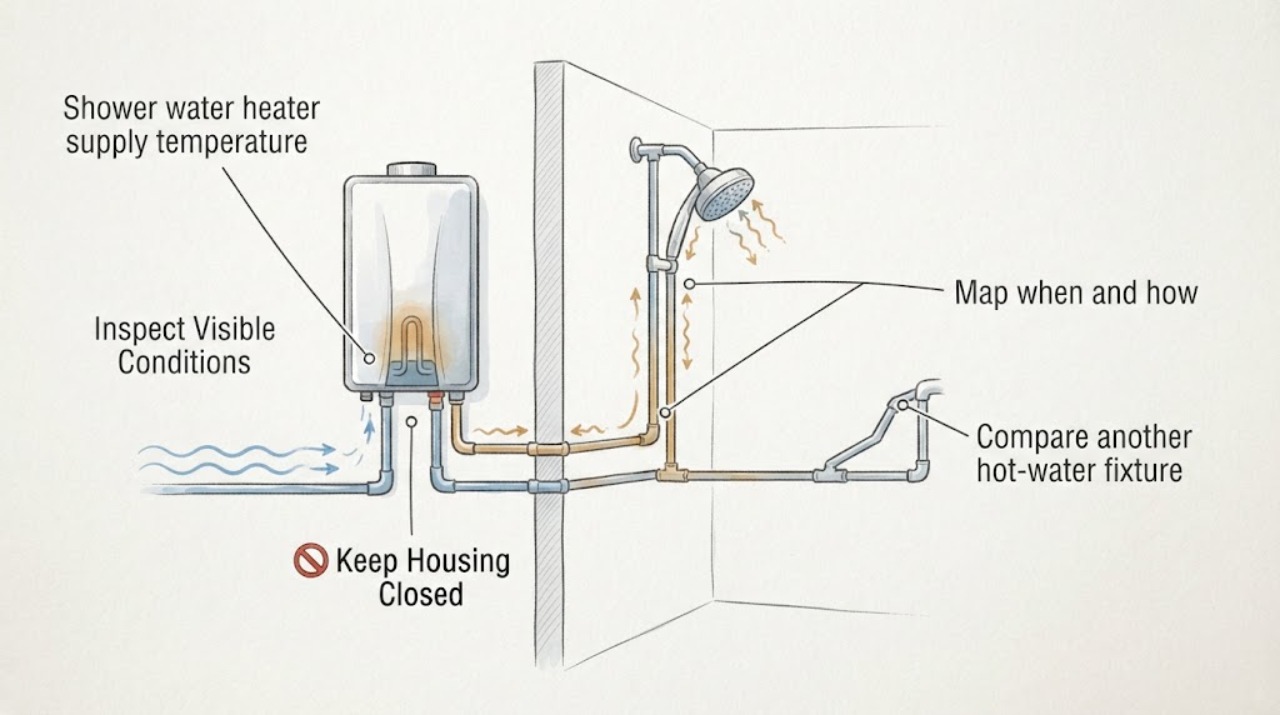
Map when and how the shower temperature changes
During one safe, ordinary shower with no deliberate load test, note the starting temperature, whether the change is gradual or abrupt, whether flow changes with it, and whether the event repeats at the same handle position. Stop the water instead of trying to chase a comfortable setting.
Expected result: The water alternates hot and cold, drifts in one direction, changes when flow changes, or fluctuates without an obvious flow change.
Next step: Write the sequence and approximate duration in a log, then compare it with the other-fixture check without changing the heater setting.
Stop if: Stop immediately for scalding heat, an unsafe cold shock, dizziness, electrical exposure, a leak, or water that cannot be controlled normally.
Why this matters
Why: A flow-linked swing makes pressure balance, supply flow, or the shower valve worth checking; a drift may point toward available hot-water recovery or mixing behavior. These are clues only and cannot identify a cartridge or heater fault.
-
Compare another hot-water fixture
At a nearby sink, briefly run hot water using the normal handle and a safe hand-held check away from your body. Note whether that fixture also changes temperature while no other person is using water; do not run multiple fixtures to provoke a swing.
Expected result: The sink stays steady while the shower fluctuates, or the sink and shower both fluctuate.
Next step: Record which fixtures were steady or affected, whether the change followed a toilet, washer, or dishwasher draw, and give that comparison to a plumber.
Stop if: Stop if any fixture delivers scalding water, loses control, leaks, or requires disassembly to inspect.
Why this matters
Why: A shower-only pattern points more toward the shower valve, cartridge, showerhead flow, or local supply path. A change at several fixtures points toward the heater, whole-home pressure, mixing, or hot-water distribution and should not be treated as a shower-cartridge diagnosis.
-
Observe the water heater without opening it
From outside the heater enclosure, note fuel or power type from the rating label if visible, error display or indicator, unusual noise, visible water, corrosion, and whether hot-water demand was recently high. Do not remove panels, touch wiring, operate a relief valve, adjust a thermostat, or drain the heater.
Expected result: No visible issue is present; the heater shows a fault; water or corrosion is visible; recovery seems limited after several ordinary uses; or the heater type and status are unknown.
Next step: Photograph only the exterior label or display if safe, keep the heater area clear, and report the observations to a plumber or water-heater professional.
Stop if: Stop for gas odor, a relief discharge, steam, active leaking, a hot enclosure, exposed electrical parts, smoke, or any pressure or temperature warning.
Why this matters
Why: EPA recommends visual leak and corrosion checks and notes that sediment and heater maintenance can affect operation. A heater fault or visible leak broadens the service scope beyond the shower valve; lack of a visible issue does not clear the supply.
-
Check visible shower flow and valve clues
Look at the showerhead spray, handle, escutcheon, and exposed pipe for scale, blockage, drips, loose trim, or water escaping at the wall. Note whether temperature changes when the handle is moved only within its normal range; do not remove the showerhead, trim, cartridge, stop, or balancing spool.
Expected result: The shower-only fluctuation occurs with weak or changing spray, the handle is loose or hard to control, there is a leak or scale, or the visible assembly looks normal.
Next step: Keep the valve at a safe setting, document the visible condition and shower type if known, and ask the plumber to assess the cartridge, balancing function, inlet screens, and local restrictions.
Stop if: Stop for water entering the wall, a loose valve body, a sharp or hot exposed surface, a handle that cannot shut the water off, or any need to disassemble the trim.
Why this matters
Why: DOE explains that an auto-compensating mixing valve must be designed for the shower flow rate to reduce significant fluctuations. Moen explains that pressure balancing responds to hot/cold flow changes and requires pressure on both sides; a local flow or valve clue therefore warrants professional inspection, not a guessed replacement.
-
Prepare the plumbing-service handoff
Compile the temperature-swing log, steady or affected fixtures, other water use at the time, heater exterior observations, visible shower-valve clues, recent plumbing or water-heater work, and whether the shower is single-handle, thermostatic, or unknown. State that no trim, cartridge, heater control, or pressure control was disturbed.
Expected result: The evidence points to a shower-only issue, a whole-home supply issue, a heater fault or leak, or an unresolved safety problem.
Next step: Request plumbing service and give the provider the observations in order. Keep the shower out of use if temperature control remains unreliable.
Stop if: Do not increase heater temperature, adjust a mixing valve or pressure regulator, remove trim, pull a cartridge, clean a spool, or open the water heater as part of this guide.
Why this matters
Why: A plumber can decide whether to test supply pressure and temperature, inspect the heater and mixing controls, identify the valve, or evaluate the cartridge without replacing a part solely from the symptom.
Use your observations
Decision map
Find the observation that best matches what you see, then follow the next safe action.
-
PATH 01Safety boundary
What you see
The sink remains steady while the shower changes temperature, especially when shower flow changes.
Do this next
Keep the shower unused if the swing is unsafe and request a plumber to identify the valve and inspect the pressure-balancing or thermostatic path, flow restriction, and local supply.
Why this path and its safety boundary
Safety stop: Do not remove the trim, cartridge, balancing spool, or showerhead to experiment.
-
PATH 02Safety boundary
What you see
The shower and another hot-water fixture change, or the swing follows another household water draw.
Do this next
Request plumbing or water-heater assessment of supply temperature, pressure, heater recovery, mixing controls, and distribution; provide the fixture comparison and timing.
Why this path and its safety boundary
Safety stop: Do not raise heater settings or adjust pressure controls to mask the symptom.
-
PATH 03Safety boundary
What you see
The heater has an indicator fault, active leak, corrosion, relief discharge, gas odor, or another visible abnormality.
Do this next
Stop using affected equipment as appropriate, keep clear of the area, and request prompt water-heater/plumbing service; follow emergency guidance for gas or electrical hazards.
Why this path and its safety boundary
Safety stop: Do not open the heater, operate the relief valve, touch wiring, or attempt combustion or pressure diagnosis.
-
PATH 04Safety boundary
What you see
Temperature remains unpredictable, becomes scalding or dangerously cold, or the source cannot be safely observed.
Do this next
Stop using the shower and arrange professional inspection with the log and photographs.
Why this path and its safety boundary
Safety stop: Do not continue bathing, repeatedly adjust the handle, or ask a child or vulnerable person to test it.
Helpful context
Understand the symptom
Temperature that swings during a shower is a safety and comfort problem, but the phrase water-heater supply does not by itself identify the failed part. A pressure-balancing valve responds to changes in hot and cold flow, while the heater, piping, other fixtures, and shower valve can each affect the temperature that reaches the outlet. DOE guidance says an auto-compensating mixing valve can reduce significant pressure and temperature fluctuations when it is designed for the shower flow rate.
Begin with a short observation log rather than turning the heater hotter. Compare the shower with a nearby faucet only when doing so is safe, note whether another fixture is used, and document visible leaks or heater indicators from the outside. The purpose is to separate a shower-only pattern from a whole-home hot-water or pressure pattern so a plumber can choose the right inspection.
Prevent a scald before testing
Do not put a child, older adult, or anyone with reduced temperature sensation under a fluctuating stream. Test only by a safe hand-held method away from the body, and stop the shower if the water becomes suddenly very hot or cold. Do not increase the heater setting to compensate: EPA warns that hot water at a shower can present a scalding risk, and heater and mixing-valve adjustments belong to the appropriate product instructions or a professional.
Only after diagnosis
Potential parts
- shower cartridge
Consider this category only after the valve model and failure mode are identified; a whole-home supply or heater problem will not be corrected by a shower cartridge.
Match the exact valve family and cartridge specification, and follow professional isolation and installation procedures. Do not remove the existing cartridge from this observation guide. - thermostatic shower cartridge
A thermostatic cartridge is relevant only when the installed valve is confirmed to be thermostatic and its control path is diagnosed as the cause.
Confirm the valve, temperature range, flow conditions, and manufacturer requirements before any replacement; do not use it as a generic pressure-balancing substitute. - pressure-balancing spool
A balancing spool may be relevant when the shower-only swing tracks pressure changes, but supply pressure, debris, valve design, and heater behavior must be checked first.
Match the exact valve and approved service method; do not remove, soak, lubricate, or alter the spool based only on a temperature symptom.
When checks do not resolve it
Need a professional?
Request plumbing service for a repeatable shower temperature fluctuation, a shower-only or whole-home hot-water pattern, a suspected cartridge or balancing issue, a heater fault, or visible leakage. Escalate promptly for scalding, sudden cold shock, gas odor, active heater leakage, or a water stream that cannot be controlled.
Common questions
FAQ
Does a fluctuating shower prove the water heater is failing?
No. A shower valve, flow restriction, pressure change, heater, mixing control, or distribution issue can produce a similar symptom. Compare another fixture and provide the pattern to a plumber.
Can flushing a toilet make a shower change temperature?
It can reveal a pressure-balance or supply response, but it does not identify the failed component. Record whether the change follows another water draw and do not intentionally provoke an unsafe swing.
Should I turn up the water-heater thermostat?
No. A higher setting can increase scald risk and may not fix the cause. Leave adjustments to the product instructions and a qualified professional after the supply and mixing path are assessed.
Could a shower cartridge cause temperature swings?
It is one conditional possibility, particularly when other fixtures are steady, but the cartridge cannot be identified or replaced safely from the temperature symptom alone. Keep the trim closed and request plumbing diagnosis.
When should I call a plumber?
Call when the temperature swing repeats, affects multiple fixtures, follows plumbing work, or comes with a leak, heater fault, poor control, or unsafe heat. Stop using the shower for a sudden scalding or cold shock.
Read the exact guide
Official sources
- Home MaintenanceU.S. Environmental Protection Agency WaterSense · Supports visual-only observations of heater leaks, corrosion, service pressure context, and directing water-heater maintenance to the manual or a professional.
- Best Management Practice #7: Faucets and ShowerheadsU.S. Department of Energy · Supports explaining that a properly designed thermostatic or pressure-balancing mixing valve can reduce pressure and temperature fluctuation and that supply pressure matters.
- What is meant by pressure-balancing tub and shower faucet?Moen · Supports distinguishing a shower valve's response to changing hot and cold flow from a water-heater diagnosis.
Community feedback
Share a repair observation
Share a plain-text repair observation. Accepted observations are published automatically; this page may take a moment to update.