
On this page
Start here
Quick answer
If a Delta shower's flow is steady but the water turns noticeably hotter and colder, first determine whether the change also affects another faucet or happens when a toilet, washer, or other fixture uses water. A whole-home change points to the hot-water supply, pressure, or plumbing; a shower-only change makes the Delta mixing valve, pressure-balance or thermostatic cartridge, mineral buildup, or temperature setting more likely. Check the Delta handle or temperature control for normal operation and inspect the visible showerhead and trim for blockage or damage, but do not remove the cartridge, alter the anti-scald stop, open the wall, or work on the water heater as a guess. Stop for a scalding change, leak, or unsafe access and arrange a licensed plumbing diagnosis.
Before you begin
Safety first
- This article supports safe comparison of outlets, front-panel control observation, visible showerhead inspection, and documentation only. It does not authorize cartridge removal, limit-stop changes, water-heater adjustment, concealed plumbing access, or unsafe temperature testing.
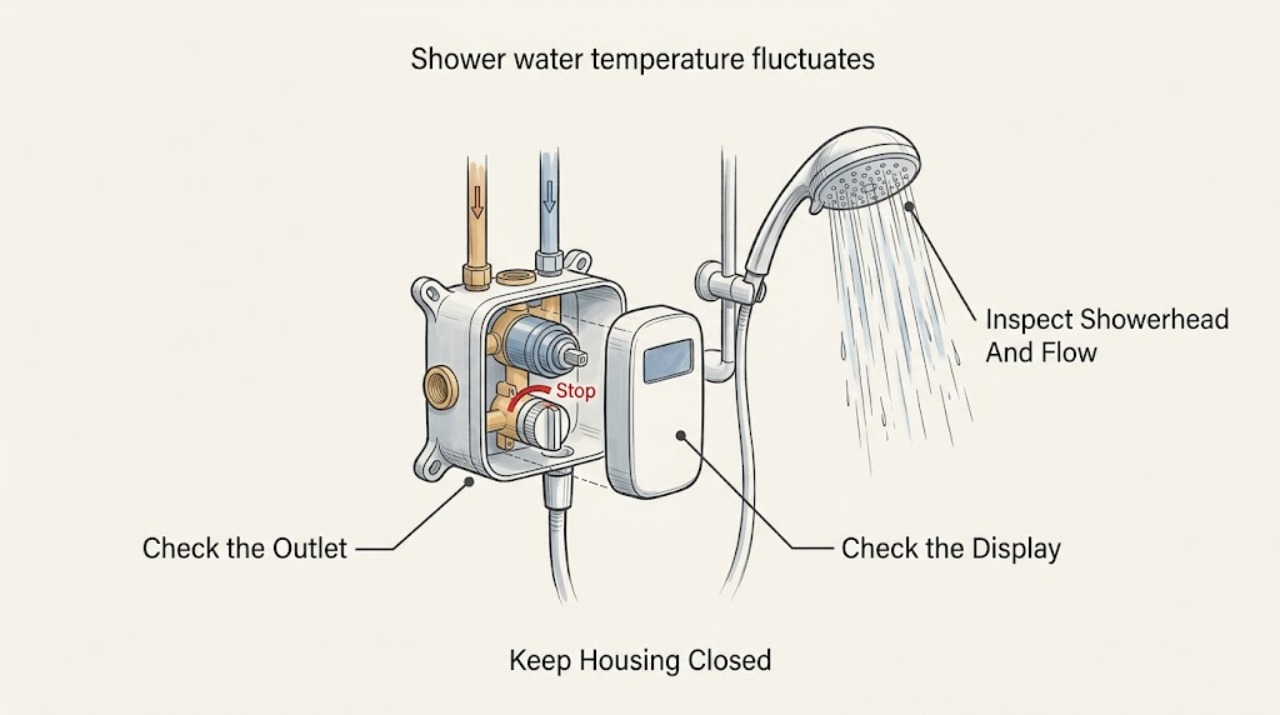
Work through in order
Diagnostic checks
Use only checks that match the exact appliance or system and its official guide.
-
Check 1
Run the affected Delta shower at a safe, steady flow and compare its temperature with a nearby faucet or another shower; without changing the shower controls, note what happens when a toilet is flushed or another fixture begins using water.
Expected result: Only the Delta shower fluctuates, several fixtures fluctuate together, or the shower changes when another fixture runs and its flow also changes.
Next step: Record the fixture comparison and timing. Keep the shower at a safe setting and arrange plumbing service when the change is abrupt, recurring, or not isolated to the shower.
Stop if: Stop using the shower for a scalding or chilling change, a leak, or any need to reach behind the trim or access the water heater.
Why this matters
Why: A shower-only change makes the Delta valve, cartridge, or trim more likely. A change across fixtures or one that tracks another fixture's demand points toward supply pressure, hot-water production, or building plumbing; a simultaneous flow change supports a pressure-related event.
-
Check 2
From the front of the shower, operate the Delta handle or separate temperature control gently through its normal range and check whether it moves smoothly, remains in position, and clearly controls temperature or volume as expected for the installed trim.
Expected result: The control is loose, stiff, difficult to turn, does not hold its setting, has an uncertain function, or moves normally while temperature still drifts.
Next step: Photograph the trim, identify the Delta series or model if safely available, and arrange model-specific plumbing service when the control is abnormal or the temperature continues to drift.
Stop if: Do not remove the handle, cover, sleeve, bonnet, cartridge, or rotational limit stop, and do not force a seized control.
Why this matters
Why: A loose, stiff, or confusing control can indicate trim or cartridge wear and should not be forced. A normal control with persistent drift makes an internal balancing or thermostatic cartridge, supply, or hot-water issue more likely.
-
Check 3
Inspect the visible showerhead face, connection, and trim for scale, blocked openings, damage, or a leak, without disassembling the valve or reaching into the wall; note whether the water temperature changes while the flow remains normal.
Expected result: The showerhead is visibly scaled or damaged, the connection leaks, flow changes with temperature, or the head and flow appear normal.
Next step: Clean or replace only through the showerhead manufacturer's ordinary care instructions and only after the leak is isolated; arrange a plumber when the valve or trim is involved or the temperature remains unstable.
Stop if: Do not drill openings, remove an internal flow-control component, overtighten the connection, or use a leaking fixture near the wall.
Why this matters
Why: A blocked or damaged head can change the hydraulic conditions seen by a mixing valve, but a normal-flow head with temperature drift keeps the valve, cartridge, and supply checks in focus. A leak requires repair before continued use.
-
Check 4
From safe access, compare the bathroom sink's hot-water behavior with the shower and note whether the shower is the first hot-water draw, whether hot water runs out, and whether other hot-water fixtures remain stable; do not adjust or open the water heater.
Expected result: The sink and shower both fluctuate, hot water is limited across the home, only the shower fluctuates, or the supply remains stable but the shower still drifts.
Next step: Document the outlet comparison and arrange the appropriate licensed plumbing or water-heater service; keep the shower temperature low enough to avoid a sudden scald if it must be used before diagnosis.
Stop if: Do not change water-heater controls, open a heater, adjust a mixing valve, or continue bathing through an abrupt temperature change.
Why this matters
Why: Whole-home hot-water instability points away from a Delta-only cartridge and toward the water heater, supply, or plumbing. Stable hot water at the sink with shower-only drift makes the shower valve or cartridge more likely.
-
Check 5
Record the Delta trim series or model from visible documentation, installation date if known, hard-water or scale history, cartridge replacement history, recent plumbing work, and whether the fluctuation began after a repair; do not remove the cartridge to inspect it.
Expected result: Mineral buildup is common, the valve is older or has a prior cartridge history, the issue began after plumbing work, or there is no clear history.
Next step: Give the model or series, history, and symptom pattern to a licensed plumber and ask them to verify the cartridge and valve compatibility before replacement or cleaning.
Stop if: Do not soak, remove, or substitute a cartridge without safe water shutoff, exact model instructions, and the experience to complete the repair without exposing the wall to water damage.
Why this matters
Why: Delta identifies mineral deposits as one possible reason a pressure-balance mixing component may stop working properly. A recent repair can also raise an alignment, part-selection, or supply question, but history alone cannot prove the cartridge is the cause.
-
Check 6
If a licensed plumber or exact Delta instructions are available, have the hottest outlet condition and adjustable limit-stop setting evaluated with a suitable thermometer and safe procedure; do not change the stop based on a guess or a hand-only estimate.
Expected result: The maximum temperature is stable but incorrectly limited, the outlet temperature itself fluctuates, or the limit stop and exact valve series cannot be identified.
Next step: Leave the current setting unchanged until the valve series, local safety requirements, and hottest outlet condition are verified; arrange licensed plumbing service for any limit-stop, cartridge, or valve work.
Stop if: Do not expose anyone to a hot-water test, remove trim, alter the anti-scald stop by tooth count, or continue use when the hottest setting is unsafe or uncertain.
Why this matters
Why: A stable but undesired maximum temperature is a limit-stop or supply-setting question, not the same as temperature drift. Fluctuation at a fixed control position suggests the balancing or thermostatic function or the supply, while an unknown valve needs identification before adjustment.
Use your observations
Decision map
Find the observation that best matches what you see, then follow the next safe action.
-
PATH 01Safety boundary
What you see
The Delta shower and another hot-water outlet fluctuate together, especially when another fixture runs, or flow and temperature change at the same time.
Do this next
Arrange licensed plumbing or water-heater diagnosis and provide the fixture comparison and timing; avoid using the shower if the change can scald or chill you.
Why this path and its safety boundary
Why it matters: Hot-water production, supply pressure, a shared plumbing restriction, or building piping is more likely than a shower-only cartridge problem.
Safety stop: Do not open the water heater, adjust a pressure regulator, or change supply valves as a test.
-
PATH 02Safety boundary
What you see
The sink's hot water and the shower flow remain stable, but the Delta shower temperature drifts at a fixed control position.
Do this next
Identify the exact Delta series and have a licensed plumber diagnose the cartridge and valve before cleaning or replacement.
Why this path and its safety boundary
Why it matters: The Delta pressure-balance or thermostatic cartridge, mineral deposits, valve body, or trim/control relationship is more likely.
Safety stop: Do not remove the cartridge, alter the limit stop, or order a visually similar part without model verification.
-
PATH 03Safety boundary
What you see
Temperature changes are accompanied by a noticeable flow change or occur when another outlet opens or closes.
Do this next
Record which fixture triggers the event and have plumbing service evaluate both hot and cold supply pressure and the Delta valve; do not compensate by repeatedly adjusting the handle.
Why this path and its safety boundary
Why it matters: The pressure-balancing function may be responding to a supply event, but a restricted supply, valve, or cartridge can also create unstable mixing.
Safety stop: Stop for a sudden hot surge, leak, or pressure event that makes bathing unsafe.
-
PATH 04Safety boundary
What you see
The shower is the only affected outlet, flow is otherwise normal, and the valve has hard-water history, mineral residue, age, or a prior cartridge concern.
Do this next
Provide the series, trim photo, history, and symptom record to a licensed plumber and ask for model-specific cartridge assessment and safe isolation.
Why this path and its safety boundary
Why it matters: Mineral deposits or a worn pressure-balance or thermostatic cartridge become plausible, but the exact Delta series still controls the repair.
Safety stop: Do not soak or remove an internal cartridge, force the stem, or substitute a generic cartridge without verified compatibility.
-
PATH 05Safety boundary
What you see
The maximum temperature is consistently too hot or too cool, but it does not drift while the control remains fixed.
Do this next
Have the valve series and hottest outlet condition verified against Delta and local plumbing guidance before any adjustment; use a licensed plumber if inexperienced.
Why this path and its safety boundary
Why it matters: A rotational limit-stop or supply-temperature setting may be involved; this differs from a fluctuating temperature and has scald implications.
Safety stop: Do not turn the limit stop by guesswork or expose a bather to an unverified hottest setting.
-
PATH 06Safety boundary
What you see
The water suddenly becomes scalding or very cold, the shower leaks at the trim or wall, the control is seized, or the valve identity is unknown and access would require opening the wall.
Do this next
Stop bathing, isolate water if it can be done safely, protect the area from damage, and arrange licensed plumbing service.
Why this path and its safety boundary
Why it matters: This is a safety and professional-service boundary, not an adjustment opportunity.
Safety stop: Do not keep testing with a person under the shower, remove trim, or reach into a concealed valve cavity.
Helpful context
Understand the symptom
Separate a supply-wide temperature change from a shower-valve problem
Keep the shower flow at a safe, comfortable level and note whether the temperature changes when another fixture is used. If a sink or another shower also changes, the cause may be water-heater recovery, building pressure, a supply restriction, or a plumbing event. If other fixtures remain stable while the Delta shower changes, the shower valve's balancing or thermostatic cartridge, mineral deposits, or trim setting becomes the more focused path. Stable flow does not rule out a valve that is failing to blend temperature correctly.
Understand what Delta's valve can and cannot correct
A Delta pressure-balance valve responds to changes in hot and cold pressure, while a thermostatic valve monitors the outlet temperature and adjusts the mix. Those mechanisms can reduce sudden temperature changes, but they cannot correct a closed supply, a failing water heater, severe mineral deposits, a damaged cartridge, or a valve that is not suited to the installed trim. The exact Delta series and cartridge identity matter, so do not order a cartridge from the trim appearance alone.
Check only the accessible controls and showerhead
From ordinary access, verify that the handle or separate temperature control moves normally and that the visible showerhead face is not damaged or obstructed. A temperature limit stop may cap the maximum temperature, but changing it does not repair temperature fluctuation and can create a scalding risk if set incorrectly. Do not remove the handle or cartridge, loosen the bonnet, open the wall, or change the water heater setting unless the exact instructions and a qualified plumber support that work.
When the fluctuation persists, preserve the evidence for service
Record whether the temperature changes immediately or after the shower has run, whether it tracks another fixture, whether the flow changes at the same time, and whether the bathroom sink remains stable. Photograph the Delta trim and any leak or mineral residue, and keep the model or series information if available. Persistent shower-only fluctuation with normal flow is a valve or cartridge diagnosis, not proof that a generic replacement part will fit.
Safety boundary
Stop conditions
- Stop using the shower for a sudden scalding or chilling change, a leak at the trim or wall, or water damage; isolate the water supply only through safe, accessible controls.
- Do not remove the handle, trim, sleeve, bonnet, cartridge, or valve body, open the wall, or work on a concealed supply without the exact Delta instructions, safe shutoff, and appropriate plumbing experience.
- Do not alter the anti-scald or rotational limit stop by guesswork, expose a bather to an unverified hottest setting, or use hand temperature alone as proof of safety.
- Do not adjust the water heater, pressure regulator, supply valves, or plumbing connections as a trial, and do not order a cartridge from trim appearance alone.
- Arrange licensed plumbing service when the temperature fluctuates at a fixed control position, the flow or other outlets also change, mineral buildup or a cartridge fault is suspected, or the cause cannot be isolated safely.
Only after diagnosis
Potential parts
- Delta pressure-balance or thermostatic cartridge
Consider this category only when a licensed plumber confirms a shower-only temperature-drift problem caused by the cartridge after supply, control, and showerhead checks.
Confirm the exact Delta series, valve body, trim configuration, revision, and manufacturer fit information before ordering; do not rely on visual similarity. - Delta cartridge seal or valve service component
Consider this category only when service diagnosis identifies mineral-damaged or worn seals during a model-specific cartridge repair and the valve body remains suitable.
Confirm the exact Delta valve and seal arrangement and use the manufacturer's repair procedure; safe water isolation and leak testing are required. - Delta showerhead screen or showerhead assembly
Consider this category only when visible scale, debris, damage, or a leak at the showerhead is shown to affect flow or the pressure conditions at the valve.
Confirm the exact showerhead model and connection, and preserve any required flow-control parts; do not drill openings or overtighten a connection.
When checks do not resolve it
Need a professional?
Arrange licensed plumbing service for persistent Delta shower temperature fluctuation, shower-only drift with normal flow, a suspected pressure-balance or thermostatic cartridge problem, mineral buildup that needs internal access, a limit-stop or water-heater question, or any leak. Treat sudden scalding or chilling, a leak into the wall, inability to shut off water safely, or any need to open the wall or alter concealed plumbing as an urgent stop condition.
Safety scope: This article supports safe comparison of outlets, front-panel control observation, visible showerhead inspection, and documentation only. It does not authorize cartridge removal, limit-stop changes, water-heater adjustment, concealed plumbing access, or unsafe temperature testing.
Common questions
FAQ
Why does my Delta shower water temperature fluctuate when the flow is normal?
A shower-only fluctuation can involve the Delta pressure-balance or thermostatic cartridge, mineral deposits, a control or limit-stop issue, or a supply problem that does not noticeably change flow. Compare another hot-water outlet and note whether another fixture triggers the change before arranging a licensed plumbing diagnosis.
Can another faucet make a Delta shower turn hot or cold?
Yes. Opening another fixture can change hot or cold supply pressure. A pressure-balance valve is designed to reduce that effect, but a whole-home supply issue or a valve or cartridge that is not balancing correctly can still cause fluctuation. Stop for an abrupt scalding change and have the supply and valve evaluated.
Could mineral buildup cause a Delta shower to fluctuate?
Delta identifies mineral deposits as one possible reason a pressure-balance mixing component may not work properly. Mineral history makes a cartridge or valve check reasonable, but do not remove or soak the cartridge without exact series instructions, safe shutoff, and appropriate plumbing experience.
Is the temperature limit stop the same as a fluctuating temperature problem?
No. A limit stop can restrict the maximum temperature, while fluctuation means the water changes while the control remains in one position. Do not change the stop by guesswork; incorrect adjustment can create a scald risk and should be verified against the exact Delta series and local requirements.
When should I call a plumber for a Delta shower temperature problem?
Arrange licensed plumbing service when the temperature drifts at a fixed setting, other outlets or fixtures affect it, the valve has mineral or cartridge history, the trim leaks or is seized, the water heater may be involved, or any repair requires cartridge, limit-stop, valve, or concealed plumbing access.
Read the exact guide
Official sources
- How do I set the adjustable rotational limit stop on my bath or shower?Delta Faucet · Official Delta Faucet guidance for adjustable shower temperature limits and safety verification; model series and local plumbing requirements control.
- Interchangeable Shower Valve with MultiChoice® TechnologyDelta Faucet · Official Delta Faucet product and technology explanation for pressure-balanced and thermostatic tub and shower valves.
- The water in the shower is either hot or cold; I cannot get any temperature in between. What is wrong?Delta Faucet · Official Delta Faucet support guidance for a shower that cannot blend hot and cold water normally; exact valve series and safe shutoff control repair.
- How can I make sure my shower is safe?Delta Faucet · Official Delta Faucet safety guidance for tub and shower temperature control and anti-scald protection.
Community feedback
Share a repair observation
Share a plain-text repair observation. Accepted observations are published automatically; this page may take a moment to update.