
On this page
Start here
Quick answer
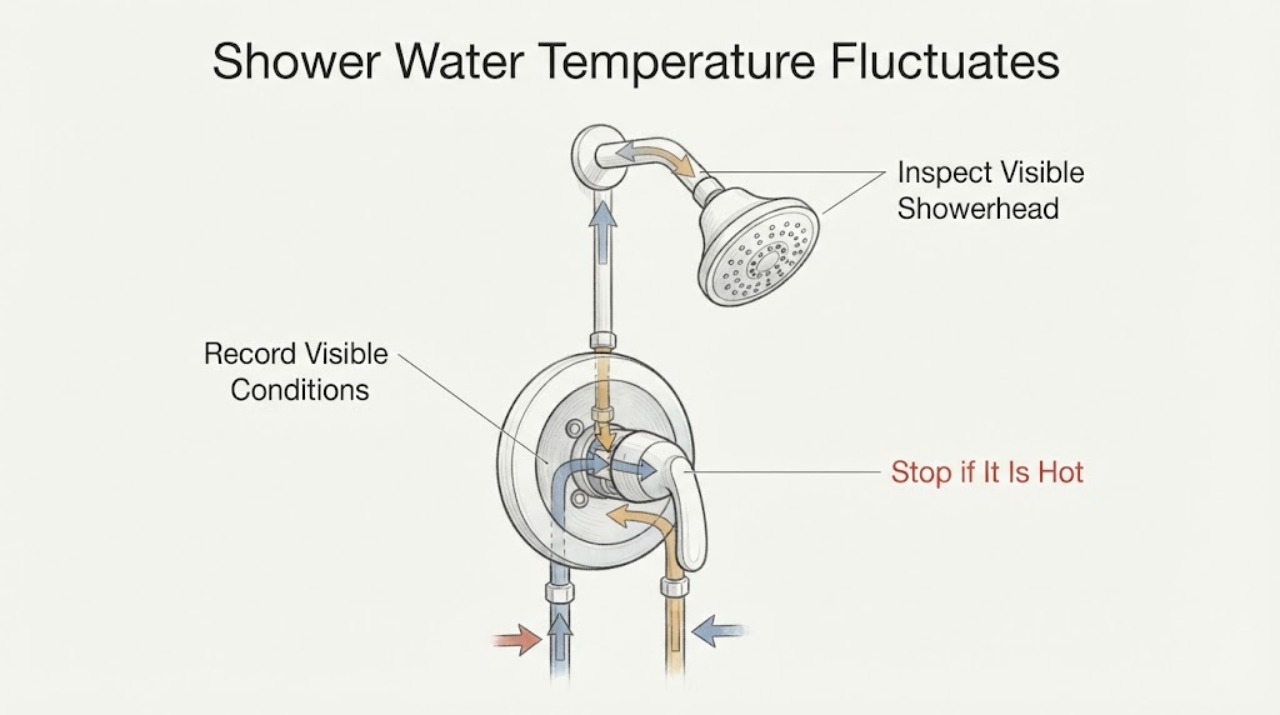
Start by noting whether the American Standard shower swings hot and cold when another fixture runs, only when flow changes, or even with no other demand. American Standard explains that pressure-balancing valves are designed to reduce temperature changes caused by hot or cold pressure fluctuations, while thermostatic valves use a wax element to maintain a selected temperature. If the fluctuation affects only this shower, a clogged showerhead, uneven supply through the valve, mineral debris, a cartridge or check-valve issue, or a model-specific setting is more likely. Brush or clean only an accessible showerhead feature covered by the exact model instructions, and do not remove the valve, cartridge, check valves, or hot-limit stop as a trial repair. Stop using the shower for scalding swings, a leak, failed shutoff, or uncontrolled flow, and arrange qualified plumbing service when the symptom persists.
Work through in order
Diagnostic checks
Use only checks that match the exact appliance or system and its official guide.
-
Check 1
During one brief, comfortable-temperature shower, note when the water changes: at startup, when the shower volume changes, when another fixture opens or flushes, after several minutes, or without any obvious trigger. Do not keep using the shower if the swing becomes scalding or cold enough to create a fall risk.
Expected result: The swing follows another fixture; follows a change in shower flow; occurs only after warm-up; or appears randomly with no other demand.
Next step: Record the timing and proceed to the fixture comparison. Do not compensate by setting the handle to an extreme temperature or by repeatedly cycling the valve.
Stop if: Stop immediately for a scalding swing, a persistently cold or hot stream, a leak, uncontrolled flow, or any symptom that makes standing in the shower unsafe.
Why this matters
Why: A correlation with another fixture makes supply-pressure interaction more likely. A change with shower flow suggests the valve, cartridge, check path, or a restricted outlet. A delayed or random swing makes a supply-temperature, valve-control, or internal component issue more plausible than a single spray nozzle alone.
-
Check 2
Compare the affected shower with another shower or tub outlet and a nearby hot and cold faucet. If the shower controls allow a separate comparison, note whether the hot side, cold side, or both change when another fixture runs. Keep the test brief and at a safe temperature.
Expected result: Only the American Standard shower fluctuates; several outlets fluctuate; hot supply changes elsewhere too; or one shower temperature side is consistently weaker or less stable.
Next step: Use the observed pattern to choose a branch. Arrange plumbing diagnosis rather than changing a valve setting when several fixtures or an entire hot-water supply are affected.
Stop if: Stop for a failed fixture shutoff, exposed pipe damage, active water leak, unsafe temperature, or a supply problem that cannot be isolated safely.
Why this matters
Why: A shower-only symptom points toward the showerhead, valve, cartridge, check valves, or local supply path. Changes at several fixtures point upstream to building supply, a water heater, or a shared valve. A difference on one side makes a restricted supply, screen, check path, or cartridge imbalance more likely.
-
Check 3
With the water off, inspect the visible American Standard showerhead, spray face, and hose for mineral scale, blocked nozzles, kinks, or a damaged seal. Clean only an accessible surface or screen using the exact product instructions; do not insert a sharp tool, remove a concealed flow part, or open the wall valve.
Expected result: The spray pattern is visibly restricted; the hose is kinked or damaged; the head and hose look clear; or checking the inlet screen would require disassembly not described for the exact model.
Next step: Correct only a plainly visible kink or model-approved external cleaning issue, then repeat the brief temperature comparison. If the fluctuation remains, preserve the model information and continue with service-boundary checks.
Stop if: Stop if the head or hose leaks, the wall connection moves, threads are damaged, or further cleaning requires removing a concealed part or pressurized connection.
Why this matters
Why: A local outlet restriction can disturb flow and make a pressure-balancing or thermostatic valve behave differently, especially when only one outlet is affected. A clear external path shifts attention toward the valve, cartridge, supply, or check components.
-
Check 4
Identify whether the trim is paired with an American Standard pressure-balancing or thermostatic rough-in valve using the visible trim, product label, or installation paperwork. Check the exact manual for documented integrated stops, a hot-limit safety stop, or a user-accessible temperature calibration procedure. Do not turn a hidden adjustment or remove the handle as a guess.
Expected result: The valve type and model are known; only the trim is known; the hot-limit stop or calibration setting appears altered; or the valve and model cannot be identified.
Next step: Follow only the exact model's documented user adjustment, if any, and record the original setting before a qualified technician changes it. If the model is unknown or internal access is needed, arrange service instead of experimenting.
Stop if: Do not bypass or defeat an anti-scald stop, remove a cartridge or check valve, loosen valve-body connections, or continue if the setting could create a scalding condition.
Why this matters
Why: Pressure-balancing and thermostatic systems respond differently to supply changes, and American Standard's calibration component is explicitly model-dependent. An altered stop can limit hot water but does not by itself prove why temperature is fluctuating.
-
Check 5
Record the complete American Standard model or trim identifier, valve type if known, timing of the temperature swings, fixture comparison, hot/cold pattern, showerhead condition, recent plumbing or water-heater work, leaks, and any visible stop or calibration information. Photograph only labels and visible conditions without removing trim or panels.
Expected result: Temperature remains unstable after safe external checks; multiple fixtures are affected; a hot-limit, cartridge, check valve, or supply restriction is suspected; or there is a leak or recent installation change.
Next step: Stop using the shower if the temperature is unsafe and arrange qualified plumbing service. Provide the model and the recorded timing so the technician can use the correct American Standard documentation.
Stop if: Do not disassemble the valve, test live or pressurized connections, bypass an anti-scald feature, or repeatedly reset the water-heating or plumbing system to hide the symptom.
Why this matters
Why: The remaining diagnosis may require supply measurement, valve isolation, cartridge or check-valve inspection, temperature calibration, or water-heater evaluation. Those actions are model- and installation-specific and cannot be selected reliably from the symptom alone.
Use your observations
Decision map
Find the observation that best matches what you see, then follow the next safe action.
-
PATH 01Next step
What you see
Do this next
Check whether another fixture has the same hot or cold change and record which supply side moves. Arrange plumbing service if the effect is strong, new, or affects multiple outlets; do not increase the hot limit.
Why this path and its safety boundary
Why it matters: Relative hot or cold supply pressure is changing. A pressure-balancing valve is designed to reduce this effect, but a restriction, failed cartridge or diaphragm, check-path issue, or upstream supply problem can still require diagnosis.
-
PATH 02Next step
What you see
Do this next
Perform only the visible showerhead and hose check allowed by the model instructions. If the pattern remains, use the model identifier for qualified valve diagnosis rather than opening the wall or removing the cartridge.
Why this path and its safety boundary
Why it matters: The local outlet, hose, diverter, supply screen, valve path, or pressure-balancing or thermostatic control is more likely than a whole-building temperature problem.
-
PATH 03Next step
What you see
Do this next
Record whether the same side is affected at a nearby faucet and arrange plumbing diagnosis. Do not reverse connections, remove check valves, or adjust hidden stops.
Why this path and its safety boundary
Why it matters: A supply-side restriction, water-heater issue, shutoff, screen, check valve, or cartridge imbalance is more likely than a simple temperature-handle setting.
-
PATH 04Next step
What you see
Do this next
Stop if the swing is unsafe, record the duration and whether the water heater or other hot fixtures behave similarly, and arrange qualified service for valve and supply diagnosis.
Why this path and its safety boundary
Why it matters: The valve's cartridge or thermostatic element, a check path, supply temperature, hot-water recovery, or a concealed restriction may be involved. A single external showerhead check is unlikely to explain every pattern.
-
PATH 05Next step
What you see
Do this next
Stop using the shower, isolate the correct supply only if it is known and safe, protect nearby finishes, and obtain qualified plumbing help. Seek urgent help for active water damage or an uncontrollable leak.
Why this path and its safety boundary
Why it matters: A damaged seal, valve body, cartridge, check component, supply connection, or installation condition may be involved. Safe operation matters more than further diagnosis.
Helpful context
Understand the symptom
The timing of the swing is the most useful first clue
A temperature change that occurs when a toilet, washer, or faucet starts can reflect a pressure change in one supply line. A swing that occurs when the shower volume changes, or that continues with no other fixture running, points more toward the shower valve, cartridge, check path, showerhead restriction, or a model-specific temperature setting. American Standard distinguishes pressure-balancing valves from thermostatic valves, so identify the installed valve type from the trim, manual, or visible product information before assuming a repair.
Pressure balance and thermostatic control are not interchangeable diagnoses
American Standard says its pressure-balancing cartridge responds to relative hot and cold supply pressure, while its thermostatic products use a wax unit and spring-loaded check valves. A pressure-balancing valve may not correct a supply temperature problem, and a thermostatic valve may still fluctuate if a supply is restricted, a check path is compromised, or the cartridge has debris. The exact American Standard installation instructions control any internal service or calibration.
Use external observations and model identification before touching the valve
Inspect the visible showerhead for mineral buildup or an altered spray pattern, and note whether the temperature changes with the head removed only if the exact product instructions explicitly allow that check. Do not use the symptom to choose a cartridge or calibration piece. American Standard's calibration-unit page specifically says to check the particular model for compatibility, which is why a complete model or trim identifier matters before parts or settings are considered.
Safety boundary
Stop conditions
- Stop using the shower for a scalding or freezing swing, uncontrolled flow, active wall or ceiling water damage, a failed shutoff, or a leak that cannot be isolated safely.
- Do not remove the valve, cartridge, check valves, concealed screens, or pressurized connections as a trial repair.
- Do not bypass or defeat the anti-scald or hot-limit stop, reverse hot and cold connections, or apply a calibration procedure from another American Standard model.
- Do not use sharp tools, aggressive chemicals, or force on the showerhead, trim, hose, or valve connections; stop if threads, seals, or wall fittings appear damaged.
- Arrange qualified service when fluctuation persists after approved visible checks, affects multiple fixtures, or requires supply measurement, internal valve diagnosis, water-heater diagnosis, or model-specific calibration.
Only after diagnosis
Potential parts
- American Standard pressure-balancing cartridge or diaphragm
Consider this part class only if the exact valve is pressure-balancing and qualified diagnosis confirms that a restricted, damaged, or mineral-affected balancing cartridge is causing the temperature swing.
Cartridge shape, trim family, valve body, hot-limit arrangement, and service procedure vary by American Standard model; identify the complete valve and trim before selecting a part. - American Standard thermostatic cartridge, wax element, or calibration component
Consider this part class only when the exact installation uses a thermostatic valve and inspection confirms a cartridge, wax element, or calibration issue after supply and outlet causes are ruled out.
American Standard states that its temperature calibration unit is for specific thermostatic valves; verify the full model and the manufacturer's fit information before any replacement. - American Standard shower check valve, inlet screen, or seal
Consider this part class only when a qualified diagnosis finds cross flow, a supply-side restriction, debris, or a failed seal in the exact shower valve or connection.
Check-valve style, screen location, seal dimensions, flow direction, and required isolation vary by product and installation; do not select from appearance alone.
When checks do not resolve it
Need a professional?
Call qualified plumbing service when safe external checks do not stop the fluctuation, several fixtures are affected, one hot or cold side is unstable, the symptom is delayed or random, a leak is present, or diagnosis requires trim removal, valve isolation, cartridge work, or temperature calibration. Seek urgent help for an active uncontrollable leak, severe water damage, or a scalding hazard.
Have this ready
- Complete American Standard model, trim, or valve identifier visible without disassembly
- Whether the installation is pressure-balancing or thermostatic, if known
- Timing of the temperature swings and whether another fixture or flow change triggers them
- Hot and cold comparison at the shower and a nearby fixture
- Showerhead, hose, leak, recent plumbing, water-heater, shutoff, and safety observations
Common questions
FAQ
Why does my American Standard shower turn cold when someone flushes a toilet?
That pattern indicates a change in hot or cold supply pressure. American Standard says pressure-balancing valves are intended to reduce temperature changes from this type of pressure fluctuation, but a restricted supply, mineral-affected balancing cartridge, check-path problem, or upstream issue can still need diagnosis. Compare another fixture and arrange service if the effect is strong or new.
Is a pressure-balancing valve the same as a thermostatic valve?
No. American Standard describes pressure balancing as responding to relative hot and cold supply pressure, while thermostatic control uses a wax unit to maintain a selected temperature. Identify the installed valve before using any troubleshooting or calibration procedure.
Could a dirty showerhead cause temperature fluctuations?
A blocked showerhead or hose can reduce or disturb flow at one outlet and make a local valve symptom more noticeable, but it does not prove the valve is healthy or faulty. Inspect only visible parts and follow the exact model instructions; persistent hot and cold swings need valve and supply diagnosis.
Should I adjust the American Standard hot-limit stop?
Do not adjust it generically. American Standard documents an adjustable hot-limit safety stop on some valve products, but the setting and procedure are model-specific and affect scald protection. Use only the exact instructions or have qualified service verify calibration.
When is an American Standard shower temperature swing a plumbing service call?
Arrange service when safe external checks do not help, the swing is scalding or persistent, several fixtures are affected, one supply side is weak, a leak is present, or the suspected cause is a cartridge, check valve, supply restriction, water-heater interaction, or model-specific calibration.
Read the exact guide
Official sources
- 1/2-Inch (13 mm) Central Thermostatic Rough-In ValveAmerican Standard · Official product page for the R510 documented valve; used narrowly for its wax element, spring-loaded check valves, integrated stops, and hot-limit safety stop, not as a universal feature list for every American Standard shower.
- Shower Rough Valve Temperature Calibration UnitAmerican Standard · Official American Standard product page used only to establish that the listed calibration unit is for thermostatic valves and requires checking the specific model for compatibility.
- Pb Rough W Universal Inlts/OutltsAmerican Standard · Official product page for the R121 documented valve; used narrowly for its pressure-balancing cartridge and anti-cross-flow description, not as a universal specification for all shower trims.
- How Do I Choose a Rough-in Valve for my Shower?American Standard · Official American Standard consumer education page used for the distinction between pressure-balancing and thermostatic temperature control; the exact installed valve manual controls service.
Community feedback
Share a repair observation
Share a plain-text repair observation. Accepted observations are published automatically; this page may take a moment to update.