
On this page
Start here
Quick answer
A temperature swing at an American Standard shower is not enough to prove that the thermostatic cartridge has failed. First make the shower safe, then note whether the change happens when another fixture runs, at a particular flow rate, or continuously at steady flow. American Standard describes its thermostatic valve as using a wax thermostatic unit to move between hot and cold seats and spring-loaded check valves to limit cross flow, with temperature intended to remain stable when supply pressure changes. A persistent swing can still involve the cartridge or calibration, a check valve, the showerhead or volume-control flow path, or the home's hot-water and pressure supply. Keep the controls and valve intact, avoid opening the wall, and arrange qualified plumbing service for scalding, a leak, a persistent swing, or any model-fit uncertainty.
Before you begin
Safety first
- This article is limited to safe observation, identification, and manufacturer-approved ordinary-access care. A qualified professional must handle concealed valve access, cartridge removal, check-valve diagnosis, pressure adjustments, and any repair involving a leak or unsafe temperature.
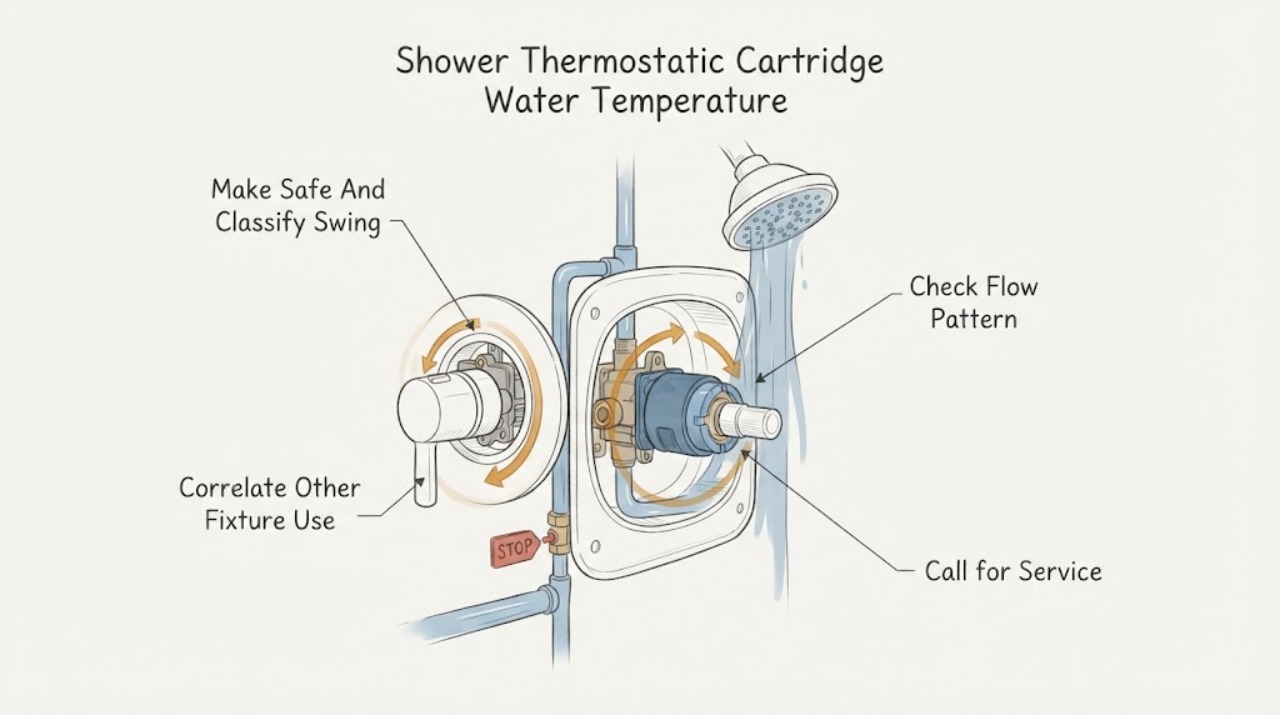
Work through in order
Diagnostic checks
Use only checks that match the exact appliance or system and its official guide.
-
Check 1
Keep hands and body out of the stream until its temperature is known, set the shower controls normally, and observe from a safe position whether the water changes from cold to hot, hot to cold, or alternates repeatedly.
Expected result: Record whether the change is a brief start-up transition, a repeatable swing during use, a sudden scalding change, or a temperature that never reaches a stable setting; note whether there is a leak or visible trim damage.
Next step: Stop using the shower and arrange qualified plumbing service for a scalding change, a leak, damaged controls, or no safe setting. Otherwise continue only with cautious, brief observations and keep the result as a symptom record.
Stop if: Do not continue testing an unexpectedly hot stream, an active leak, or a control that cannot be returned to a safe position.
Why this matters
Why: A repeatable or sudden swing is not established as normal warm-up. Scalding, a leak, or inability to hold a safe setting is an immediate stop-use condition; a mild pattern still needs correlation with flow and other fixtures.
-
Check 2
Without changing the shower valve or opening plumbing, note whether the shower temperature changes when a toilet is flushed or a nearby sink, tub, washer, or other water fixture is started or stopped by another person.
Expected result: The temperature is stable when the shower is alone but swings during another fixture's use, or it fluctuates even when no other fixture is running.
Next step: Document which fixture and event triggered the change and give that pattern to a plumber. Do not adjust a hidden stop or compensate by setting the shower dangerously hot.
Stop if: Stop if the correlation produces a scalding change, a loss of water control, or water visible outside the normal shower outlet.
Why this matters
Why: A repeatable link to another fixture makes a pressure or flow interaction more likely than a shower-only symptom, although a thermostatic valve and its check valves still need model-specific assessment. A swing with no other demand keeps the cartridge, calibration, check-valve, and hot-water paths in consideration.
-
Check 3
Observe whether the temperature swing appears only at very low flow, only at high flow, or across the ordinary usable range; inspect the showerhead face and visible outlet for scale or debris without poking openings or disassembling the valve.
Expected result: The swing follows a restricted or uneven spray, disappears at one flow setting, or occurs with an apparently normal and steady spray; record whether the showerhead or outlet leaks.
Next step: Follow only the exact showerhead care instructions for visible debris, then stop if the temperature remains unstable. Provide flow observations and photos to a qualified plumber; do not remove a flow-control component or change the valve arrangement.
Stop if: Do not poke, drill, scrape, enlarge, or force any showerhead opening, screen, trim, or valve component.
Why this matters
Why: A flow-dependent pattern makes the showerhead, inlet, volume-control path, or a flow-sensitive valve condition more likely. A normal, steady spray with continuing temperature swings shifts attention toward temperature control, check valves, supply conditions, or calibration rather than visible spray-face scale alone.
-
Check 4
From outside the wall, photograph or transcribe the American Standard trim, handle markings, rough-in or valve identification, and any separate volume-control handle; do not remove the escutcheon to search for a cartridge.
Expected result: The installation can be identified as a thermostatic valve, a pressure-balance valve, a trim kit over a separate rough-in, or an unknown arrangement; note whether the model information is incomplete.
Next step: Use the model information to locate the exact owner or installation documentation, or give the photographs to American Standard support or a qualified plumber. Keep the existing parts in place until compatibility is confirmed.
Stop if: Stop when identification would require removing trim, loosening the valve, opening the wall, or working on concealed plumbing.
Why this matters
Why: The valve type and exact model determine whether a thermostatic cartridge, pressure-balance cartridge, or calibration unit is relevant. An unknown arrangement is a fitment uncertainty, not evidence that a generic cartridge is appropriate.
-
Check 5
After identifying the exact model, read only that model's American Standard installation or service guidance for temperature calibration and hot-limit adjustment; do not turn an adjustment or remove a cartridge by trial and error.
Expected result: The documentation explicitly describes a user-accessible calibration or limit procedure for the installed model, or it says the part or procedure is model-specific, unavailable, or intended for service.
Next step: If the exact instructions permit a simple external adjustment, follow them precisely and stop if temperature becomes unstable. Otherwise provide the model, symptoms, and records to qualified service; do not substitute a calibration unit based on appearance.
Stop if: Do not remove the cartridge, bypass the hot-limit safety feature, alter concealed stops, or proceed when the model match is uncertain.
Why this matters
Why: A documented model-specific calibration path can explain a stable but incorrectly set temperature. A generic or missing instruction leaves cartridge condition, check valves, supply, and installation details unresolved and should not be improvised.
-
Check 6
At a safe distance, compare the shower's hot-water behavior with another nearby hot-water outlet at a separate time, without changing the water heater, pressure controls, or concealed plumbing.
Expected result: Only the shower fluctuates, multiple hot-water outlets fluctuate, hot water is delayed or exhausted, or the comparison cannot be made safely.
Next step: Record the comparison and have a plumber assess the system when more than one outlet is affected or the shower remains unstable. Leave the shower out of use if any outlet produces a scalding or unsafe change.
Stop if: Do not adjust water-heater controls, pressure regulators, concealed stops, or plumbing connections as a test.
Why this matters
Why: A shower-only pattern focuses diagnosis on the shower valve, cartridge, check valves, trim, and local flow path. Similar behavior elsewhere makes a broader hot-water, supply, or pressure issue more likely; the comparison does not prove a cartridge failure.
Use your observations
Decision map
Find the observation that best matches what you see, then follow the next safe action.
-
PATH 01Safety boundary
What you see
The shower is stable by itself but changes when another fixture starts, stops, or changes demand.
Do this next
Give the plumber the triggering fixture, timing, flow setting, and model identity for a supply and valve assessment. Do not compensate by setting the temperature hotter or by altering a stop.
Why this path and its safety boundary
Why it matters: A pressure or flow interaction is more likely than a shower-only obstruction, even though a thermostatic valve is intended to compensate for pressure changes; a check valve, supply condition, installation, or valve fault remains possible.
Safety stop: Stop use for any sudden hot surge, loss of control, or leak.
-
PATH 02Safety boundary
What you see
Temperature fluctuates repeatedly with no other fixture running and with an apparently steady shower spray.
Do this next
Arrange qualified plumbing service and provide the exact trim, rough-in, symptom timing, and safe observations. Ask the technician to verify model-specific parts before replacing a cartridge.
Why this path and its safety boundary
Why it matters: The thermostatic cartridge or its calibration becomes more relevant, but check valves, hot-water supply, trim/volume control, and concealed installation conditions cannot be ruled out from the symptom alone.
Safety stop: Do not pull the cartridge, open the wall, or operate a valve that cannot hold a safe temperature.
-
PATH 03Safety boundary
What you see
The swing appears only at very low or high flow, or the showerhead spray is restricted or uneven.
Do this next
Use only model-approved, ordinary-access showerhead care, then reassess without modifying flow-control parts. Escalate to a plumber if the temperature remains unstable or the head leaks.
Why this path and its safety boundary
Why it matters: The showerhead, inlet, volume-control path, or a flow-sensitive valve condition is more likely to influence the symptom; a restricted spray does not prove a failed cartridge.
Safety stop: Do not drill openings, remove a limiter, bypass a pressure-compensating feature, or continue with a damaged head.
-
PATH 04Safety boundary
What you see
Another hot-water outlet shows a similar fluctuation, delay, or loss of hot water.
Do this next
Arrange plumbing or water-heating assessment and keep the shower setting conservative. Include which outlets were affected and whether another fixture triggered the change.
Why this path and its safety boundary
Why it matters: A broader hot-water supply, pressure, or water-heating issue is more likely than a shower-only cartridge fault.
Safety stop: Stop for a scalding change, water leak, steam or burn injury, or any condition that makes the outlet unsafe.
-
PATH 05Safety boundary
What you see
The temperature cannot be controlled safely, a leak is present, the trim or valve is damaged, or the installed model and cartridge type cannot be identified.
Do this next
Leave the shower out of use and obtain qualified plumbing service; supply photos, model markings, symptom timing, and any prior work history.
Why this path and its safety boundary
Why it matters: The issue has crossed the ordinary-observation boundary. A wrong cartridge, calibration unit, or adjustment could remove temperature protection or create a concealed leak.
Safety stop: Do not remove trim or valve parts, open the wall, or order a part solely from a visual resemblance.
Helpful context
Understand the symptom
What a fluctuating temperature does and does not identify
A thermostatic cartridge is part of a temperature-control system, not an isolated symptom label. A swing that follows another fixture starting or stopping makes a supply-pressure or flow interaction more likely; a swing that persists with no other water use keeps the cartridge, its calibration, check valves, volume-control path, and hot-water supply in consideration. The pattern narrows the next safe step but cannot confirm a hidden part without the exact trim and rough-in information.
Why the American Standard model matters
American Standard's product information distinguishes thermostatic valves, trim kits, pressure-balance cartridges, and model-specific repair or calibration parts. Its temperature calibration unit is expressly described as being for American Standard thermostatic valves with compatibility checked against the specific model. Record the trim and rough-in markings before considering a part; do not assume that a pressure-balance cartridge or a calibration unit fits a thermostatic valve just because both control shower temperature.
Keep the first checks outside the wall
Use a cautious, ordinary-access observation sequence: classify the temperature change, compare it with other fixtures, note the shower's flow behavior, and identify the controls and model. Do not repeatedly expose yourself to an unexpectedly hot stream. Do not remove the escutcheon, pull a cartridge, alter a stop, bypass a check valve, or open the wall as a test. If the shower can scald, leaks into the wall, or cannot hold a safe setting, leave it out of use and obtain qualified help.
Safety boundary
Stop conditions
- Stop using the shower for a sudden scalding change, a temperature that cannot be held safely, or a leak reaching the wall, floor, or ceiling.
- Do not remove the escutcheon, pull the thermostatic cartridge, open the wall, or disturb concealed stops or check valves as a troubleshooting test.
- Do not bypass or disable a hot-limit safety feature, install a generic cartridge, or use a calibration unit without exact model compatibility and instructions.
- Do not drill, scrape, force, or alter the showerhead, flow-control component, volume-control path, or valve to compensate for unstable temperature.
- Do not adjust the water heater, pressure regulator, or concealed plumbing based only on this symptom; arrange qualified service when more than one outlet is affected or the cause is uncertain.
Only after diagnosis
Potential parts
- thermostatic cartridge or wax thermostatic unit
Consider this category only after the symptom persists with steady flow, the exact American Standard valve is identified, and qualified diagnosis rules out supply, flow, and check-valve causes.
Confirm the rough-in, trim, model, revision, and manufacturer's fit information; do not substitute a pressure-balance cartridge or a visually similar part. - shower valve check valve
Consider this category only when the installation uses the relevant check-valve arrangement and the pressure-linked or cross-flow pattern is confirmed by qualified diagnosis.
Check the exact valve model and service procedure. Do not bypass, remove, or replace concealed check valves as a user test. - temperature calibration unit
Consider this category only when the exact American Standard thermostatic valve documentation identifies a compatible calibration unit or procedure and the issue is a setting rather than an unstable cartridge or supply.
American Standard states that compatibility must be checked against the specific model; confirm that model before ordering or installing.
When checks do not resolve it
Need a professional?
Arrange qualified plumbing service when temperature continues to fluctuate at steady flow, changes with other fixtures, affects multiple hot-water outlets, follows a prior valve or trim repair, or cannot be traced to an exact model-approved external check. Seek prompt service for a leak or damaged trim, and stop using the shower immediately for a sudden scalding change or any setting that cannot be controlled safely.
Safety scope: This article is limited to safe observation, identification, and manufacturer-approved ordinary-access care. A qualified professional must handle concealed valve access, cartridge removal, check-valve diagnosis, pressure adjustments, and any repair involving a leak or unsafe temperature.
Common questions
FAQ
Does a fluctuating American Standard shower temperature prove the thermostatic cartridge is bad?
No. The same symptom can involve supply-pressure changes, check valves, flow control, calibration, hot-water delivery, installation, or the cartridge. Correlate the swing with other fixtures and flow, identify the exact valve, and have a professional confirm the part before replacement.
Why does the shower get hotter when someone flushes a toilet?
That pattern indicates a pressure or flow interaction is involved. American Standard describes its thermostatic valve as intended to hold temperature when supply pressure changes, so a repeatable swing deserves valve, check-valve, supply, and installation assessment rather than a hotter temperature setting.
Can I adjust the American Standard thermostatic cartridge myself?
Only follow an explicit, model-specific external calibration instruction if the installation is identified and the procedure is clearly within ordinary safe access. Do not remove the cartridge, open the wall, alter concealed stops, or disable a hot-limit safety feature.
What if the showerhead flow is weak when the temperature fluctuates?
A restricted or uneven spray can make a flow-sensitive temperature problem more noticeable, but it does not identify the cartridge. Follow only the exact showerhead care instructions, keep flow-control parts intact, and arrange plumbing service if temperature remains unstable or the head leaks.
When should I stop using the shower?
Stop immediately for a sudden scalding change, a setting that cannot be controlled safely, a leak reaching the wall or floor, damaged trim, or a temperature swing that returns despite safe ordinary-access checks. Keep the shower out of use until qualified plumbing service assesses it.
Read the exact guide
Official sources
- Shower Rough Valve Temperature Calibration UnitAmerican Standard · Official American Standard repair-parts page for a calibration unit; used only to establish that thermostatic-valve compatibility must be checked against the specific model.
- Serin® 2-Handle Thermostatic Shower Valve Trim KitAmerican Standard · Official American Standard trim-kit page for the Serin product; used for the distinction between temperature and volume controls and for its explicit model-specific rough-valve fit, not a generic fit claim.
- 1/2-Inch (13 mm) Central Thermostatic Rough-In ValveAmerican Standard · Official product information for an American Standard thermostatic rough-in valve; used for the valve's described operating principles and safety features, not as proof that every American Standard model uses the same cartridge.
- Edgemere® 1.8 gpm/6.8 L/min Shower Trim Kit With Water-Saving Showerhead, Double Ceramic Pressure Balance Cartridge With Lever HandleAmerican Standard · Official American Standard product information for a pressure-balance shower trim; used to distinguish that product family from a thermostatic valve, not to claim compatibility with the assigned installation.
Community feedback
Share a repair observation
Share a plain-text repair observation. Accepted observations are published automatically; this page may take a moment to update.