
On this page
Start here
Quick answer
If shower temperature swings hot and cold, first note whether the change occurs when another fixture runs, only at one handle position, or throughout the home. A pressure-balancing cartridge or spool may be involved, but supply pressure, a partially closed stop, a water-heater issue, or a different valve design can look similar. Observe without removing trim; keep the shower out of use if temperatures become unsafe, and call a plumber when the swing is severe, persistent, or requires valve disassembly.
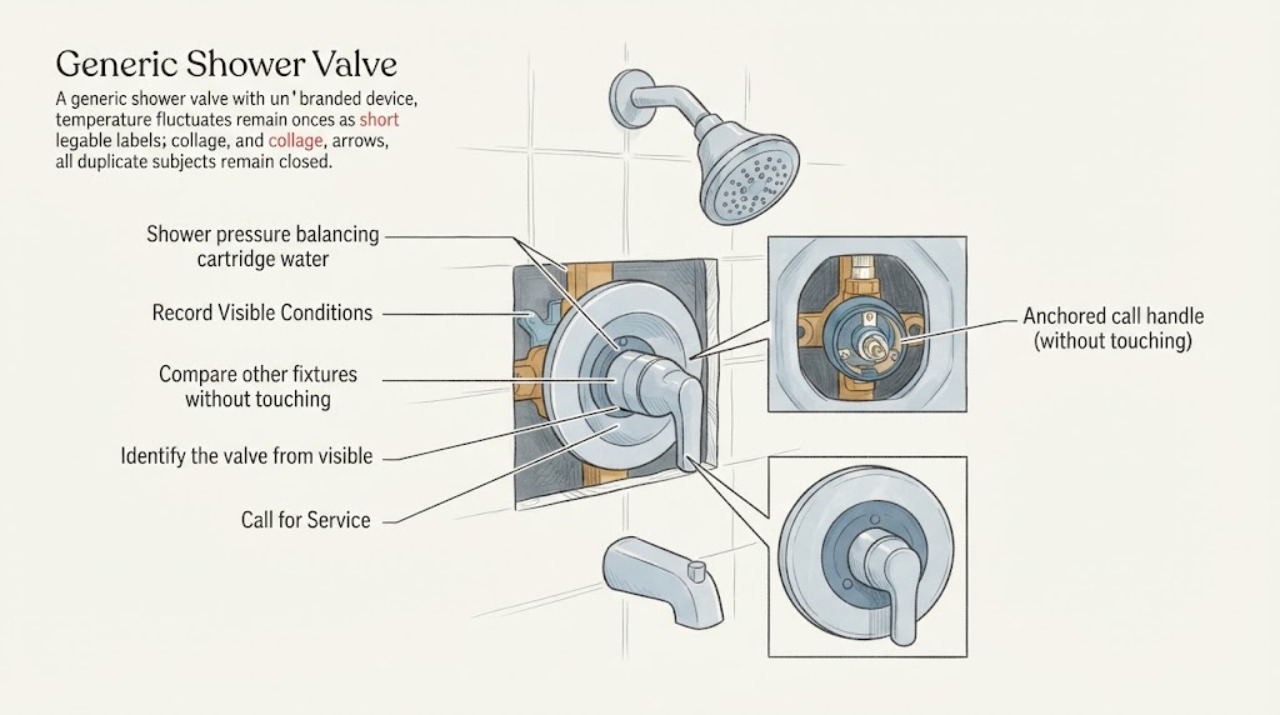
Work through in order
Diagnostic checks
Use only checks that match the exact appliance or system and its official guide.
-
Record the swing pattern safely
During one normal shower only if the temperature is safe, note the starting temperature, handle position, time to the first change, whether the water becomes hot or cold, and whether the change repeats. Stop rather than continuing if the water is uncomfortable or unsafe.
Expected result: The swing may happen at startup, after several minutes, when the handle is moved, at random, or only once. Record severity without guessing a precise temperature.
Next step: Write the pattern down and use the branches below. Keep the shower unused if the change is severe or unpredictable.
Stop if: Stop immediately for scalding water, a sudden cold shock, a leak, steam or burn risk, or any need to remove trim.
Why this matters
Why: A repeatable swing at one valve can indicate a pressure-balancing or thermostatic component, but supply pressure and water-heater behavior can produce similar symptoms. A dangerous temperature change is a safety issue regardless of cause.
-
Compare other fixtures without touching the shower valve
At a safe time, observe whether another sink, tub, or shower has the same hot/cold fluctuation. Note whether the change begins when a toilet fills, a faucet runs, or an appliance uses water; do not intentionally create an unsafe shower test.
Expected result: Only this shower changes, several fixtures change, or the pattern follows another fixture starting or stopping.
Next step: Report the comparison to a plumber and avoid ordering a cartridge until the valve family and symptom are confirmed.
Stop if: Stop if testing another fixture causes a dangerous shower temperature, active leak, or water damage.
Why this matters
Why: A whole-home or cross-fixture pattern points toward supply pressure, water-heater, or plumbing distribution conditions; a single-shower pattern makes the local valve or cartridge more plausible without proving it.
-
Identify the valve from visible information
Photograph the handle, escutcheon, tub/shower arrangement, visible brand mark, and any model marking. Note whether the control rotates only for temperature or also changes volume, and whether there are separate hot and cold handles. Do not remove the trim.
Expected result: A readable brand/model is available, only a brand or series clue is visible, or identification is not possible without disassembly.
Next step: Use the model evidence in a manufacturer lookup or provide it to the plumber. If no model can be identified, plan for professional identification.
Stop if: Do not remove screws, handles, retaining nuts, or wall materials to obtain a part number.
Why this matters
Why: Moen documents different cartridges for different M-Core series, and Kohler directs users to identify the installed valve before repair. Similar-looking trim can hide a different cartridge or pressure-balancing design.
-
Record visible supply and pressure clues
Look for a partially closed accessible stop, recent plumbing work, low flow, a clogged showerhead, water-heater service, or other changes without adjusting any valve. If a pressure gauge is already installed and readable, record its normal reading; do not install one or manipulate plumbing for this guide.
Expected result: Record normal flow, weak flow, a recent water-system change, a visible stop position, pressure variation, or no useful clue.
Next step: Include the clue and any pressure reading with the service request; leave adjustment and valve testing to a qualified plumber.
Stop if: Stop if a stop or connection leaks, is stuck, or would need force, disassembly, or wall access.
Why this matters
Why: Kohler notes pressure differential can cause temperature fluctuations, and EPA describes normal residential incoming pressure as a range while directing higher-pressure adjustment to professionals. A pressure clue does not identify a cartridge fault.
-
Prepare a model-specific service handoff
Compile the temperature-swing timeline, handle position, other-fixture comparison, valve brand/model evidence, flow and pressure clues, recent work, visible leaks, and photographs. State whether the shower has been kept out of use and whether the water reached an unsafe temperature.
Expected result: The record shows a local repeatable swing, a whole-home pressure pattern, an unknown valve, a visible leak, or a safety-critical temperature change.
Next step: Request plumbing service for a persistent or unsafe swing, leaking valve, uncertain isolation, or any repair requiring cartridge or wall access.
Stop if: Do not remove the cartridge, adjust internal stops, open the wall, or perform deep valve disassembly as part of this guide.
Why this matters
Why: A plumber can distinguish cartridge, pressure-balancing, stop, water-heater, and distribution issues and select a compatible repair only after identifying the valve and supply conditions.
Use your observations
Decision map
Find the observation that best matches what you see, then follow the next safe action.
-
PATH 01Safety boundary
What you see
Only one shower repeatedly swings hot and cold with no clear whole-home trigger.
Do this next
Keep the shower out of use if the swing is unsafe and request model-specific inspection of the pressure-balancing valve and cartridge.
Why this path and its safety boundary
Safety stop: Do not order or remove a cartridge based only on trim appearance.
-
PATH 02Safety boundary
What you see
Several fixtures change temperature or the swing follows another fixture using water.
Do this next
Request plumbing assessment of supply pressure, stops, distribution, and water-heater behavior before replacing a local cartridge.
Why this path and its safety boundary
Safety stop: Do not adjust pressure regulators or shutoffs yourself.
-
PATH 03Safety boundary
What you see
The shower becomes scalding or suddenly cold, or the valve leaks or damages the wall.
Do this next
Stop using the shower, keep people away from the area, and request prompt plumbing service.
Why this path and its safety boundary
Safety stop: Do not continue testing, remove trim, or open a wall.
-
PATH 04Safety boundary
What you see
The change is brief or not repeatable and no leak or unsafe temperature is present.
Do this next
Keep a short log of handle position, timing, other water use, and visible clues; request service if it returns.
Why this path and its safety boundary
Safety stop: A temporarily normal shower does not justify disassembly or a guessed replacement part.
Helpful context
Understand the symptom
Pressure-balancing valves respond to hot and cold inlet pressure so a change elsewhere in the home does not create a sudden temperature shift. Kohler explains that a pressure differential at the valve can cause temperature fluctuations, while Moen's product guidance shows that valve series and cartridges differ. A cartridge name alone is not enough to identify the correct replacement.
Treat this as safe observation, not a cartridge-removal tutorial. Do not remove the handle or escutcheon, pull a cartridge, adjust stops, change valve settings, or open a wall. If the water becomes scalding, turns cold suddenly, or the valve leaks, stop using the shower and arrange plumbing service.
Separate a local valve symptom from a supply problem
Record the shower handle position, when the swing happens, whether another tap or toilet is running, and whether other fixtures show the same temperature behavior. The safest useful output is a pattern that lets a plumber inspect the valve, stops, supply pressure, and water heater in the right order.
Do not assume a brief change after another fixture starts proves the cartridge is faulty. Conversely, a repeated swing with no other water use, a stuck control, or a sudden unsafe temperature deserves a model-specific valve inspection.
Only after diagnosis
Potential parts
- shower cartridge
Only after the exact valve family is confirmed and a plumber or manufacturer identifies the cartridge.
- thermostatic shower cartridge
Only when the installed valve is confirmed to be thermostatic rather than pressure-balancing.
- pressure-balancing spool
When the manufacturer or plumber confirms the valve uses a serviceable pressure-balancing spool and the water can be safely isolated.
When checks do not resolve it
Need a professional?
Request plumbing service for persistent or unsafe temperature fluctuation, a leaking or stuck shower valve, a whole-home pressure pattern, uncertain shutoff, or any repair requiring cartridge or wall access.
Common questions
FAQ
Does a fluctuating shower temperature always mean the pressure-balancing cartridge is bad?
No. Supply pressure, a stop, water-heater behavior, a clogged outlet, or a different valve design can look similar. Compare other fixtures and identify the valve before choosing a repair.
Why does the shower turn cold when another faucet runs?
A change in hot or cold supply pressure can affect the shower valve, especially if the system or valve is not balancing as expected. Report the trigger and have a plumber assess the supply and local valve together.
Can I remove the shower handle to clean the pressure-balancing spool?
Not in this observation guide. Valve service requires safe isolation and model-specific instructions; if the shutoff or valve is uncertain, leave the trim assembled and call a plumber.
How do I know which replacement cartridge to buy?
Use the exact valve brand, series or model, control layout, and manufacturer parts information. Similar trim can use different cartridges, so do not choose by appearance alone.
When should I call a plumber for temperature fluctuations?
Call for severe or persistent swings, scalding or sudden cold water, a leaking valve, a whole-home pressure pattern, uncertain shutoff, or any repair requiring cartridge removal, pressure adjustment, or wall access.
Read the exact guide
Official sources
- Dripping From Showerhead or Bath Spout - Rite Temp ValveKohler Assist · Use for pressure differential, temperature fluctuation, valve identification, and model-specific repair limits.
- Shower Faucet: Leaking-M-Core ValveMoen Solutions · Use as a manufacturer example that valve series use different cartridges and that symptoms need model-specific diagnosis.
- Home MaintenanceU.S. Environmental Protection Agency WaterSense · Use for the relationship between incoming pressure, leaks, and professional pressure-regulating work.
Community feedback
Share a repair observation
Share a plain-text repair observation. Accepted observations are published automatically; this page may take a moment to update.