
On this page
Start here
Quick answer
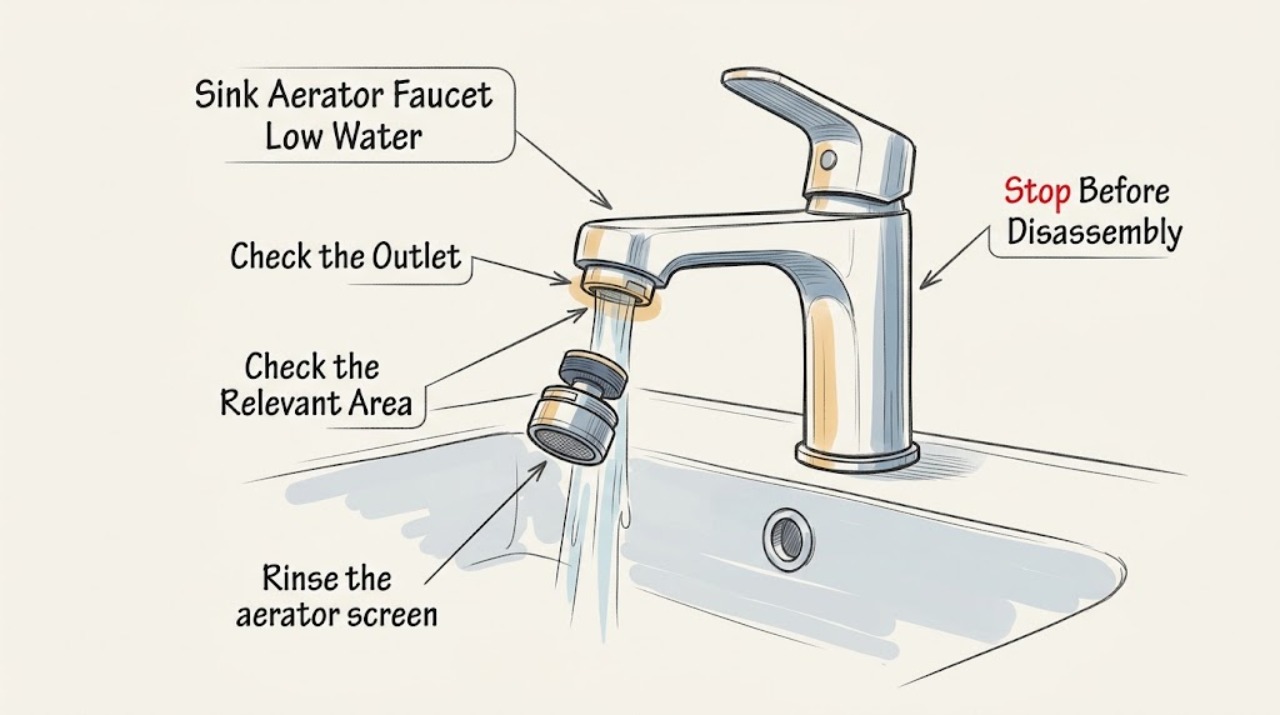
When one American Standard sink faucet has weak flow, first compare the stream at the spout, spray outlet, and both temperature positions, then remove and rinse the aerator and briefly retest with it out. If flow returns, the aerator screen or flow insert is restricted; clean it or identify the exact model before replacing it. If flow stays weak with the aerator removed, inspect the two stop valves and supply hoses without opening pressurized connections. Weak flow at several fixtures, a sudden house-wide change, a leak, or a shutoff that will not work needs a plumber.
Work through in order
Diagnostic checks
Use only checks that match the exact appliance or system and its official guide.
-
Check 1
Run the faucet at its normal position and compare the main stream with any spray outlet; repeat on cold and hot.
Expected result: Only the main spout is weak, only the spray is weak, one temperature is weaker, or every outlet and temperature is weak.
Next step: Continue to the aerator check when the rest of the home has normal flow and the symptom is confined to this faucet; use the supply-path branch when one temperature or several fixtures are affected.
Stop if: Stop if the faucet or hose visibly leaks while running.
Why this matters
Why: A problem isolated to the spout outlet makes the aerator or outlet screen more likely. A one-temperature difference points to that supply path or the cartridge. Weakness in every outlet is less likely to be just the aerator.
-
Check 2
Place a drain stopper or cloth over the sink drain, put a small container under the outlet, and remove the aerator only if it turns without force.
Expected result: The insert comes out intact, is packed with grit or mineral material, or will not move without a wrench or risk to the finish.
Next step: Keep the insert and any seals in order, rinse them over the container, and stop rather than force a corroded part. Use the faucet model to identify the correct service key or replacement.
Stop if: Stop if removal would twist the spout, damage the finish, or expose a connection that cannot be shut off.
Why this matters
Why: Debris at the outlet can restrict a single faucet. A seized or damaged outlet can turn a simple cleaning into a finish or thread repair.
-
Check 3
Rinse the aerator screen and insert with clean water and use a soft brush for loose deposits; do not use abrasive or harsh cleaner on the faucet finish.
Expected result: The screen clears, the insert is cracked or deformed, or the openings remain blocked after gentle cleaning.
Next step: Reassemble the screen, seals, and insert in their original order only if they are intact; otherwise pause and verify the faucet model and part diagram.
Stop if: Stop if a seal tears, the insert breaks, or cleaning requires a chemical that could harm the finish or drinking-water path.
Why this matters
Why: A clear screen supports a temporary restriction diagnosis. A damaged or permanently blocked insert may need a model-matched part, while a clean insert shifts attention to the faucet or supply line.
-
Check 4
With the outlet aimed into the sink and the handles closed before opening the stops, briefly run the faucet with the aerator still removed.
Expected result: Flow is strong without the aerator, remains weak, or produces grit, a spray pattern, or a leak at the spout.
Next step: If flow improves, clean or replace only the correctly identified aerator and retest after reassembly. If it does not, close the stops and move to the visible supply check.
Stop if: Stop immediately for uncontrolled spray, a leak at the spout, or a stop valve that will not close.
Why this matters
Why: Strong flow without the insert identifies the outlet assembly as the restriction. Weak flow without it points to a stop valve, hose, cartridge, or upstream supply. Grit or leakage means the test should end.
-
Check 5
Look under the sink at both stop valves and flexible supply hoses while the faucet is off, then open each stop slowly only if it operates normally.
Expected result: A stop is partly closed, a hose is sharply kinked, a connection is wet, or both valves and hoses look normal.
Next step: Correct only a clearly partial valve position or gentle hose routing without disconnecting anything. If water appears or the valve is stiff, close the workable stop and arrange service.
Stop if: Do not loosen a supply nut, pull a hose, or continue if a valve is seized or water is present under the sink.
Why this matters
Why: A partly closed stop or kink can limit the faucet without a bad aerator. Moisture indicates a leak risk. Normal visible supply paths make a cartridge or concealed restriction more likely when the outlet test stayed weak.
-
Check 6
Open a nearby sink or another fixture and compare its flow with the affected American Standard sink after the faucet outlet is restored.
Expected result: Only this faucet remains weak, several fixtures are weak, or the change began suddenly after plumbing work or a water interruption.
Next step: For a single faucet, have a plumber evaluate the cartridge or concealed supply after the safe checks. For several fixtures, check only the accessible main shutoff and contact building or plumbing service rather than replacing an aerator at random.
Stop if: Stop user troubleshooting for house-wide loss, flooding, discolored water, or any inaccessible main control.
Why this matters
Why: A single-faucet result favors its cartridge, stops, hose, or outlet. Several fixtures or a sudden wider change points to the home shutoff, pressure regulator, supply interruption, or building plumbing.
Use your observations
Decision map
Find the observation that best matches what you see, then follow the next safe action.
-
PATH 01Next step
What you see
Do this next
Install the original clean parts or a model-matched aerator, then check for leaks and a normal stream.
-
PATH 02Next step
What you see
Do this next
Use the visible supply check only; arrange plumbing service for cartridge or concealed-path diagnosis if the valves and hoses are normal.
-
PATH 03Next step
What you see
Do this next
Avoid forcing the outlet; isolate the affected path and have service inspect the relevant valve or spray assembly if gentle cleaning does not restore flow.
-
PATH 04Next step
What you see
Do this next
Stop replacing faucet parts, check only an accessible main control without forcing it, and contact a plumber or building maintenance.
Helpful context
Understand the symptom
Start with the symptom pattern
Low flow at only this spout is different from low flow throughout the home. Note whether the main stream is weak, whether a pull-out or side spray is also weak, and whether hot and cold behave the same way. A screen restriction is more likely when the rest of the home is normal and the flow changes after the aerator is removed.
Keep the part identity exact
American Standard sells different aerators for different faucet families, including pressure-compensating designs and model-specific kits. Do not assume that a thread size, finish, or advertised flow label proves fit. Record the faucet model from its paperwork or an accessible marking before ordering a part.
A safe stopping point
These checks are limited to the outlet, visible shutoffs, and visible hoses. Stop if a connection drips, a valve will not close, threads are damaged, or the faucet body must be opened. Water damage or a loss affecting several fixtures is a plumbing diagnosis, not an aerator-cleaning task.
Safety boundary
Stop conditions
- Stop if water sprays uncontrollably, a supply connection is wet, or a shutoff will not close.
- Stop if the aerator or spout threads are seized, damaged, or would require force that could twist the faucet.
- Stop and arrange plumbing service for a house-wide flow loss, flooding, discolored water, or a cartridge or concealed-pipe diagnosis.
Only after diagnosis
Potential parts
- faucet aerator or flow insert
Consider this only when flow is normal with the outlet insert removed or the screen is damaged, blocked, or missing.
Confirm the faucet family, model, thread style, seals, and any required service key from American Standard documentation before selecting a part. - faucet cartridge
Consider this only when the aerator is clear, flow stays weak without it, and the supply checks do not show a closed valve or kinked hose.
Do not infer cartridge fit from the faucet brand alone; match the exact faucet model and valve design. - faucet supply hose
Consider this only when a hose is visibly damaged or leaking and the correct shutoff works; a plumber should handle a seized or wet connection.
Verify connection type and length for the faucet and stop valve; never substitute a part without confirming the fitting.
When checks do not resolve it
Need a professional?
Call a plumber when the faucet remains weak with the aerator removed, only one supply side is affected after the visible checks, a valve or hose leaks, the cartridge or concealed passage needs access, or more than one fixture has low flow.
Common questions
FAQ
Can a dirty aerator cause low pressure at only one sink faucet?
Yes. If the other fixtures are normal and flow becomes strong with the aerator removed, the outlet screen or insert is the likely restriction. Clean or replace it only after matching the faucet model.
Should I run an American Standard faucet without its aerator?
Use only a brief, controlled test with the outlet aimed into the sink and the drain protected. Stop for spray or leakage, then reinstall the original clean parts or a confirmed replacement.
What if the faucet is still weak with the aerator removed?
Check for a partly closed stop, kinked hose, temperature-side difference, or weak flow at multiple fixtures. If the visible checks are normal, a cartridge or concealed supply path needs plumbing service.
Can I use any American Standard aerator that looks the same?
No. Official American Standard pages list aerators and kits for particular faucet families. Match the exact faucet model, thread style, seals, and any key before buying a part.
When is low faucet flow a house plumbing problem?
Treat it as a wider plumbing issue when several fixtures are weak or the change was sudden after an interruption or plumbing work. Stop changing faucet parts and arrange a plumber or building-maintenance inspection.
Read the exact guide
Official sources
- Pc Aerator 55/64 FemaleAmerican Standard · Official American Standard repair-part page; use as an example of model-specific aerator identity, not as a universal sink-faucet fit.
- Colony® Soft 2-Handle Laundry FaucetAmerican Standard · Official American Standard product page showing a faucet family with an aerator option and ceramic disc valves; use for component context only.
- Monterrey® Single-Handle Gooseneck Kitchen Faucet 1.5 gpm/5.7 LpmAmerican Standard · Official American Standard faucet product page; model-specific evidence for an aerator and ceramic disc valve, not a claim about the assigned faucet model.
- Aerator KitAmerican Standard · Official American Standard repair-part page; the listed kit is for a named faucet family and must not be generalized to every sink faucet.
Community feedback
Share a repair observation
Share a plain-text repair observation. Accepted observations are published automatically; this page may take a moment to update.