
On this page
Start here
Quick answer
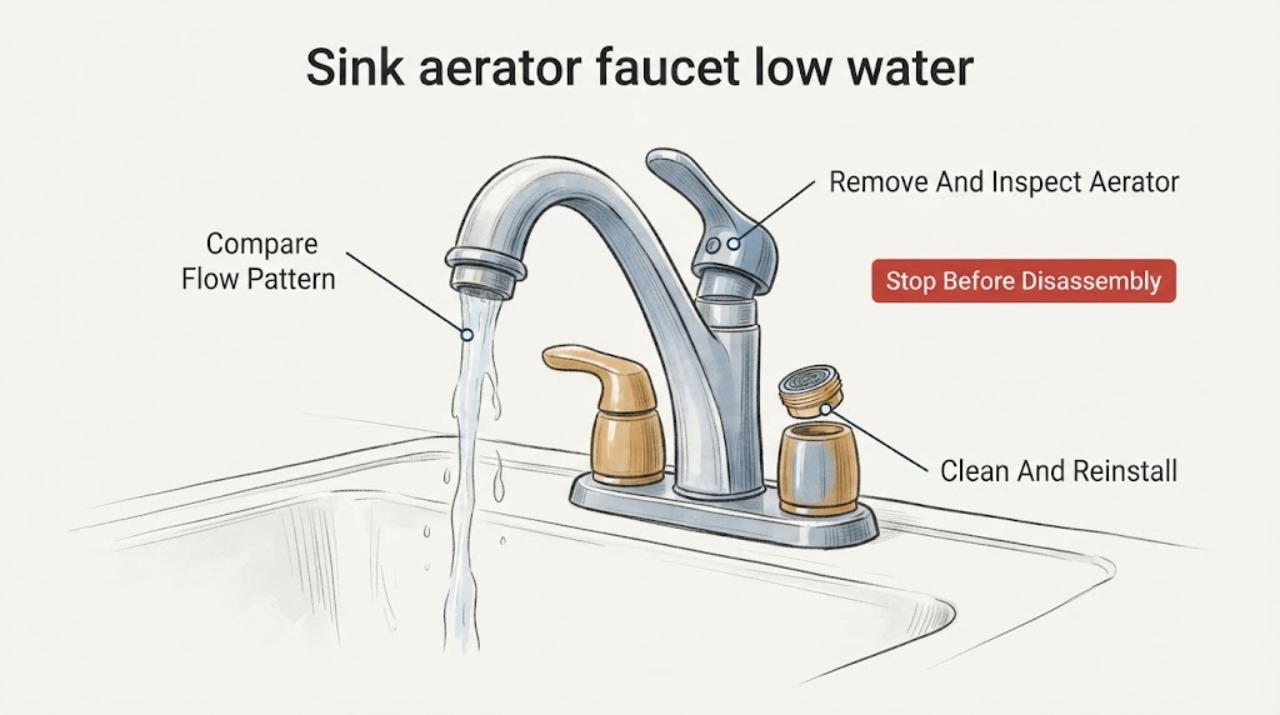
If only this Delta sink faucet has weak flow, compare hot and cold flow and another nearby fixture first. Delta says a clogged aerator or flow restrictor can greatly reduce faucet flow; remove the aerator only as the exact faucet instructions allow, clean its screen and gasket without force, and reinstall it correctly. If flow is still weak with the aerator removed, or several fixtures are affected, the cause may be a supply stop, hose, valve, internal filter, or house-side pressure problem and needs model-specific or qualified plumbing service. Do not force a stuck aerator or disassemble a cartridge, valve, or model-specific filter by guesswork.
Before you begin
Safety first
- This article supports ordinary-access observation, model-permitted aerator cleaning, and model-permitted flushing only. Do not improvise cartridge, valve, solenoid, supply-line, or wall work.
Work through in order
Diagnostic checks
Use only checks that match the exact appliance or system and its official guide.
-
Check 1
Operate the Delta sink faucet normally and compare its cold flow, hot flow, and a nearby fixture without removing trim or opening plumbing.
Expected result: Record whether the restriction affects only this faucet, only hot or cold water, both temperatures, or several nearby fixtures; note whether another fixture changes the flow.
Next step: Continue to the aerator check only when the problem is isolated to this faucet and there is no leak or unstable temperature; arrange plumbing service for widespread or unstable flow.
Stop if: Stop for a leak under the sink, water damage, hot-water instability, or any need to open a wall or disturb a valve.
Why this matters
Why: A problem limited to this faucet makes the aerator or faucet-side restriction more likely. Weak flow across fixtures or a temperature-specific problem makes a supply, stop valve, pressure, or house-side issue more likely.
-
Check 2
If the exact Delta instructions show that the aerator is removable, protect the finish with a cloth and loosen it gently by hand; use a tool only in the manner specified by those instructions.
Expected result: Inspect the aerator screen, flow-control opening, and gasket for scale, grit, fibers, a displaced seal, damage, or a missing piece. Record whether the part was easy to remove or required force.
Next step: Clean only the removable aerator parts using the approved Delta procedure, then preserve the gasket and original arrangement for reassembly; if the aerator will not loosen without force, stop and use model-specific service.
Stop if: Do not force threads, pry the faucet apart, drill or enlarge the opening, or remove an unidentified flow-control component.
Why this matters
Why: Scale or debris at the aerator can explain a localized restriction, while a damaged or displaced gasket can cause leakage or poor seating. A clean aerator shifts suspicion toward the inlet, hose, internal faucet component, or supply.
-
Check 3
Rinse the aerator screen and remove loose debris using only the cleaning method allowed by the exact Delta faucet instructions; keep the gasket and flow-control pieces in their original order, then reinstall without overtightening.
Expected result: After restoring the faucet, observe whether flow becomes stronger and even, stays weak, becomes uneven, or leaks at the aerator connection.
Next step: Use the result to choose the matching branch: monitor an improved faucet, document the model for a model-specific filter check when flow remains low, or arrange plumbing service for persistent low flow or a leak.
Stop if: Do not mix cleaners, use abrasive tools or unapproved solvents, discard the flow-control insert, or keep using the faucet if it leaks.
Why this matters
Why: Improved even flow supports a clogged aerator as the cause. No change makes an upstream restriction, internal filter or valve, hose, or supply issue more likely; a new leak indicates sealing, damage, or incorrect reassembly.
-
Check 4
If the exact Delta instructions permit line flushing, leave the aerator off, direct the outlet safely into the sink, and briefly run the affected hot and cold sides normally to clear loose debris before reinstalling the aerator.
Expected result: Compare the open outlet flow with the flow after the cleaned aerator is restored; note whether debris appears, the open outlet remains weak, or the faucet leaks at a connection.
Next step: Reassemble only as the model instructions specify and use the persistent-low-flow branch when the open outlet is still weak; do not remove internal components merely to continue the test.
Stop if: Stop if flushing causes a leak, water cannot be controlled safely, or the next step would require cartridge, valve, solenoid, or supply-line disassembly.
Why this matters
Why: Debris followed by improved open flow supports a faucet-line or aerator restriction. Weak flow even with the aerator removed points toward the supply stop, flex hose, cartridge, model-specific filter, or house-side pressure rather than the aerator itself.
-
Check 5
With the cabinet dry and the faucet off, look at the visible hot and cold stop valves and flexible hoses for a valve that is not fully open, a kink, corrosion, or a wet connection; do not loosen or force any fitting.
Expected result: Record whether a stop valve is visibly partly closed, a hose is kinked, there is a leak, or the visible supply looks normal while the aerator has already been cleaned.
Next step: Only correct a clearly accessible valve position if it moves normally and there is no leak; otherwise provide the observations and faucet model to a qualified plumber or Delta support for diagnosis.
Stop if: Do not force a stop valve, disconnect a pressurized hose, tighten a leaking fitting aggressively, or continue if water is reaching the cabinet or wall.
Why this matters
Why: A visible valve position or kink can restrict one faucet, while a normal visible supply with weak flow after aerator cleaning makes an internal faucet or broader pressure issue more likely. A wet connection is a service and water-damage concern.
Use your observations
Decision map
Find the observation that best matches what you see, then follow the next safe action.
-
PATH 01Safety boundary
What you see
Only the Delta sink faucet is weak, and the aerator contains scale or debris; flow improves after approved cleaning and correct reassembly.
Do this next
Keep the gasket and aerator seated, watch for a recurrence, and use the faucet's model instructions if cleaning is needed again.
Why this path and its safety boundary
Why it matters: A local aerator or flow-control restriction is the best-supported explanation for this episode.
Safety stop: Stop if the connection leaks, the aerator is damaged, or cleaning no longer restores flow.
-
PATH 02Safety boundary
What you see
The faucet remains weak with the aerator removed, while other fixtures have normal flow.
Do this next
Stop at ordinary-access checks, identify the exact Delta model, and request model-specific or qualified diagnosis rather than opening the cartridge or guessing at an internal filter.
Why this path and its safety boundary
Why it matters: The restriction is more likely in the faucet inlet, hose, internal filter or valve, or a supply stop than in the aerator screen.
Safety stop: Do not bypass, drill, discard, or substitute a flow-control part, and do not disconnect the hose or valve without qualified guidance.
-
PATH 03Safety boundary
What you see
The sink and other fixtures are weak, or hot and cold behavior indicates a shared pressure or supply problem.
Do this next
Arrange qualified plumbing diagnosis and report which fixtures and temperatures are affected, any recent shutoff or repair, and whether flow changes when another fixture runs.
Why this path and its safety boundary
Why it matters: The evidence does not isolate the Delta aerator; a house shutoff, supply, pressure condition, or upstream plumbing issue is more likely.
Safety stop: Stop for a leak, water damage, unsafe temperature changes, or any need to open a wall or service a valve.
-
PATH 04Safety boundary
What you see
The aerator is stuck, the gasket or screen is damaged, a leak appears, or the model instructions identify a screen or filter not covered by the general aerator procedure.
Do this next
Record the model and visible part arrangement, retain all pieces, and use the exact Delta manual or a qualified plumber for the repair decision.
Why this path and its safety boundary
Why it matters: The next step depends on the exact Delta design and may involve a compatible seal, aerator, filter, or internal faucet service; forceful disassembly could create a second problem.
Safety stop: Do not force threads, substitute an unverified part, or open a cartridge, valve, or solenoid because the faucet is still weak.
Helpful context
Understand the symptom
Start with the flow pattern, not the part
A Delta sink faucet that is weak only at one outlet points toward a local restriction such as the aerator, screen, gasket, hose, or faucet inlet. Weak flow at several fixtures, or a difference between hot and cold, points farther upstream to a stop valve, supply, pressure condition, or building plumbing. The aerator is a sensible first check because Delta specifically notes that debris or a flow restrictor can reduce flow, but it is not proof that the aerator is the only cause.
Use the exact Delta model instructions
Delta's general guidance says to avoid excessive force when removing an aerator, protect the finish with a cloth, preserve the gasket, and clean debris before reinstalling it. Model designs differ: one Delta kitchen-faucet manual also describes a spray-head screen and an internal filter for that model. Treat those extra screens or filters as conditional model features, not universal parts, and stop when access requires force or unverified internal disassembly.
Safety boundary
Stop conditions
- Do not force a stuck aerator, faucet fitting, stop valve, hose, cartridge, valve, or model-specific filter.
- Do not drill, pry, scrape, or enlarge an aerator or flow-control opening, and do not discard or bypass an original flow-control component.
- Do not mix cleaning products or use an unapproved solvent, abrasive, or tool; keep the gasket and all original pieces together.
- Stop for a leak under the sink, water damage, uncontrolled water, unsafe hot-water behavior, or any repair requiring wall, valve, cartridge, or supply-line access.
- Treat low flow at multiple fixtures as a plumbing or pressure diagnosis rather than continuing to clean the Delta aerator.
Only after diagnosis
Potential parts
- sink faucet aerator or flow-control insert
Consider this category only when the exact Delta model uses a removable aerator and inspection confirms that the screen or insert is damaged, missing, or cannot be restored by approved cleaning.
Confirm the exact faucet model, thread, gasket, flow-control design, and manufacturer's fit information before ordering; do not assume a generic aerator fits. - model-specific faucet filter or cartridge
Consider this category only after a clean, correctly installed aerator and permitted flushing leave this faucet weak while other fixtures remain normal, and a qualified or model-specific diagnosis identifies the internal component.
Confirm the exact Delta model and the manufacturer's service procedure; some designs use screens or filters that are not interchangeable with a cartridge or generic insert.
When checks do not resolve it
Need a professional?
Arrange qualified plumbing or model-specific Delta service when cleaning the aerator does not restore flow, the faucet is weak with the aerator removed, multiple fixtures are affected, a stop valve or hose is suspect, a connection leaks, the aerator will not loosen without force, or an internal filter, cartridge, valve, or solenoid requires access.
Safety scope: This article supports ordinary-access observation, model-permitted aerator cleaning, and model-permitted flushing only. Do not improvise cartridge, valve, solenoid, supply-line, or wall work.
Common questions
FAQ
How do I tell whether the Delta sink faucet aerator is causing low flow?
Compare hot and cold flow and another nearby fixture. If only this faucet is weak and the removable aerator contains scale or debris, clean it using the exact Delta instructions and preserve the gasket. If the faucet remains weak with the aerator removed, the cause is likely elsewhere in the faucet or supply.
Should I remove the flow restrictor to get more water pressure?
No. Do not drill, enlarge, discard, or bypass an aerator's flow-control component. Keep the original arrangement and ask Delta or a qualified plumber to identify a compatible repair or replacement if approved cleaning does not help.
What if the aerator is stuck?
Do not force it or damage the faucet finish. Delta's general guidance favors gentle removal with finish protection, while the exact model instructions determine whether a tool is appropriate. Record the model and use model-specific or qualified service.
Why is the Delta faucet still weak after cleaning the aerator?
A weak open outlet shifts suspicion to the inlet, hose, internal filter or valve, supply stop, or house-side pressure. If other fixtures are also weak, or a leak or unstable temperature is present, stop ordinary troubleshooting and arrange qualified plumbing assessment.
Read the exact guide
Official sources
- What do I do if my single-handle kitchen faucet drips from the aerator?Delta Faucet · Delta single-handle kitchen-faucet guidance; use the installed model's instructions for the exact faucet.
- Why does my faucet have low water pressure?Delta Faucet · Delta's general faucet guidance; the exact faucet's installation and care instructions control model-specific access.
- How to Fix Your FlowDelta Faucet · Delta general faucet-care article; use the exact model instructions for aerator access and parts.
- 114376 TOUCH2O® WITH TOUCHLESS PULL-DOWN KITCHENDelta Faucet Company · This manual applies to the identified Delta 114376 model family only; it demonstrates model variation and is not a universal procedure for every Delta sink faucet.
Community feedback
Share a repair observation
Share a plain-text repair observation. Accepted observations are published automatically; this page may take a moment to update.