
On this page
Start here
Quick answer
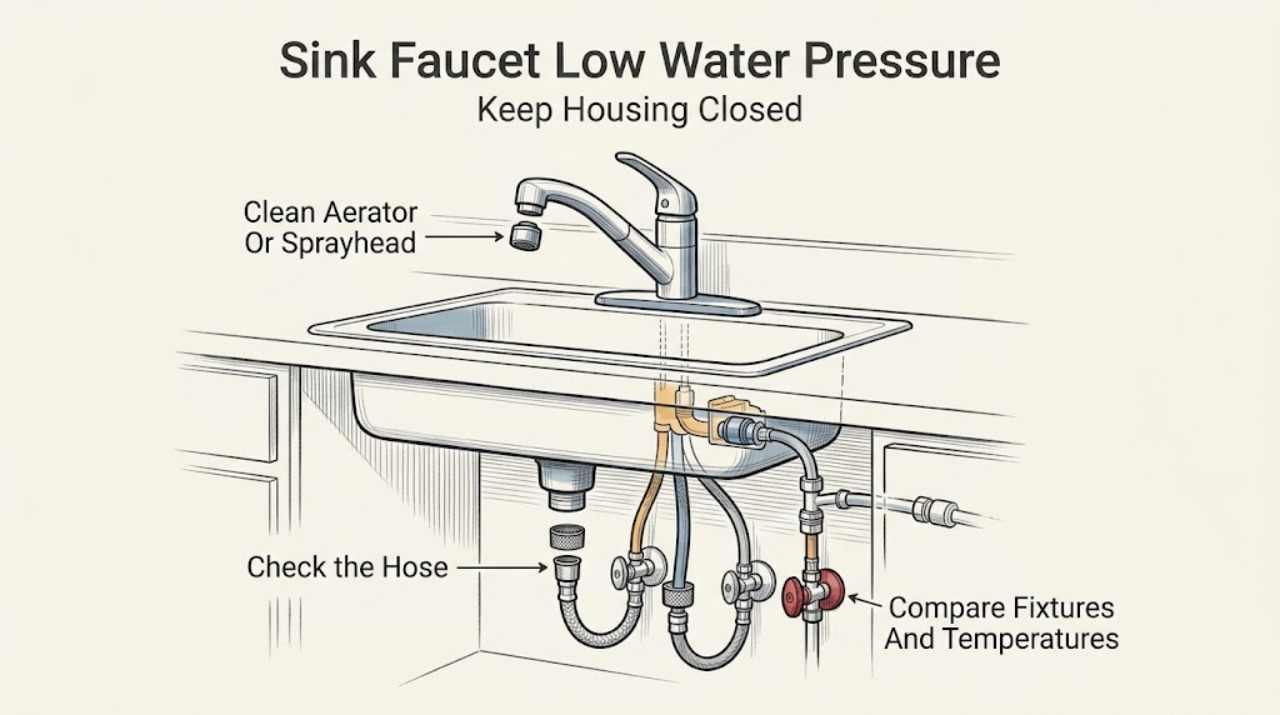
Low flow at a Kohler sink faucet usually comes from a restricted aerator or sprayhead, a partly closed supply stop, a kinked hose, debris in a screen or supply line, or a valve or cartridge restriction. First compare this faucet with another fixture and test hot and cold separately. Confirm the handle is fully open, the under-sink stops are open, and the hoses are not kinked. Then clean the model-appropriate aerator or sprayhead; on a pull-down faucet, running water briefly through the detached hose into the sink can show whether the restriction is in the sprayhead or faucet body. If flow stays low from the hose, both hot and cold are affected, the supply is weak throughout the home, or a connection leaks, stop disassembly and arrange qualified plumbing service. Do not force a Kohler aerator, alter a flow-control device, or open a pressurized connection without the model instructions.
Work through in order
Diagnostic checks
Use only checks that match the exact appliance or system and its official guide.
-
Check 1
Open the Kohler faucet fully and compare its flow with another nearby faucet. Test hot and cold separately, noting whether the weakness is at the spout, sprayhead, or both. Look under the sink for a wet cabinet or a visibly loose hose, but do not loosen a connection while water is on.
Expected result: Only the Kohler faucet is weak, both hot and cold are weak, only one temperature is weak, the whole home has low flow, or water leaks under the sink.
Next step: For an isolated, leak-free problem, continue with the handle, supply-stop, hose, and aerator checks. If several fixtures are affected, flow is weak throughout the home, or a connection leaks, stop using the affected supply and arrange qualified plumbing service.
Stop if: Do not keep opening a leaking faucet, remove pressurized hoses, or use a tool near a wet electrical outlet or disposal connection.
Why this matters
Why: A single-faucet problem points toward the aerator, sprayhead, hose, screen, valve, or cartridge. One-temperature weakness points toward that supply path. Low flow at several fixtures suggests a shared or household supply issue, while a leak changes the priority from flow testing to water-damage prevention.
-
Check 2
With the faucet handle closed, look at both under-sink supply stops and confirm they are open as the installation instructions describe. Inspect the hot and cold flexible hoses for a kink, twist, crushing, or sharp bend; make only a gentle visible correction that does not require disconnecting the hose.
Expected result: A handle is not fully open, a supply stop is partly closed, a hose is kinked or twisted, the visible supply path is clear, or moving the handle or stop causes a leak.
Next step: Return the handle and accessible stops to the model-approved open position and retest briefly. If flow remains low, continue to the aerator or sprayhead check. Stop and arrange service for a leaking stop, damaged hose, seized valve, or uncertain plumbing connection.
Stop if: Do not force a seized stop, disconnect a supply line, or continue turning a valve that begins to leak.
Why this matters
Why: A partly closed stop, partially open handle, or kinked hose can restrict flow before water reaches the faucet. A clear supply path makes debris in the aerator, sprayhead, screen, valve, or cartridge more likely. A leak indicates a connection or valve problem that should not be tightened by guesswork while pressurized.
-
Check 3
Identify whether the outlet is a threaded, keyed, or recessed Kohler aerator, or a pull-down sprayhead. Turn the water off at the handle, remove only the outlet part using the model's instructions and the correct tool, rinse away debris, and soak only compatible removable plastic insert material as the Kohler guide permits. Reassemble without overtightening and test for leaks.
Expected result: Mineral or sediment debris is visible, the outlet is clear but flow improves with it removed, flow remains weak after cleaning, or the outlet or threads are damaged.
Next step: Reinstall the clean, model-appropriate outlet and retest. If a pull-down model remains weak, isolate the sprayhead from the hose in the next check. Use qualified service for damaged threads, a stuck outlet, a concealed screen, or continuing low flow.
Stop if: Do not pry against the finish, insert sharp objects into the outlet, use an unapproved cleaner, or overtighten the aerator or sprayhead.
Why this matters
Why: Debris in the aerator or sprayhead can reduce the stream while the supply inside the faucet remains adequate. A strong stream with the outlet removed localizes the restriction to that part. Persistently low flow after cleaning points upstream to a hose, screen, valve, cartridge, or supply issue; damaged threads or an incorrect tool can create a leak.
-
Check 4
For a Kohler pull-out or pull-down faucet only, follow the model instructions to detach the sprayhead while holding the hose so it cannot retract. Point the hose into the sink or a bucket, turn the handle on briefly, and compare the hose flow with the sprayhead flow. Stop before disconnecting a supply connection unless the exact manual permits it and the water supply is safely shut off.
Expected result: Flow is strong from the bare hose but weak through the sprayhead, flow is weak from the bare hose, sediment appears, or water leaks at a connection.
Next step: Clean or replace only the model-identified sprayhead when the test localizes the issue there. If bare-hose flow is weak, use qualified service to diagnose the valve, cartridge, screen, hose, or supply line; provide the Kohler model and the observed comparison.
Stop if: Do not let the hose fall below the counter, run water into cabinetry, disconnect a pressurized line, or continue if a fitting leaks.
Why this matters
Why: Strong bare-hose flow localizes the restriction to the sprayhead. Weak bare-hose flow makes a kinked hose, inlet screen, valve, cartridge, or supply-line restriction more likely. Sediment after a new installation can come from unflushed supply lines, while a leak requires repair rather than more testing.
Use your observations
Decision map
Find the observation that best matches what you see, then follow the next safe action.
-
PATH 01Next step
What you see
The faucet has weak flow, but flow becomes strong when the aerator or pull-down sprayhead is removed, and debris or mineral buildup is visible.
Do this next
Clean the model-appropriate outlet and reinstall it without overtightening. If the stream remains weak or the outlet is damaged, identify the exact Kohler model before selecting a replacement or arranging service.
Why this path and its safety boundary
Why it matters: The outlet is the most likely restriction; the faucet's upstream supply is delivering water.
-
PATH 02Next step
What you see
Only one temperature or this faucet is weak, a supply stop is partly closed, a flexible hose is visibly kinked, or nearby fixtures have normal flow.
Do this next
Correct only the accessible handle, stop, or hose position allowed by the model instructions. Arrange plumbing service for a seized stop, leaking connection, damaged hose, or low flow that remains after those checks.
Why this path and its safety boundary
Why it matters: The restriction is more likely in the faucet's local supply path than in the household water system.
-
PATH 03Next step
What you see
The aerator or sprayhead is clear, flow is weak from a detached pull-down hose or at both temperatures, and visible stops and hoses are open and undamaged.
Do this next
Stop disassembling and arrange qualified faucet or plumbing service. Give the technician the Kohler model, hot-versus-cold result, outlet-versus-hose result, installation age, and any sediment observed.
Why this path and its safety boundary
Why it matters: Debris in an inlet screen, valve, cartridge, spray hose, or faucet body is more likely; a part cannot be selected from low flow alone.
-
PATH 04Next step
What you see
Several fixtures have low flow, the problem began after water service or a faucet installation, water appears under the sink, or a stop or hose leaks during testing.
Do this next
Stop using the leaking or affected supply, protect the cabinet from water, and arrange qualified plumbing service. Do not open additional connections or assume a faucet part will correct a household supply problem.
Why this path and its safety boundary
Why it matters: A shared supply, installation flush, plumbing connection, or leak is more likely than a dirty Kohler outlet.
Helpful context
Understand the symptom
Use the pattern to locate the restriction
If only this faucet is weak, the restriction is more likely at its aerator, sprayhead, hose, screen, valve, or cartridge. If hot and cold are both weak at several fixtures, the issue is more likely at the household supply or a shared stop. If only one temperature is weak, compare that supply hose and stop before assuming the Kohler faucet needs a part.
The sprayhead test separates two different paths
On a Kohler pull-out or pull-down faucet, flow from the hose with the sprayhead removed points toward a clogged sprayhead. Poor flow from the hose as well points farther upstream, such as a kinked hose, screen, valve, cartridge, or supply line. Follow the exact model instructions and keep the hose supported so it cannot retract below the counter.
Only after diagnosis
Potential parts
- Kohler faucet aerator or sprayhead
Only consider this category when flow becomes strong with the outlet removed or the outlet is visibly damaged after the correct model-specific cleaning procedure.
Kohler outlet designs and tools vary; confirm the exact faucet model, outlet type, and finish before selecting a component. - Kohler faucet flexible supply or spray hose
Only consider this category when a hose is visibly damaged or a qualified diagnosis confirms a restriction or leak after stops and connections are safely checked.
Hose routing and connection types are model-specific; confirm the exact faucet and connection configuration before replacement. - Kohler faucet valve or cartridge
Only consider this category when the aerator or sprayhead, stops, hoses, and supply path are adequate and qualified diagnosis identifies an internal valve or cartridge restriction.
Kohler valve and cartridge fitment is model-specific; do not choose by appearance or replace it before isolating the restriction.
When checks do not resolve it
Need a professional?
Arrange qualified plumbing or faucet service when flow remains low after the handle, supply-stop, hose, aerator, and model-approved sprayhead checks; the bare pull-down hose has poor flow; a valve, cartridge, screen, or faucet body may be restricted; or a connection leaks. Use service promptly when several fixtures have weak flow or the problem followed installation or water-service work. Stop testing a wet or leaking connection, do not disconnect pressurized supply lines, and do not force or bypass a Kohler flow-control component. Provide the exact model and the results of the hot-versus-cold and outlet-versus-hose comparisons.
Common questions
FAQ
Why is my Kohler sink faucet pressure low but other faucets are normal?
An isolated faucet problem is more likely to be a partly closed stop, kinked hose, clogged aerator or sprayhead, inlet screen, valve, cartridge, or faucet-body restriction. Check the handle, stops, hoses, and outlet first, then use the model-approved sprayhead or hose comparison if it is a pull-down faucet.
How do I clean a Kohler faucet aerator when the flow is weak?
Identify whether the outlet is threaded, keyed, or recessed, turn the handle off, and use the model's removal method and correct tool. Rinse away debris and soak only a compatible removable insert as the Kohler instructions allow. Reinstall without overtightening and check for leaks.
When does low water pressure require a plumber?
Use qualified service when flow stays low after the outlet, stops, and visible hoses are checked; flow is weak from a detached pull-down hose; several fixtures are affected; or a stop, hose, or faucet connection leaks. A valve, cartridge, screen, supply line, or household pressure problem needs diagnosis rather than a guessed replacement.
Read the exact guide
Official sources
- Removing an aeratorKohler Assist · Kohler kitchen-faucet aerator identification by threaded, keyed, and recessed outlet styles
- No Job NameKohler Co. · Kohler faucet troubleshooting for low flow, supply stops, handles, hoses, screens, spray nozzles, and safe water-supply checks
- Low Flow from Hot and Cold WaterKohler Assist · Kohler kitchen-faucet low-flow causes and model-directed checks for supply lines, hoses, sprayheads, valves, and cartridges
Community feedback
Share a repair observation
Share a plain-text repair observation. Accepted observations are published automatically; this page may take a moment to update.