
On this page
Start here
Quick answer
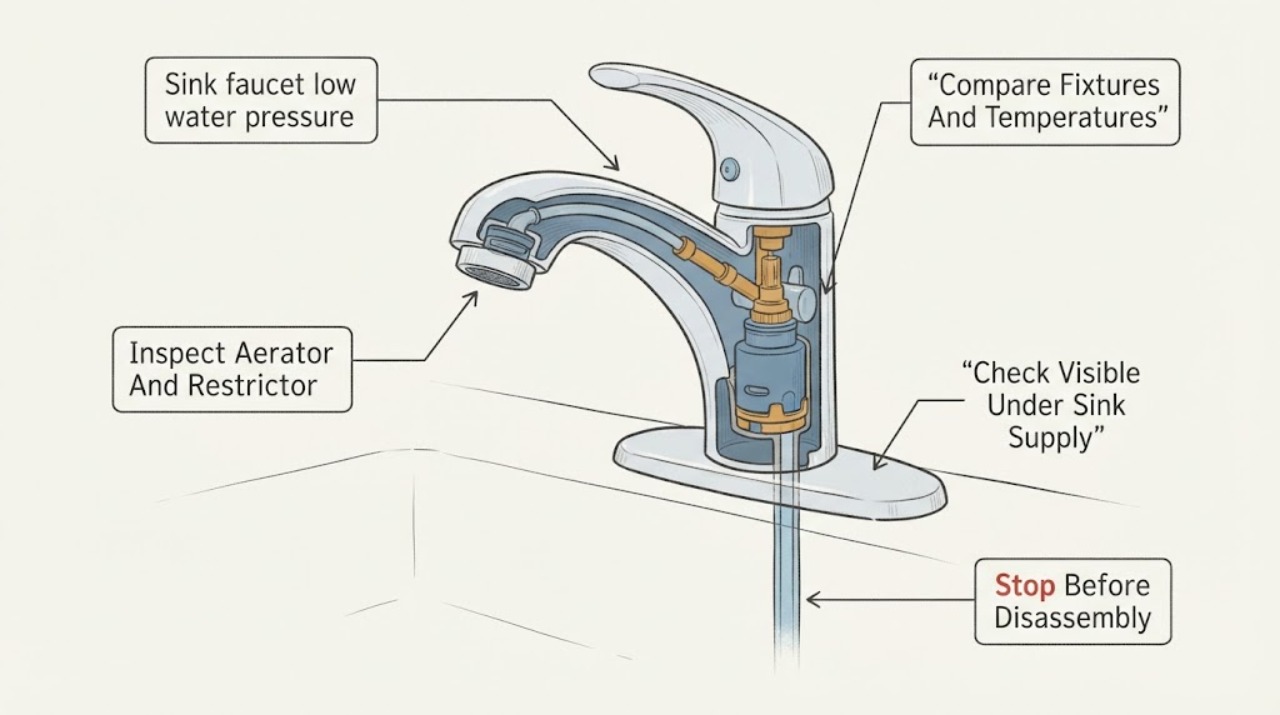
Low pressure at a Delta sink faucet is usually a restriction or supply problem, not a reason to remove the faucet's flow-control parts. First compare the affected faucet with another nearby fixture and test hot and cold separately. If only this faucet is weak, inspect the aerator or spray head, flow restrictor, and any visible pull-down hose or diverter for scale, debris, or kinks. If both hot and cold are weak, a clogged aerator or inlet path is more likely; if only one side is weak, that side's supply, shutoff, stem, cartridge, or internal passage needs attention. Delta recommends flushing lines after water work and cleaning or replacing model-specific parts with the supplies shut off. If every fixture is weak, the shutoff cannot open fully, a hose or connection leaks, or flow remains low after safe cleaning, arrange plumbing service rather than drilling out a restrictor or opening the wall.
Before you begin
Safety first
- Do not work on pressurized connections, modify flow-control parts, perform in-wall or pressure-regulator work, or disconnect hoses or electronic components without model-specific isolation and training.
Work through in order
Diagnostic checks
Use only checks that match the exact appliance or system and its official guide.
-
Check 1
Run the Delta sink faucet normally and compare its flow with another nearby faucet, then test hot and cold separately without removing any part.
Expected result: Only the Delta faucet is weak, both temperatures are weak, only hot or only cold is weak, or several fixtures throughout the home are weak.
Next step: Record the comparison and choose the matching branch. Call a plumber for house-wide loss, a suspected building shutoff or pressure problem, or any leak at the supply connections.
Stop if: Do not remove a pressure regulator, open a wall, or keep running water if a supply connection is leaking.
Why this matters
Why: A single-faucet issue supports a local aerator, inlet, hose, valve, or cartridge check. One-temperature weakness points toward that side's supply or valve path, while house-wide weakness points upstream rather than to the Delta outlet.
-
Check 2
If the problem is local to the faucet outlet, remove the aerator or spray-head outlet only as the exact Delta instructions allow, inspect the screen and flow restrictor for mineral scale or debris, rinse the part, and reinstall it without force.
Expected result: The outlet is visibly clogged, the restrictor or gasket is displaced, the part is damaged or seized, or the outlet is clean but flow remains low.
Next step: Make one controlled flow check after cleaning. If the outlet cannot be removed without force or the flow does not improve, stop and identify the model or call a plumber.
Stop if: Do not drill, pry, enlarge, discard, or substitute the flow restrictor, and do not use harsh abrasives on the Delta finish.
Why this matters
Why: A clogged aerator or flow restrictor can reduce flow at one faucet. A clean outlet with low flow shifts attention to the inlet, hose, diverter, valve or cartridge, shutoff, or upstream supply; a damaged or seized part needs model-specific replacement or service.
-
Check 3
From a dry, safe position under the sink, verify that both shutoff valves are open as intended, supply hoses are not kinked or crushed, and no visible connection is leaking; do not loosen a fitting.
Expected result: A shutoff is partly closed, a hose is kinked, a connection is wet or corroded, or the visible supply path is open and dry.
Next step: Correct only an obvious accessible valve-position or loose-object issue without force, then retest. For corrosion, active leakage, a valve that will not turn, or unresolved low flow, isolate the supply if possible and call a plumber.
Stop if: Do not force shutoff valves, disconnect supply hoses, work near wet electrical equipment, or leave the cabinet unattended during a leak.
Why this matters
Why: A partly closed valve or restricted hose can reduce flow to one temperature side or the whole faucet. A wet or corroded connection is a leak and service issue, not an invitation to tighten a pressurized fitting.
-
Check 4
For a pull-down, pull-out, or side-spray Delta faucet, inspect the spray head and the visible hose loop for scale, debris, or a kink. If the model instructions permit, compare flow from the hose with the spray head removed while keeping the hose supported.
Expected result: Flow is strong from the hose but weak through the spray head, the hose kinks as the wand moves, flow is weak from both, or a diverter or solenoid path is present and inaccessible.
Next step: Clean the spray head only as the model instructions allow and route the hose without a kink. If the hose retracts, the diverter or solenoid is inaccessible, or flow remains low, arrange qualified service.
Stop if: Do not let a detached hose retract, disconnect a pressurized hose or solenoid, or disassemble a diverter without verified model instructions and water isolation.
Why this matters
Why: Strong hose flow isolates the restriction to the spray head or its inlet. A kink points to hose routing, while weak flow before the spray head suggests an inlet, diverter, solenoid, cartridge, supply, or upstream restriction.
-
Check 5
If low flow started after a shutoff, repair, or supply interruption, remove only the aerator and sealing gasket as the Delta instructions permit, flush the hot and cold lines into the sink, then reinstall the clean outlet.
Expected result: Debris appears during flushing and flow improves afterward, no debris appears and flow remains low, or a connection begins leaking when water is restored.
Next step: If flow improves and the connections stay dry, monitor normal use. If debris persists, flow stays low, or a leak appears, stop the faucet and call a plumber or qualified Delta service.
Stop if: Do not flush with internal components removed unless the exact instructions authorize it, leave the aerator off during normal use, or restore water against a leaking connection.
Why this matters
Why: Debris introduced during water work can lodge at the outlet or internal passage. No improvement points to another local or upstream restriction; a new leak means the connection or shutoff needs attention before normal use.
-
Check 6
Record the faucet model or series, handle and spray configuration, hot-versus-cold result, outlet and hose findings, shutoff condition, and whether flushing changed flow before deciding on an internal part or plumbing service.
Expected result: Flow is restored after an outlet or hose correction, only one temperature side remains weak, both sides remain weak with a clean outlet, or all fixtures remain weak.
Next step: Use the model information to select only documented compatible parts, or provide the findings to a licensed plumber. Stop use for active leaks, damaged fittings, or a restriction that cannot be safely isolated.
Stop if: Do not remove a cartridge or supply line by guesswork, alter a flow restrictor, open the wall, or perform pressure or electrical testing yourself.
Why this matters
Why: A resolved local restriction supports continued monitoring. Persistent one-side weakness may involve that valve or supply; persistent both-side weakness may involve an inlet, cartridge, diverter, solenoid, or upstream supply. House-wide weakness is not a faucet-part diagnosis.
Use your observations
Decision map
Find the observation that best matches what you see, then follow the next safe action.
-
PATH 01Safety boundary
What you see
The Delta faucet and several other fixtures have low flow, or the home's main supply or pressure also appears abnormal.
Do this next
Stop local part replacement and ask a licensed plumber or building service to assess the supply, shutoff, pressure-control, or shared piping condition.
Why this path and its safety boundary
Why it matters: The restriction is more likely upstream of this faucet, so cleaning its aerator or replacing its cartridge will not restore house-wide flow.
Safety stop: Do not adjust a pressure regulator, open a wall, or dismantle a building supply component as a faucet repair.
-
PATH 02Safety boundary
What you see
Only the Delta faucet is weak, both temperatures are weak, and the aerator or flow restrictor is visibly scaled or debris-filled.
Do this next
Clean the outlet as the Delta instructions allow, preserve the gasket and flow-control arrangement, and make one normal flow check.
Why this path and its safety boundary
Why it matters: An outlet restriction is more likely than a failed internal valve.
Safety stop: Stop if cleaning does not improve flow, the part is seized, or the faucet begins leaking at the outlet.
-
PATH 03Safety boundary
What you see
Cold flow is normal but hot is weak, or hot is normal but cold is weak, while nearby fixtures are normal.
Do this next
Check the accessible valve position and hose for that side, then identify the exact Delta model before internal service; call a plumber for corrosion, leakage, or a valve that will not isolate.
Why this path and its safety boundary
Why it matters: A restriction in that side's shutoff, supply hose, inlet passage, stem, seat, spring, or cartridge is more likely than a whole-faucet outlet clog.
Safety stop: Do not remove a pressurized supply line or change a stem, seat, spring, or cartridge without model-specific instructions.
-
PATH 04Safety boundary
What you see
A pull-down, pull-out, or side spray is weak, but flow improves when the spray head is removed or the hose is moved clear of a kink.
Do this next
Clean the spray head and correct only an obvious hose kink as the model instructions allow. Have service inspect an inaccessible diverter, solenoid, or damaged hose.
Why this path and its safety boundary
Why it matters: The spray head, hose routing, or diverter path is more likely than the home's water pressure.
Safety stop: Do not let the hose retract, disconnect pressurized components, or force the diverter or spray head.
-
PATH 05Safety boundary
What you see
Both temperatures remain weak at one Delta faucet after the clean outlet, visible supply, hose, and permitted flush checks, or flow returns low immediately after cleaning.
Do this next
Keep the model identity and test results, avoid altering the restrictor, and arrange qualified plumbing or Delta service for model-specific diagnosis.
Why this path and its safety boundary
Why it matters: An inlet, cartridge, diverter, solenoid, internal passage, shutoff, or upstream branch restriction remains possible; the symptom does not identify a replaceable part.
Safety stop: Stop if there is a leak, corroded fitting, inability to isolate water, or any need to open the wall or perform pressure testing.
Helpful context
Understand the symptom
Separate a faucet restriction from a house-wide pressure problem
Start by comparing the Delta faucet with another sink or tub outlet and by testing hot and cold separately. Low flow at every fixture points upstream to the home's supply, a building shutoff, or a pressure problem. Flow that is weak only at this faucet points toward the aerator, spray head, inlet screen, hose, diverter, cartridge, stems, or a shutoff under the sink. A faucet that improved briefly after plumbing work may have picked up debris in its passages.
Clean the outlet before changing internal parts
Delta notes that flow restrictors in aerators can clog and recommends removing and cleaning the aerator or flushing the faucet correctly. Remove an outlet part only if the installed instructions allow it and it can be handled without force. Keep the restrictor and sealing gasket in their original arrangement; a flow limiter is not an obstruction to drill out or discard.
Pull-down and pull-out faucets add a separate path
If the faucet has a spray wand, compare flow from the wand and from the hose with the wand removed only as the model instructions permit. A mineral-blocked spray head, kinked hose under the sink, or diverter debris can reduce spray flow while the main valve and house pressure are normal. Do not let a detached hose retract into the faucet body, and do not disconnect a solenoid or supply line while pressurized.
Internal valves are model-specific
A single-handle faucet may use a cartridge; a two-handle design may use separate stems, seats, and springs. Delta manuals show different service paths for these designs, and some cartridges are not intended to be disassembled. If cleaning the outlet and checking visible supply conditions does not restore flow, identify the faucet model before selecting a cartridge, stem, diverter, hose, or seal.
Stop when the restriction is not safely accessible
Do not use pressure symptoms to justify opening the wall, changing a pressure regulator, removing a backflow or safety device, or forcing a shutoff. Water leaks, corroded fittings, a shutoff that will not isolate, low flow at every fixture, or persistent low flow after model-approved cleaning are plumber boundaries. Keep the cabinet dry and provide the plumber with the hot-versus-cold and fixture-comparison results.
Safety boundary
Stop conditions
- Stop use for an active leak, corroded or damaged supply connection, a shutoff that will not isolate the faucet, or water near electrical equipment.
- Do not drill out, remove, enlarge, or substitute a flow restrictor, aerator insert, gasket, or internal safety component.
- Do not disconnect pressurized hoses or supply lines, open the wall, alter a pressure regulator, or perform pressure or electrical testing as a faucet check.
- Arrange plumbing service for house-wide low flow, persistent low flow after model-approved cleaning, unresolved one-temperature weakness, or any inaccessible cartridge, diverter, solenoid, or inlet restriction.
Only after diagnosis
Potential parts
- aerator or flow-control insert
Consider only if the outlet is visibly clogged or damaged and the exact Delta model identifies a compatible aerator or insert.
Confirm thread, screen, gasket, finish, and flow-control design for the exact faucet; do not remove a restrictor to increase flow. - valve cartridge or two-handle stem assembly
Consider only when persistent low flow is traced to a model-specific cartridge, stem, seat, spring, or internal valve path after the outlet and supply checks.
Single- and two-handle faucets use different parts; verify the exact model and installation instructions before ordering. - spray hose or diverter assembly
Consider only when a pull-down, pull-out, or side-spray restriction is confirmed at the hose or diverter rather than the spray head or supply.
Hose connectors and diverter designs vary by model; confirm routing and compatibility before disconnecting anything. - under-sink supply hose or shutoff component
Consider only when a plumber confirms a kinked, leaking, corroded, or failed supply component is restricting one side or the whole faucet.
Verify connection type, length, valve, local requirements, and water-isolation procedure; do not select from low flow alone.
When checks do not resolve it
Need a professional?
Call a licensed plumber when low flow affects several fixtures, a shutoff or supply connection leaks or will not isolate, the Delta faucet remains weak after the aerator, hose, and permitted flush checks, or the restriction requires cartridge, stem, diverter, solenoid, pressure, or in-wall work. Use model-specific Delta service for internal parts and keep the cabinet dry while troubleshooting.
Safety scope: Do not work on pressurized connections, modify flow-control parts, perform in-wall or pressure-regulator work, or disconnect hoses or electronic components without model-specific isolation and training.
Common questions
FAQ
Why is my Delta sink faucet pressure low but the rest of the house is normal?
A local restriction is more likely, such as a clogged aerator or flow restrictor, debris in the inlet or valve, a kinked spray hose, or a diverter issue. Compare hot and cold separately, clean only the accessible outlet as the model allows, and identify the faucet before ordering internal parts.
Can a clogged aerator cause low water pressure?
Yes. Delta says debris or scale at the aerator or flow restrictor can greatly reduce flow. Remove and clean the outlet only as the faucet instructions allow, preserve the gasket and restrictor, and call service if flow remains low.
Why is only the hot or cold side of my Delta faucet weak?
One-side weakness points toward that side's shutoff, supply hose, inlet, stem, seat, spring, or cartridge rather than the whole outlet. Check only the accessible valve position and hose; isolate water and use model-specific instructions or a plumber for internal service.
Why is my Delta pull-down spray weak?
The spray head may have mineral deposits, the hose may kink under the sink, or the diverter path may be restricted. If the model allows, compare the hose flow with the spray head removed while supporting the hose. Do not let it retract or disconnect pressurized components.
Should I remove the flow restrictor to improve Delta faucet pressure?
No. A restrictor can be clogged, but it is part of the faucet's intended flow control. Clean or replace it only with a model-compatible part identified by Delta; do not drill, enlarge, discard, or substitute it.
Read the exact guide
Official sources
- SINGLE HANDLE KITCHEN FAUCETDelta Faucet · Delta single-handle kitchen faucet low-flow, cartridge, aerator, and spray-path maintenance
- TWO HANDLE WASHERLESS KITCHEN FAUCETDelta Faucet · Delta two-handle kitchen faucet low-flow, stems, seats, springs, aerator, and diverter maintenance
- My kitchen spray attachment is not working. What can I do?Delta Faucet · Delta kitchen faucet spray-head, hose, and diverter flow troubleshooting
- Why does my faucet have low water pressure?Delta Faucet · Delta sink faucet low-flow, aerator, flow-restrictor, and flushing guidance
Community feedback
Share a repair observation
Share a plain-text repair observation. Accepted observations are published automatically; this page may take a moment to update.