
On this page
Start here
Quick answer
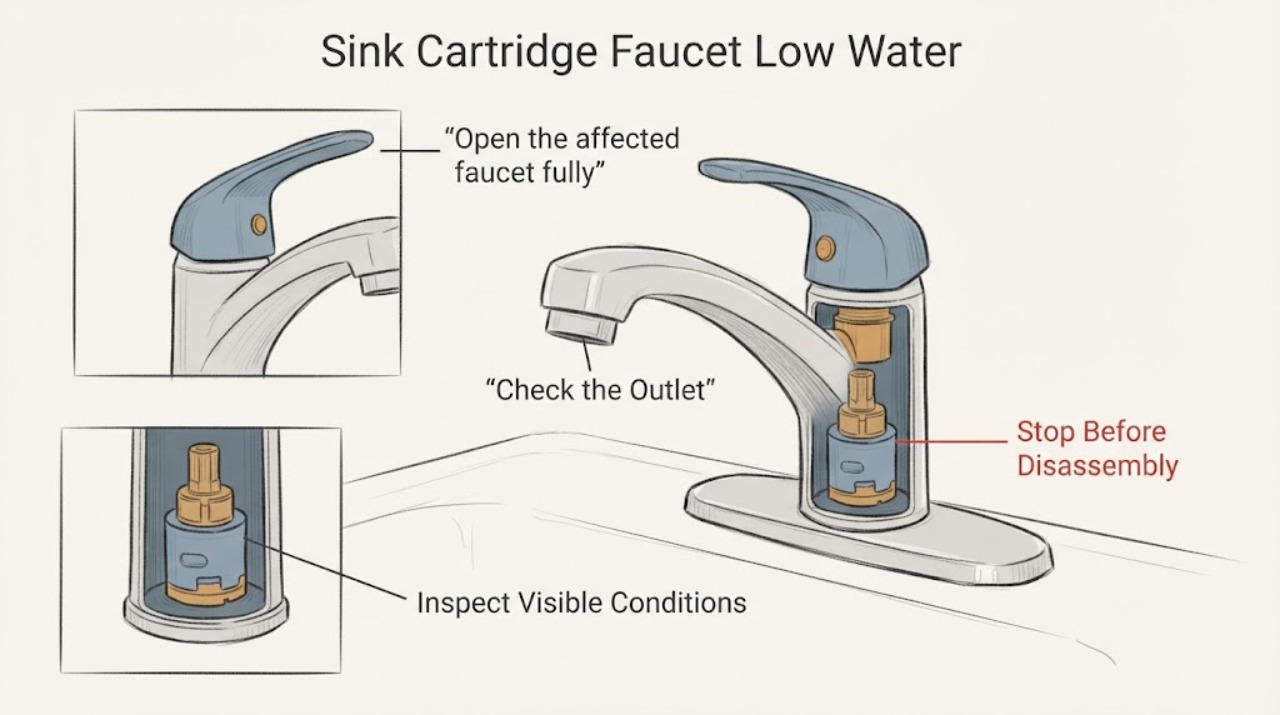
When an American Standard sink faucet has low water pressure, first determine whether the restriction is at the faucet outlet, one supply side, or the whole sink. Remove and rinse a dirty aerator or spray outlet, confirm both stop valves are fully open and the hoses are not kinked, then compare hot and cold flow with another nearby fixture. American Standard models use different cartridge and aerator arrangements, so use the exact model's installation or parts information before opening the valve body. If flow remains low after the outlet and supplies are checked, or there is a leak, seized handle, damaged hose, or an inaccessible cartridge, stop and arrange qualified plumbing service.
Before you begin
Safety first
- Do not work on pressurized connections, force a seized handle or cartridge, alter building supply equipment, or continue using a faucet after a leak or uncontrolled water condition.
Work through in order
Diagnostic checks
Use only checks that match the exact appliance or system and its official guide.
-
Check 1
Open the affected faucet fully and compare it with a nearby cold-water faucet or another fixture while no other fixture is running. Note whether only the American Standard sink faucet is weak, whether the whole sink is weak, and whether the flow is a steady stream or a spray.
Expected result: Only this faucet is weak, both sink handles are weak, one temperature is weak, or other fixtures are weak too.
Next step: Keep this comparison result and continue with the outlet and supply checks that match the observed pattern; do not order a cartridge yet.
Why this matters
Why: A single weak outlet suggests a faucet restriction. Weak flow throughout the sink or home shifts attention to the stop valves, branch supply, pressure regulator, or building supply rather than the cartridge alone.
-
Check 2
With the faucet off, inspect the spout aerator or pull-out spray head for scale, grit, a distorted stream, or a flow insert that is visibly blocked. Follow the exact model instructions to remove the outlet; place a cloth over the finish and do not force a seized part.
Expected result: The outlet screen is clogged or damaged, the stream improves after rinsing and reinstalling it, or the outlet looks clear but flow remains low.
Next step: Rinse the removable outlet with clean water, remove loose debris without abrasive tools, reinstall it correctly, and retest. Replace it only after confirming the exact model and flow specification.
Why this matters
Why: A clogged outlet can restrict a faucet that has normal supply. American Standard lists pressure-compensating aerators as model-specific components, so an outlet that is clear and correctly installed makes the cartridge or supply path more relevant.
-
Check 3
Look under the sink for both faucet stop valves and flexible supply hoses. Confirm the valves are open as intended, check for a kinked or crushed hose, and look for dampness or a connection that is leaking. Do not loosen a connection while it is pressurized.
Expected result: A stop valve is partly closed, a hose is kinked, water is leaking, or the supply path looks open and dry.
Next step: Correct only an obvious valve-position or hose-routing issue without forcing the valve. If there is any leak, corrosion, or a valve that will not operate, shut off water at a safe upstream point if possible and arrange plumbing service.
Why this matters
Why: A partly closed valve or restricted hose can limit flow before water reaches the cartridge. A leak is a separate plumbing fault and can make continued testing unsafe or cause cabinet damage.
-
Check 4
Compare hot and cold flow separately at the American Standard faucet, using the same handle opening and the same cleaned outlet. Observe whether the weak flow follows one side, occurs equally on both sides, or changes only as the handle passes through part of its travel.
Expected result: Only hot is weak, only cold is weak, both temperatures are weak, or the stream changes abruptly with handle position.
Next step: Use the exact model documentation before accessing the cartridge. Do not remove the handle, retaining ring, or cartridge while the supplies are open or without a way to control and drain the water safely.
Why this matters
Why: One weak temperature points toward that side's stop valve, hose, inlet, or cartridge passage. Equal weakness on both sides is more consistent with an outlet or shared faucet restriction; an abrupt handle change can make the cartridge or handle mechanism more relevant but does not prove failure.
-
Check 5
Identify the faucet model and compare its parts diagram or installation information with the installed outlet and handle. Confirm whether it is a single-handle or two-handle design and whether the specified cartridge, aerator, spray head, or flow insert matches the model.
Expected result: The model documentation identifies a cartridge and outlet that match, the installed parts differ, or the model cannot be identified.
Next step: Use only model-confirmed instructions and part information. If the faucet or documentation cannot be identified, stop before disassembly and have a plumber or manufacturer support identify it.
Why this matters
Why: American Standard uses different faucet families and part arrangements. A mismatched or incorrectly seated flow component can restrict water, and a cartridge replacement chosen by appearance may not fit or may alter temperature control.
-
Check 6
If the outlet is clear, supplies are open and dry, and the model-specific instructions permit cartridge access, shut off the faucet supplies, relieve pressure, and inspect only as directed for a blocked inlet screen, damaged seal, or cartridge that is not seated. Do not pry the valve body or test hidden plumbing by guesswork.
Expected result: The model instructions show debris or a damaged cartridge seal, the cartridge is not the specified part, or the cartridge area looks normal but flow remains low.
Next step: Clean or reseat only what the exact model instructions allow. If the cartridge is damaged, seized, leaking, or still leaves low flow after the outlet and supply checks, stop and arrange qualified plumbing service.
Why this matters
Why: Debris or a cartridge restriction can explain low flow confined to one faucet, but the visible condition cannot reliably distinguish a worn cartridge from a supply or valve-body problem. Forcing retaining hardware can create a leak.
-
Check 7
After any permitted cleaning or correction, retest the faucet with the same outlet, handle position, and nearby fixture comparison. Record whether flow is restored, improved on only one temperature, or still low and leaking.
Expected result: Flow returns, improves only on one side, remains weak, or a leak appears after reassembly.
Next step: If flow remains low or a leak appears, shut off the affected supply when safe and call a plumber with the model number and test results. Do not keep cycling a damaged cartridge or connection.
Why this matters
Why: Restored flow supports a local removable restriction or valve-position issue. Persistent or temperature-specific low flow requires a more focused diagnosis; a new leak means the faucet should not continue operating unattended.
Use your observations
Decision map
Find the observation that best matches what you see, then follow the next safe action.
-
PATH 01Next step
What you see
Only the American Standard faucet has low flow, both hot and cold are weak, and the aerator or spray outlet is visibly restricted.
Do this next
Clean or replace the outlet only with the exact model's compatible part information, then retest before accessing the cartridge.
Why this path and its safety boundary
Why it matters: The outlet is the most likely first restriction; the cartridge is not established as the cause.
-
PATH 02Next step
What you see
The outlet is clear, the stop valves are open, other fixtures have normal flow, and only one temperature is weak.
Do this next
Inspect that side's hose and valve without loosening pressurized connections, then use the exact model documentation or qualified service for cartridge diagnosis.
Why this path and its safety boundary
Why it matters: A restriction on that hot or cold supply side, its hose, inlet passage, or one side of the cartridge becomes more likely than a whole-home pressure problem.
-
PATH 03Next step
What you see
The outlet is clear, both temperatures are weak at this sink, and nearby fixtures are also weak.
Do this next
Check only accessible valve positions and visible hose restrictions. If more than one fixture is affected, arrange plumbing diagnosis for the supply rather than disassembling the faucet.
Why this path and its safety boundary
Why it matters: The restriction may be upstream of the faucet, such as a partly closed supply valve, branch restriction, pressure regulator, or building supply issue; a faucet cartridge replacement is unlikely to be the first decision.
-
PATH 04Next step
What you see
Flow is low only after reinstalling a different aerator, spray head, cartridge, or flow insert, or the installed part does not match the model documentation.
Do this next
Stop changing parts, identify the exact faucet model, and confirm the correct component through the model's manufacturer documentation or qualified service.
Why this path and its safety boundary
Why it matters: A mismatched, restricted, or incorrectly seated component is plausible, and the brand name alone is not enough to establish compatibility.
-
PATH 05Next step
What you see
The cartridge area leaks, the handle is seized or unusually loose, the stop valve will not shut off, or flow remains low after the outlet and supplies are checked.
Do this next
Stop using the faucet, shut off water at a safe upstream valve if possible, and arrange qualified plumbing service. Do not force the handle or open a pressurized valve body.
Why this path and its safety boundary
Why it matters: The problem has moved beyond a safe external cleaning check and may involve a failed seal, cartridge, valve body, or shutoff that can cause water damage.
Helpful context
Understand the symptom
First find where the flow is being lost
Low flow from only the faucet outlet points toward the aerator, spray head, or faucet body. Low flow on only hot or only cold points toward one stop valve, supply hose, or cartridge inlet. If the nearby sink or other fixtures are also weak, investigate supply pressure before blaming the American Standard cartridge.
Do not assume the cartridge from the brand name
American Standard publishes different faucets with different cartridge and aerator specifications. Identify the model from the faucet, paperwork, or available manufacturer support information. A cartridge that looks similar may not be the correct replacement, and forcing the handle or retaining hardware can damage the faucet.
Safety boundary
Stop conditions
- Do not loosen supply connections, remove a cartridge, or open the valve body while the water supplies are pressurized or without a safe way to shut off and drain the faucet.
- Stop and arrange plumbing service for a leak, corroded or seized shutoff, damaged hose, damaged cartridge housing, uncontrolled water, or a faucet that cannot be identified from its model information.
- Do not select a cartridge or aerator by appearance alone. If flow remains low after the outlet, valve-position, hose, and model-specific checks, stop changing parts and have the restriction diagnosed.
Only after diagnosis
Potential parts
- American Standard faucet aerator or spray outlet
Consider only when the removable outlet is clogged, damaged, or confirmed to be the restriction after comparing flow upstream and at the faucet.
Aerator type, thread, and rated flow vary by American Standard model. Confirm the exact model before selecting an outlet component. - American Standard faucet cartridge
Consider only when the outlet and supply path are clear and qualified diagnosis or exact model instructions identify a cartridge restriction, seal failure, or damaged valve component.
Cartridge dimensions, hot-limit features, and fit vary across American Standard faucet families. Confirm the exact model and installation requirements before ordering or replacing it. - Faucet supply hose or stop-valve component
Consider only when one supply side is restricted or leaking and a qualified diagnosis identifies the hose or shutoff as the cause rather than the faucet cartridge.
Connection size, shutoff type, and code requirements vary by installation. Confirm the existing connection and have a plumber handle a corroded or inaccessible valve.
When checks do not resolve it
Need a professional?
Arrange qualified plumbing service when low flow persists after the outlet and accessible supply checks, when only one temperature remains weak with normal nearby fixtures, when the cartridge or valve body is leaking or seized, when a stop valve will not shut off, or when the faucet model and correct replacement component cannot be confirmed. Provide the model number, one- or two-handle type, hot/cold comparison, outlet-cleaning result, stop-valve and hose observations, nearby-fixture comparison, and any leak location.
Safety scope: Do not work on pressurized connections, force a seized handle or cartridge, alter building supply equipment, or continue using a faucet after a leak or uncontrolled water condition.
Common questions
FAQ
Why is my American Standard sink faucet pressure low?
Start by separating a blocked outlet from a supply problem. Check the aerator or spray outlet, both stop valves and hoses, then compare hot and cold flow and another nearby fixture. A faucet-only restriction makes the outlet or cartridge more relevant; low flow at several fixtures points upstream.
Should I replace the American Standard faucet cartridge first?
No. Clean and confirm the outlet, check accessible valves and hoses, and identify the exact model first. Replace a cartridge only when model documentation or qualified diagnosis identifies it as the restriction or a damaged seal; low pressure alone does not prove cartridge failure.
What if only the hot or cold side has low flow?
A one-sided problem makes that side's stop valve, supply hose, inlet passage, or cartridge passage more relevant. Compare both sides with the same cleaned outlet, inspect only accessible external connections, and use the exact model instructions before cartridge access.
How do I choose an American Standard aerator or cartridge?
Use the faucet model number and the manufacturer's model-specific parts information. American Standard lists different aerator and cartridge arrangements across faucet families, so thread, flow, dimensions, and temperature-control features cannot be safely inferred from appearance.
Read the exact guide
Official sources
- American Standard Knowledge CenterAmerican Standard · Official American Standard support portal with separate Bathroom Sink Faucets and Kitchen Faucets categories and links to manufacturer support resources.
- American Standard Knowledge BaseAmerican Standard · Official American Standard knowledge-base document URL for a Culinaire faucet installation and service guide; model-specific instructions and outlet details apply to the referenced faucet family.
- Berwick® Single Hole Single-Handle Bathroom Faucet 1.2 gpm/4.5 L/min WAmerican Standard · Official American Standard US product page for a Berwick single-handle sink faucet; its cartridge and aerator details illustrate model-specific variation, not universal fitment.
- Pc Aerator 55/64 FemaleAmerican Standard · Official American Standard US repair-parts page for one pressure-compensating aerator; the listed model use and flow apply to that component, not every faucet.
Community feedback
Share a repair observation
Share a plain-text repair observation. Accepted observations are published automatically; this page may take a moment to update.