
On this page
Start here
Quick answer
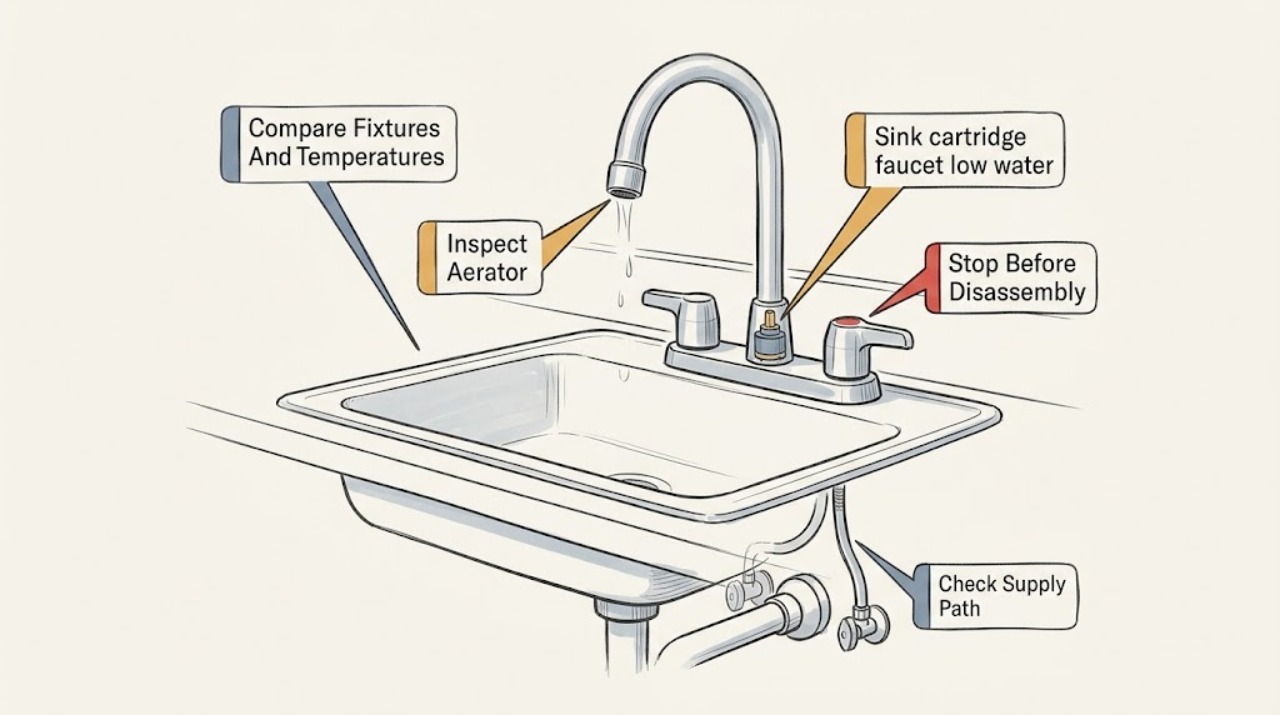
When one sink faucet has low flow but nearby fixtures are normal, start at the faucet outlet and supply path: compare hot and cold, inspect the aerator, and check that the visible shutoff valves are open without forcing them. If the aerator is clear and both sides remain weak, debris or wear in the cartridge or valve body becomes more likely. Do not assume a cartridge is the cause from the symptom alone; identify the faucet model before removing internal parts, and stop for leaks, seized valves, or work that requires uncertain disassembly.
Work through in order
Diagnostic checks
Use only checks that match the exact appliance or system and its official guide.
-
Check 1
Run the affected sink faucet briefly and compare it with another nearby fixture; then compare hot-only, cold-only, and mixed flow at the sink without holding a handle against its stop.
Expected result: The weak flow is isolated to this faucet, affects both hot and cold, affects only one temperature, or is present at multiple fixtures.
Next step: If multiple fixtures are weak, check for a broader water-supply issue or contact a plumber. If only this sink is affected, continue with the faucet-side checks.
Stop if: Stop if the flow is accompanied by discolored water, a new leak, rapidly changing pressure, or water entering the cabinet.
Why this matters
Why: An isolated both-sides symptom points toward the faucet outlet, supply path, or cartridge. One-temperature weakness points toward that side's supply or cartridge inlet. Several weak fixtures point upstream to building or branch plumbing rather than this cartridge.
-
Check 2
With the faucet off, inspect the spout aerator or screen; if it is plainly removable without force and the faucet manual permits removal, rinse the screen and reinstall it with its washer in the same order.
Expected result: The screen contains grit or scale, the stream improves after cleaning, or the aerator is captive, damaged, cross-threaded, or difficult to remove.
Next step: Run the faucet briefly and compare hot and cold again. If the aerator cannot be removed safely or the stream remains weak, do not escalate to force; continue to the visible supply checks or arrange service.
Stop if: Do not use pliers on a concealed or seized aerator, drill the spout, or omit a required screen or flow-control part.
Why this matters
Why: Debris at the outlet can make a healthy supply look like low pressure. Improvement after cleaning localizes the restriction to the aerator, while no improvement keeps the supply path or cartridge in consideration.
-
Check 3
Look beneath the sink from a dry, accessible position for the hot and cold shutoff valves, kinked flexible hoses, crushed tubing, or signs of a connection leak; confirm the valves are in their normal open position only if they turn freely by hand.
Expected result: One valve is visibly not open, a hose is sharply bent or crushed, both supply connections look normal, or there is moisture around a valve or hose.
Next step: If a valve turns freely to its normal open position and there is no leak, retest once. If a valve is seized, a hose is damaged, or any connection leaks, close the accessible main or branch isolation only if you know it, contain the water, and call a plumber.
Stop if: Do not force a valve, disconnect a pressurized hose, or work inside the cabinet while water is escaping.
Why this matters
Why: A local supply restriction can reduce flow before water reaches the cartridge. A wet connection is a leak problem, not a reason to tighten blindly; a normal-looking supply path shifts suspicion back toward the faucet internals or an upstream restriction.
-
Check 4
After the aerator and visible supply path are clear, identify the faucet brand and model and note whether low flow began after plumbing work, a supply interruption, or a cartridge service; do not remove the handle or retainer yet.
Expected result: Both temperature sides remain weak on a single-handle faucet, only one side remains weak, the faucet was recently disturbed, or the model cannot be identified.
Next step: Use the exact model instructions or provide the identification and observations to a qualified plumber. Internal cartridge removal, flushing, and replacement should be done only after the water is fully isolated and the model procedure is clear.
Stop if: Do not pry, drill, heat, or force a cartridge retainer, and do not open the faucet if the supplies cannot be completely shut off.
Why this matters
Why: Persistent both-side weakness makes cartridge or valve-body debris more plausible; one-side weakness can be an inlet restriction or a two-handle cartridge issue. Recent plumbing work increases the chance of debris, while an unknown model makes parts and disassembly uncertain.
-
Check 5
Make at most one controlled retest after a permitted aerator rinse or freely operated supply valve, then document which temperature sides changed, whether the cabinet stayed dry, and whether the faucet is a pullout, pulldown, one-handle, or two-handle design.
Expected result: Flow returns, improves only on one side, remains low, or the faucet now leaks around the spout, handle, hose, or supply connection.
Next step: If flow remains low or a leak appears, stop using the faucet as needed and call a qualified plumber with the model, photos, timing, and checks performed. Do not keep cycling the handle to compensate.
Stop if: Stop immediately for an uncontrolled leak, inability to isolate water, or any need to remove concealed or pressurized parts.
Why this matters
Why: A lasting improvement supports the cleaned or opened restriction; unchanged flow supports a cartridge, valve body, hose, or upstream diagnosis. A new leak means the last action disturbed a seal and the faucet should not be left unattended.
Use your observations
Decision map
Find the observation that best matches what you see, then follow the next safe action.
-
PATH 01Next step
What you see
The sink alone is weak on both temperatures, and the aerator contains debris or flow improves after a permitted rinse.
Do this next
Reinstall the screen and washer correctly, retest once, and replace the aerator only after matching the exact faucet model and flow design.
Why this path and its safety boundary
Why it matters: The restriction is most likely at the spout outlet rather than the cartridge.
-
PATH 02Next step
What you see
Only hot or only cold is weak, or one visible shutoff/ hose is not in normal condition.
Do this next
Do not disconnect the supply. Isolate water safely if known and call a plumber for the valve or hose.
Why this path and its safety boundary
Why it matters: The affected supply side is more likely than a whole-cartridge failure; a wet or seized valve needs plumbing service.
-
PATH 03Next step
What you see
The faucet is the only weak fixture, the aerator and visible supplies are normal, and both temperatures remain weak, especially after recent plumbing work.
Do this next
Follow the exact manufacturer procedure or have a plumber isolate, flush, and assess the cartridge; do not choose a generic replacement by appearance.
Why this path and its safety boundary
Why it matters: Debris or wear in the cartridge or valve body becomes more likely, but the exact model and shutoff condition still control the repair.
-
PATH 04Next step
What you see
Several fixtures lose flow, or the sink changes with a broader supply event.
Do this next
Check other fixtures and recent shutoff or plumbing work, then contact the responsible plumber, building maintenance, or water provider as appropriate.
Why this path and its safety boundary
Why it matters: The problem is less likely to be the sink cartridge and more likely to involve a branch, building supply, pressure-control, or utility condition.
Helpful context
Understand the symptom
Low pressure versus a local faucet restriction
A single sink faucet with weak flow is a local fixture problem until comparison shows otherwise. A clogged aerator can restrict the stream at the spout; a partly closed or obstructed supply path affects one or both temperature sides; a cartridge or valve-body restriction is farther inside the faucet. If several fixtures are weak, the faucet cartridge is less likely to be the common cause.
Keep the checks low risk
Protect the cabinet and floor with a towel, keep the handles closed before touching a supply connection, and use only the faucet's model-specific instructions for internal work. Never force a stuck shutoff, cut a hose, pry a cartridge, or continue if water cannot be isolated.
Why the cartridge is only a later suspect
The cartridge controls the faucet's hot and cold paths, but the aerator and supply valves are easier to check and can produce the same weak stream. A cartridge replacement is conditional: it should follow model identification and upstream checks, not precede them.
Safety boundary
Stop conditions
- Stop if water is entering the cabinet, a connection is spraying, or the water cannot be isolated completely.
- Do not force shutoff valves, disconnect pressurized hoses, pry cartridges, or drill or heat faucet parts.
- Do not treat one-time improvement as proof of a correct cartridge or aerator fit; recheck for leaks after any permitted work.
Only after diagnosis
Potential parts
- Match the exact spout, thread, screen, and flow design; do not remove a required flow-control part just to increase flow.
- Cartridges are model-specific; identify the faucet and follow its isolation and flushing procedure before ordering or replacing.
- Thread, length, material, and local plumbing requirements must be matched; a leaking or seized valve is a service task.
When checks do not resolve it
Need a professional?
Call when the symptom persists after safe outlet and supply observations, returns after a temporary improvement, or involves leakage, seized valves, or uncertain internal access.
Have this ready
- Faucet brand, model, and one- or two-handle design
- Whether hot, cold, or both sides are weak
- Comparison with another fixture
- Photos of the spout, aerator, cabinet valves, and hoses
- Recent plumbing work and any leak or shutoff problem
Common questions
FAQ
Could a clogged aerator look like a bad cartridge?
Yes. Both can reduce flow at the spout. An aerator is the lower-risk first check when it is safely removable; if cleaning does not help and the visible supplies are normal, the cartridge or valve body becomes more plausible.
What does it mean if only hot or only cold is weak?
Start with that side's shutoff valve and supply hose. A one-temperature symptom can also be an inlet restriction in the cartridge, but it does not by itself prove the cartridge has failed.
Should I replace the cartridge immediately?
No. Identify the faucet first and rule out the aerator, visible supply restriction, and broader water-supply problem. Choose a cartridge only when the exact model and the repair procedure are confirmed.
Read the exact guide
Official sources
- 5900 Series MT136A Two-Handle Lavatory Faucets Installation InstructionsMoen · Moen 5900 series two-handle lavatory faucet; use the installed faucet's exact instructions when available.
- High-Flow Aerator Assembly Service Kit InstructionsKohler · Kohler high-flow aerator kit; exact faucet and kit compatibility must be confirmed.
- Aerators that can Fix Low Flow issues in Kitchen FaucetsDelta Faucet · Delta kitchen faucet parts page; use the exact faucet model and product identifier.
- Low water flow from spout- BOTH hot and cold water on sink faucetsMoen Solutions · Moen's general troubleshooting page; model-specific instructions govern.
Community feedback
Share a repair observation
Share a plain-text repair observation. Accepted observations are published automatically; this page may take a moment to update.