
On this page
Start here
Quick answer
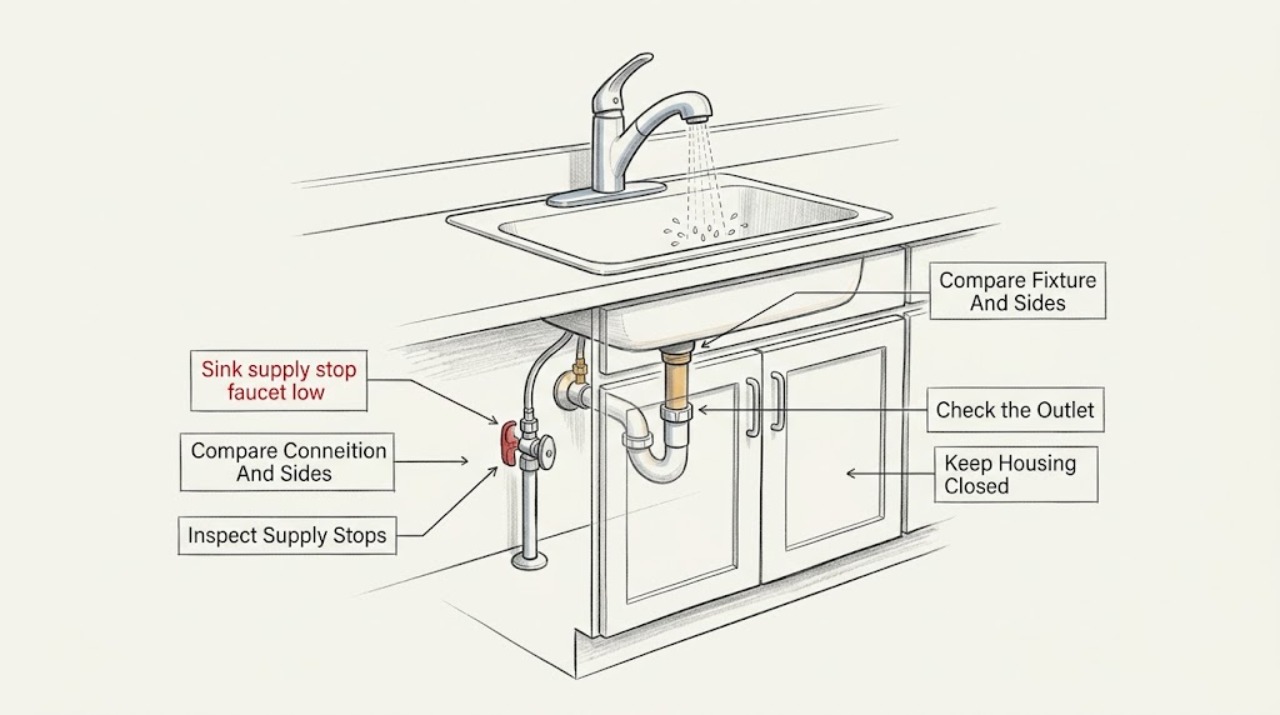
First determine whether low flow affects only this American Standard faucet or the whole sink, then compare hot and cold flow. If one side is weak, check that its accessible supply stop is fully open and not visibly leaking; if both sides are weak only at the faucet, inspect an accessible aerator or spray outlet for debris. American Standard documents model-specific aerators, cartridges, check valves, and supply connections, so do not assume a universal part. If the stop is seized, the supply connection leaks, flow remains low with the aerator removed, or the faucet needs cartridge or hose access, stop and have a plumber diagnose it. Do not force a stop, disconnect a pressurized line, or use a sharp object inside the valve.
Before you begin
Safety first
- This article covers comparing fixtures and sides, visual inspection, gentle operation of an accessible stop, and cleaning an accessible outlet only as the model instructions allow. A plumber must handle pressurized connections, seized stops, cartridge or check-valve access, faucet mounting, internal screens, and any live or concealed plumbing work.
Work through in order
Diagnostic checks
Use only checks that match the exact appliance or system and its official guide.
-
Check 1
Run the affected faucet briefly and compare its stream with another nearby fixture. Then test hot and cold separately at the same faucet without moving any connections.
Expected result: Only this faucet is weak, the whole sink is weak, both sides are weak, or only hot or only cold is weak.
Next step: Use the result to choose the next check. Do not alter the building supply or disconnect a line to compare flow.
Stop if: Stop if the faucet sprays from a connection, water enters the cabinet, or electrical equipment is wet; isolate safely and arrange plumbing service.
Why this matters
Why: A single-faucet problem points toward the faucet, its stops, hoses, outlet, cartridge, or inlet. A whole-sink or whole-home problem points upstream; one-sided weakness points toward that side's stop, hose, or valve path.
-
Check 2
Look under the sink for the hot and cold supply stops and hoses. Check for a visibly closed handle, kinked hose, wet fitting, corrosion, or a stop that will not move normally; operate a stop only gently and only if it is accessible.
Expected result: One stop appears closed or partially closed, a hose is kinked, a fitting is wet, both stops look normal, or a stop is seized or absent.
Next step: If a stop turns normally, open it gently and retest. If the hose is kinked, arrange it without stressing fittings. Arrange a plumber for a leak, seized or absent stop, or any connection that needs disassembly.
Stop if: Do not use pliers, force a valve, disconnect a supply hose, or work on a connection while pressurized.
Why this matters
Why: A closed stop or kink can restrict one side. Wetness indicates a supply-path leak. Normal-looking stops do not rule out an internal restriction, and a seized or absent stop means the faucet cannot be safely isolated for further work.
-
Check 3
If the supply path is dry and the faucet-only stream is weak, inspect the accessible aerator or spray outlet for mineral debris. Remove or rinse it only as the exact faucet instructions permit, then briefly compare flow with the outlet back in its normal position.
Expected result: The outlet contains debris and flow improves after cleaning, the stream remains weak, or removing the outlet does not improve flow.
Next step: Use only the model's specified outlet or aerator. If low flow remains, record the result and arrange model-specific diagnosis rather than probing deeper into the valve.
Stop if: Do not use needles or sharp tools inside the faucet, damage the screen, or run an open outlet where water can reach the cabinet or electrical equipment.
Why this matters
Why: Improvement after outlet cleaning makes an aerator or spray-screen restriction more likely. No improvement shifts concern upstream to the hose, stop, inlet screen, cartridge, or check valve.
-
Check 4
For a pull-out, pull-down, or spray faucet, return the head fully to its normal seat and verify the stream/spray selector is not in a restricted or pause position. Visually check the exposed hose for a kink without pulling the faucet body or hose connection.
Expected result: Only spray or stream is weak, the head is not seated, the selector is in a pause or alternate mode, the hose is kinked, or every mode is weak.
Next step: Correct only an obvious mode or seating issue. Arrange service for a kink that cannot be relieved without disconnecting the hose, a wet connection, or flow that remains weak in every mode.
Stop if: Do not disconnect a pull-down hose, pull on a stuck head, or open the faucet body under pressure.
Why this matters
Why: A selector, head, or hose restriction can reduce apparent flow without proving a cartridge fault. Weakness in every mode makes the common inlet, stop, hose, cartridge, or check-valve path more likely.
-
Check 5
If the supply stops operate normally, the outlet is clear, and flow is still low at one faucet, record the model, handle type, side affected, and all prior observations. Use the official parts or repair diagram to identify whether the faucet has a cartridge, inlet screen, or check-valve assembly before opening anything.
Expected result: The model is confirmed and its diagram identifies a serviceable valve path, or the model remains unknown and access hardware is seized or unclear.
Next step: Arrange a plumber for cartridge or internal-inlet diagnosis; provide the model and whether cleaning the outlet or opening a stop changed the flow.
Stop if: Do not pry the cartridge, force a retaining nut, twist the faucet body, or substitute a visually similar cartridge.
Why this matters
Why: A confirmed model allows a technician to distinguish cartridge, inlet, hose, and check-valve causes. An unknown model or seized access point makes generic part selection and disassembly unsafe.
Use your observations
Decision map
Find the observation that best matches what you see, then follow the next safe action.
-
PATH 01Safety boundary
What you see
Other fixtures or both hot and cold outlets at the sink are also weak.
Do this next
Check only for an obvious building-wide service interruption or accessible supply condition; arrange plumbing diagnosis if more than one fixture is affected.
Why this path and its safety boundary
Why it matters: An upstream supply, building pressure, or sink-level restriction is more likely than an American Standard faucet-only part.
Safety stop: Do not change a pressure regulator or alter building plumbing as a faucet adjustment.
-
PATH 02Safety boundary
What you see
Only hot or only cold is weak, and that side's stop is closed, the hose is kinked, or its connection is wet.
Do this next
Open a normally operating stop gently or relieve only an obvious hose bend; arrange service for leakage, corrosion, or a stop that will not operate.
Why this path and its safety boundary
Why it matters: The affected supply-stop or hose path is more likely than the common faucet outlet.
Safety stop: Do not force or disconnect the affected supply connection.
-
PATH 03Safety boundary
What you see
Flow improves when an accessible aerator or spray outlet is cleaned or returned from a restricted mode.
Do this next
Use the model-specific outlet or aerator and monitor the faucet; arrange service if the restriction returns quickly or the outlet cannot be safely serviced.
Why this path and its safety boundary
Why it matters: An outlet screen, aerator, or selector restriction is more likely than a cartridge or supply-stop fault.
Safety stop: Do not probe the valve with sharp tools or damage the screen.
-
PATH 04Safety boundary
What you see
Both sides are weak at this faucet, the stops are dry and open, the hose and mode are normal, and outlet cleaning does not restore flow.
Do this next
Arrange model-specific plumbing service and provide the faucet model, handle type, and controlled test results.
Why this path and its safety boundary
Why it matters: A common inlet, cartridge, check-valve, or internal passage restriction is more likely than the supply stop alone.
Safety stop: Do not open the cartridge or remove retaining hardware unless the water is confirmed isolated and the exact model procedure is being followed by a qualified person.
-
PATH 05Safety boundary
What you see
A stop is seized or absent, a connection leaks, the faucet body moves, the model is unknown, or internal access requires force.
Do this next
Keep the affected supply isolated only if it can be done gently, protect the cabinet, and have a plumber establish isolation and diagnose the faucet.
Why this path and its safety boundary
Why it matters: Safe isolation and part identification are unresolved; forcing access can create a larger water leak.
Safety stop: Do not use tools to force the stop, disconnect pressurized lines, pry the cartridge, or twist the faucet body.
Helpful context
Understand the symptom
A supply-stop problem looks different from an outlet restriction
If other fixtures have normal flow but one sink faucet is weak, start at the faucet and its two supply paths. Compare hot and cold separately, then observe whether the stream improves when an accessible aerator or spray outlet is removed according to the faucet instructions. A faucet-wide loss with both sides affected can also involve a stop, hose, inlet screen, cartridge, or check valve; the first result only narrows the path.
American Standard parts are model-specific
American Standard lists pressure-compensating aerators for particular faucet families and lists ceramic cartridges and integral check valves on particular kitchen-faucet models. Those pages are useful for identifying component categories, not for proving that a part fits an unidentified sink faucet. Record the model and use the manufacturer's parts or repair diagram before ordering anything.
Treat the supply stop as an isolation device, not a throttle
A partially closed stop can restrict one faucet, but a stop that is stiff, corroded, or leaking can fail when forced. American Standard's installation guidance for a specific faucet starts with turning off hot and cold water supplies before service access. If the stop cannot be operated gently or the hose connection will not remain dry, leave the faucet alone and have a plumber establish safe isolation and inspect the supply path.
Safety boundary
Stop conditions
- Isolate the affected water supply and arrange prompt plumbing service for a spray, cabinet leak, wet supply fitting, or water near electrical equipment.
- Do not force a seized supply stop, disconnect a pressurized hose, pry a cartridge, twist the faucet body, or open internal parts without confirmed isolation.
- Do not use needles, abrasive tools, heat, or unapproved chemicals in an aerator, cartridge, seal, or drinking-water passage.
- Do not select a replacement aerator, cartridge, hose, or check valve from appearance alone; confirm the exact model and manufacturer's parts information.
Only after diagnosis
Potential parts
- American Standard faucet aerator or spray outlet
Consider this category only when flow improves with outlet cleaning or the exact model's parts information identifies a restricted or damaged aerator or spray outlet.
Confirm the exact American Standard model, outlet thread or assembly, flow specification, and manufacturer's fit information before ordering. - American Standard faucet cartridge or valve assembly
Consider this category only when both sides remain weak after supply-stop, hose, mode, and outlet checks and a technician confirms an internal valve restriction for the exact model.
Confirm the exact model, handle configuration, cartridge design, seals, and manufacturer's fit information before ordering. - American Standard faucet supply hose or stop valve
Consider this category only when the affected supply side has a confirmed kink, leak, failed stop, or restricted hose path after safe isolation.
Confirm the exact connection type, hose length, valve specification, and manufacturer's or plumbing-code fit information before ordering; pressurized work is professional service. - American Standard faucet check valve or inlet screen
Consider this category only when a technician confirms that the exact faucet's common inlet, check valve, or screen is restricting flow after external checks are normal.
Confirm the exact model, assembly location, flow direction, and manufacturer's fit information before ordering.
When checks do not resolve it
Need a professional?
Safety scope: This article covers comparing fixtures and sides, visual inspection, gentle operation of an accessible stop, and cleaning an accessible outlet only as the model instructions allow. A plumber must handle pressurized connections, seized stops, cartridge or check-valve access, faucet mounting, internal screens, and any live or concealed plumbing work.
Common questions
FAQ
Why is my American Standard sink faucet water pressure low?
Compare other fixtures and hot versus cold first. A single-side issue points toward that side's supply stop or hose; a faucet-only issue can involve an aerator, spray outlet, cartridge, inlet, or check valve. A whole-sink or whole-home issue is upstream of the faucet.
Can a supply stop cause low flow at one sink faucet?
Yes, a closed, restricted, kinked, or leaking supply path can affect one side or one faucet. Operate an accessible stop only gently; if it is seized, absent, or leaks, do not force it or disconnect the hose.
Could the American Standard aerator be causing low flow?
An outlet screen or aerator can restrict or distort the stream. Clean or remove it only as the exact faucet instructions allow. If flow does not improve with the outlet clear, the restriction is more likely in the supply, hose, inlet, cartridge, or check-valve path.
How do I know which American Standard faucet cartridge or valve part fits?
Identify the exact model and handle or spray configuration first. American Standard lists different cartridges, aerators, hoses, and check-valve arrangements by faucet family; brand name and appearance alone do not prove compatibility.
When should I call a plumber for low faucet pressure?
Call when low flow remains after safe stop, hose, mode, and outlet checks; when a stop or connection leaks or will not close; when more than one fixture is affected; or when cartridge, inlet, check-valve, or pressurized supply access is required.
Read the exact guide
Official sources
- Chatfield® Single-Handle Pull-Out Kitchen FaucetAmerican Standard · Official product page for one Chatfield pull-out faucet; component details cannot be generalized to an unidentified faucet.
- American Standard Parts StoreAmerican Standard · Official parts resource; model identification remains necessary for any faucet supply or valve component.
- Pc Aerator 55/64 FemaleAmerican Standard · Official American Standard parts page for a Cadet lavatory faucet; it demonstrates model-specific outlet selection and is not a universal sink-faucet fit claim.
- Faucet Replacement Valve Cartridge for 2-Handle FaucetsAmerican Standard · Official American Standard parts page for many two-handle kitchen and bath faucets; it is not evidence of fit for an unidentified faucet.
- How To Replace The Hand Spray Diverter For Your Colony Soft FaucetAmerican Standard · Official instructions for a Colony faucet design; used only for the isolation and model-specific service boundary.
Community feedback
Share a repair observation
Share a plain-text repair observation. Accepted observations are published automatically; this page may take a moment to update.