
On this page
Start here
Quick answer
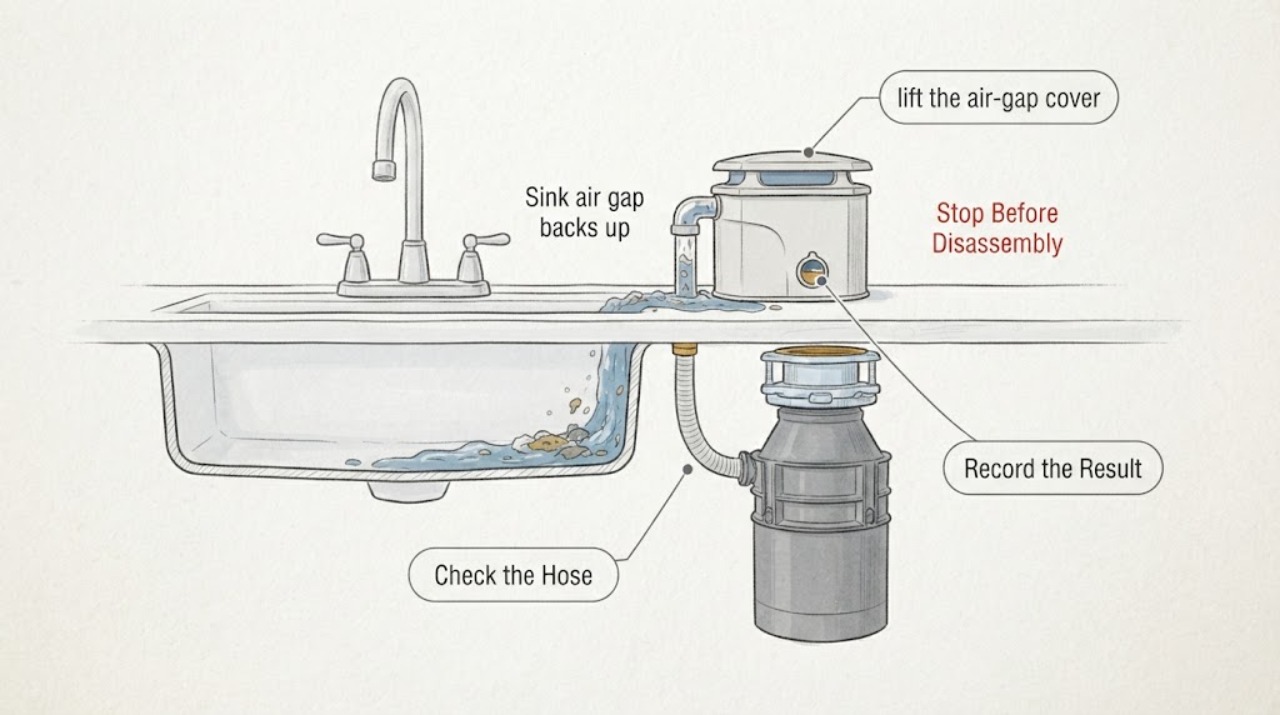
When an American Standard sink air gap backs up as the garbage disposal runs, the restriction is usually in the air-gap outlet path, the disposal inlet, or the shared drain—not necessarily in the air-gap cap itself. Stop the disposal and keep hands out of it. Once water has stopped and there is no active leak, visually check the air-gap cover and cap for debris, then inspect the outlet hose for a kink, sag, crushed section, loose clamp, or blocked connection to the disposal. GE's air-gap guidance specifically calls for clearing the air gap and checking the hose to the sink drain or disposal. If the sink or disposal remains backed up, the hose connection is inaccessible, or the symptom returns after visible debris is removed, stop using the disposal and have a qualified plumber clear and verify the drain path.
Before you begin
Safety first
- A qualified plumber should distinguish a cap or hose restriction from a disposal inlet, trap, shared drain, venting, or installation fault before selecting a replacement fitting or hose.
Work through in order
Diagnostic checks
Use only checks that match the exact appliance or system and its official guide.
-
Check 1
Stop the garbage disposal and watch the air gap, sink basin, and visible hose area until water stops moving; do not put hands into the disposal or reach through standing water.
Expected result: Water spills from the air gap while the sink or disposal side also remains slow, or water leaks from an under-sink connection.
Next step: Do not run the disposal again. Continue only with a dry, visual inspection; call a qualified plumber if water remains, a connection is leaking, or the blockage is not visibly accessible.
Why this matters
Why: A restriction may be downstream of the air gap or at a shared drain connection, rather than only in the removable air-gap cap.
-
Check 2
With no active odor or standing water at the opening, lift the air-gap cover and remove the top cap only if the exact American Standard or installed air-gap instructions allow it; rinse the cap and remove visible food debris without probing deeper passages.
Expected result: Food particles or sludge are present in the cap or air-gap body, and the cover can be replaced without forcing it.
Next step: Replace the cap and cover as instructed, then leave the disposal off until the outlet hose and drain path have also been checked. If the backup returns, use the service branch rather than repeating the cycle.
Why this matters
Why: The air gap itself may have been restricted by debris, which can divert discharge upward instead of through the outlet hose.
-
Check 3
From outside the disposal chamber, follow the hose leaving the air gap to the disposal inlet and visually check for a kink, crushed section, low sag, loose clamp, or a connection that has come off; do not pull hard on the fittings.
Expected result: The hose is sharply kinked, sagging, crushed, disconnected, or the outlet connection is visibly restricted.
Next step: Do not run the disposal with the restriction present. Have a plumber or qualified installer correct the route and verify the connection against the exact model instructions.
Why this matters
Why: The outlet route can be restricted even when the air-gap cap is clean; the disposal's discharge then has nowhere to go except back through the air gap.
-
Check 4
Compare the symptom with the disposal and sink off: note whether the sink drains freely, whether only the disposal-side drain is slow, and whether the air gap backs up only when the disposal runs or also when the sink drains by gravity.
Expected result: The sink is slow even with the disposal off, or the air gap backs up whenever the shared drain is used.
Next step: Stop using the disposal and arrange qualified plumbing service to clear and verify the shared drain. Do not use chemical drain opener or dismantle an unfamiliar connection as a substitute for diagnosis.
Why this matters
Why: A trap or downstream kitchen-drain restriction is more likely than an air-gap cap blockage alone.
-
Check 5
Record the American Standard sink or fixture model information, the air-gap brand or markings if visible, where the outlet hose joins the disposal or drain, and whether the installation or disposal was recently changed.
Expected result: The model or installation history is available, or the connection does not match the current instructions.
Next step: Give the model and connection details to American Standard support or a qualified plumber. Do not make a new disposal or drain connection based on a generic diagram.
Why this matters
Why: A recent installation can leave a knockout, hose route, clamp, or drain connection incomplete; the exact product documentation is needed before modifying it.
Use your observations
Decision map
Find the observation that best matches what you see, then follow the next safe action.
-
PATH 01Next step
What you see
The air-gap cap contains debris, the visible outlet path is otherwise intact, and the sink drains normally when the disposal is off.
Do this next
Clean and reseat the cap only under the installed instructions, keep the disposal off until the path is dry, and stop if the backup returns.
-
PATH 02Next step
What you see
The air-gap cap is clear but the outlet hose has a kink, low sag, crushed section, loose clamp, or a visibly restricted disposal connection.
Do this next
Do not run the disposal until a qualified plumber or installer corrects and verifies the hose and connection against the exact instructions.
-
PATH 03Next step
What you see
The sink or disposal-side drain is slow even when the disposal is off, or several drain uses cause the air gap to overflow.
Do this next
Stop using the disposal and have a qualified plumber clear the shared drain and check for leaks before use resumes.
-
PATH 04Next step
What you see
The issue began after a new disposal or sink installation, the outlet connection is hidden or altered, or water continues to leak after accessible cleaning.
Do this next
Leave the disposal off, avoid disassembly, and arrange qualified plumbing service using the American Standard model information and installation history.
Helpful context
Understand the symptom
Why the disposal exposes the restriction
The disposal sends discharge into the shared sink drain path. If the air-gap outlet hose, disposal inlet, trap, or downstream drain cannot pass that flow, water can rise through the air gap and spill into the sink. A clear air-gap cap does not prove the outlet path is clear, so note exactly where water first appears and whether the sink itself drains normally when the disposal is not running.
Stay on the accessible side of the plumbing
Only inspect the cover, cap, and visible hose after the disposal is off and the water has stopped. Do not put hands into the disposal, remove its housing, loosen an unknown drain connection, or use a chemical drain opener to force a diagnosis. American Standard model documentation and local plumbing requirements control any connection change.
Only after diagnosis
Potential parts
- air-gap cap or air-gap body
Consider this category only if the installed air-gap cap or body is damaged or remains obstructed after qualified diagnosis confirms it is the restriction.
Confirm the exact air-gap and sink model and official fit information; an overflowing air gap can be caused by the outlet drain path instead. - air-gap-to-disposal drain hose and clamps
Consider this category only if the visible hose is damaged, kinked beyond correction, disconnected, or incorrectly routed and a qualified installer confirms replacement is needed.
Verify the hose route, connection sizes, clamps, disposal inlet, and local plumbing requirements for the exact installation before ordering.
When checks do not resolve it
Need a professional?
Stop using the disposal and call a qualified plumber when water continues to back up, an under-sink connection leaks, the sink is slow with the disposal off, the outlet route is concealed or altered, or cleaning the accessible air-gap cap does not resolve the symptom. Do not put hands into the disposal, use chemical drain opener to force a diagnosis, remove the disposal housing, or change the air-gap connection without exact model and local plumbing guidance.
Safety scope: A qualified plumber should distinguish a cap or hose restriction from a disposal inlet, trap, shared drain, venting, or installation fault before selecting a replacement fitting or hose.
Common questions
FAQ
Why does my sink air gap back up when the disposal runs?
The disposal may be pushing discharge into a restricted path. Check the air-gap cap for debris and the visible outlet hose for a kink, sag, loose connection, or blockage; a trap or shared drain restriction can also cause the overflow.
Can I clean an air gap without replacing it?
Often, visible debris in the removable cover or cap can be cleared after the water stops, following the installed instructions. Cleaning the top does not clear a blocked outlet hose or downstream drain, so stop if the backup returns.
What if the air-gap cap is clean but water still backs up?
Inspect the visible route from the air gap to the disposal for a kink, low sag, crushed hose, or loose clamp. If the sink is slow even with the disposal off, or the route is concealed, stop using the disposal and call a qualified plumber.
Should I buy an American Standard air-gap part for this symptom?
Not from the symptom alone. Confirm the installed air-gap and sink models, determine whether the restriction is in the cap, hose, disposal inlet, or shared drain, and use American Standard's model documentation before selecting any replacement fitting.
Read the exact guide
Official sources
- Waste FittingAmerican Standard · American Standard product identification for sink drain fittings and model-specific component context
- SupportAmerican Standard · American Standard support route for product diagrams, manuals, warranty information, and model-specific assistance
- 400-0650-010AIR GAP INTERNATIONAL · Manufacturer installation and maintenance guidance for air-gap hose routing, outlet connection, debris cleaning, and disposal inlet safety
- Dishwasher - Cleaning the Air GapGE Appliances · General manufacturer guidance for identifying an air gap, clearing debris, and checking its hose to a sink drain or garbage disposal
Community feedback
Share a repair observation
Share a plain-text repair observation. Accepted observations are published automatically; this page may take a moment to update.