
On this page
Start here
Quick answer
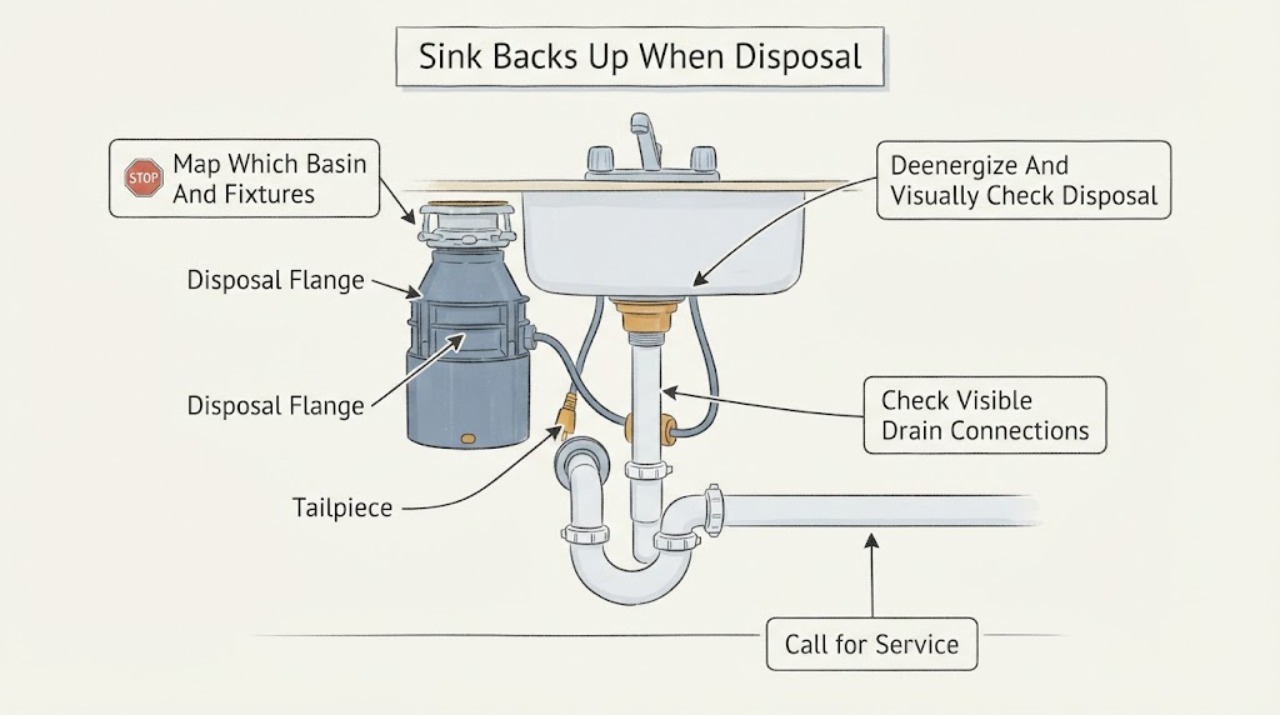
If a Delta sink rises or backs up when the garbage disposal runs, the disposal is moving water into a drain path that is restricted, or the disposal itself is jammed or not moving water as expected. First stop adding water and compare whether one basin or both basins rise, whether the disposal runs normally or only hums, and whether another nearby fixture drains slowly. Delta's sink guidance shows that a compatible disposal replaces the supplied sink strainer; the backup diagnosis then depends on the disposal model and the connected drain path. Turn the disposal switch off, disconnect power before looking or reaching near the opening, and never put a hand into the grinding chamber. If the disposal runs and water swirls without draining, use only the disposal maker's safe clog procedure; persistent, deep, leaking, or multi-fixture backups need a qualified plumber. Do not pour chemical drain cleaner into the disposal or force the unit to run against standing water.
Work through in order
Diagnostic checks
Use only checks that match the exact appliance or system and its official guide.
-
Check 1
Stop adding water and note the pattern without running the disposal again: does only the disposal basin rise, does the other basin rise too, does water appear at the sink connection or cabinet, and do a nearby faucet or another drain also move slowly? Record whether the backup begins immediately or only after the disposal has run for a while.
Expected result: Only the disposal basin rises; both sink bowls rise; water leaks under the sink; or several nearby fixtures drain slowly or back up.
Next step: Use the matching branch and keep the disposal off while water is standing. Do not add more water to determine how high the backup goes.
Stop if: Stop for water near an electrical receptacle, an active cabinet or wall leak, sewage-colored water, an overflowing sink, or a drain that cannot be isolated safely.
Why this matters
Why: A single-basin response points toward the disposal outlet or its immediate drain path. Both bowls rising suggests a restriction farther along the shared trap or branch. A cabinet leak may be a failed connection or seal. Multiple slow fixtures make a shared downstream or building drain problem more likely.
-
Check 2
Turn the disposal wall switch off and disconnect its power according to the disposal's instructions before looking into the opening. Use a flashlight from above and keep hands out of the chamber. If a plainly visible object is reachable with tongs and the exact manual permits removal, remove it only with power isolated; do not force the grinding plate or insert a hand.
Expected result: The disposal contains a visible foreign object; the chamber looks clear; the motor previously hummed or stopped; or power cannot be isolated confidently.
Next step: Follow the exact disposal manual's jam or overload procedure only if it is explicitly intended for the model. If there is no model-specific safe procedure, the motor remains abnormal, or power cannot be isolated, arrange service.
Stop if: Never put a hand into the disposal, work with power connected, use a knife or sharp tool, or continue after damaged wiring, a burnt odor, a cracked housing, or an object that cannot be safely reached.
Why this matters
Why: A visible object or a hum without normal grinding makes a local jam or overload more likely, but it does not explain every sink backup. A clear chamber with a motor that ran normally makes a drain-line restriction more likely. Uncertain isolation is a safety stop.
-
Check 3
With the disposal off and the cabinet dry enough to inspect, look at the disposal discharge connection, sink tailpiece, trap, and visible branch pipe. Check for a loose slip joint, a collapsed or displaced washer, standing water, a kinked connected hose, or a recent under-sink change. Do not loosen a trap full of water or disconnect the disposal.
Expected result: A joint is visibly leaking or displaced; a recent disposal or sink installation preceded the problem; the visible connections look intact; or the restriction appears beyond the accessible trap.
Next step: Place a container under a minor accessible drip only if doing so does not require loosening anything, keep the disposal off, and arrange plumbing service for a leaking joint, concealed clog, or recent installation-related backup.
Stop if: Stop for an active leak, corroded or seized fittings, water near electrical equipment, a cabinet that cannot support access, or any need to remove the trap, flange, disposal, or wall pipe.
Why this matters
Why: A local connection leak or recent installation change can obstruct or misroute drainage. Intact visible connections do not rule out food buildup inside the trap, a downstream clog, or a disposal discharge problem. A restriction beyond the trap is not safely identified by looking at the cabinet alone.
-
Check 4
If the disposal is de-energized, there is no electrical or leak hazard, and the sink is suitable for it, use only the disposal manufacturer's gentle plunger procedure for a shallow clog. On a double-bowl sink, seal the other opening as directed. Do not use chemical drain cleaner, do not plunge against an unsecured disposal, and do not test by repeatedly running the motor while water is backed up.
Expected result: Water drains after a gentle, approved plunger check; the basin remains full; water returns immediately; or pressure escapes at a joint or the other bowl.
Next step: After the basin is empty, follow the disposal manual's brief cold-water test only if the unit is undamaged and the drain is flowing. If the backup returns, leave the disposal off and call a qualified plumber.
Stop if: Stop for a full sink that will not drain, sewage backup, a leak, a disposal that moves or hums abnormally, chemical residue, or any need to use a snake or remove plumbing.
Why this matters
Why: Improvement supports a shallow restriction near the disposal or sink drain but does not prove the line is clear. No improvement, immediate return, or pressure escaping at a connection makes a deeper clog, failed connection, or shared branch issue more likely.
-
Check 5
Record the Delta sink model if visible, disposal make and model, single- or double-bowl layout, whether the motor runs, the sound, backup timing, visible connection condition, recent installation work, and whether other fixtures are affected. Photograph only visible labels and dry conditions without removing parts.
Expected result: The sink backs up again after a shallow check; both bowls or multiple fixtures are affected; water leaks; the disposal hums, trips, or will not run; or the clog appears downstream.
Next step: Keep the disposal off, limit water use on the affected branch, and arrange qualified plumbing or appliance service as appropriate. Provide the model, symptom timing, and any safe observations.
Stop if: Do not repeatedly reset or run the disposal, disconnect plumbing while full, use chemical cleaner, reach into the chamber, or continue around active water damage or electrical hazards.
Why this matters
Why: The problem may involve the disposal's discharge, a trap or branch restriction, a failed seal, an electrical or motor fault, or a shared drain. The sink brand and a backup symptom alone cannot identify a compatible disposal part or safe repair.
Use your observations
Decision map
Find the observation that best matches what you see, then follow the next safe action.
-
PATH 01Next step
What you see
Do this next
Keep power isolated, inspect only from above for a visible obstruction, and use the disposal maker's model-specific clog procedure. Call service if the chamber is clear or the backup returns.
Why this path and its safety boundary
Why it matters: A restriction at the disposal outlet, discharge connection, immediate tailpiece, or disposal chamber is more likely than a whole-branch clog.
-
PATH 02Next step
What you see
Do this next
Do not keep running the disposal. A gentle approved plunger check may be reasonable only with power isolated and the other opening sealed; persistent or deep blockage needs a qualified plumber.
Why this path and its safety boundary
Why it matters: The restriction is more likely in the shared trap, branch, or downstream drain rather than only in the disposal chamber.
-
PATH 03Next step
What you see
Do this next
Switch off and disconnect power, keep hands out, and follow only the exact model's safe jam procedure. Arrange service if the unit remains abnormal or the drain is still blocked.
Why this path and its safety boundary
Why it matters: A jam, overload, motor, or electrical problem may be present in addition to a drain restriction. A disposal that does not operate normally cannot be used as a drain-clearing tool.
-
PATH 04Next step
What you see
Do this next
Limit water use on the affected branch and arrange qualified plumbing diagnosis. Do not attempt to push the obstruction farther downstream with repeated disposal cycles.
Why this path and its safety boundary
Why it matters: A shared branch, main drain, or building plumbing restriction is more likely than a Delta sink or disposal flange issue.
-
PATH 05Next step
What you see
Do this next
Keep the disposal and water off, photograph the visible connection and model information, and arrange qualified plumbing service or installer review. Do not loosen a full trap or disposal mount.
Why this path and its safety boundary
Why it matters: An incorrectly seated strainer or disposal flange, displaced seal, misaligned drain connection, or installation-related restriction is possible. A Delta sink page confirms a disposal replaces the supplied strainer on its documented model, but it does not establish correct installation for every sink.
Helpful context
Understand the symptom
A backup when the disposal runs usually points beyond the sink basin
The disposal sends water and ground food waste into the drain connection below the sink. If the outlet, tailpiece, trap, or downstream line cannot carry that flow, water can rise in the basin. A disposal that only hums or stops has a different path: it may be jammed, overloaded, or not moving water. Whether one bowl or both bowls rise, and whether other fixtures drain slowly, helps separate a local restriction from a shared drain problem.
Protect the disposal before any inspection
Do not keep switching on a disposal against standing water. Turn off its wall switch and isolate electrical power before looking into the opening or removing any visible object, and never use a hand inside the chamber. The disposal's own instructions take priority because jam-release and reset features vary by model. A Delta sink's disposal flange is an interface detail, not permission to loosen the flange, trap, or discharge connection while water is present.
Use only gentle, model-appropriate drain checks
If the disposal is safely de-energized and the sink configuration permits it, a gentle plunger check may help with a shallow drain restriction; a double-bowl sink requires the other opening to be sealed so pressure is directed toward the drain. Do not use chemical cleaner, sharp tools, or force on the disposal. If water remains, a connection leaks, the clog is deep, or the disposal cannot be isolated, stop and arrange plumbing service.
Safety boundary
Stop conditions
- Stop water and isolate the disposal for an active leak, sewage backup, uncontrolled overflow, water near electrical equipment, or cabinet or wall water damage; obtain urgent help when the leak cannot be contained safely.
- Never put a hand into the disposal or work inside it with electrical power connected; use only the exact disposal manual's safe obstruction procedure.
- Do not keep running the disposal against standing water, repeatedly reset a humming or tripping unit, or use chemical drain cleaner, sharp tools, or force.
- Do not loosen a trap, flange, discharge connection, or wall pipe while it is full or pressurized, and stop if fittings are corroded, seized, damaged, or cannot be isolated.
- Arrange qualified plumbing service when a shallow approved check does not restore drainage, the backup affects both bowls or multiple fixtures, or diagnosis requires downstream drain, disposal, electrical, or installation work.
Only after diagnosis
Potential parts
- Disposal discharge connection, sink flange, gasket, or splash baffle
Consider this part class only when qualified inspection finds a leaking, displaced, damaged, or incompatible disposal-to-sink connection after the drain path is shown to flow.
Flange dimensions, gasket arrangement, baffle, sink opening, and mounting system vary by sink and disposal; match the complete installed models and instructions. - Sink tailpiece, P-trap, or drain connection
Consider this part class only when a visible or professional inspection confirms a cracked, obstructed, misaligned, or leaking connection is causing the backup.
Pipe size, material, configuration, dishwasher branch, and local installation requirements vary; do not select a replacement from appearance alone. - Garbage disposal jam, overload, or motor component
Consider this part class only when the disposal hums, stops, trips, or fails to grind and qualified diagnosis confirms a component fault after safe power isolation.
Motor, overload protector, grinding assembly, wiring, and service procedure are disposal-model-specific; never order or install a component from a backup symptom alone.
When checks do not resolve it
Need a professional?
Call a qualified plumber when the backup returns after an approved shallow check, both bowls or multiple fixtures are affected, the clog appears downstream, a connection leaks, the disposal hums or trips, or work requires removing the disposal, trap, flange, or wall pipe. Seek urgent help for sewage backup, uncontrolled water, active cabinet or wall damage, or water near electrical equipment.
Have this ready
- Delta sink model or visible product identifier and single- or double-bowl layout
- Disposal make and model, if visible without disturbing the unit
- Which basin rises, when the backup starts, and whether the motor runs, hums, stops, or trips
- Nearby fixture drainage results and visible flange, discharge, trap, or cabinet leak observations
- Recent sink or disposal installation, power isolation status, chemical exposure, or water-damage observations
Common questions
FAQ
Why does my Delta sink back up only when the disposal runs?
The disposal is likely sending water into a restricted outlet, trap, branch, or downstream drain, or the disposal may be jammed and not moving water normally. Compare one versus both bowls and nearby fixtures, keep the disposal off while water is standing, and use only the disposal maker's safe clog procedure.
Is the Delta sink itself causing the backup?
Usually the sink brand alone does not identify the cause. Delta's product guidance describes a disposal replacing the supplied strainer on its documented sink, so the practical diagnosis is the disposal flange, discharge connection, trap, branch, or downstream drain. The exact sink and disposal installation instructions control.
Can I put my hand into the disposal to remove food?
No. InSinkErator explicitly warns against placing a hand inside the disposal. Switch off and isolate power first, use only the exact model's safe tool or tongs procedure if documented, and arrange service when the object or jam cannot be safely reached.
Should I use chemical drain cleaner for a disposal backup?
Do not use it as a first response. Chemical residue can create a hazard during later disposal or drain work and does not identify whether the clog is in the chamber, trap, or downstream line. Keep power off, follow an approved gentle clog check if safe, and call a plumber for a persistent or deep restriction.
When should a sink backup become a plumbing service call?
Arrange service when the backup returns, both bowls or multiple fixtures are affected, the disposal hums or trips, a connection leaks, water is near electrical equipment, or the restriction appears beyond the visible trap. A deep clog or internal disposal fault needs model-appropriate professional diagnosis.
Read the exact guide
Official sources
- Fixing a Clogged Garbage DisposalInSinkErator · Official InSinkErator guidance used for generic symptom interpretation and a model-family clog procedure; apply it only when the installed unit's instructions and sink configuration permit it.
- 32” Workstation Kitchen Sink Undermount Stainless Steel Single Bowl with WorkFlow™ Ledge and Accessories in Stainless Steel 95B932-32S-SSDelta Faucet Company · Official Delta page for the documented Lorelai workstation sink; used narrowly for the disposal-to-strainer interface and not as proof of a universal drain layout or backup cause.
- InSinkErator Garbage Disposal Installation and Troubleshooting | InSinkErator USInSinkErator · Official InSinkErator support hub used for general disposal troubleshooting pathways; the installed disposal manufacturer's manual controls the specific model and safety procedure.
- Disposal and Flange Stopper - Kitchen in Black Stainless 72030-KS | Delta FaucetDelta Faucet Company · Official Delta disposal-flange product page used only to distinguish the sink flange interface from the disposal's own drain mechanism; it does not establish compatibility with an unspecified disposal or diagnose a backup.
- Fixing a Jammed Garbage DisposalInSinkErator · Official InSinkErator guidance used for safety boundaries around a jammed disposal; the listed procedure is model-family-specific and must not be assumed for an unspecified disposal.
Community feedback
Share a repair observation
Share a plain-text repair observation. Accepted observations are published automatically; this page may take a moment to update.