
On this page
Start here
Quick answer
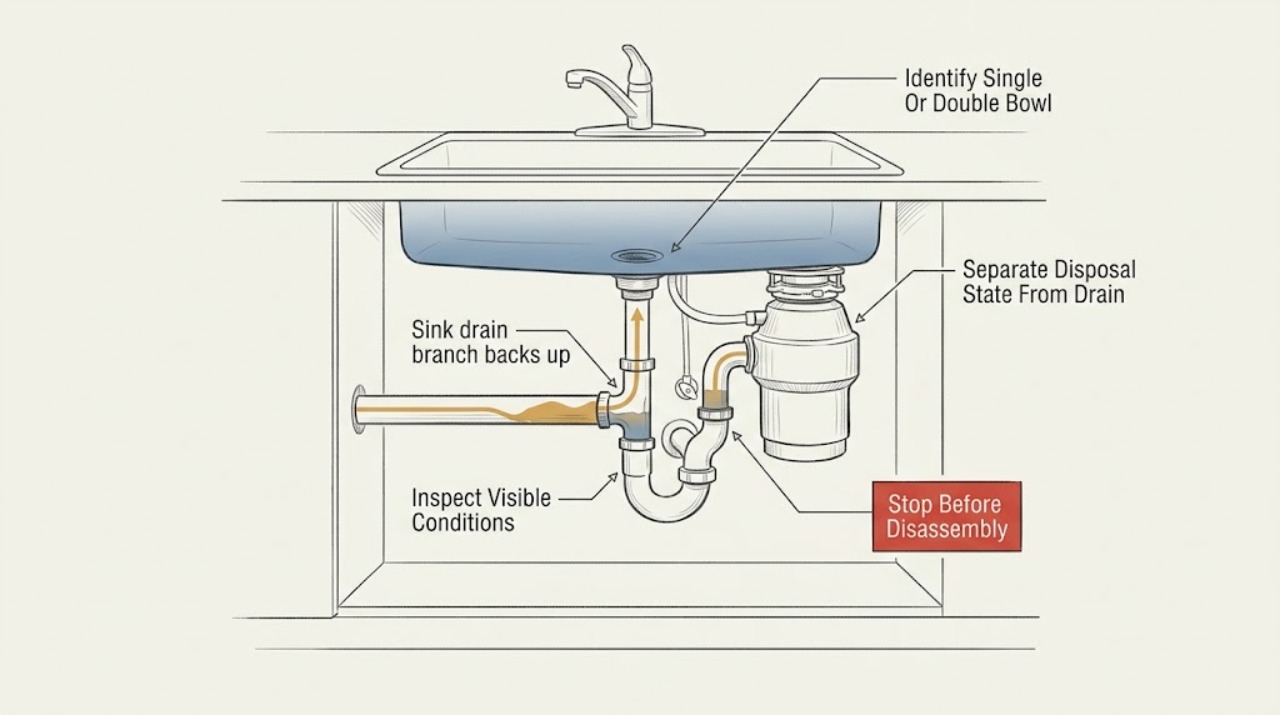
When an American Standard sink branch backs up only while the garbage disposal runs, the usual focus is the shared drain path: the disposal can move water and ground waste into a branch that has a partial obstruction, a restricted trap or tailpiece, a poor connection, or a downstream blockage. Stop grinding, keep hands out of the disposal opening, and clear standing water safely before inspecting the visible area. Note whether the disposal actually runs, whether the opposite bowl rises, whether water drains slowly with the disposal off, and whether any under-sink joint leaks. A brief, normal-use observation can distinguish a branch restriction from a jammed or non-running disposal, but do not loosen drain joints full of water, use harsh chemical drain cleaner, reach into the unit, or keep running it against a rising water level. If both bowls remain full, water leaks from the disposal or trap, the disposal hums or trips power, or the blockage is beyond the accessible trap, stop and call a qualified plumber or appliance service.
Work through in order
Diagnostic checks
Use only checks that match the exact appliance or system and its official guide.
-
Check 1
Turn the disposal control off, stop adding water or food, and keep hands and objects out of the disposal opening. From a dry, stable position, observe the water level in each sink bowl and let the area stand without repeatedly running the disposal.
Expected result: Record whether the disposal bowl, the opposite bowl, or both bowls are holding water; whether the level falls by itself; and whether a drip continues below the sink with all controls off.
Next step: Keep the disposal off and use the water-level pattern to choose a branch. Move to service promptly for a full standing-water condition, active leak, or water that is not falling.
Stop if: Stop for active flow, water near electrical equipment, an unsafe cabinet floor, sewage-like overflow, or any need to reach into standing water around the disposal.
Why this matters
Why: A level that rises during disposal operation and drains slowly afterward supports a restricted drain path. Both bowls staying full or a continuing under-sink drip raises the urgency and may indicate a larger blockage or leak. A disposal that never ran is a separate appliance-state problem.
-
Check 2
With the disposal off, identify whether the sink has one bowl or two and note which bowl is connected to the disposal. Inspect only the visible strainer, tailpiece, trap, disposal discharge, and branch fittings with a flashlight; do not loosen a joint or remove a full trap.
Expected result: A double-bowl sink sends water into the opposite bowl, the disposal bowl alone rises, or both bowls rise together; note any compression nut, discharge elbow, gasket, or trap that is visibly wet or misaligned.
Next step: Photograph the bowl pattern and first wet fitting, then continue only with the no-disassembly checks below. Use the corresponding branch if both bowls are affected or a joint is leaking.
Stop if: Do not put a hand, tool, drain snake, or chemical into the disposal or loosen a trap, discharge elbow, or connection while it may contain standing water.
Why this matters
Why: Crossing into the opposite bowl points toward a restriction after the two branches meet. A disposal bowl that rises alone can still be a restriction at the disposal outlet or its immediate branch. A visible joint leak is not solved by plunging or running the disposal and may need a plumber.
-
Check 3
From outside the sink opening, note the disposal's behavior only if there is no active overflow, electrical concern, unusual heat, burning smell, or known obstruction. Do not reach into it. The relevant observations are smooth motor operation, a hum without normal rotation, silence, repeated stopping, or a power trip.
Expected result: The motor runs normally while water rises, or the disposal hums, stays silent, stops, or trips power before the backup can be observed.
Next step: For normal operation, leave the disposal off and evaluate the drain branch. For humming, silence, repeated stopping, or a power trip, cut off use and follow the exact installed disposal manual or call appliance service; have plumbing checked if water remains backed up.
Stop if: Do not press a reset, turn a grinding plate, insert a wrench, pull an object, or restore power unless the exact model's instructions make that procedure safe and the power-isolation step is understood; otherwise stop and call service.
Why this matters
Why: Normal operation with rising water keeps the shared drain path high on the list. Humming, silence, repeated stopping, or a trip points toward a jam, overload, control, or electrical issue and does not justify repeated start attempts. A disposal fault can coexist with a drain restriction.
-
Check 4
Place a dry disposable towel or paper under the accessible drain fittings without wrapping it around moving parts. With the disposal and faucet off, observe the discharge connection, elbow, trap, tailpiece, and nearby sink drain for a new wet spot; do not fill the sink or run the disposal to force a leak.
Expected result: Water marks the disposal discharge, gasket area, elbow, trap, tailpiece, or sink drain connection, or all visible joints remain dry while the backup occurs.
Next step: Keep the cabinet dry and photograph the first wet location. Arrange service for a leaking disposal or drain joint, especially if the leak reaches the cabinet base; do not tighten a full or damaged connection by guesswork.
Stop if: Stop for cabinet flooding, a cracked fitting, a loose disposal mount, corrosion, water near wiring, or any need to remove the disposal or trap.
Why this matters
Why: A wet discharge, gasket, elbow, trap, or tailpiece is a leak path that can also admit air or disturb drainage and needs the correct model-specific connection repair. Dry visible joints shift suspicion toward an internal or downstream blockage, but do not rule out a concealed leak.
-
Check 5
Review what changed immediately before the backup: a disposal replacement, sink or strainer work, dishwasher connection, new drain hose, cabinet work, or an item recently sent through the disposal. Inspect only for a visibly kinked hose, displaced accessible connection, or debris at the sink opening; do not disconnect hoses or open the disposal.
Expected result: The symptom began after under-sink work, a connection is visibly kinked or displaced, or no recent change is known and the backup developed gradually.
Next step: Photograph the changed area and use the model documentation or a plumber for any connection correction. Do not assume a sink drain component can compensate for a disposal-side installation problem.
Stop if: Stop if the check would require moving the appliance, disconnecting a drain hose, removing a knockout or plug, opening a wall, or handling a wet electrical connection.
Why this matters
Why: A new installation or moved connection makes a routing, discharge, gasket, or retained inlet-plug issue more plausible. A gradual recurrence points more toward accumulated food or grease, a partial downstream restriction, or a developing plumbing problem. The disposal's brand and model are needed before any part or installation claim.
-
Check 6
Only if the sink is empty, visible joints are dry, the disposal is operating normally, and there is no hazard, make one brief normal-use observation with a modest cold-water flow while standing clear of the opening. Stop as soon as the level rises; do not keep feeding food or run the unit to force a suspected clog through.
Expected result: Water clears while the disposal runs, rises immediately in one or both bowls, or the disposal runs but the level does not fall after it is turned off.
Next step: Turn everything off, dry the area, and use the observed timing and bowl pattern for the service handoff. Do not escalate from this observation to chemical cleaner, repeated plunging against a powered disposal, or disassembly.
Stop if: Do not perform this observation with standing water, a suspected jam, a disposal that hums or trips, an active leak, or anyone reaching near the opening. Stop immediately for overflow, splash toward wiring, noise, heat, or smoke.
Why this matters
Why: Immediate rise with otherwise normal motor operation supports a restricted branch or downstream path. A rise that clears only after a delay suggests a partial restriction. Any abnormal sound, stopping, leak, or electrical behavior changes the issue to disposal service rather than a drain-flow test.
Use your observations
Decision map
Find the observation that best matches what you see, then follow the next safe action.
-
PATH 01Next step
What you see
The disposal runs with its usual sound, but the connected bowl rises immediately and the opposite bowl may rise when both branches join; water drains slowly or not at all afterward.
Do this next
Stop the disposal and faucet, avoid adding more water, and arrange plumbing service if the accessible visible area does not reveal a safe, simple observation. Do not open a trap full of water or pour chemical cleaner into the disposal.
-
PATH 02Next step
What you see
In a double-bowl sink, water moves into the bowl without the disposal while the disposal is operating normally, and the level does not clear promptly when the unit stops.
Do this next
Keep both bowls out of use if they are holding contaminated water, document the pattern, and call a plumber when the restriction is not safely accessible. Do not run the disposal again to push the blockage onward.
-
PATH 03Next step
What you see
Only the disposal bowl rises, the visible shared drain joints are dry, and the disposal sounds normal.
Do this next
Leave the disposal off and have a plumber inspect the branch. The exact disposal and sink configuration determine whether any accessible clearing procedure is appropriate; do not assume a generic tool or part is compatible.
-
PATH 04Next step
What you see
The disposal hums, stays silent, stops, repeatedly trips power, or has an unusual smell or noise while the sink backup is present.
Do this next
Stop using the disposal, keep hands and objects out, and use the exact installed model's safety instructions or appliance service. If water remains in the sink, have the drain branch checked separately; do not keep resetting or restarting the unit.
-
PATH 05Next step
What you see
A dry towel shows water at the disposal discharge, gasket, elbow, trap, tailpiece, or sink drain connection when the sink is otherwise not being filled.
Do this next
Keep the disposal and sink off, protect the cabinet, and arrange plumbing or appliance service for the exact connection. Do not tighten or replace a wet part by guesswork, especially if the disposal mount or wiring is involved.
-
PATH 06Next step
What you see
The backup began immediately after a disposal, sink, dishwasher, or drain connection change, or the visible drain routing is kinked, displaced, or not the same as before.
Do this next
Keep the unit off, record the change and photos, and have the installer or qualified plumber verify the drain path, discharge connection, trap, and any dishwasher tie-in. Do not remove an inlet plug or disconnect a hose as an improvised test.
Helpful context
Understand the symptom
Why the problem appears when the disposal runs
A disposal does not create a new drain path; it sends water and ground food waste into the sink's drain branch. If that branch, trap, tailpiece, connection, or downstream line is restricted, the extra flow can make water rise in the disposal bowl or cross into the other bowl. A separate possibility is that the disposal is humming, jammed, or not actually rotating, so the water is not being carried through as expected. InSinkErator's support material separates a disposal that runs but will not drain from a jammed or non-starting unit. Treat the symptom as a plumbing-and-appliance boundary question rather than assuming the American Standard sink itself is defective.
Start with the accessible, visible drain boundary
American Standard's official sink information identifies waste fittings and kitchen sink drain components, but the installed garbage disposal may be a different brand and its discharge, gasket, elbow, trap, and branch arrangement must be identified on site. Look for the first visible wet joint and for water that rises in the second bowl. Do not assume a trim or strainer component is the cause of a backup that occurs under flow. If a connection is wet or the blockage is inside the wall or beyond the trap, stop testing and arrange plumbing service.
Use a model-specific safety boundary for the disposal
The disposal is an electric appliance with moving parts. Keep hands, utensils, and tools out of its opening. If it is silent, hums, trips power, smells hot, leaks from its body, or has a suspected foreign object, stop using it and use the installed manufacturer's safety procedure or qualified service. A reset or jam procedure for one disposal model is not proof that it applies to another. Never combine a suspected electrical or mechanical fault with repeated running against a backed-up sink.
Safety boundary
Stop conditions
- Stop using the disposal for active overflow, a full standing-water sink, sewage-like water, a cabinet leak, a loose disposal mount, or water near wiring.
- Keep hands, utensils, and tools out of the disposal opening. Do not reach in, insert a wrench, press a reset, or restart the unit unless the exact model instructions and power-isolation procedure are understood; otherwise call service.
- Do not loosen a trap, discharge elbow, hose, or disposal connection while it may contain standing water, and do not open the wall or use a chemical drain cleaner to force a suspected blockage through the branch.
- Stop and arrange qualified plumbing service when both bowls remain full, the blockage appears beyond the accessible trap, water continues with all controls off, or the first wet point cannot be identified safely.
Only after diagnosis
Potential parts
- disposal discharge gasket or elbow
Consider this category only when the visible leak begins at the disposal discharge or elbow and the exact disposal model confirms that component is the source.
Match the installed disposal brand, model, discharge arrangement, gasket shape, and connection method; do not treat a generic gasket as a cure for a downstream blockage. - sink drain or waste-fitting seal
This may apply only when the first wet point is the sink drain or waste fitting itself, rather than water backing up through a dry fitting during disposal operation.
Confirm the exact American Standard sink and waste-fitting model and the approved sealing arrangement before selecting a seal; a drain seal does not clear a branch obstruction. - trap or tailpiece section
A plumber may identify this category when the trap or tailpiece is restricted, cracked, incorrectly aligned, or leaking after the bowl-rise pattern points to the immediate branch.
Have the installed sink, disposal outlet, pipe size, material, and local-code arrangement verified before selecting a replacement; do not disconnect a full trap as a first check. - garbage disposal motor or overload component
This is relevant only when the disposal hums, stays silent, repeatedly stops, or trips power and service confirms an appliance fault in addition to or instead of the drain restriction.
Confirm the exact disposal model and manufacturer service information; electrical or motor parts require appropriate appliance service rather than a generic swap.
When checks do not resolve it
Need a professional?
Call a qualified plumber promptly when the disposal runs normally but one or both bowls back up and do not drain, the restriction appears beyond the accessible trap, or any drain joint leaks. Call appliance service as well when the disposal hums, stays silent, stops, trips power, smells hot, or makes an abnormal noise. Treat overflow, contaminated water, cabinet damage, or water near wiring as urgent; stop the disposal and do not repeat the test.
Have this ready
- American Standard sink and waste-fitting model if known
- Disposal brand and model if visible without disassembly
- Single- or double-bowl layout and which bowl rises
- Whether the disposal runs normally, hums, stays silent, stops, or trips power
- Photos of the dry visible joints, first wet fitting, and water-level pattern
- Any recent sink, disposal, dishwasher, or drain-connection work
Common questions
FAQ
Why does the sink back up only when the garbage disposal runs?
The disposal adds flow to the shared drain branch. A partial restriction at its discharge, the trap, the point where two bowls join, or farther downstream can make water rise only under that flow. If the motor hums, stops, or trips power, the disposal may also have a separate mechanical or electrical fault.
If the disposal is spinning, does that mean the drain is clear?
No. A motor can run normally while a restricted branch cannot carry the added water and food waste. A normal motor with a rising bowl points toward the drain path; a hum, silence, stopping, or power trip changes the diagnosis toward the disposal as well.
What should I check first on an American Standard sink with a disposal?
Stop the disposal, observe which bowl rises, let the area stand, and inspect visible dry joints for the first wet point without loosening anything. Record the sink and waste-fitting identity separately from the disposal brand and model; the sink brand does not identify the disposal's internal parts.
Can I pour drain cleaner into the backed-up sink?
Avoid chemical drain cleaner in this situation. It can remain in standing water, create a handling hazard, and does not distinguish a disposal fault from a branch restriction. Keep the disposal off and have a plumber clear a blockage that is not safely accessible.
Should I run cold water and the disposal again to push the clog through?
Do not keep repeating a test when water is rising. A single brief normal-use observation is enough when the sink is empty, the disposal operates normally, and no hazard is present; stop immediately for a rise, abnormal sound, leak, or overflow.
When is a backed-up disposal an emergency?
Treat it as urgent when both bowls remain full, contaminated water overflows, the cabinet or floor is getting wet, water reaches wiring, the disposal trips power or smells hot, or the blockage is beyond the accessible drain path. Stop using the unit and call qualified service rather than reaching into it or opening the plumbing.
Read the exact guide
Official sources
- Waste FittingAmerican Standard · American Standard kitchen sink waste fitting and kitchen sink drain component context
- Fixing a Clogged Garbage DisposalInSinkErator · InSinkErator guidance for a garbage disposal that will not drain water from the sink, including single- and multiple-bowl symptom patterns
- Garbage Disposal Leaking at the DischargeInSinkErator · InSinkErator visible discharge, gasket, elbow, and trap-joint leak locations
- InSinkErator SupportInSinkErator · Garbage disposal support and distinction between clogged, jammed, and non-starting disposer symptoms
- SupportAmerican Standard · American Standard consumer support, product diagrams, FAQ, parts information, and installation resources
Community feedback
Share a repair observation
Share a plain-text repair observation. Accepted observations are published automatically; this page may take a moment to update.