
On this page
Start here
Quick answer
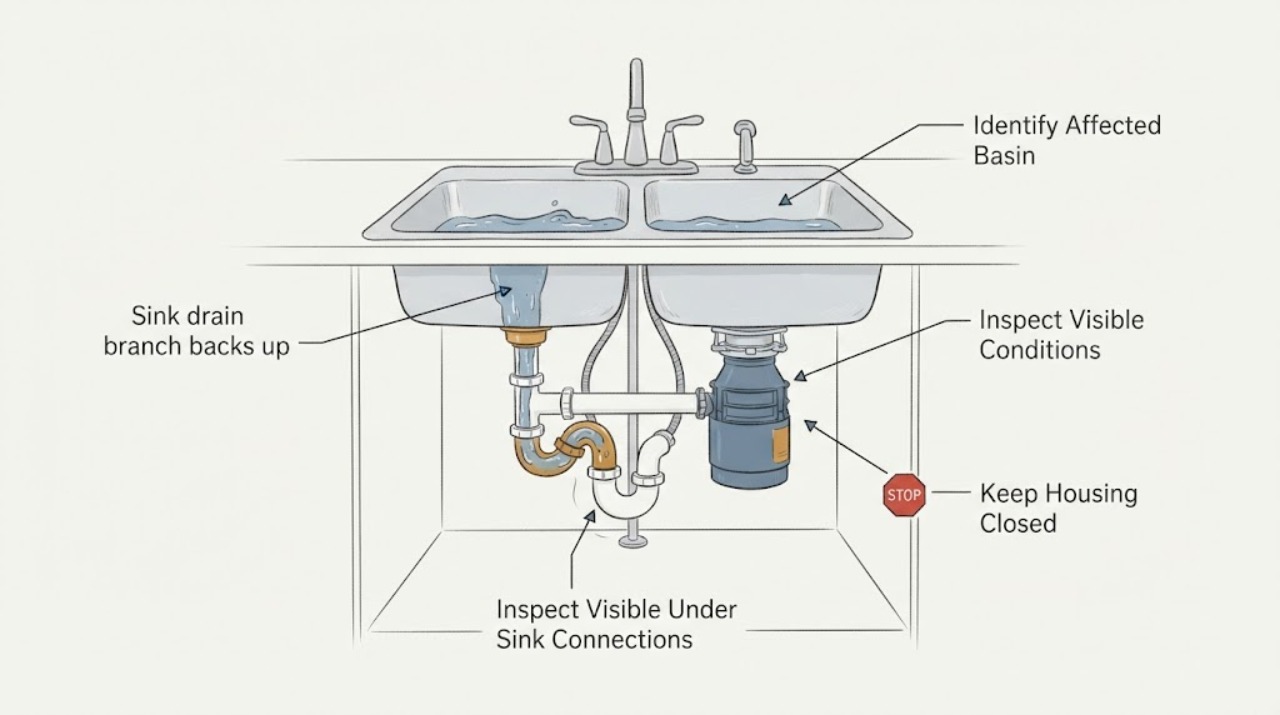
When one sink drain branch backs up as the garbage disposal runs, the disposal is usually pushing water and ground food against a restriction in the outlet, trap, shared drain, or a connected branch; the disposal itself is not proven to be the failed part. First stop repeated grinding, identify which basin rises and whether the disposal hums or spins normally, then inspect only visible, ordinary-access connections for leaks, a kinked dishwasher hose, separation, or standing water. Do not put hands or tools into the disposal, pour grease or chemical drain cleaner into it, or loosen a pressurized or contaminated connection. If water spills under the sink, the backup affects both basins or a dishwasher, the disposal hums, the reset trips, or the line remains blocked, arrange qualified plumbing service.
Work through in order
Diagnostic checks
Use only checks that match the exact appliance or system and its official guide.
-
Check 1
Stop adding food and, from a stable position, record which sink basin rises, how high it rises, whether the water is clear or contains food residue, and whether the backup occurs only while the disposal runs or also when the faucet or dishwasher drains. Do not run the disposal repeatedly just to reproduce it.
Expected result: Only the disposal basin rises; the non-disposal basin rises through the shared drain; both basins rise; a dishwasher backs up; or the symptom occurs even without disposal operation.
Next step: Photograph the water level and note the trigger, timing, recent work, and every affected fixture for the service call.
Stop if: Stop immediately for sewage-like contamination, overflow near electrical equipment, uncontrolled water, sharp debris, or any need to reach into the sink or disposal opening.
Why this matters
Why: A disposal-only trigger with a localized basin points toward the disposal outlet or nearby branch. A second basin, dishwasher, or faucet-related backup suggests a shared restriction or downstream line problem rather than a cosmetic disposal issue.
-
Check 2
From outside the sink opening, note whether the disposal sounds like it is grinding and moving water, hums without normal grinding, stops, trips its reset, or remains silent. Do not place a hand, utensil, or tool in the opening and do not remove the splash guard.
Expected result: The motor runs with a visible whirlpool; the unit hums but water does not move; it stops or resets; or it does not start.
Next step: Leave the disposal off and tell the plumber the sound and water pattern; use the exact owner manual if a model-specific service instruction is needed.
Stop if: Stop testing for smoke, burning odor, sparks, exposed wiring, loud metal-on-metal noise, a hot motor, or any unexpected start.
Why this matters
Why: A running unit with a whirlpool is consistent with restricted drainage in the manufacturer's guidance. Humming, repeated reset trips, or no start changes the path toward a jam, electrical fault, or internal disposal problem, which should not be confused with a downstream drain clog.
-
Check 3
With the disposal off and without loosening any connection, use a flashlight to inspect the visible discharge elbow, tailpipe or trap, dishwasher hose and clamp, sink flange area, cabinet floor, and nearby supply lines. Place a dry towel or sheet of paper below the visible connections only if it can be done without touching energized equipment.
Expected result: There is a fresh wet spot, drip, rust, separation, cracked fitting, loose-looking hose, water at the sink flange, or no visible leak while the branch still backs up.
Next step: Keep the area dry and unused as practical, photograph the first wet point, and arrange plumbing service for a blocked or leaking connection rather than tightening an unknown fitting by guesswork.
Stop if: Stop for water near an outlet, damaged electrical cable, sewage or chemical contamination, unstable piping, or a leak that is increasing.
Why this matters
Why: A wet trail or damaged discharge connection may explain where water escapes but does not prove it caused the backup. No visible leak leaves a hidden restriction, trap, wall connection, or disposal passage unresolved.
-
Check 4
Review the disposal and sink history: note whether the unit or dishwasher connection was recently installed, whether the backup followed a large or greasy load, and whether food, grease, bones, fibrous scraps, or a foreign object may have entered. Inspect only what is plainly visible above the baffle; do not reach inside or add chemical cleaner.
Expected result: The symptom began after installation, follows certain loads, follows grease or fibrous waste, or has no clear trigger.
Next step: Record the disposal model and installation date if safely available, stop feeding waste, and provide the waste and trigger history to the plumber. Follow the model's manufacturer guidance for future cold-water operation only after the blockage is resolved.
Stop if: Do not probe, pull, rotate, dismantle, or electrically test the disposal; stop if an object is lodged or the unit is jammed.
Why this matters
Why: Recent installation raises questions about the discharge connection or dishwasher inlet configuration; a load-linked recurrence supports a restriction or unsuitable waste pattern, while no clear trigger keeps both local and downstream causes open.
-
Check 5
If there is no contamination, electrical hazard, leak, jam, or unsafe access and the exact disposal instructions allow it, use only the manufacturer's limited sink-plunger procedure with the disposal fully off and the other basin sealed as directed. Do not use a chemical drain opener or force a connection.
Expected result: The water drains after a gentle, manufacturer-approved clearing attempt; it drains briefly and backs up again; or it does not drain at all.
Next step: Stop using the disposal if the backup returns and schedule a licensed plumber; report the basin pattern, sound, water level, visible leak evidence, recent work, and clearing result.
Stop if: Do not continue plunging against a leaking, contaminated, overfull, humming, electrically unsafe, or structurally unsupported assembly.
Why this matters
Why: A temporary improvement supports a remaining or recurring restriction, not proof that the line is clear. No improvement, repeated backup, a far-downstream blockage, or a disposal that is not operating normally calls for professional diagnosis.
Use your observations
Decision map
Find the observation that best matches what you see, then follow the next safe action.
-
PATH 01Next step
What you see
The disposal runs normally, water forms a whirlpool or rises at the disposal basin, and no other fixture is affected.
Do this next
Leave the disposal off, document the water pattern, and use only the limited manufacturer-approved clearing procedure if the assembly is safe; call a licensed plumber if the backup persists.
Why this path and its safety boundary
Why it matters: This pattern is more consistent with a restriction at the disposal outlet, nearby tailpiece, trap, or branch than with a silent electrical failure, but it does not identify the exact blockage.
-
PATH 02Next step
What you see
Both sink basins, the dishwasher, or another nearby fixture backs up, or the sink backs up even when the disposal is not running.
Do this next
Stop disposal use and arrange licensed plumbing service for the shared drain path; provide the order and timing of every affected fixture.
Why this path and its safety boundary
Why it matters: A shared or downstream restriction becomes more likely than a disposal-only problem. Repeated disposal cycles can add water without clearing that restriction.
-
PATH 03Next step
What you see
Water appears under the sink at the discharge elbow, tailpipe, hose clamp, sink flange, or another visible connection during drainage.
Do this next
Keep the disposal and affected sink branch out of use, protect the cabinet from more water, and have a plumber inspect and repair the connection.
Why this path and its safety boundary
Why it matters: The wet point identifies a leak location that may coexist with the backup; a cracked or incorrectly seated connection can require replacement or reinstallation, but visible water does not justify tightening by guesswork.
-
PATH 04Next step
What you see
The disposal hums, stops, repeatedly resets, produces smoke or a burning odor, or does not start while the sink water remains.
Do this next
Do not reach into or force the unit; turn it off from a safe control, keep the area clear, and arrange qualified appliance or plumbing service according to the symptom.
Why this path and its safety boundary
Why it matters: The disposal may have a jam, electrical issue, or internal fault in addition to—or instead of—the drain restriction. Treating it as an ordinary clog can damage the motor or create an electrical hazard.
-
PATH 05Next step
What you see
The backup returns after a limited safe clearing attempt, the obstruction appears far down the plumbing, or the required connection is concealed, contaminated, pressurized, or inaccessible.
Do this next
Stop testing and call a licensed plumber with the photos, basin pattern, recent installation history, and clearing result.
Why this path and its safety boundary
Why it matters: The user-level observation has reached its limit. The cause may be in a hidden branch, wall connection, trap, or shared drain and needs proper tools and service judgment.
Helpful context
Understand the symptom
The basin that rises tells you where to look next
A disposal can run while the sink branch is still restricted. A whirlpool or rising water at the disposal opening points toward a drain-line restriction in the manufacturer's troubleshooting flow; water appearing under the cabinet points instead to a leaking connection or component. If both basins, a dishwasher, or another fixture are affected, the restriction may be farther downstream than the disposal outlet.
Keep the test from creating a second problem
Repeatedly running a disposal against standing water can spread water and food residue into the cabinet or connected dishwasher. Keep hands and fingers out of the opening, avoid grease and chemical drain products, and use only the limited, model-appropriate clearing step described by the disposal manufacturer. A persistent or inaccessible blockage belongs with a qualified plumber.
Safety boundary
Stop conditions
- Never put hands or fingers into the disposal opening, even when it appears off; do not remove the splash guard for a user-level check.
- Do not pour grease, chemical drain opener, or unknown cleaning products into the disposal or blocked drain.
- Do not loosen, disconnect, electrically test, or force an under-sink connection when water, contamination, pressure, or energized equipment is present.
- Stop for smoke, burning odor, sparks, a humming motor, repeated reset trips, sewage, contaminated water, or overflow near electrical equipment.
When checks do not resolve it
Need a professional?
Call a licensed plumber when the backup affects both basins, a dishwasher, or another fixture; returns after a safe manufacturer-approved clearing attempt; appears downstream; or comes with a leak, damaged fitting, or inaccessible connection. Stop immediately for sewage or chemical contamination, water near electrical equipment, smoke, burning odor, sparks, a hot or humming disposal, repeated reset trips, uncontrolled overflow, or any need to put hands or tools into the disposal.
Common questions
FAQ
Why does the sink back up only when the garbage disposal runs?
The disposal is adding water and ground food to a path that may be partly restricted at its outlet, trap, shared drain, or a downstream branch. A disposal that runs normally does not prove the drain is open, and a disposal fault can also coexist with a blockage.
Does a whirlpool at the disposal mean the disposal is broken?
Not by itself. InSinkErator's troubleshooting guidance treats a whirlpool while the disposer runs as a sign to investigate a clogged drain line. Humming, no start, repeated resets, smoke, or burning odor point to a separate stop-use and service path.
Can I plunge a sink connected to a garbage disposal?
Only if the exact manufacturer instructions allow it and the disposal is fully off, there is no contamination, leak, jam, electrical hazard, or unsafe access, and the other basin is sealed as directed. Stop if the water does not clear or returns.
What should I inspect under the sink?
From a safe position, look for wet spots, rust, separation, cracks, or a loose-looking dishwasher hose at the visible discharge, tailpiece, trap, sink flange, and hose connections. Do not loosen or disconnect anything to inspect it.
What food should not go into the disposal?
Follow the exact model instructions. The manufacturer guidance used here says not to put fats, oils, or grease into the disposal or drain, and recommends cold water before and during grinding followed by a brief flush. Avoid large or unsuitable loads that can contribute to restriction.
When is this an emergency?
Stop and seek urgent qualified help for sewage or contaminated water, uncontrolled overflow, water near electrical equipment, smoke, sparks, burning odor, a hot or humming motor, repeated reset trips, or any unsafe need to reach into the disposal or disconnect plumbing.
Read the exact guide
Official sources
- Home MaintenanceU.S. Environmental Protection Agency · General household leak-maintenance guidance; a persistent or concealed plumbing problem should be assessed by a qualified professional.
- Garbage Disposal (2026)InSinkErator · General InSinkErator operating guidance; follow the installed model's owner instructions.
- INS10663 Garbage Disposal Installation and Use InstructionsMoen · Moen disposal instructions; safety boundaries apply broadly, but model-specific procedures and wiring control.
- Garbage Disposal Leaking at the DischargeInSinkErator · General InSinkErator leak-location guidance; do not infer a repair method for a different model or damaged plumbing.
- Fixing a Clogged Garbage DisposalInSinkErator · General InSinkErator support guidance; the exact installed model instructions and plumbing conditions control.
Community feedback
Share a repair observation
Share a plain-text repair observation. Accepted observations are published automatically; this page may take a moment to update.